
Parrots are what happens when a bird gets a climbing bill, hand-like feet, dramatic colors, a talent for copying household noises, and enough intelligence to notice exactly which cabinet contains the treats. The family also includes flightless night parrots, alpine troublemakers, tiny budgies, giant macaws, and birds that can outlive several dogs.
Parrots are a huge and surprisingly varied bird group
- Parrots belong to the bird order Psittaciformes.
- More than 400 living parrot species are recognized.
- Parrots occur naturally on every continent except Antarctica and Europe.
- Most species live in tropical or subtropical climates.
- South America has extraordinary parrot diversity.
- Australia, New Guinea, Indonesia, and nearby islands also support many species.
- Wild parrots occur naturally in parts of Africa and Asia.
- Humans have established introduced parrot populations in many cities outside native ranges.
- Monk parakeets have established colonies in parts of the United States and Europe.
- Rose-ringed parakeets have large introduced populations in several European cities.
- Parrot body size ranges from tiny pygmy parrots to giant macaws.
- Pygmy parrots can weigh less than an ounce.
- Hyacinth macaws are among the largest flying parrots by length.
- Kakapo are the heaviest living parrots.
- Parrots include macaws, amazons, conures, lorikeets, lovebirds, budgerigars, cockatoos, and many others.
- Cockatoos belong to a distinct major branch of the parrot family tree.
- New Zealand parrots such as kakapo, kea, and kaka represent another ancient branch.
- The word parakeet describes a general body shape and long tail rather than one single taxonomic group.
- A budgerigar is a type of parakeet.
- “Parrot” is less one bird design and more an entire collection built around one very successful curved-bill concept.
The bill works like a climbing hook, nutcracker, and precision tool
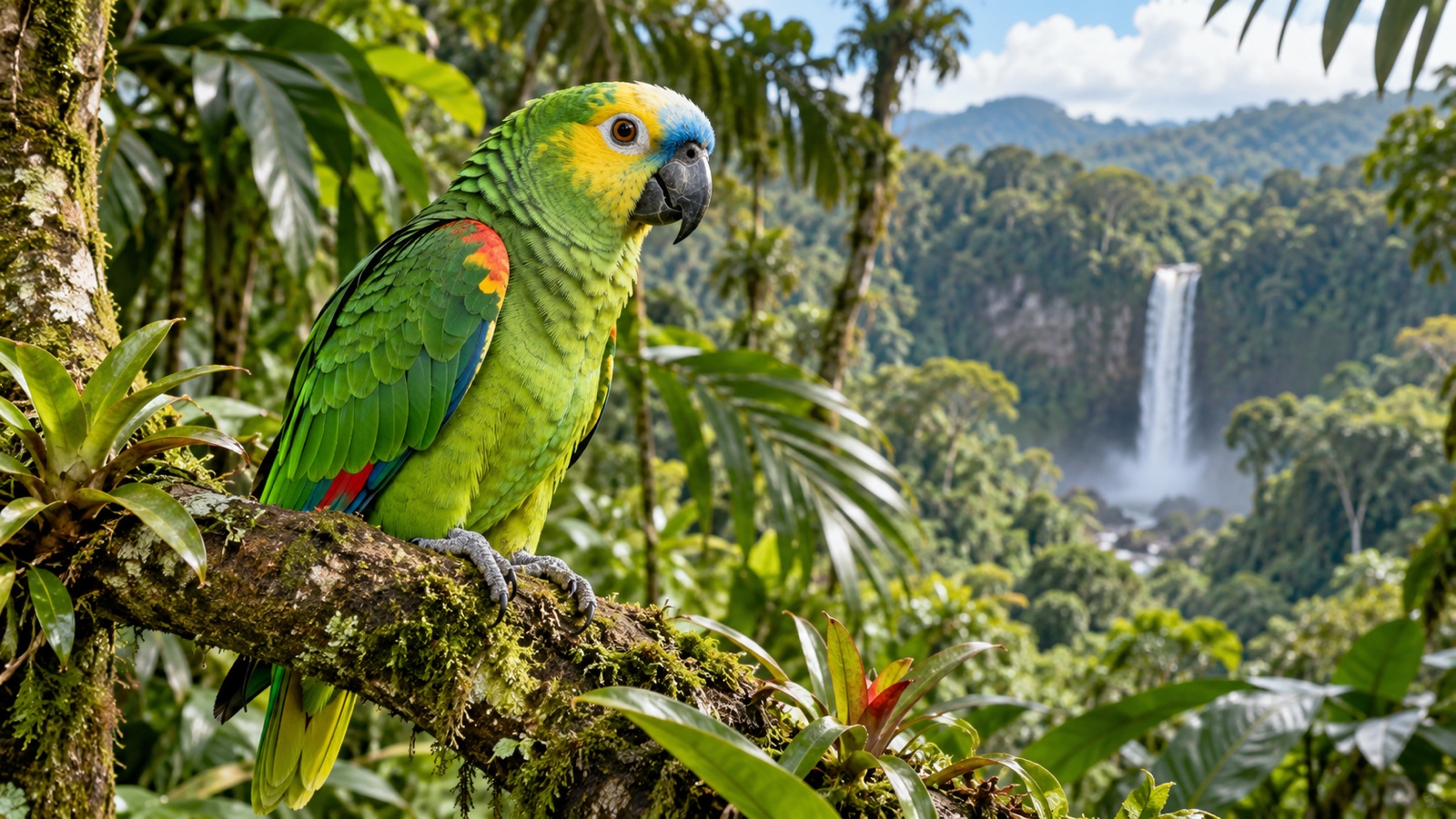
- Parrots have powerful curved upper bills.
- The upper bill moves more independently from the skull than in many birds.
- This mobility increases biting and manipulating power.
- The lower bill works against the upper bill like a cutting and crushing tool.
- Large parrots can open extremely hard seeds and nuts.
- The bill is covered by keratin.
- Keratin also forms human fingernails.
- The bill grows continuously and wears through normal use.
- Parrots use the bill as a third point of contact while climbing.
- A bird may hook its bill onto a branch before moving a foot.
- The tongue is thick, muscular, and highly mobile.
- Parrots use the tongue to position food against the bill.
- Some nectar-feeding parrots have specialized brush-tipped tongues.
- Lories and lorikeets are famous for brush-like tongue structures.
- Those tongue tips help collect nectar and pollen.
- Parrots investigate unfamiliar objects with the bill.
- Chewing is normal parrot behavior.
- Wild parrots chew bark, wood, seeds, fruits, and nest material.
- Pet parrots need safe objects to destroy because furniture is otherwise an available research project.
- A parrot bill is strong enough to crack nuts and precise enough to peel the skin from a grape, which is an unsettlingly versatile face tool.
Their feet can hold food almost like hands
- Most parrots have zygodactyl feet.
- Two toes point forward and two point backward.
- This arrangement creates a strong grip around branches.
- Parrots use their feet to climb vertically.
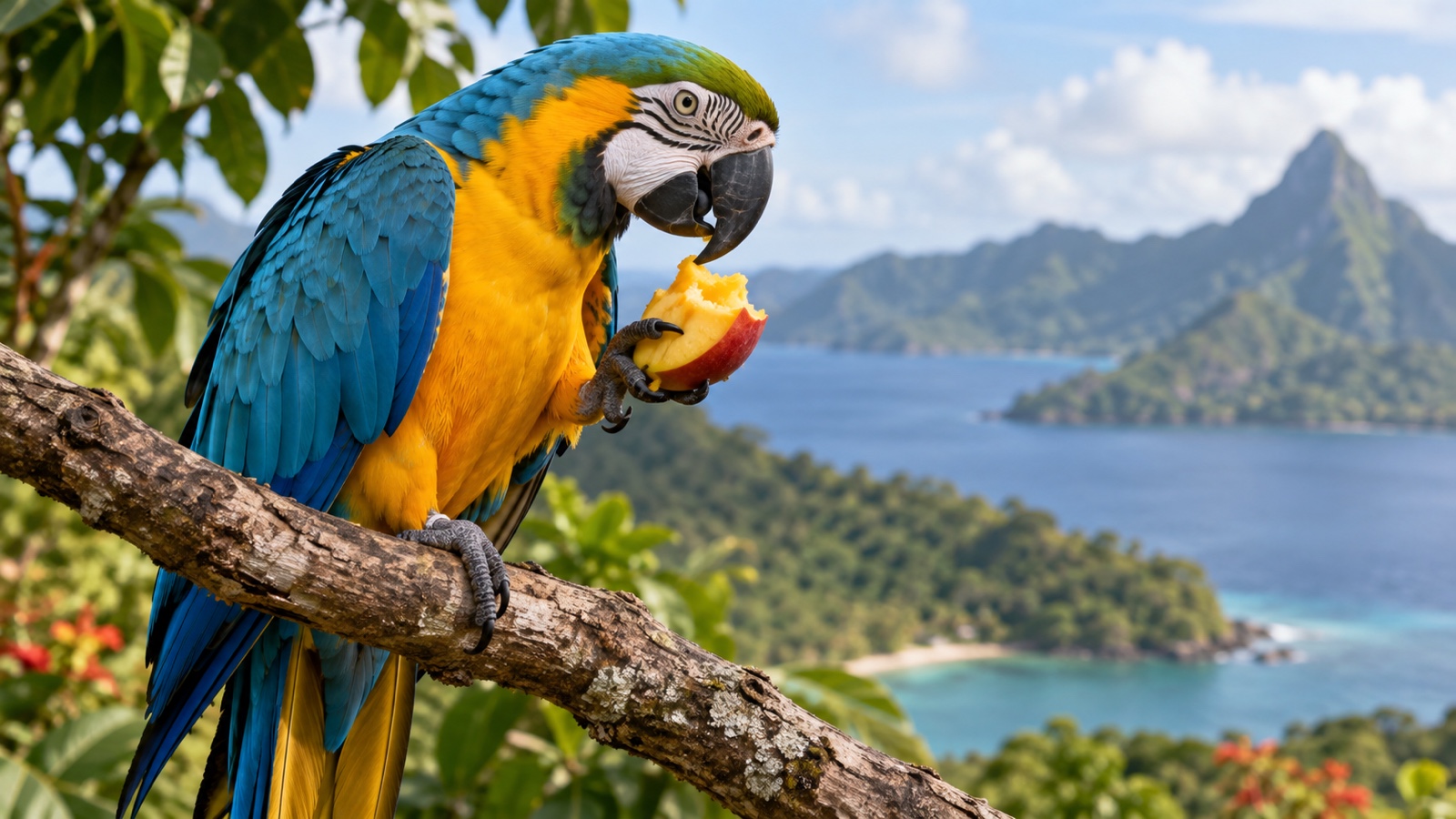
- Many species hold food in one foot while eating.
- That behavior is relatively unusual among birds.
- Individual parrots can show a preferred food-holding foot.
- Some species show population-level tendencies toward one foot.
- Foot preference has been compared cautiously with handedness.
- Claws curve around perches for stability.
- Different perch diameters exercise the foot in different positions.
- Wild parrots move across branches of many shapes and textures.
- A perfectly uniform perch does not recreate that variety for captive birds.
- Feet also manipulate toys and nest material.
- Parrots can transfer an object between bill and foot smoothly.
- Large macaws can hang upside down from one foot.
- Young parrots develop coordination through climbing and play.
- Arboreal life rewarded precise foot control.
- Flight remains important for most species even though they are excellent climbers.
- The basic parrot eating pose looks suspiciously like a person holding a sandwich with one hand.
Parrot colors use chemistry that other birds do not have
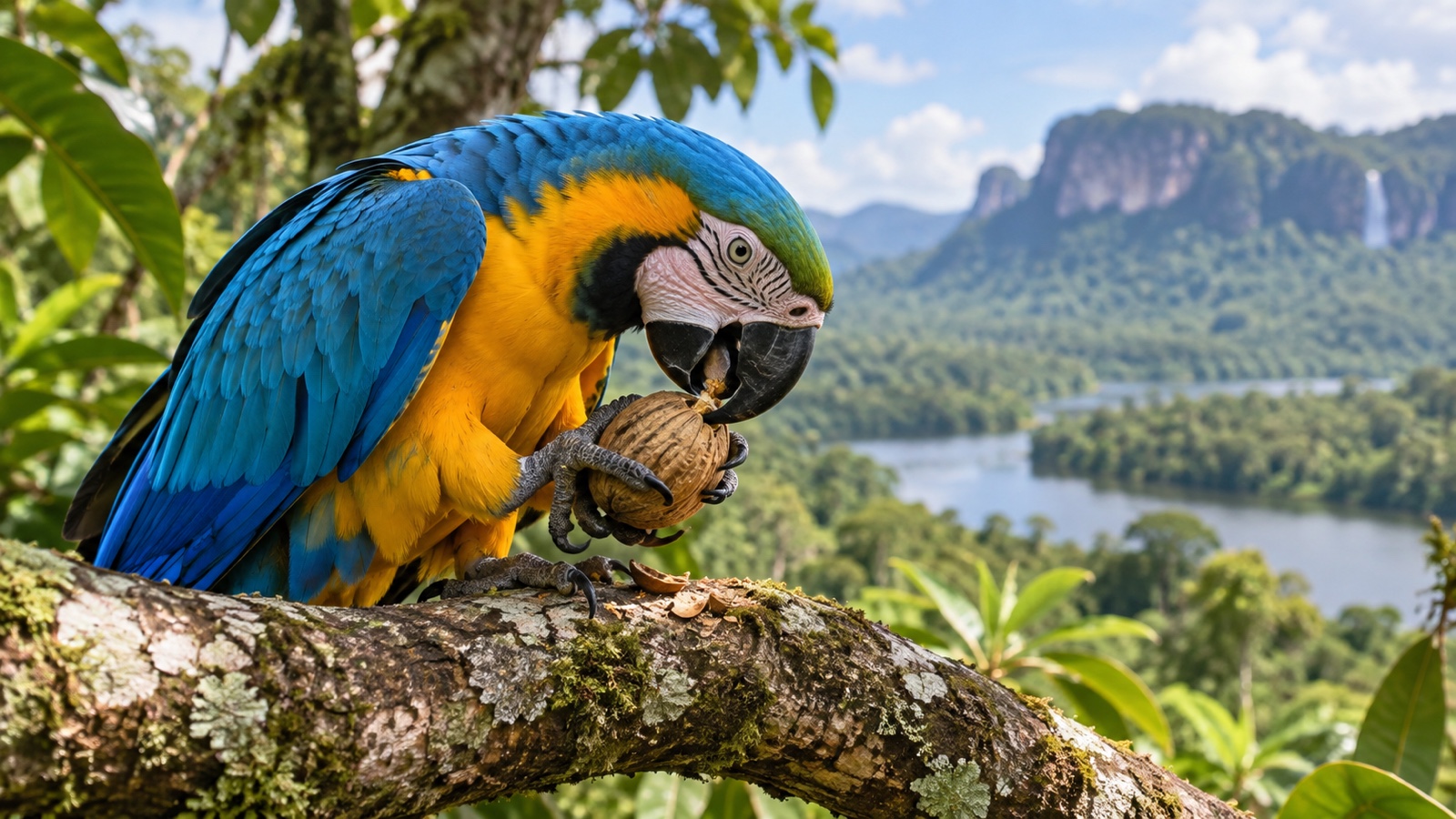
Parrot feathers are not colorful for one simple reason. Blues and some greens depend strongly on microscopic feather structure, while many red and yellow colors come from a unique family of pigments called psittacofulvins that parrots manufacture themselves.
- Psittacofulvins are pigments found in parrot feathers.
- They produce many red, orange, and yellow colors.
- Parrots synthesize these pigments rather than obtaining all of them directly from food.
- Blue feather color is often structural.
- Microscopic arrangements scatter blue wavelengths of light.
- Green can result from yellow pigment layered with structural blue.
- Feathers can look different under ultraviolet light.
- Parrot vision extends into ultraviolet wavelengths that humans cannot see.
- Plumage that looks similar to us may look more distinct to another parrot.
- Color can provide information about species, age, sex, or condition depending on the species.
- Some parrots have males and females that look almost identical.
- Eclectus parrots are a dramatic exception.
- Male eclectus parrots are primarily green.
- Females are largely red and blue or purple.
- Early taxonomists once mistook male and female eclectus parrots for different species.
- Cockatoos often rely more on white, black, gray, pink, or salmon tones than macaw-like rainbows.
- Many cockatoos also raise dramatic feather crests.
- Feather condition affects the quality of visual displays.
- Molting replaces worn feathers.
- A parrot feather can be both a pigment factory and a microscopic light-scattering device, which makes ordinary paint feel lazy.
Talking parrots are vocal learners, not feathered voice recorders
- Parrots are vocal learners.
- They can modify sounds after hearing other individuals.
- Vocal learning supports complex social communication in the wild.
- Pet parrots may redirect that ability toward human speech and household sounds.
- Parrots do not have human-style vocal cords.
- Bird sounds are produced mainly with an organ called the syrinx.
- The syrinx sits near the base of the windpipe.
- Tongue and bill movements help shape parrot sounds.
- African gray parrots are famous mimics.
- Amazon parrots can also develop large human-speech repertoires.
- Budgerigars have set records for exceptionally large learned vocabularies.
- Not every individual parrot chooses to imitate speech.
- A quiet species or individual is not less intelligent because it does not talk.
- Some parrots imitate phones, alarms, microwaves, doors, dogs, and other sounds.
- Context matters when evaluating whether a bird understands a copied word.
- Parrots can learn associations between specific words and objects or actions.
- African gray parrot Alex participated in famous cognition studies led by Irene Pepperberg.
- Alex learned labels for colors, shapes, materials, quantities, and other categories.
- His performance did not make him a human-language user, but it showed abilities beyond simple sound copying.
- A parrot imitating your smoke alarm is demonstrating vocal learning and simultaneously making your afternoon much worse.
Parrot intelligence is strongly social
Parrots evolved in social worlds where recognizing individuals, tracking food, manipulating objects, maintaining pair bonds, and learning from flock mates all matter. That combination helps explain why a bored captive parrot can become a highly motivated demolition expert with excellent memory.
- Many parrots solve multi-step problems.
- Several species use tools.
- Goffin's cockatoos have manufactured and used tools in experiments.
- Kea investigate mechanical puzzles with exceptional persistence.
- Parrots can learn by watching other birds.
- Social learning helps young birds identify foods and dangers.
- Many species form strong pair bonds.
- Partners preen one another in a behavior called allopreening.
- Allopreening helps maintain hard-to-reach head feathers.
- It also reinforces social relationships.
- Wild parrots often travel in flocks.
- Large evening roosts can contain hundreds or thousands of birds.
- Flock calls help maintain contact during flight.
- Individual parrots can have signature-like vocal features.
- Some species modify contact calls toward social partners.
- Play is common in young parrots.
- They manipulate objects, hang upside down, wrestle, and chase one another.
- Play helps develop physical and cognitive skills.
- Captive parrots deprived of stimulation can develop serious behavioral problems.
- An intelligent animal with bolt-cutters on its face should probably not be given nothing to do for eight hours.
Kakapo, kea, nests, and 25 final parrot facts
- Kakapo are flightless nocturnal parrots native to New Zealand.
- They are the heaviest living parrot species.
- Male kakapo gather at display areas and produce deep booming calls during breeding seasons.
- This mating system is called lek breeding.
- Kakapo are critically endangered.
- Intensive conservation moved surviving birds to predator-managed islands.
- Every living kakapo is individually known and monitored.
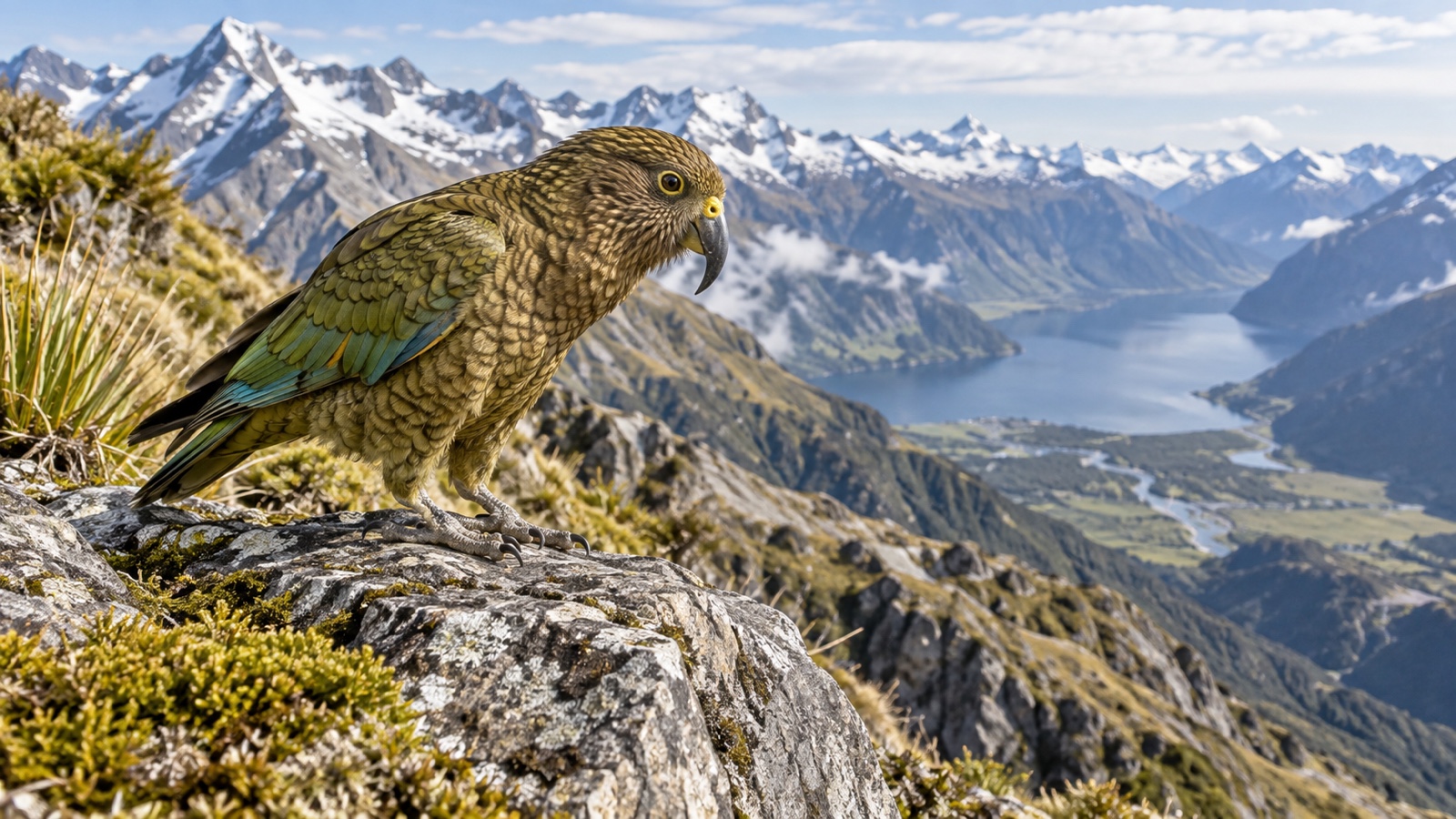
- Kea are alpine parrots native to New Zealand's South Island.
- They are famous for curiosity and problem-solving.
- Kea sometimes investigate cars, backpacks, boots, and building materials with destructive enthusiasm.
- Many parrots nest in tree cavities.
- Some use cliff holes, termite mounds, ground cavities, or palm trunks.
- Monk parakeets are unusual because they build large communal stick nests.
- Parrot eggs are usually white.
- Cavity nests reduce the need for camouflaged egg markings.
- Both parents participate in care in many species, although exact roles vary.
- Parrot chicks hatch helpless and require extensive parental feeding.
- Larger parrots often mature slowly.
- Many large species can live for several decades.
- Claims that every parrot lives 80 or 100 years are exaggerated because lifespan varies greatly by species.
- Large macaws and cockatoos can outlive several common household pets and sometimes outlive an owner.
- Habitat loss and wildlife trafficking threaten many parrot species.
- Buying a wild-caught parrot can support destructive trade and animal suffering.
- Responsible pet ownership requires social interaction, veterinary care, flight or exercise, safe chewing material, appropriate diet, and a plan that may span decades.
- After 145 facts, parrots look less like colorful talking pets and more like a global bird radiation built around intelligence, climbing feet, crushing bills, social learning, intense parenting, and enough personality to make captivity a serious welfare responsibility.
Quick FAQ
Q: Why can parrots talk?
A: Parrots are vocal learners. They can copy and modify sounds using the syrinx, tongue, and bill, and some individuals learn meaningful associations between sounds and situations.
Q: Are parrots really intelligent?
A: Yes. Multiple species demonstrate problem-solving, social learning, memory, tool use, categorization, and flexible behavior.
Q: Why do parrots have two toes forward and two backward?
A: The zygodactyl arrangement creates a strong grip for climbing branches and manipulating food.
Q: What is the largest parrot?
A: Hyacinth macaws are among the longest flying parrots, while the flightless kakapo is the heaviest living parrot.
Q: Do all parrots live for 80 years?
A: No. Lifespan varies enormously. Small parrots may live a decade or two, while some large parrots can live many decades with good care.

Ellie is the owner and sole author of Fun Facts, combining her mechanical engineering background with years of research-driven writing to deliver facts you can trust. Every article is thoroughly fact-checked and routinely updated as new science and sources emerge to keep information accurate and current. Her mission is to make learning delightful while upholding high standards of reliability and transparency.