
Niagara Falls is not one waterfall, not the world’s tallest, and not entirely natural in its modern flow. It is a three-fall system on an international river where engineers divert enormous amounts of water for hydropower, treaties protect the daytime spectacle, and the brink has migrated miles upstream since the last ice age. These 145 Niagara Falls facts explore geology, flow, erosion, bridges, daredevils, power, tourism, winter, wildlife, and the Great Lakes.
Niagara Falls basics
- Niagara Falls is a group of waterfalls on the Niagara River.
- The river forms part of the border between Canada and the United States.
- The falls lie between Ontario and New York.
- Niagara Falls consists of three main waterfalls.
- They are Horseshoe Falls, American Falls, and Bridal Veil Falls.
- Horseshoe Falls is the largest of the three.
- Most of Horseshoe Falls lies on the Canadian side of the international boundary.
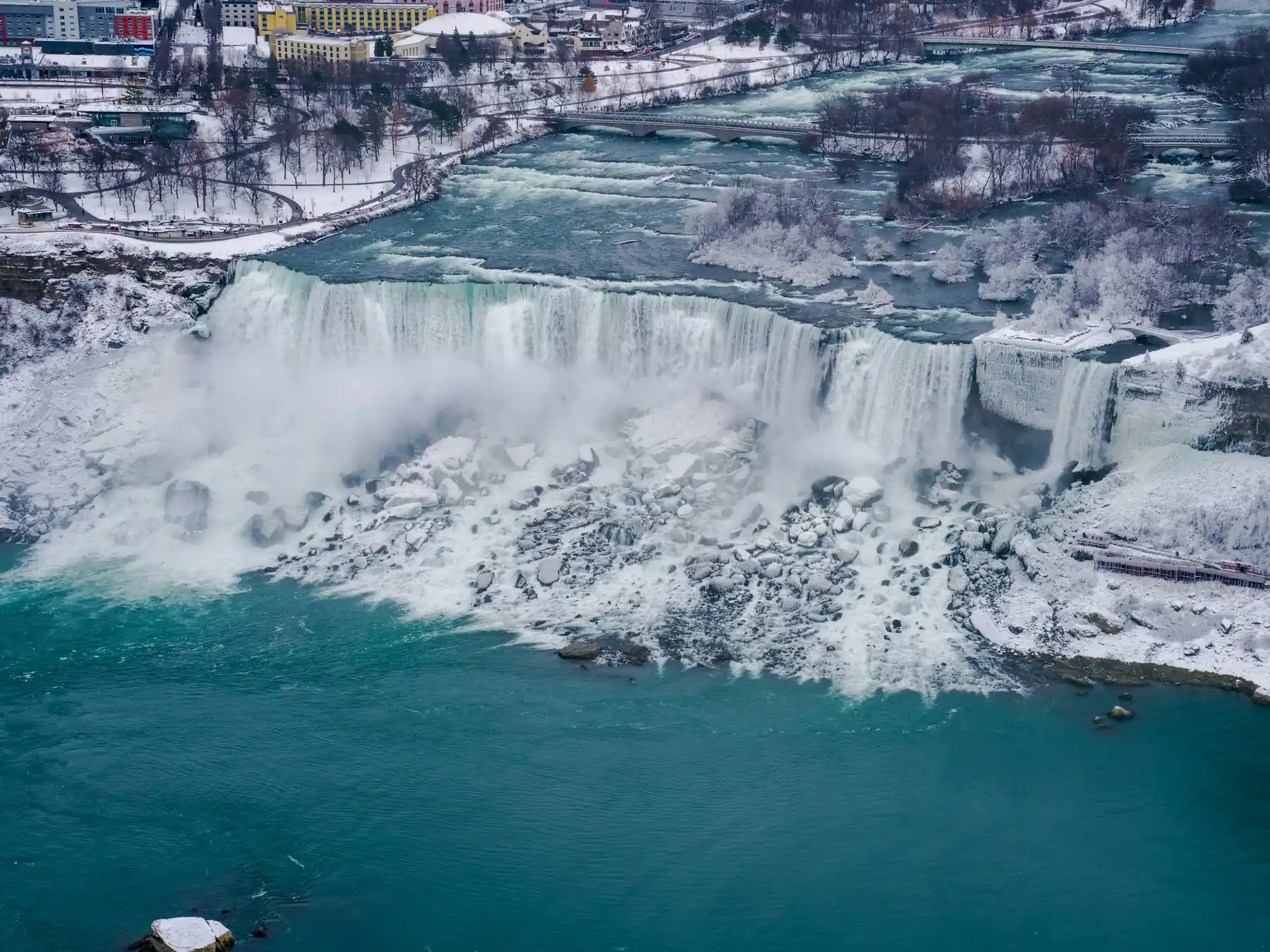
- American Falls lies entirely in the United States.
- Bridal Veil Falls also lies on the U.S. side.
- Goat Island separates Horseshoe Falls from the American and Bridal Veil falls.
- Luna Island separates Bridal Veil Falls from American Falls.
- The Niagara River connects Lake Erie with Lake Ontario.
- The river flows generally northward.
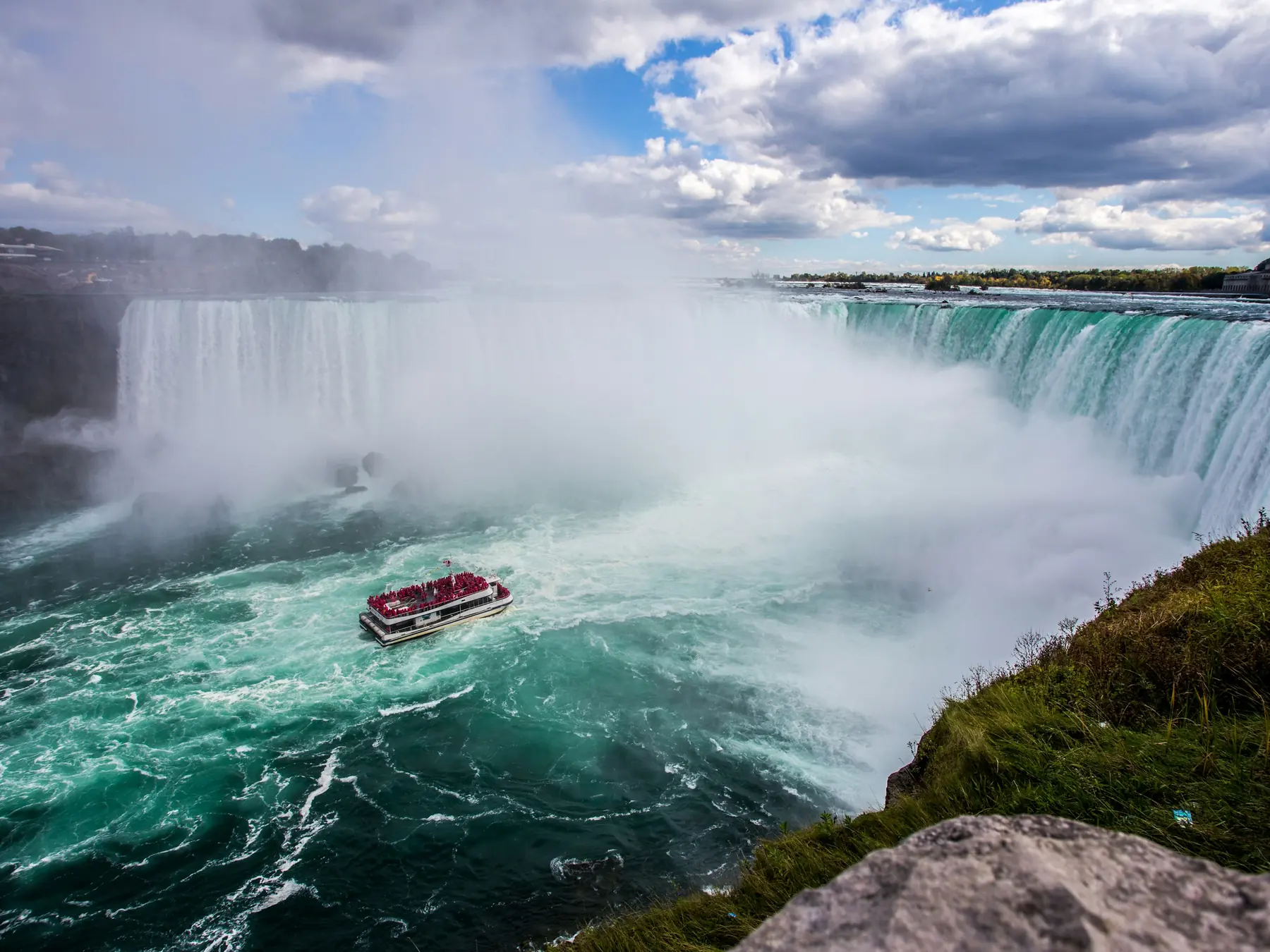
- Niagara Falls is famous for its enormous water volume rather than exceptional height alone.
- Niagara Parks reports that roughly 168,000 cubic meters of water can pass over the crest each minute during peak daytime tourist flow.
Niagara is not the tallest waterfall
- Niagara Falls is much shorter than the world’s tallest waterfalls.
- Horseshoe Falls drops about 57 meters, or 188 feet.
- Angel Falls in Venezuela is many times taller.
- What makes Niagara extraordinary is the combination of height and flow.
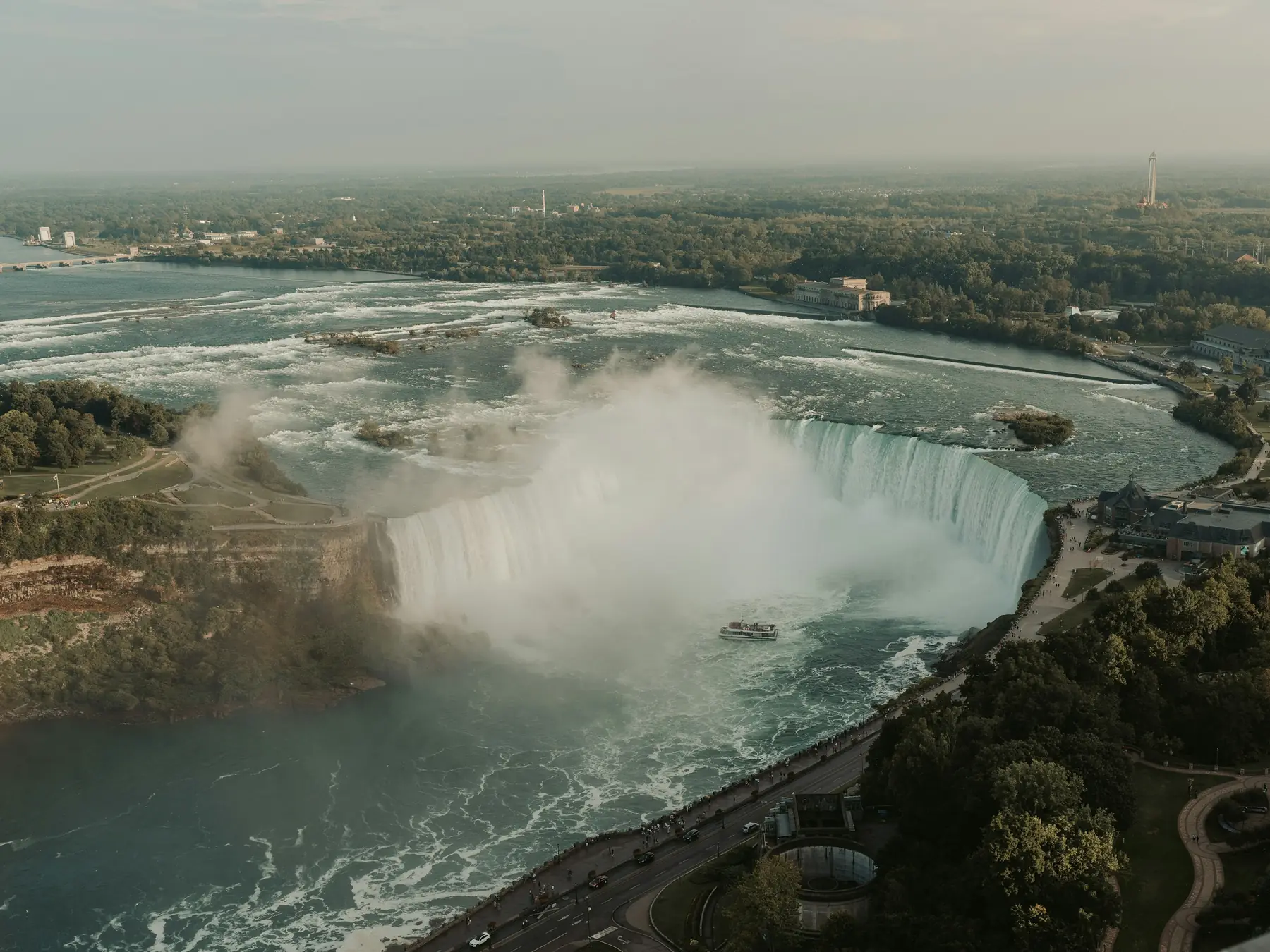
- Horseshoe Falls has a crest line roughly 670 meters wide.
- American Falls has a crest line roughly 260 meters wide.
- Large blocks of fallen rock sit at the base of American Falls.
- That talus pile makes its visible free fall shorter than the total river elevation change.
- The American Falls drop to the river level is about 57 meters.
- The visible drop to the top of the talus ranges roughly from 21 to 34 meters.
- Bridal Veil Falls is the narrowest of the three falls.
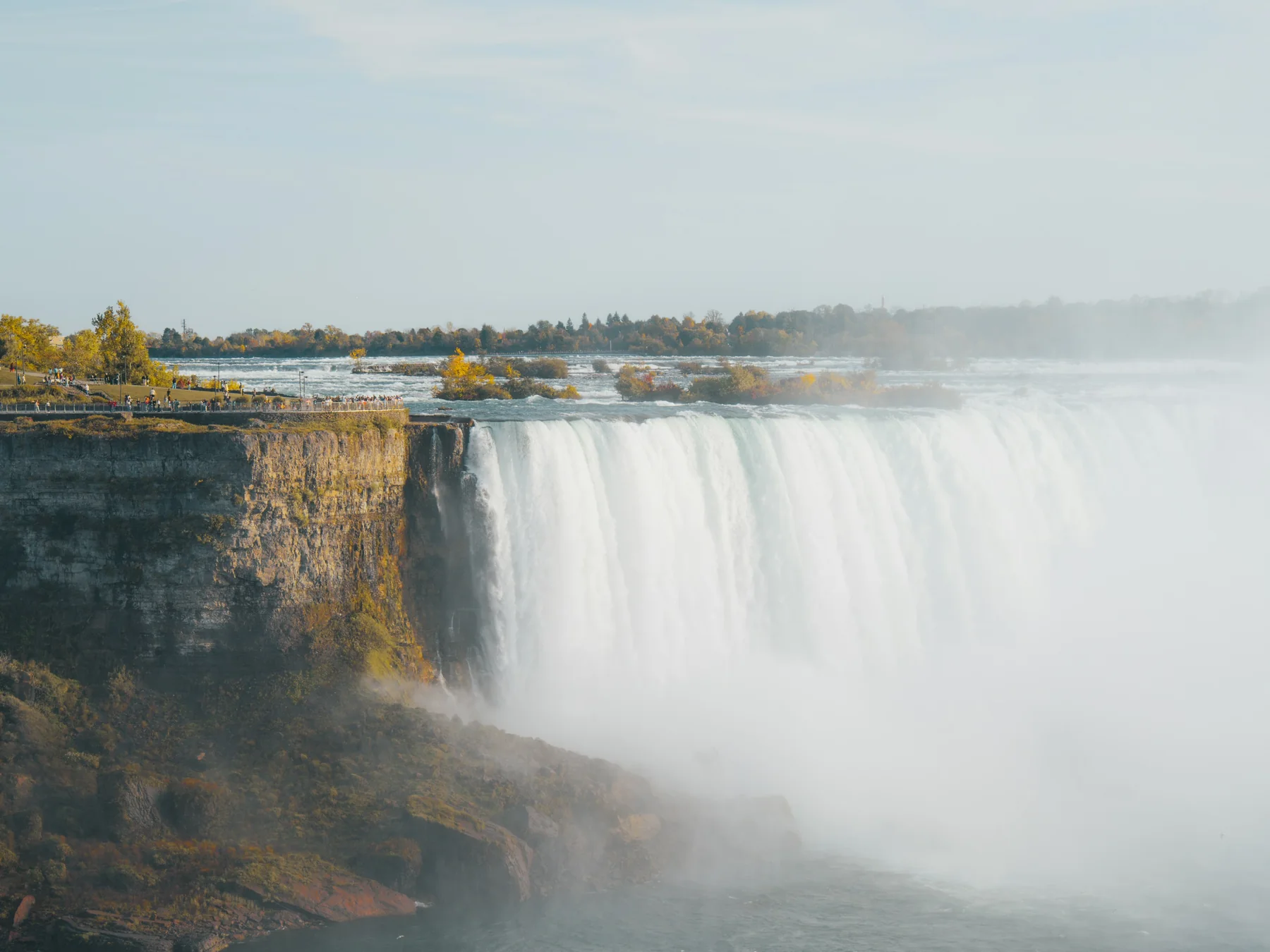
- Terrapin Point offers close views of Horseshoe Falls from Goat Island.
- Table Rock provides a famous Canadian viewpoint beside Horseshoe Falls.
- The roar comes from massive volumes of turbulent water and entrained air.
- Niagara’s fame proves that waterfall drama depends on volume, width, setting, and sound as much as raw height.
The last ice age created the modern landscape
- The modern Niagara River system developed after the last continental ice sheet retreated.
- Glaciers reshaped the Great Lakes basin.
- Melting ice opened changing drainage routes between the lakes.
- Water eventually flowed across the Niagara Escarpment.
- The escarpment is a long geological cliff extending far beyond Niagara.
- Its resistant upper rock layer includes dolostone.
- Softer rocks lie beneath the harder caprock.
- Falling water erodes the softer layers.
- Unsupported caprock eventually breaks away.
- This process causes the waterfall brink to retreat upstream.
- Niagara Falls began near the present Queenston-Lewiston area thousands of years ago.
- The falls have retreated roughly seven miles since formation by Niagara Parks estimates.
- The retreat carved the Niagara Gorge.
- The gorge exposes a dramatic cross-section through sedimentary rock layers.
- Standing at the modern falls means looking at one temporary position in a waterfall that has migrated for thousands of years.
The falls still erode
- Natural erosion continues at Niagara Falls today.
- The modern retreat rate is much slower than it was in the past.
- Water diversion for hydropower reduces erosive flow over the brink.
- Engineering work has also stabilized vulnerable rock.
- Horseshoe Falls naturally concentrates tremendous force in its curved crest.
- Water plunges into a deep pool below the falls.
- Turbulence removes loosened rock fragments.
- Freeze-thaw cycles can widen cracks.
- Groundwater also moves through rock layers.
- Large rockfalls periodically alter the shape of the falls.
- American Falls experienced substantial rockfalls during the 20th century.
- Engineers studied whether the talus should be removed.
- They ultimately left much of the fallen rock in place.
- Future Niagara Falls will not have exactly the same outline seen today.
- The waterfall is a dynamic landform even when tourist photographs make it look permanent.
Engineers once stopped American Falls
- In 1969, engineers temporarily diverted water away from American Falls.
- A temporary cofferdam was built between the U.S. mainland and Goat Island.
- Water was redirected toward Horseshoe Falls.
- The dewatered American Falls exposed the rock face and talus below.
- Engineers studied erosion and rock stability.
- Loose rocks were removed from dangerous areas.
- Sensors were installed to monitor movement.
- Drainage improvements reduced water pressure in fractures.
- Bolts and other stabilization work strengthened parts of the rock face.
- The project generated remarkable photographs of a nearly dry waterfall.
- Tourists visited specifically to see the exposed geology.
- The diversion lasted several months.
- Water returned to American Falls later in 1969.
- The project did not permanently eliminate the talus pile.
- One of North America’s most famous natural spectacles briefly became a giant engineering inspection site.
Niagara is a hydropower giant
- People have used Niagara River water for mechanical power since the 18th and 19th centuries.
- Early mills diverted water through canals.
- Later engineers developed large hydroelectric plants.
- Nikola Tesla and George Westinghouse are associated with major alternating-current projects at Niagara.
- AC transmission allowed electricity generated near the falls to travel farther than earlier systems.
- Power from Niagara helped electrify Buffalo and surrounding areas.
- Modern generating stations operate on both sides of the border.
- Water is diverted upstream through tunnels and canals.
- It drops through turbines at generating stations downstream.
- Not all Niagara River water goes over the visible waterfalls.
- The 1950 Niagara Treaty regulates water diversion between Canada and the United States.
- The treaty requires higher minimum flow over the falls during daytime tourist hours in the high season.
- More water can be diverted for power at other times.
- Hydropower therefore changes the falls’ flow through a carefully managed international system.
- The spectacle and the power plants are two different uses of the same falling water.
Whirlpool Rapids and the gorge
- The Niagara River continues through a deep gorge below the falls.
- The gorge extends roughly 11 kilometers downstream.
- Whirlpool Rapids are among the river’s most violent sections.
- The river narrows sharply through the gorge.
- That constriction increases current speed and turbulence.
- The Niagara Whirlpool occupies a large basin where the gorge turns sharply.
- Incoming water creates complicated circular flow.
- The whirlpool’s direction can change with river flow.
- The Niagara River’s deepest sections occur below the falls.
- The gorge walls expose layers deposited hundreds of millions of years ago.
- Trails descend into sections of the gorge.
- The Whirlpool Aero Car carries visitors above the river on the Canadian side.
- Its cable route crosses the international boundary in the air several times without landing in the United States.
- The gorge is a direct record of the falls’ long upstream retreat.
- Every kilometer of gorge represents landscape the waterfall once occupied.
Daredevils and barrels
- Niagara Falls has attracted daredevils for more than a century.
- Annie Edson Taylor became the first person known to survive going over Horseshoe Falls in a barrel.
- She completed the stunt in 1901.
- Taylor was a schoolteacher and was in her sixties.
- She hoped the stunt would bring financial security.
- It did not make her wealthy.
- Other people later attempted barrel or capsule descents.
- Some survived.
- Others died.
- Going over the falls intentionally is illegal without authorization.
- Tightrope performers also became part of Niagara history.
- Charles Blondin crossed the gorge on a tightrope repeatedly in the 19th century.
- He performed variations including crossings blindfolded and carrying another person.
- In 2012, Nik Wallenda crossed above Horseshoe Falls on a wire with official permission and extensive safety planning.
- Daredevil stories are entertaining history, not evidence that attempting a stunt at Niagara is safe or legal.
Ice changes the falls
- Niagara Falls does not normally freeze into a completely solid wall of ice.
- Water continues flowing beneath and around surface ice.
- Spray freezes onto surrounding rocks, railings, trees, and structures.
- This creates enormous ice formations in severe winter weather.
- Ice can accumulate at the base of the falls.
- Floating river ice can jam downstream.
- An ice boom is installed seasonally near the outlet of Lake Erie.
- The boom reduces large ice movements into the Niagara River while still allowing water to flow.
- Historic ice bridges sometimes formed below the falls.
- Visitors once walked onto those natural ice formations.
- A deadly 1912 breakup helped end casual public access to ice bridges.
- Winter mist can coat nearby surfaces extremely quickly.
- Cold weather changes the appearance but not the basic hydrology of the falls.
- Photographs claiming Niagara has entirely frozen often show heavy surface ice around still-flowing water.
- The winter falls can look motionless in a photograph while thousands of tons of water continue moving every minute.
Ten surprising Niagara Falls facts
- Niagara Falls is three waterfalls rather than one.
- It is nowhere near the world’s tallest waterfall.
- The Niagara River flows north from Lake Erie to Lake Ontario.
- The falls have retreated roughly seven miles since the last ice age.
- Engineers temporarily dried up American Falls in 1969.
- A treaty requires different minimum flows over the falls depending on season and time of day.
- Large amounts of Niagara River water are diverted through hydroelectric plants.
- Annie Edson Taylor was in her sixties when she survived a barrel trip over Horseshoe Falls.
- Niagara does not normally freeze completely solid.
- For more natural-wonder trivia, explore our Grand Canyon facts and Science facts.
Quick Niagara Falls FAQ
Is Niagara Falls in Canada or the United States?
Both. The falls span the international boundary between Ontario and New York.
How many waterfalls make up Niagara Falls?
Three: Horseshoe Falls, American Falls, and Bridal Veil Falls.
How tall is Niagara Falls?
Horseshoe Falls drops about 57 meters, or 188 feet. American Falls has the same total river-level difference but a large rock pile reduces its visible free fall.
Does Niagara Falls ever freeze?
Ice can cover large parts of the falls and surrounding landscape, but enormous volumes of water normally continue flowing beneath and around the ice.
Why does Niagara Falls have so much water?
The Niagara River drains water from the upper Great Lakes toward Lake Ontario and ultimately the St. Lawrence River and Atlantic Ocean.

Ellie is the owner and sole author of Fun Facts, combining her mechanical engineering background with years of research-driven writing to deliver facts you can trust. Every article is thoroughly fact-checked and routinely updated as new science and sources emerge to keep information accurate and current. Her mission is to make learning delightful while upholding high standards of reliability and transparency.