
Nebraska gets reduced to corn so often that the Sandhills, crane migrations, pioneer trails, world-famous zoo, fossil beds, Kool-Aid, Runza sandwiches, and one delightfully weird unicameral legislature barely get a chance. The Cornhusker State is much more interesting once you leave the interstate stereotype.
Nebraska basics beyond the corn stereotype
- Nebraska became the 37th U.S. state on March 1, 1867.
- Lincoln is the state capital.
- Omaha is Nebraska’s largest city.
- Nebraska has 93 counties.
- The postal abbreviation is NE.
- The official nickname is the Cornhusker State.
- The state motto is “Equality Before the Law.”
- Nebraska borders South Dakota, Iowa, Missouri, Kansas, Colorado, and Wyoming.
- The Missouri River forms much of its eastern boundary.
- Most of Nebraska uses Central Time.
- The western part of the state uses Mountain Time.
- Nebraska stretches about 430 miles east to west.
- Its eastern landscape is generally more humid than its western landscape.
- The state rises gradually in elevation as you travel west.
- Panorama Point is Nebraska’s highest natural point.
- It reaches 5,424 feet near the Colorado and Wyoming borders.
- Panorama Point is a gentle high plain rather than a mountain summit.
- Nebraska’s name comes from an Indigenous word associated with the Platte River.
- The name is often translated as “flat water.”
- That is wonderfully appropriate for a river famous for being broad and shallow.
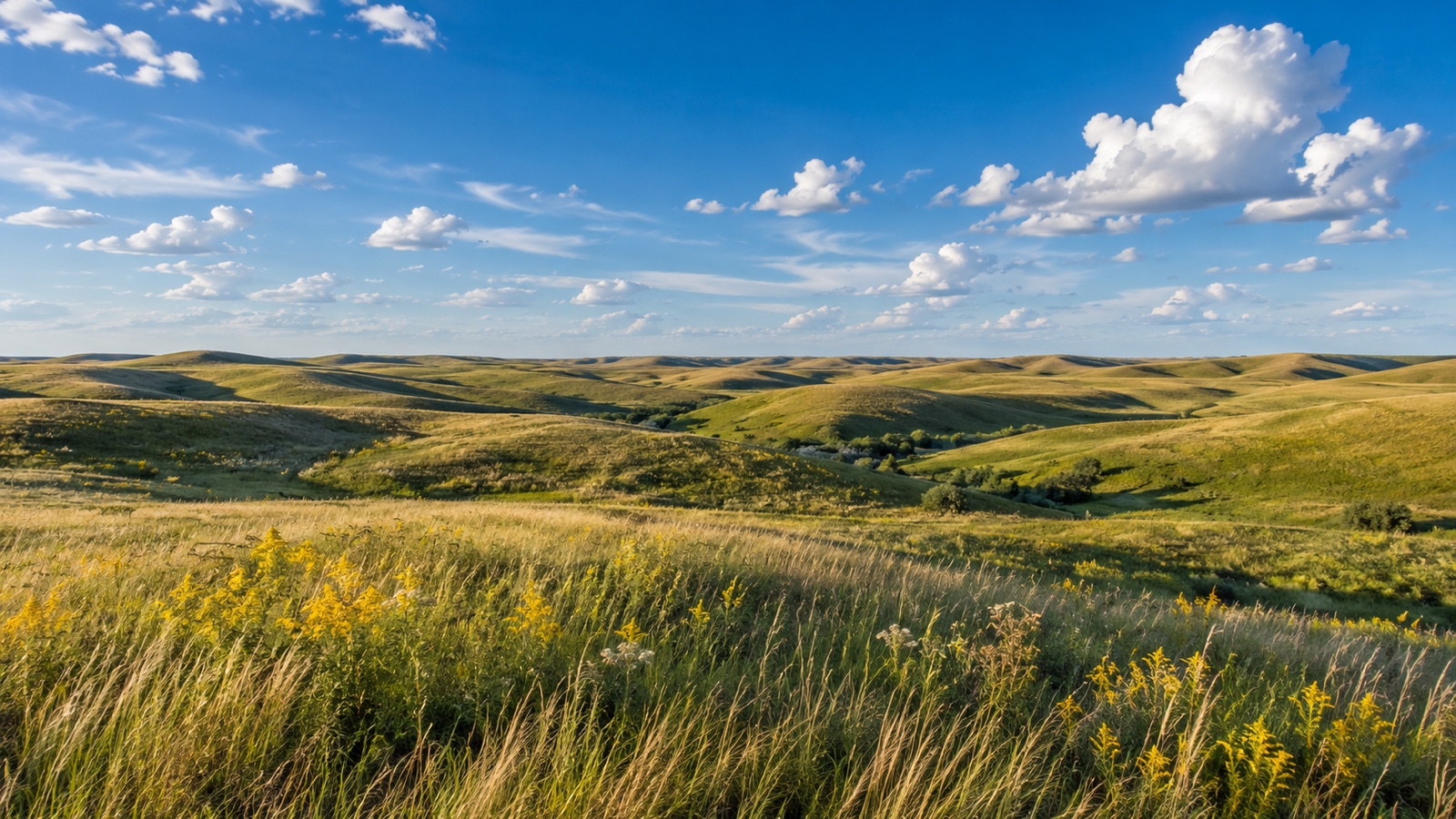
The Sandhills are one of America’s great grasslands
- The Nebraska Sandhills cover roughly a quarter of the state.
- They form one of the largest areas of grass-stabilized sand dunes in the Western Hemisphere.
- The dunes were built largely by wind during drier periods of the past.
- Grass now holds most Sandhills dunes in place.
- The region is famous for cattle ranching.
- Its soils are generally too sandy for intensive row-crop farming.
- The Ogallala Aquifer lies beneath much of western and central Nebraska.
- The aquifer is one of the world’s major groundwater resources.
- Sandhills wetlands and shallow lakes provide important wildlife habitat.
- The Niobrara River crosses northern Nebraska.
- Niobrara National Scenic River protects a biologically diverse corridor.
- Several ecological regions meet along the Niobrara.
- Eastern forest species can grow surprisingly close to western and northern plant communities there.
- Smith Falls is Nebraska’s tallest waterfall.
- It drops about 70 feet.
- The Pine Ridge region in northwestern Nebraska contains pine-covered escarpments and badlands.
- Toadstool Geologic Park preserves strange eroded formations in the northwest.
- Ancient volcanic ash helped preserve fossils in several parts of Nebraska.
- The state looks flatter from Interstate 80 than it actually is.
- Driving only the main interstate is basically reading one paragraph of Nebraska and reviewing the entire book.
The Platte River hosts an enormous crane gathering
- The Platte River crosses Nebraska from west to east.
- It forms from the North Platte and South Platte rivers.
- The rivers meet near North Platte, Nebraska.
- The Platte is famously wide and shallow across much of the state.
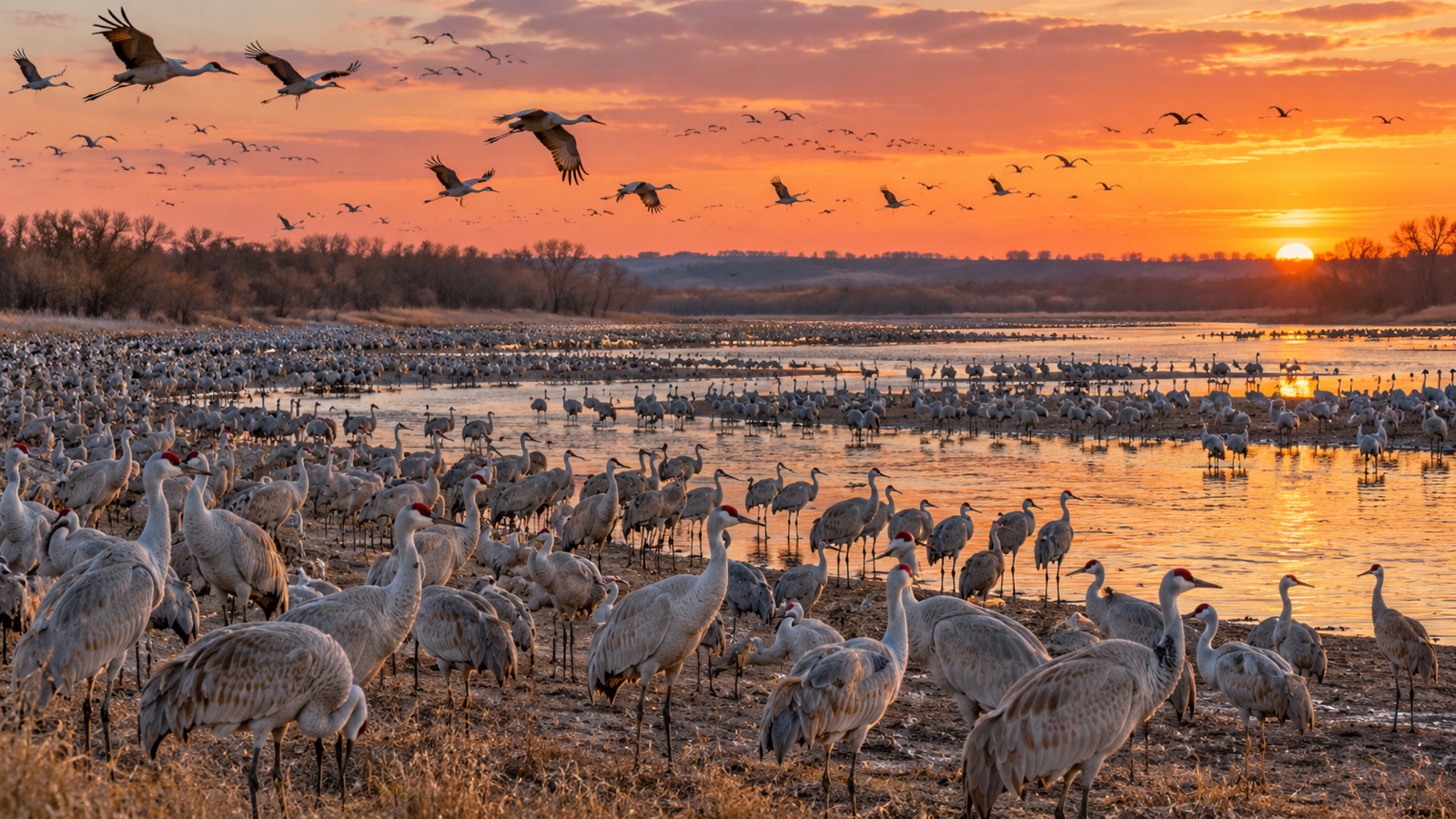
- Every spring, huge numbers of sandhill cranes stop along the central Platte Valley.
- The cranes are migrating north toward breeding grounds.
- They use shallow river channels as nighttime roosts.
- Nearby fields provide waste grain and other food during the day.
- Hundreds of thousands of cranes can pass through the region in one migration season.
- The gathering is one of the world’s great wildlife spectacles.
- Crane tourism brings birdwatchers from around the world to central Nebraska.
- The birds make loud rolling calls that can carry over long distances.
- Sandhill cranes perform elaborate dances involving jumps, bows, and tossed vegetation.
- The species can live for decades.
- Whooping cranes also migrate through Nebraska but are much rarer.
- The endangered whooping crane is one of North America’s tallest birds.
- River habitat management helps maintain open sandbars needed by cranes.
- Trees invading river channels can reduce preferred roosting habitat.
- The Platte is both a working water system for people and an essential migration corridor.
- Nebraska’s loudest spring visitors arrive without hotel reservations and sleep standing in a river.
Pioneer trails crossed Nebraska in huge numbers
Nebraska sat directly in the path of several famous westward trails, which means the state is covered in places where wagon traffic, military roads, railroads, telegraph lines, and Indigenous homelands collided. The pioneer story is important, but it makes more sense when the people already living there stay in the picture.
- The Pawnee, Omaha, Otoe-Missouria, Ponca, Lakota, Cheyenne, Arapaho, and other nations have deep connections with Nebraska.
- Tribal nations were displaced from much of their land through treaties, warfare, coercion, and U.S. expansion.
- The Omaha Tribe retains a reservation in northeastern Nebraska and Iowa.
- The Winnebago Tribe of Nebraska has a reservation in northeastern Nebraska.
- The Santee Sioux Nation is based in northern Nebraska.
- The Ponca Tribe of Nebraska is federally recognized without a conventional reservation.
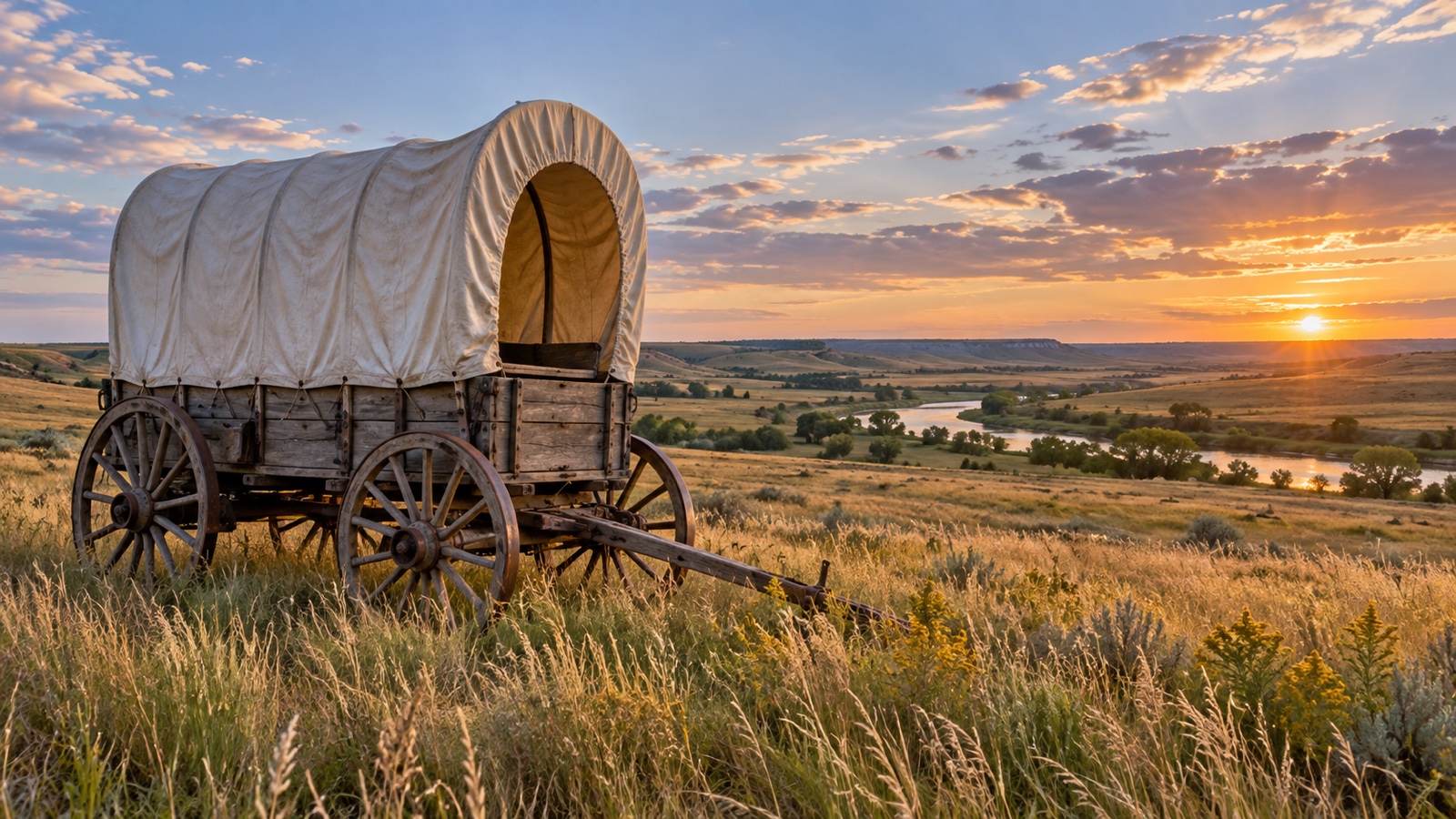
- The Oregon Trail crossed Nebraska along the Platte River corridor.
- The California Trail followed much of the same route.
- The Mormon Pioneer Trail also crossed the state.
- Chimney Rock became one of the most famous landmarks seen by westbound emigrants.
- Its narrow spire rises dramatically above the North Platte River valley.
- Scotts Bluff was another major trail landmark.
- Scotts Bluff National Monument preserves historic trail routes and towering bluffs.
- Fort Kearny was established along the Platte in 1848.
- The fort supported travelers, mail service, military operations, and communication routes.
- The Pony Express crossed Nebraska during its brief 1860–1861 run.
- The transcontinental telegraph soon made the Pony Express obsolete.
- The Union Pacific Railroad began building west from Omaha.
- The first transcontinental railroad was completed in Utah in 1869.
- Nebraska went from wagon corridor to railroad corridor with astonishing speed.
Nebraska has America’s only unicameral state legislature
- Nebraska is the only U.S. state with a unicameral legislature.
- Unicameral means the legislature has only one chamber.
- Every other state has both a state house and a state senate.
- Nebraska voters approved the unicameral system in 1934.
- The new system began operating in 1937.
- U.S. Senator George Norris strongly promoted the reform.
- Norris argued that one chamber would be simpler and more accountable.
- Nebraska legislators are officially called senators.
- The legislature has 49 members.
- It is the smallest state legislature in the United States.
- Legislative elections are officially nonpartisan.
- Candidate party labels do not appear on the legislative ballot.
- Individual senators can still have clear personal party affiliations.
- Nebraska’s governor works across the street from one legislature instead of two.
- The Nebraska State Capitol is in Lincoln.
- Its tall central tower makes it look very different from a typical domed statehouse.
- The building was designed by architect Bertram Goodhue.
- A bronze figure called The Sower tops the tower.
- The sculpture represents agriculture and settlement.
- Nebraska took “streamline government” literally enough to delete an entire legislative chamber.
Omaha, Lincoln & inventions with Nebraska roots
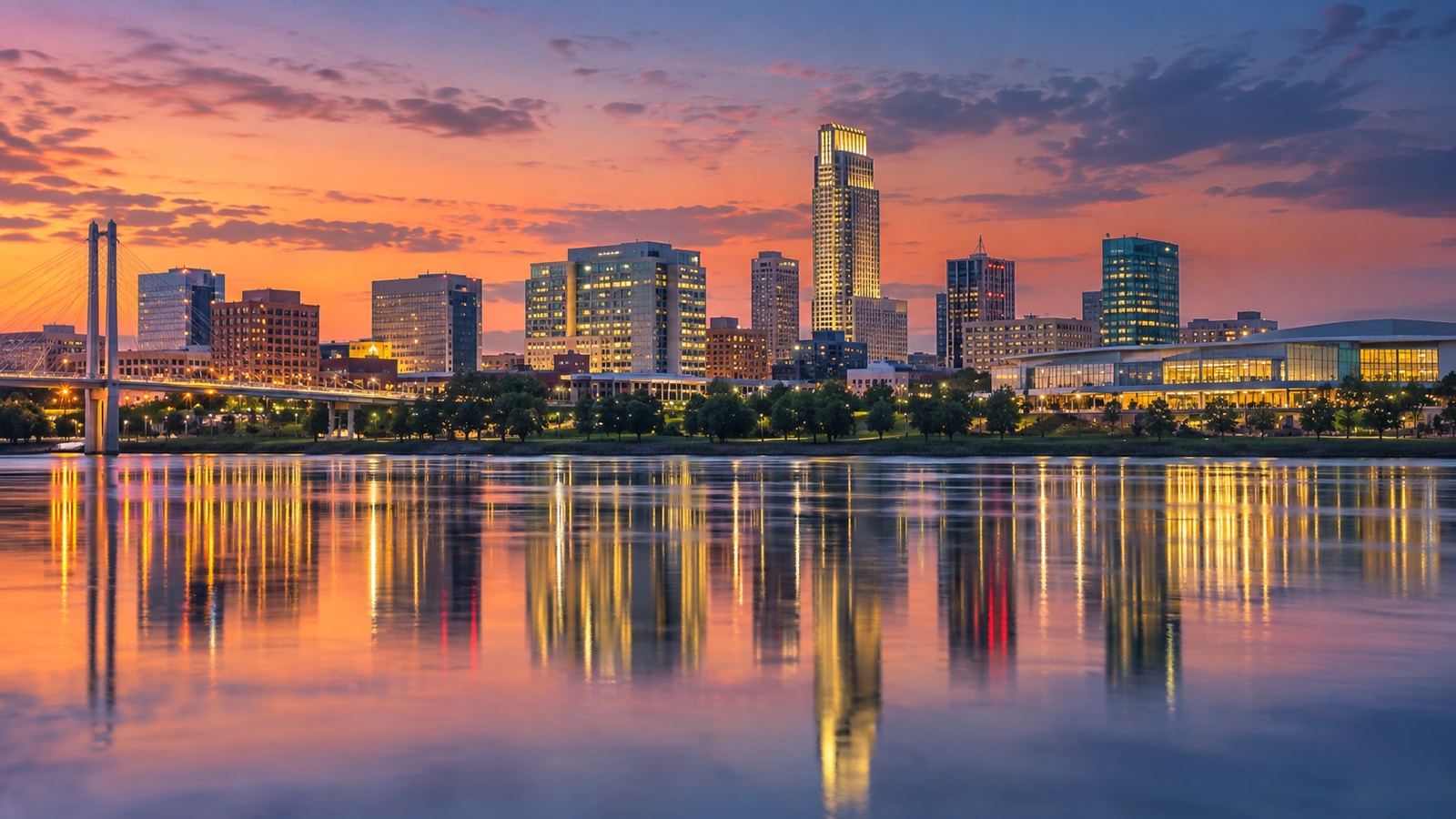
Omaha and Lincoln give Nebraska a much more urban side than the farm stereotype suggests. One produced investor Warren Buffett and a globally known zoo, while the other is a university capital city where fall Saturdays can turn football into the state’s loudest temporary population center.
- Omaha sits along the Missouri River near Iowa.
- The city became important through railroads, meatpacking, trade, and finance.
- Warren Buffett was born in Omaha.
- His company Berkshire Hathaway is headquartered there.
- Berkshire’s annual shareholder meeting draws visitors from around the world.
- Omaha’s Henry Doorly Zoo and Aquarium is one of the country’s major zoos.
- Its Lied Jungle is a large indoor rainforest exhibit.
- The zoo also operates a massive indoor desert environment.
- Union Pacific Railroad is headquartered in Omaha.
- Lincoln became the state capital after Nebraska achieved statehood.
- The city was previously called Lancaster.
- It was renamed Lincoln in honor of President Abraham Lincoln.
- The University of Nebraska’s flagship campus is in Lincoln.
- The school’s athletic teams are called the Cornhuskers.
- Memorial Stadium has become famous for long-running football sellout crowds.
- Kool-Aid was invented in Hastings, Nebraska.
- Edwin Perkins developed the powdered drink mix during the 1920s.
- Hastings celebrates that history with Kool-Aid Days.
- Arbor Day began in Nebraska City in 1872.
- J. Sterling Morton promoted the tree-planting holiday.
Runza, fossils, football & 25 final Nebraska facts
- A Runza is a baked bread pocket filled traditionally with beef, cabbage, onions, and seasonings.
- The dish reflects German-Russian food traditions brought to the Great Plains.
- The Runza restaurant chain was founded in Lincoln.
- “Runza” is a trademarked restaurant name as well as a widely used Nebraska food term.
- Reuben sandwiches are frequently claimed as an Omaha invention.
- One popular origin story credits Omaha grocer Reuben Kulakofsky and a poker group in the 1920s.
- New York has competing Reuben origin claims, so the sandwich birthplace remains debated.
- Nebraska is a major producer of corn.
- Beef cattle are another major part of the agricultural economy.
- Soybeans, wheat, hay, and pork also matter.
- Center-pivot irrigation systems create the circular crop fields visible from airplanes.
- The Ogallala Aquifer supplies much of Nebraska’s irrigation water.
- Groundwater management is therefore an enormous long-term issue for the state.
- Ashfall Fossil Beds State Historical Park preserves animals killed after a massive volcanic ashfall about 12 million years ago.
- The ash came from an enormous volcanic eruption in what is now Idaho.
- Rhinos, horses, camels, and other mammals were preserved at the Nebraska site.
- The state fossil is the mammoth.
- Elephant relatives once roamed prehistoric Nebraska.
- The state bird is the western meadowlark.
- The state flower is goldenrod.
- The state tree is the eastern cottonwood.
- The official state soft drink is Kool-Aid.
- The University of Nebraska football team’s “Cornhuskers” name replaced earlier nicknames.
- Nebraska’s license plates have used imagery ranging from Chimney Rock to the state capitol.
- After 145 facts, Nebraska’s best trick is still hiding giant dunes, migrating cranes, extinct rhinos, and a one-house legislature behind one word: corn.
Quick FAQ
Q: What is Nebraska famous for?
A: The Sandhills, Platte River crane migration, pioneer trails, Chimney Rock, agriculture, Omaha, the Cornhuskers, Kool-Aid, Arbor Day, and America’s only unicameral state legislature.
Q: What is the capital of Nebraska?
A: Lincoln is the capital, while Omaha is the largest city.
Q: Why is Nebraska’s legislature unusual?
A: It is the only one-chamber state legislature in the United States. Its 49 members are called senators and run in officially nonpartisan elections.
Q: Was Kool-Aid invented in Nebraska?
A: Yes. Edwin Perkins developed the powdered drink mix in Hastings during the 1920s.
Q: Why do so many cranes gather in Nebraska?
A: The central Platte River provides safe shallow roosting habitat surrounded by productive feeding areas along a major migration route.

Ellie is the owner and sole author of Fun Facts, combining her mechanical engineering background with years of research-driven writing to deliver facts you can trust. Every article is thoroughly fact-checked and routinely updated as new science and sources emerge to keep information accurate and current. Her mission is to make learning delightful while upholding high standards of reliability and transparency.