
Meerkats became famous for standing upright like tiny neighborhood-watch volunteers, but the real social system is much more intense. They dig communal burrows, babysit relatives, teach pups to handle dangerous prey, use distinct alarm calls, fight rival groups, and organize family life around a dominant breeding pair with very strong opinions.
Meerkats are mongooses, not cats
- The meerkat's scientific name is Suricata suricatta.
- Meerkats belong to the mongoose family Herpestidae.
- They are not cats.
- They are native to southern Africa.
- Wild meerkats live in parts of South Africa, Namibia, Botswana, and Angola.
- They favor dry open habitats.
- Those habitats include desert, semidesert, scrub, and dry grassland.
- Adult meerkats usually weigh less than 2 pounds.
- The body is long and slender.
- The tail is long but not bushy.
- A dark tip usually marks the end of the tail.
- Dark patches surround the eyes.
- Those patches may reduce glare from bright sunlight.
- The ears are small and rounded.
- Meerkats can close their ears while digging.
- Long curved front claws are specialized for excavation.
- The claws are not retractable.
- The coat is usually tan, gray, or brown with darker bands across the back.
- The lighter belly has relatively sparse fur.
- The meerkat silhouette is basically what happens when a mongoose adds a kickstand and starts monitoring the horizon.
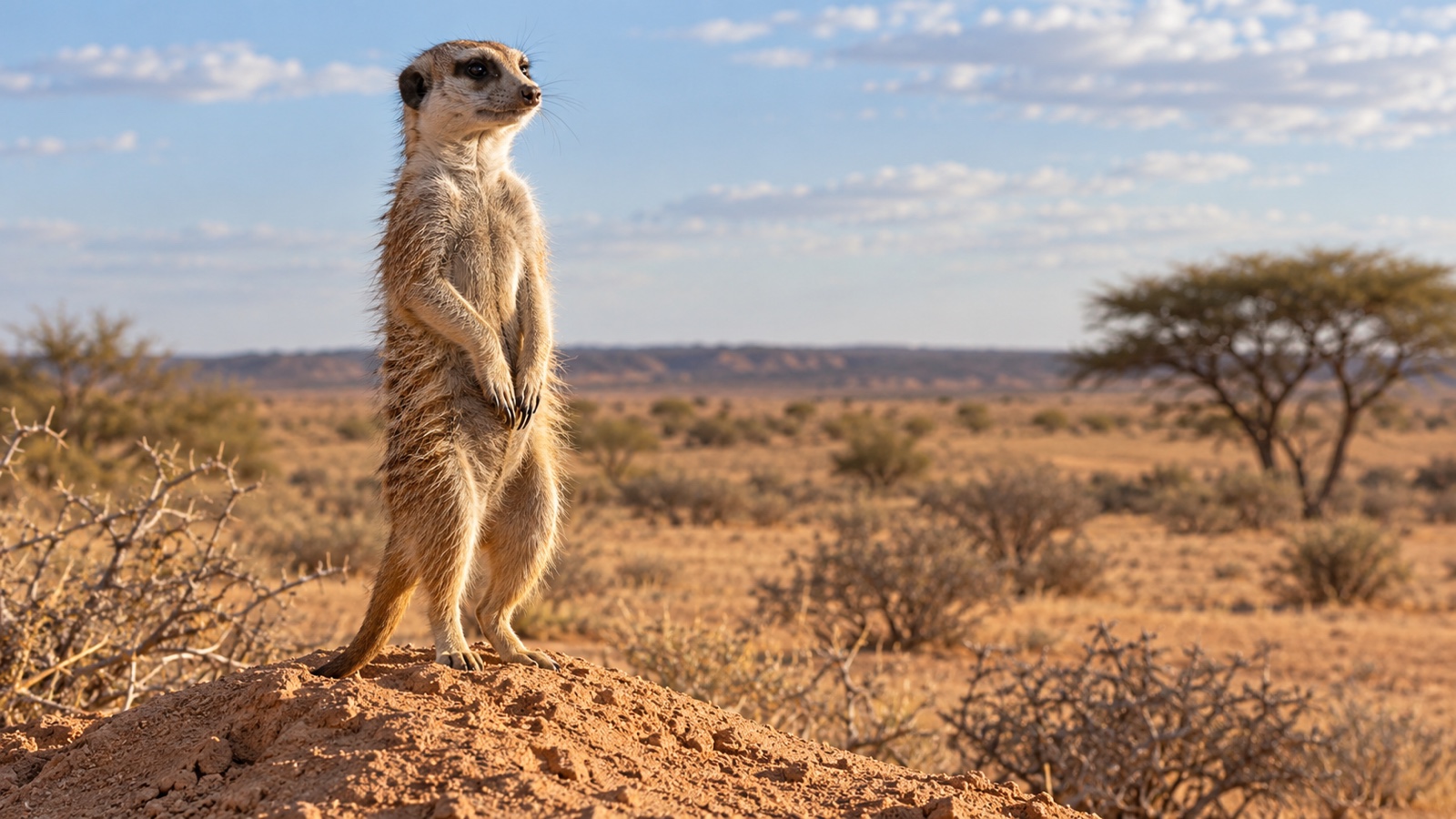
Standing upright helps them scan for danger and warm up
- Meerkats often stand on their hind legs.
- The tail can help balance the upright posture.
- Standing raises the head above low vegetation.
- This improves the view of approaching predators.
- Meerkats also sit upright to bask in sunlight.
- Cold desert mornings can leave them chilled after a night underground.
- The sparsely furred belly absorbs solar warmth efficiently.
- Individuals may face the rising Sun while warming.
- They can press the belly against warm soil later in the day.
- Meerkats retreat to shade or burrows during extreme heat.
- Activity often peaks during cooler parts of the day.
- Body posture changes with alertness.
- A relaxed animal may sit or forage low to the ground.
- An alarmed meerkat stretches tall and stares toward the threat.
- Group members frequently copy one another's attention.
- One animal looking upward can cause several others to scan the sky.
- Meerkats use scent and hearing as well as vision.
- They have good daytime eyesight.
- Dark eye markings do not give them magical immunity to desert glare.
- The upright pose is useful enough that evolution turned it into both a security camera and a solar panel.
A sentinel watches while the others forage
- Meerkat groups use sentinel behavior.
- A sentinel climbs to an elevated position and scans for danger.
- Other group members can spend more time feeding while a sentinel is on duty.
- Sentinel duty is not assigned through a formal schedule.
- Well-fed individuals are more likely to take watch.
- Sentinels make quiet calls that tell foragers they are still present.
- Those calls can reassure group members that surveillance continues.
- Alarm calls change when danger appears.
- Meerkats distinguish several predator types.
- Aerial threats include eagles and other raptors.
- Ground threats can include jackals and snakes.
- The urgency of alarm calls can vary with risk.
- Group members respond differently to different calls.
- Some alarms trigger immediate dives into burrows.
- Others prompt animals to scan or gather together.
- Young meerkats learn how to interpret calls through experience.
- Sentinels are not completely self-sacrificing.
- They often choose positions close to shelter and can benefit from detecting danger early.
- Cooperative vigilance helps the whole group while still making sense for the individual.
- Meerkat neighborhood watch works because the guard gets safety benefits too, which is probably the only sustainable committee model.
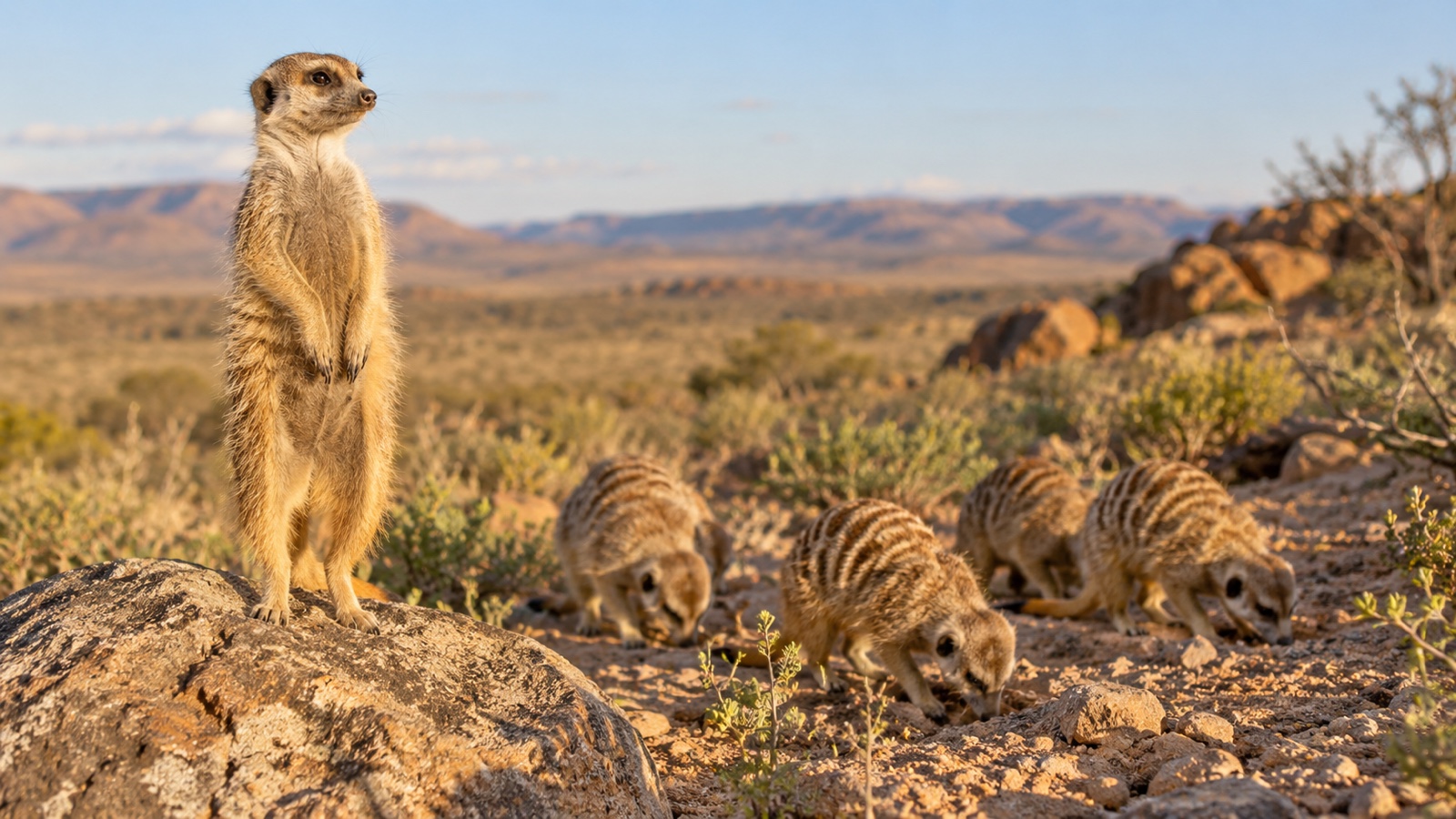
They dig sprawling burrow systems
A meerkat burrow is not one simple hole. Groups use networks of tunnels, chambers, and entrances that offer sleeping space, escape routes, shade, nursery areas, and a remarkably stable climate compared with the desert surface.
- Meerkats are powerful diggers.
- Long front claws loosen compact soil.
- They can move dirt quickly with repeated strokes.
- Burrows may contain many entrances.
- Multiple exits help animals escape predators.
- Underground chambers provide sleeping areas.
- Nursery chambers shelter young pups.
- Burrow temperatures vary less than surface temperatures.
- This protects meerkats from both daytime heat and nighttime cold.
- Groups may use several separate burrow systems within a territory.
- They sometimes move from one sleeping burrow to another.
- Meerkats can excavate their own tunnels.
- They also enlarge or reuse burrows made by other animals.
- Ground squirrels and yellow mongooses can share or use overlapping burrow systems.
- Different species may tolerate one another around large tunnel complexes.
- Meerkats often bolt toward the nearest entrance when alarmed.
- Temporary bolt holes provide emergency shelter during foraging.
- Burrow digging changes soil structure.
- Excavated soil can affect seeds, insects, and local plant growth.
- The safest meerkat real estate has enough exits that nobody ever needs to argue about a fire code.
Scorpions are food, but meerkats are not magically immune to venom
- Meerkats are omnivores with a strong preference for animal prey.
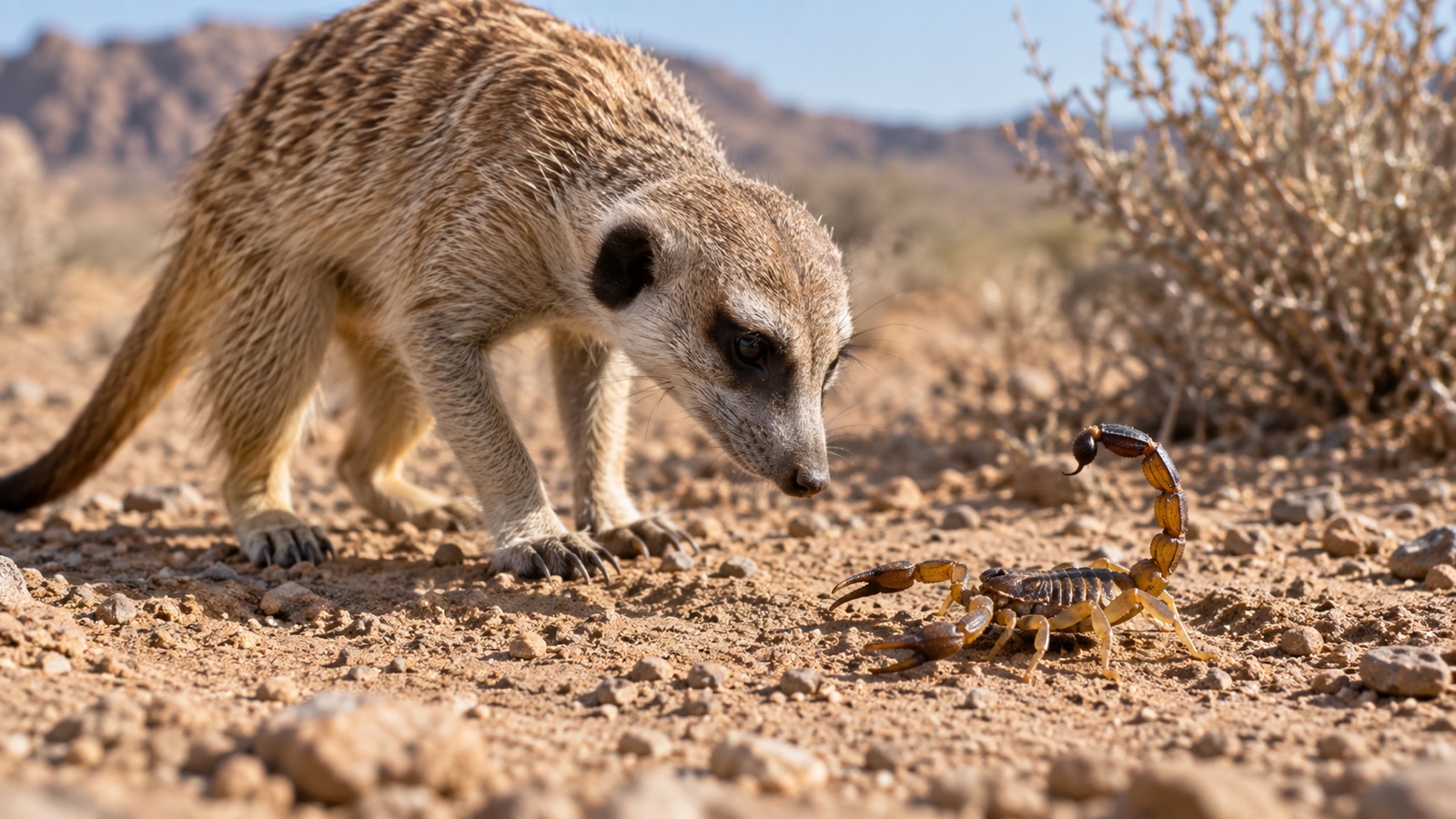
- They eat beetles, larvae, spiders, scorpions, centipedes, and other invertebrates.
- They also eat lizards, small snakes, eggs, and occasional plant foods.
- Strong claws help dig prey from underground.
- Meerkats locate buried prey using smell and hearing.
- They can handle scorpions skillfully.
- An experienced meerkat may bite or remove a scorpion's stinger before eating it.
- Adults sometimes teach pups how to handle dangerous prey.
- Helpers first give very young pups dead or disabled scorpions.
- Older pups receive increasingly intact prey.
- This staged teaching lets pups practice safely.
- It is one of the clearest examples of teaching behavior documented in a wild nonhuman animal.
- Meerkats have some physiological resistance to certain venoms.
- Resistance does not mean complete immunity to every scorpion or snake toxin.
- A dangerous sting or bite can still injure a meerkat.
- Adults reduce risk through handling technique as well as physiology.
- They often forage individually while remaining within communication range of the group.
- Foraging animals dig many small holes across their territory.
- Prey availability changes with rainfall and season.
- Meerkat parenting includes the sentence “Here is a slightly less dangerous scorpion than yesterday,” which is an educational philosophy I am glad humans skipped.
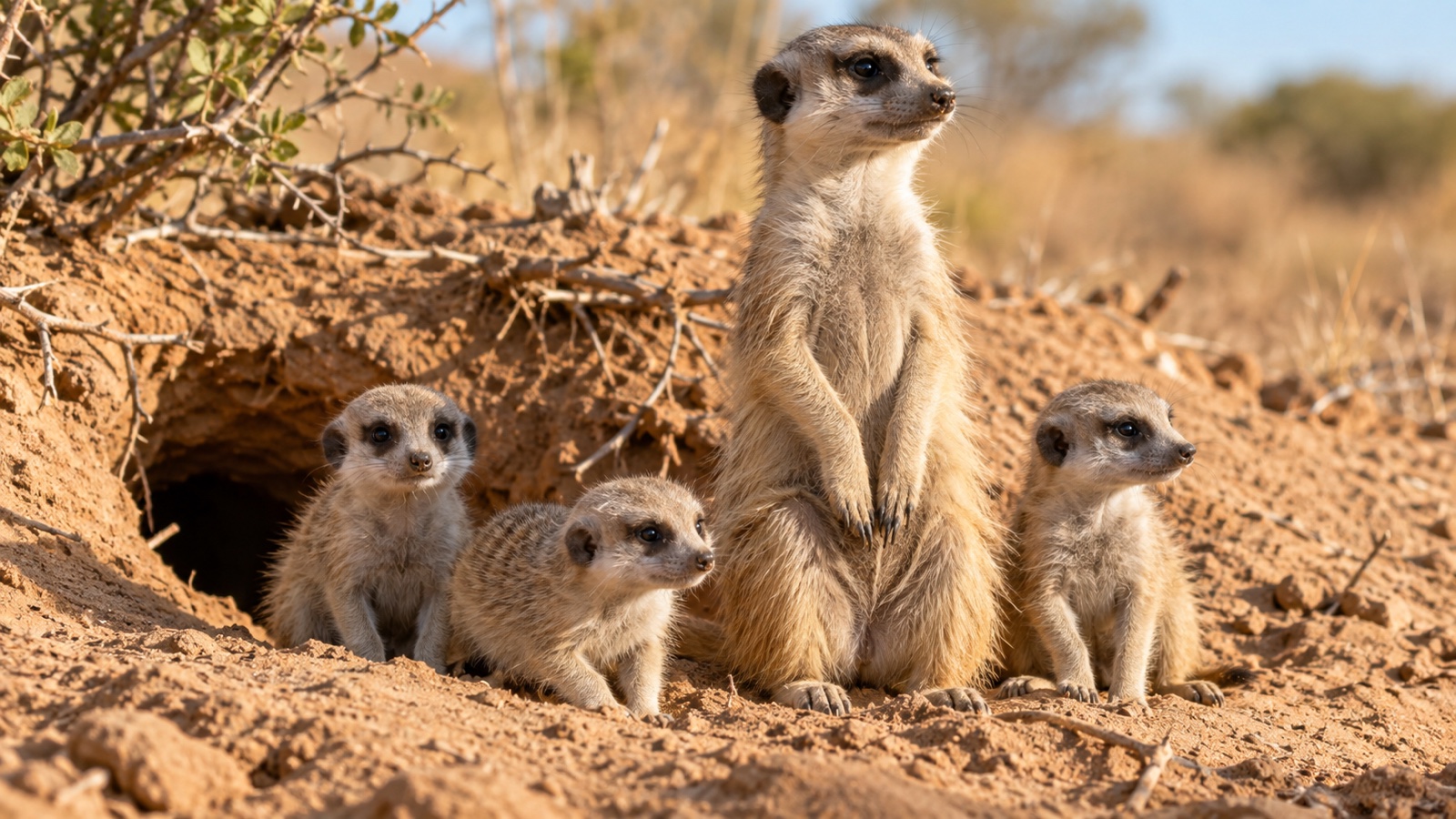
One dominant female can shape the whole family
Meerkat society looks cooperative because it is, but it is not egalitarian. A dominant female typically produces most of the pups, subordinate adults help raise them, and breeding conflicts can lead to eviction, aggression, or even the killing of another female's newborns.
- Meerkats live in social groups often called mobs, gangs, or clans.
- Groups commonly contain several related adults and young.
- A dominant female usually produces most successful litters.
- A dominant male often fathers many pups within the group.
- Subordinate females can sometimes become pregnant.
- The dominant female may evict pregnant subordinates temporarily.
- Infanticide can occur when breeding competition becomes intense.
- Social cooperation therefore exists alongside serious reproductive conflict.
- Gestation lasts roughly 11 weeks.
- Litters commonly contain several pups.
- Pups are born underground.
- They emerge from the burrow after several weeks.
- Nonbreeding adults help babysit pups.
- Helpers also bring food to young.
- Babysitters may lose feeding opportunities while staying near the burrow.
- Close relatives gain indirect evolutionary benefits when related pups survive.
- Pups beg loudly for food from helpers.
- Helpers respond to begging intensity and pup age.
- Young gradually join the group on daily foraging trips.
- Meerkat family life is adorable until you read the actual rules of succession.
Territories, predators and 25 final meerkat facts
- Meerkat groups defend territories from neighboring groups.
- They mark territory with scent from anal glands.
- Group boundaries can shift as resources and group sizes change.
- Encounters between rival mobs can become violent.
- Larger groups often have an advantage in territorial confrontations.
- Some conflicts end with one group retreating before physical fighting begins.
- Meerkats recognize members of their own group through scent and behavior.
- Immigrating males may attempt to join new groups.
- Dispersal reduces mating with close relatives.
- Predators include martial eagles, tawny eagles, jackals, snakes, and other carnivores.
- Young pups are especially vulnerable.
- Heavy rainfall can flood burrows.
- Drought reduces insect prey and body condition.
- Climate variation strongly influences breeding success.
- Meerkats do not need to drink frequently when prey provides enough moisture.
- They can obtain much of their water from food.
- Wild meerkats spend a large share of daylight digging and searching for prey.
- They are not naturally interested in posing upright for tourists all day.
- Habituated research populations may tolerate observers at close range.
- Habituation requires careful protocols and does not turn the animals into pets.
- Meerkats can live for more than a decade in managed care.
- Wild lifespan is usually shorter because of predation, disease, drought, and conflict.
- Long-term meerkat research has produced unusually detailed records of individual family relationships.
- Those studies have helped scientists understand cooperation, teaching, dominance, aging, and climate effects.
- After 145 facts, meerkats look less like cute sentries and more like a tiny desert society with childcare, education, border disputes, alarm systems, real estate networks, and deeply complicated family politics.
Quick FAQ
Q: Are meerkats cats?
A: No. Meerkats are members of the mongoose family.
Q: Why do meerkats stand up?
A: Standing helps them scan for predators, communicate alertness, and warm their sparsely furred bellies in morning sunlight.
Q: Are meerkats immune to scorpion venom?
A: They have some venom resistance and excellent prey-handling skills, but they are not completely immune to all venom.
Q: Do meerkats really babysit each other's babies?
A: Yes. Nonbreeding helpers guard pups, feed them, and even help teach young how to handle difficult prey.
Q: What is a group of meerkats called?
A: A group is commonly called a mob, gang, or clan.

Ellie is the owner and sole author of Fun Facts, combining her mechanical engineering background with years of research-driven writing to deliver facts you can trust. Every article is thoroughly fact-checked and routinely updated as new science and sources emerge to keep information accurate and current. Her mission is to make learning delightful while upholding high standards of reliability and transparency.