
Mars has blue sunsets, a volcano nearly three times taller than Mount Everest, two tiny moons, planet-wide dust storms, and strong evidence that rivers once crossed its surface. It is cold, dry, rusty, and surprisingly Earth-like in a few important ways. These 145 Mars facts explore the Red Planet from its iron-rich dust to the robots still studying it today.
Mars basics
- Mars is the fourth planet from the Sun.
- It is the second-smallest planet in the solar system after Mercury.
- Mars is a rocky, or terrestrial, planet.
- Its average distance from the Sun is about 228 million kilometers, or 142 million miles.
- Mars has an equatorial diameter of about 6,792 kilometers, or 4,220 miles.
- That makes Mars a little more than half as wide as Earth.
- Mars has only about 11% of Earth’s mass.
- Surface gravity on Mars is about 38% as strong as gravity on Earth.
- A person who weighs 100 pounds on Earth would exert a weight of roughly 38 pounds on Mars.
- Mars is named after the Roman god of war.
- Its reddish appearance made it stand out to ancient skywatchers.
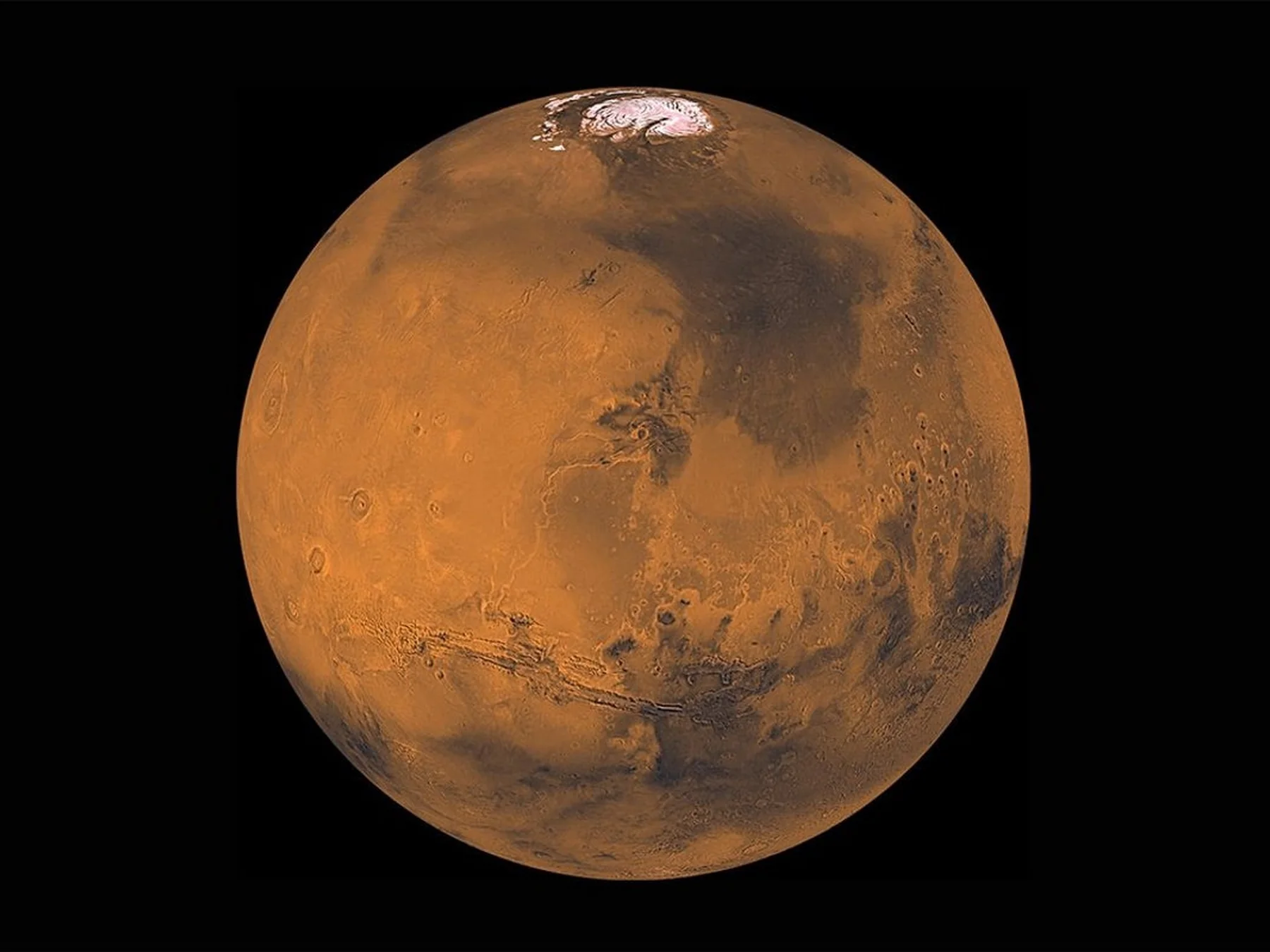
- The reddish color comes largely from iron minerals in Martian soil and dust that have oxidized.
- That rusty color is why Mars is nicknamed the Red Planet.
- Mars has two small moons named Phobos and Deimos.
- NASA maintains an up-to-date overview on its official Mars facts page.
Days, years, and seasons on Mars
- A Martian day lasts about 24 hours and 39 minutes.
- Scientists and mission teams call a Martian solar day a sol.
- A sol is only about 40 minutes longer than an Earth day.
- Mars takes about 687 Earth days to orbit the Sun.
- That means a Martian year lasts nearly twice as long as an Earth year.
- Mars rotates in the same general direction as Earth.
- Mars has an axial tilt of about 25 degrees.
- Its tilt gives Mars recognizable seasons.
- Martian seasons last longer than Earth’s because Mars takes longer to orbit the Sun.
- The seasons are not equal in length because Mars follows a noticeably elliptical orbit.
- Southern Hemisphere summers occur when Mars is relatively close to the Sun.
- This orbital geometry helps make southern Martian summers shorter and warmer than northern summers.
- Mars has polar regions that change visibly with the seasons.
- Seasonal carbon-dioxide frost grows and shrinks around the poles.
- Because a Martian sol resembles an Earth day, rover teams can temporarily live on “Mars time” during intense mission operations.
Mars has enormous volcanoes and canyons
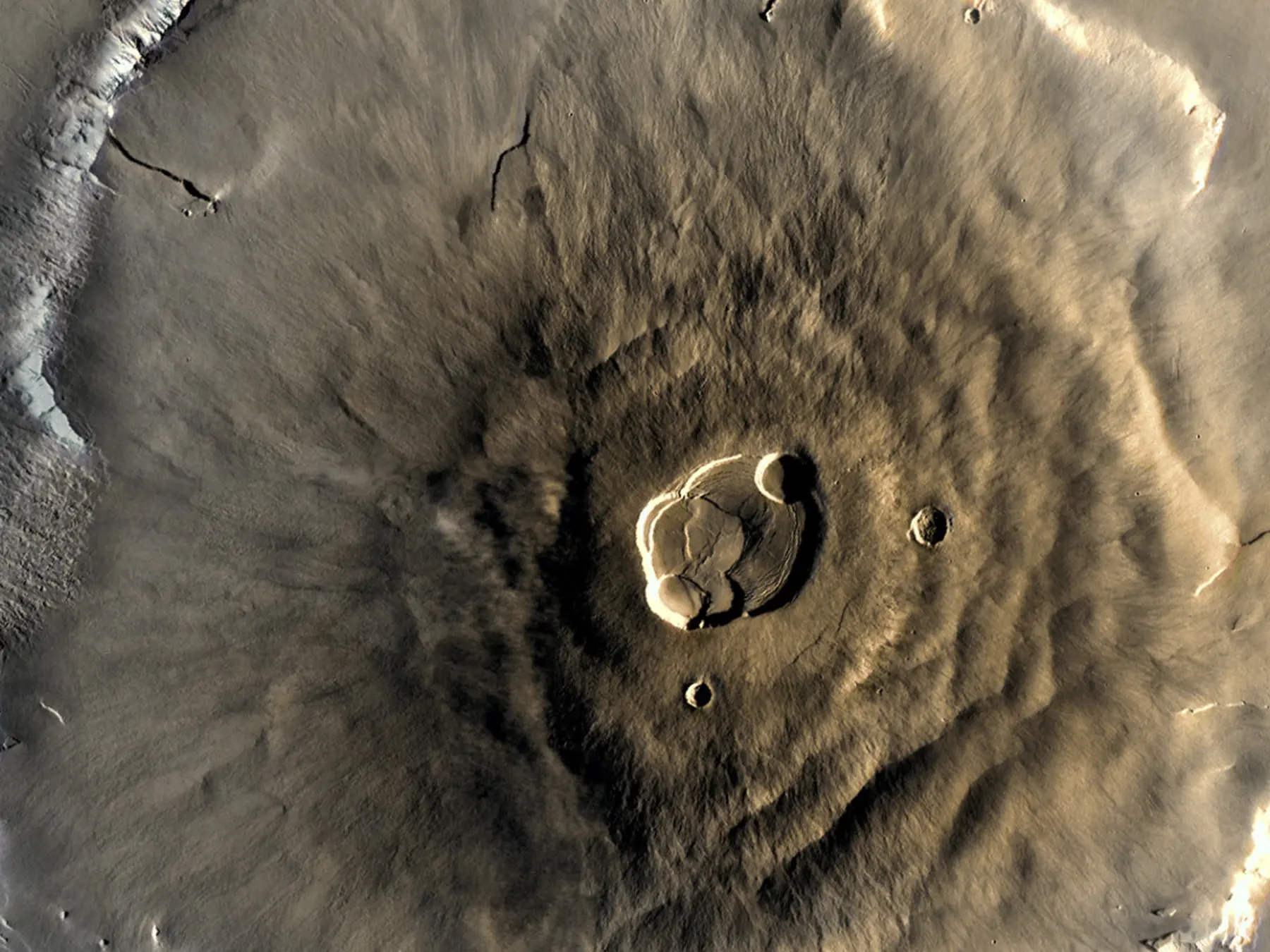
- Olympus Mons is the largest known volcano in the solar system.
- Olympus Mons rises roughly 22 kilometers, or about 13.6 miles, above the surrounding plains.
- That makes it nearly three times the height of Mount Everest above sea level.
- Olympus Mons is a shield volcano with very broad, gently sloping sides.
- Its base is hundreds of kilometers across.
- Mars could grow such enormous volcanoes partly because its crust does not recycle through Earth-like plate tectonics.
- Long-lived volcanic centers could therefore remain over magma sources for very long periods.
- The Tharsis region contains several of Mars’s most impressive volcanoes.
- Valles Marineris is a vast canyon system near the Martian equator.
- Valles Marineris stretches more than 4,000 kilometers, or roughly 2,500 miles.
- It is several times longer than the Grand Canyon.
- Some parts of Valles Marineris reach several kilometers deep.
- The canyon system formed through a combination of crustal stretching, faulting, collapse, erosion, and landslides.
- Mars contains impact basins so large that they span huge fractions of a hemisphere.
- Hellas Planitia is one of the largest and deepest impact basins on Mars.
The Martian atmosphere
- Mars has a very thin atmosphere compared with Earth.
- Carbon dioxide makes up about 95% of the Martian atmosphere.
- Nitrogen and argon make up most of the remainder.
- Surface air pressure on Mars averages less than 1% of Earth’s sea-level pressure.
- Humans could not breathe Martian air.
- The atmosphere is too thin to provide Earth-like protection from radiation.
- Mars also lacks a strong global magnetic field like Earth’s present-day field.
- Solar wind has helped strip away part of Mars’s atmosphere over billions of years.
- NASA’s MAVEN mission studies how the Martian atmosphere escapes into space.
- The thin atmosphere allows large day-to-night temperature swings.
- Average surface temperatures on Mars are far below freezing.
- Temperatures vary dramatically with latitude, season, elevation, and time of day.
- Liquid water is unstable on most of today’s Martian surface because pressure is so low and temperatures are usually cold.
- Water can exist as ice beneath or on the surface in many regions.
- Carbon dioxide can freeze directly from the atmosphere onto the polar surface during winter.
Dust, weather, and blue sunsets
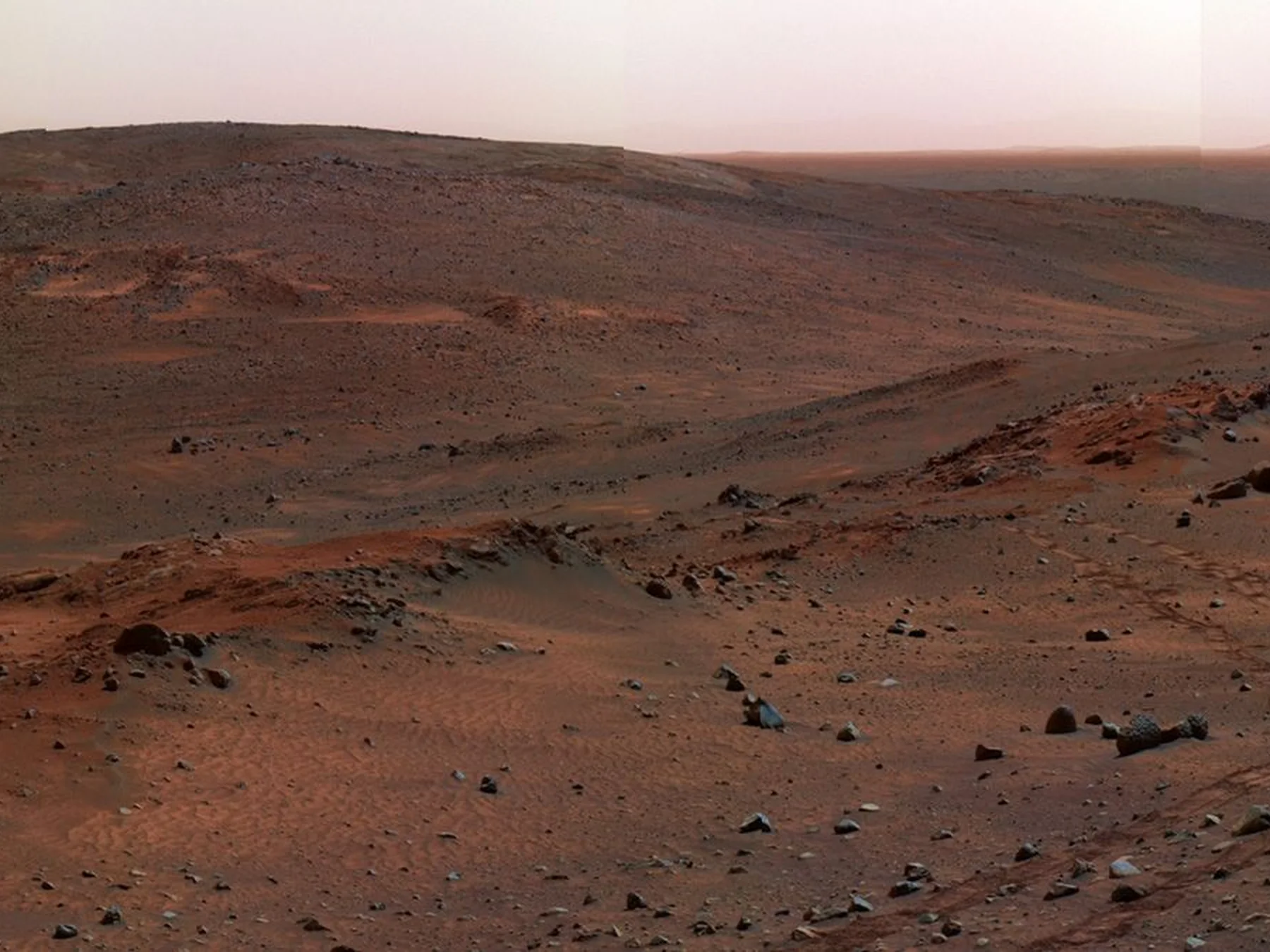
- Fine dust covers large areas of Mars.
- Martian dust contains iron-rich minerals that contribute to the planet’s reddish color.
- Winds can lift dust high into the atmosphere.
- Dust devils regularly cross the Martian surface.
- Rovers have photographed and measured Martian dust devils.
- Some Martian dust storms grow to regional scales.
- On rare occasions, dust storms can spread around nearly the entire planet.
- A global dust storm in 2018 helped end NASA’s solar-powered Opportunity rover mission by blocking sunlight.
- Martian winds can be fast even though the thin air means they exert less force than equally fast winds on Earth.
- Clouds form in the Martian atmosphere.
- Many Martian clouds are made of water ice.
- Carbon-dioxide ice clouds can also form under very cold conditions.
- Mars can have bluish sunsets near the Sun.
- Fine Martian dust scatters light differently from particles in Earth’s atmosphere, contributing to the unusual sunset color.
- The daytime Martian sky often appears butterscotch, tan, or reddish in rover images.
Water on ancient and modern Mars
- Mars today is cold and dry, but its surface preserves abundant evidence of ancient liquid water.
- Orbital images show dried river valleys and channels.
- Ancient lake basins have been identified across the planet.
- Some Martian sedimentary rocks formed in environments influenced by liquid water.
- NASA rovers have found minerals that form or change in the presence of water.
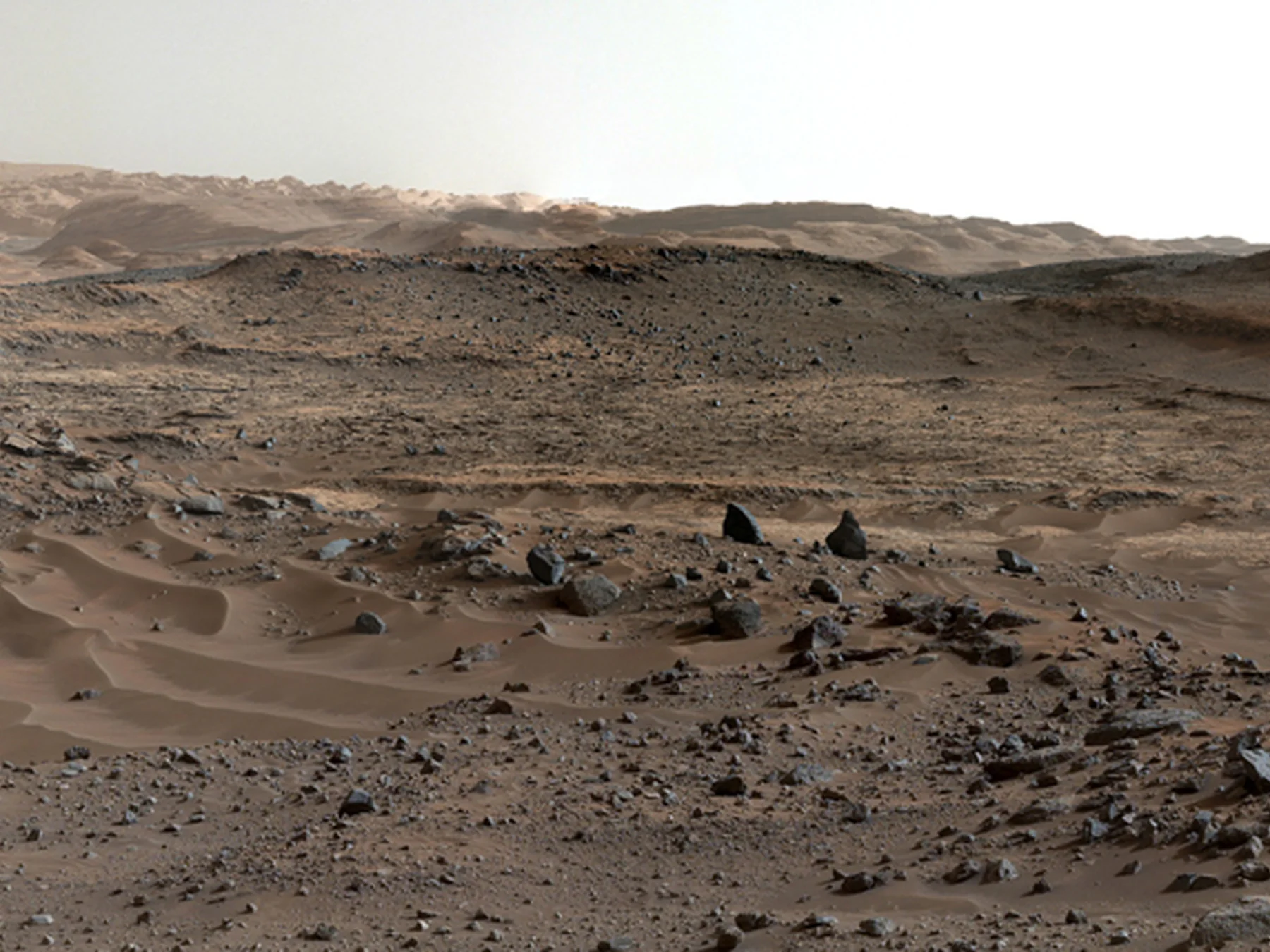
- Curiosity landed inside Gale Crater, which once contained a long-lived lake system.
- Perseverance landed in Jezero Crater, home to an ancient river delta and lake environment.
- River deltas preserve layered sediments that can record past environmental conditions.
- Water ice exists in Mars’s polar regions.
- Subsurface water ice has also been detected at lower latitudes.
- Some buried ice deposits may be important resources for future explorers.
- Future missions could potentially use Martian water ice for drinking, oxygen production, or rocket propellant ingredients.
- Scientists continue debating how warm, wet, and long-lived different ancient Martian environments were.
- Ancient Mars probably did not look exactly like modern Earth, even when liquid water was present.
- Understanding Mars’s water history is central to the search for evidence of past habitability.
Phobos and Deimos
- Phobos is the larger and closer of Mars’s two moons.
- Deimos is smaller and orbits farther from Mars.
- Both moons are tiny compared with Earth’s Moon.
- Phobos is only about 22 kilometers, or 14 miles, across on average.
- Deimos is only about 12 kilometers, or 7.5 miles, across on average.
- Both moons are irregularly shaped rather than spherical.
- Phobos circles Mars in less than eight hours.
- Because it orbits faster than Mars rotates, Phobos appears to rise in the west and set in the east.
- Deimos takes about 30 hours to orbit Mars.
- Both moons keep the same face pointed toward Mars as they orbit.
- Phobos is slowly spiraling inward toward Mars.
- Scientists expect Phobos eventually to break apart or crash into Mars, although not for many millions of years.
- Phobos has a huge crater named Stickney.
- The origins of Phobos and Deimos remain an active area of research.
- NASA summarizes their unusual orbits on its official Mars moons page.
Robots that explored Mars
- Mars is the only planet whose surface has been explored by operating rovers.
- The Soviet Mars program achieved important early milestones but also suffered many mission failures.
- NASA’s Mariner 4 returned the first close-up images of Mars in 1965.
- Mariner 9 became the first spacecraft to orbit another planet in 1971.
- NASA’s Viking 1 and Viking 2 landers reached Mars in 1976.
- Viking performed the first successful long-duration scientific operations on the Martian surface.
- Sojourner became the first rover to operate on Mars in 1997.
- Spirit and Opportunity landed on opposite sides of Mars in 2004.
- Opportunity operated for nearly 15 years, far beyond its planned 90-sol primary mission.
- Curiosity landed in Gale Crater in 2012.
- Curiosity uses a radioisotope power system rather than solar panels.
- Perseverance landed in Jezero Crater in 2021.
- Perseverance is collecting and caching carefully selected Martian rock and sediment samples.
- The Ingenuity helicopter arrived with Perseverance and made the first powered, controlled flight on another planet in 2021.
- Ingenuity ultimately completed 72 flights before its mission ended in 2024.
Could people live on Mars?
- Mars is one of the most discussed destinations for future human exploration beyond the Moon.
- A crew on Mars would need pressurized habitats because the atmosphere is far too thin to breathe.
- Habitats would also need reliable oxygen, water, food, power, heating, and waste-management systems.
- Radiation exposure is a major challenge because Mars lacks Earth’s thick atmosphere and strong global magnetic shield.
- Martian dust can be electrostatic, abrasive, and difficult for machinery and spacesuits.
- Reduced gravity may affect human bones, muscles, cardiovascular systems, and other body processes during long stays.
- Scientists do not yet know all health effects of living for years at 38% of Earth gravity.
- Communication delays mean Mars crews could not rely on real-time conversations with Earth.
- A one-way radio signal between Earth and Mars can take several minutes to more than 20 minutes depending on orbital positions.
- That delay requires crews and robots to operate with substantial independence.
- Launch opportunities between Earth and Mars occur on a favorable cycle roughly every 26 months.
- Future explorers may use local water ice instead of carrying every kilogram of water from Earth.
- Mars’s carbon-dioxide atmosphere may also be useful as a raw material for producing oxygen or fuel ingredients.
- NASA’s MOXIE experiment aboard Perseverance demonstrated technology that produced oxygen from Martian carbon dioxide.
- A permanent human settlement on Mars has never been attempted, so many practical questions remain unresolved.
Ten surprising Mars facts
- Mars has about the same total surface area as all of Earth’s dry land combined.
- Sunsets near the Sun can look blue on the Red Planet.
- The largest volcano in the solar system is on Mars, not Earth or Venus.
- Mars has no modern global magnetic field, but ancient crust preserves evidence that it once had a stronger one.
- The Red Planet has enough atmosphere to create weather but not enough for humans to breathe or survive unprotected.
- A Martian day feels familiar in length, while a Martian year feels almost twice as long.
- Robots on Mars have photographed eclipses caused by Phobos passing in front of the Sun.
- Martian meteorites have landed naturally on Earth after impacts blasted rocks off Mars.
- Scientists can identify some Martian meteorites because gases trapped inside match measurements of Mars’s atmosphere.
- For another distant-world rabbit hole, compare Mars with our 145 facts about Pluto.
Quick Mars FAQ
Why is Mars red?
Iron-bearing minerals in Martian rocks and dust have oxidized, producing iron oxides similar to rust. Fine reddish dust then coats much of the surface and hangs in the atmosphere.
How long is a day on Mars?
One Martian solar day, called a sol, lasts about 24 hours and 39 minutes.
Does Mars have water?
Yes, mostly as ice today. Mars also preserves extensive geological evidence that liquid water once flowed across its surface and collected in rivers, lakes, and groundwater systems.
How many moons does Mars have?
Two. Phobos is the larger inner moon, while Deimos is smaller and farther away.
Has a human ever been to Mars?
No. Every successful Mars explorer so far has been robotic. Human missions remain a future goal rather than a completed achievement.

Ellie is the owner and sole author of Fun Facts, combining her mechanical engineering background with years of research-driven writing to deliver facts you can trust. Every article is thoroughly fact-checked and routinely updated as new science and sources emerge to keep information accurate and current. Her mission is to make learning delightful while upholding high standards of reliability and transparency.