
DNA is a chemical molecule that stores biological instructions in a four-letter code. Every cell does not use every instruction at once, and genes are only part of the story. DNA is copied, repaired, packaged, switched on and off, inherited, mutated, and constantly managed.
DNA stores biological information in four chemical letters
- DNA stands for deoxyribonucleic acid.
- DNA is a nucleic acid.
- Its basic building blocks are nucleotides.
- Each DNA nucleotide contains a sugar called deoxyribose.
- Each also contains a phosphate group.
- The third component is a nitrogen-containing base.
- The four main DNA bases are adenine, thymine, cytosine, and guanine.
- They are abbreviated A, T, C, and G.
- The order of these bases carries genetic information.
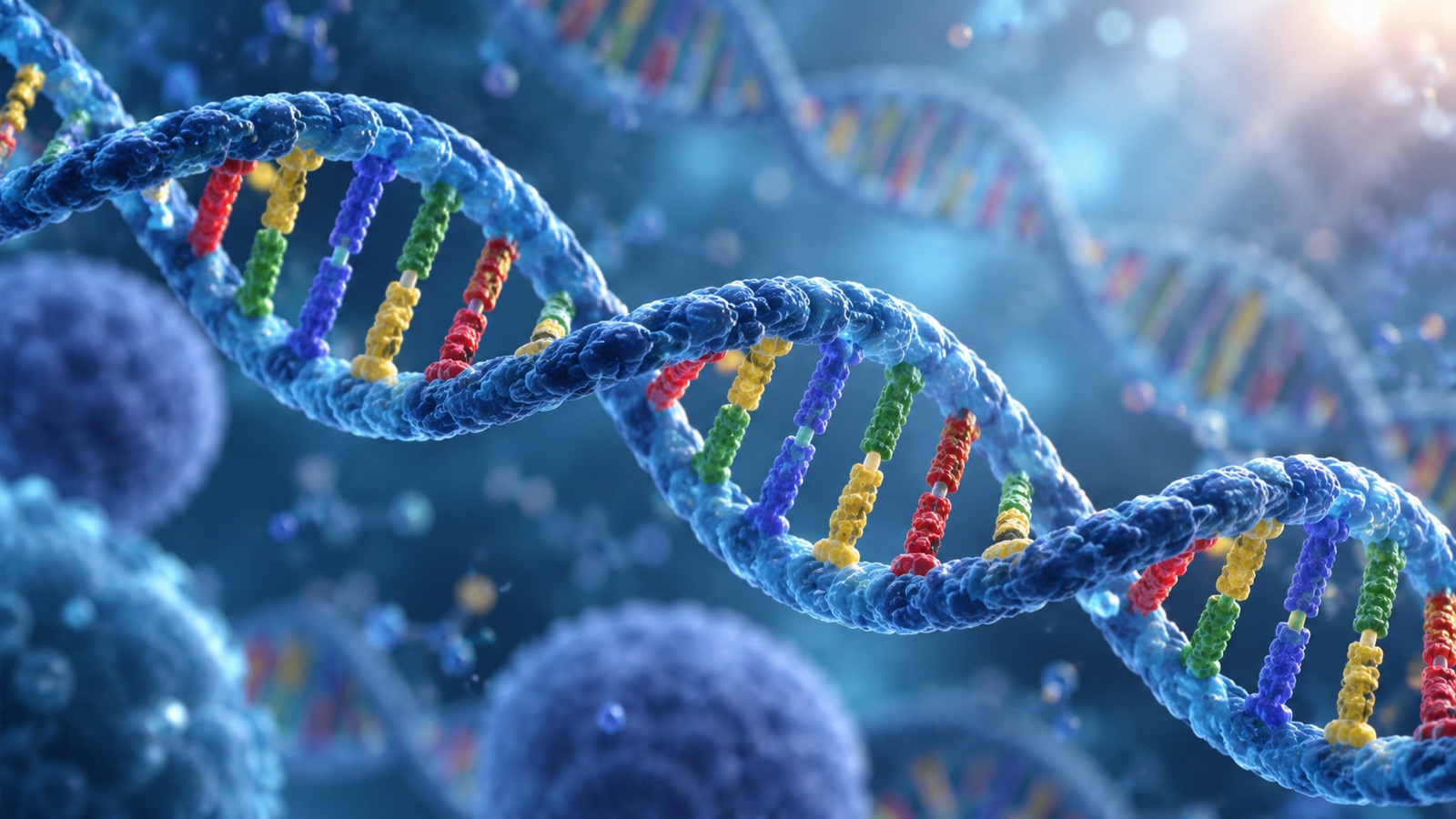
- DNA usually exists as a double-stranded molecule.
- The two strands twist into a double helix.
- Adenine pairs with thymine.
- Cytosine pairs with guanine.
- Base pairs are held together by hydrogen bonds.
- The sugar-phosphate backbone forms the outside of the helix.
- The bases point inward.
- The two DNA strands run in opposite chemical directions.
- This arrangement is called antiparallel.
- DNA is chemically stable enough to store long-term information but flexible enough to be copied and repaired.
- Four molecular letters are enough to encode the instructions for building and maintaining organisms as different as bacteria, oak trees, whales, and humans.
Human DNA is packaged into chromosomes
- Most human DNA is located inside cell nuclei.
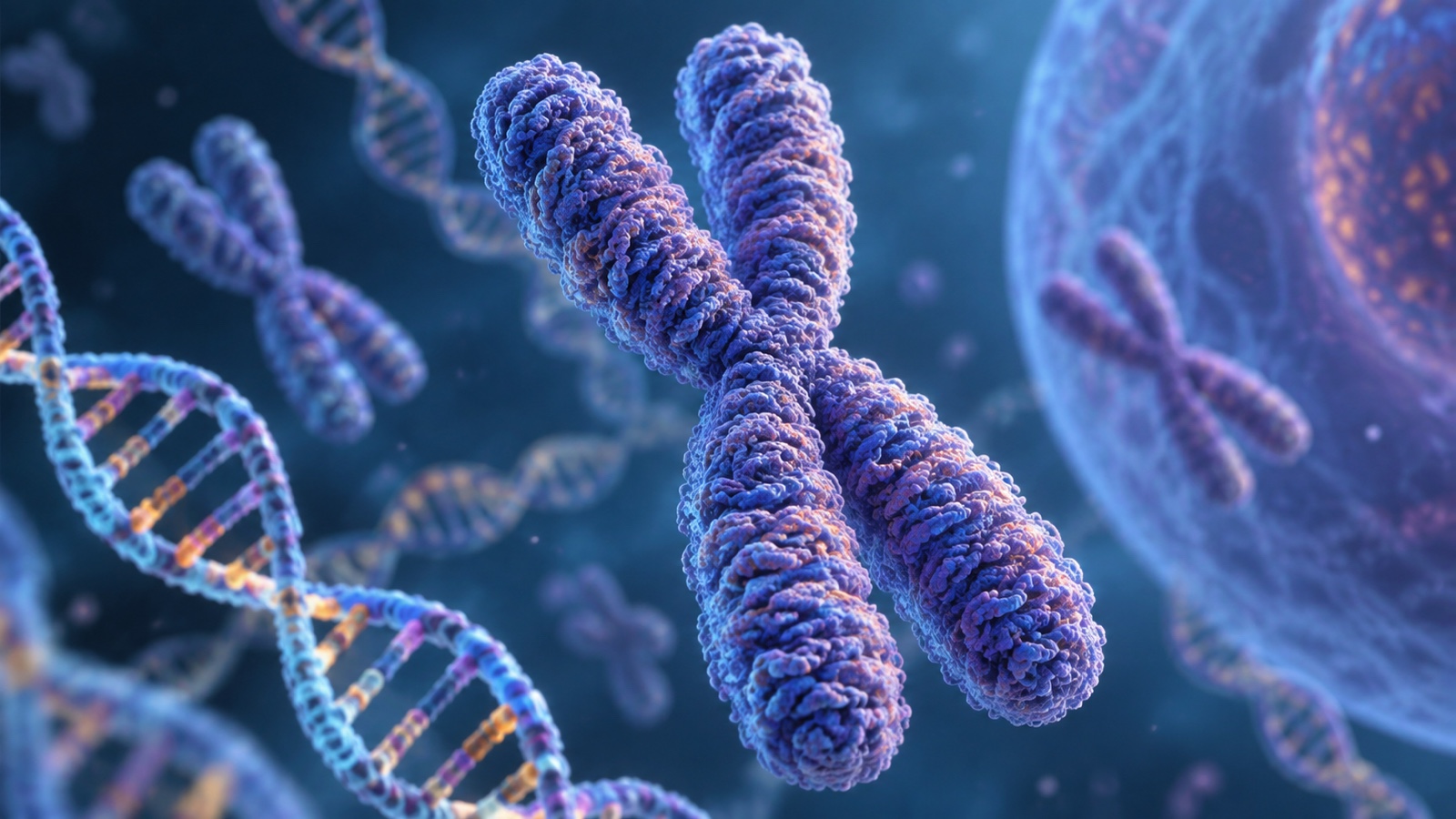
- Nuclear DNA is divided among chromosomes.
- Typical human body cells contain 46 chromosomes.
- Those chromosomes are arranged as 23 pairs.
- One chromosome of each pair is usually inherited from each biological parent.
- Egg and sperm cells normally contain 23 chromosomes rather than 46.
- Fertilization combines two haploid chromosome sets.
- The resulting embryo usually begins with a diploid set of 46 chromosomes.
- Human chromosome pairs 1 through 22 are called autosomes.
- The remaining pair is the sex-chromosome pair.
- Most people have XX or XY sex-chromosome combinations.
- Other sex-chromosome combinations occur naturally.
- Chromosomes are made of DNA wrapped around proteins.
- Histones are major DNA-packaging proteins.
- DNA winds around histone groups to form nucleosomes.
- Nucleosomes help compact extremely long DNA molecules into nuclei.
- Chromatin is the DNA-protein material that makes up chromosomes.
- Chromatin can become more or less compact depending on cell activity.
- Highly compacted DNA is generally less accessible for transcription.
- Stuffing roughly 6 feet of DNA into a microscopic nucleus requires packaging engineering that makes a suitcase look embarrassingly simple.
Genes are useful DNA regions, but most DNA is not protein-coding
- A gene is a DNA sequence that contributes to a functional product.
- Some genes contain instructions for making proteins.
- Other genes produce functional RNA molecules.
- Humans have roughly 20,000 protein-coding genes.
- Protein-coding sequences make up only a small fraction of the human genome.
- Large portions of human DNA are noncoding.
- Noncoding does not mean useless.
- Some noncoding DNA regulates when genes are used.
- Promoters help control where transcription begins.
- Enhancers can increase gene activity from a distance.
- Silencers can reduce gene activity.
- Introns are noncoding sections removed from many RNA transcripts before translation.
- Exons are sequences retained in mature RNA after splicing.
- Alternative splicing allows one gene to produce different RNA and protein products.
- Some noncoding DNA produces regulatory RNAs.
- Some DNA consists of repeated sequences.
- Transposable elements make up a large portion of the human genome.
- Many transposable-element copies are no longer capable of moving.
- Genome function depends on both genes and regulatory context.
- Calling all noncoding DNA “junk” is like calling every sentence outside a recipe's ingredient list useless because it does not directly become dinner.
Cells copy DNA before they divide
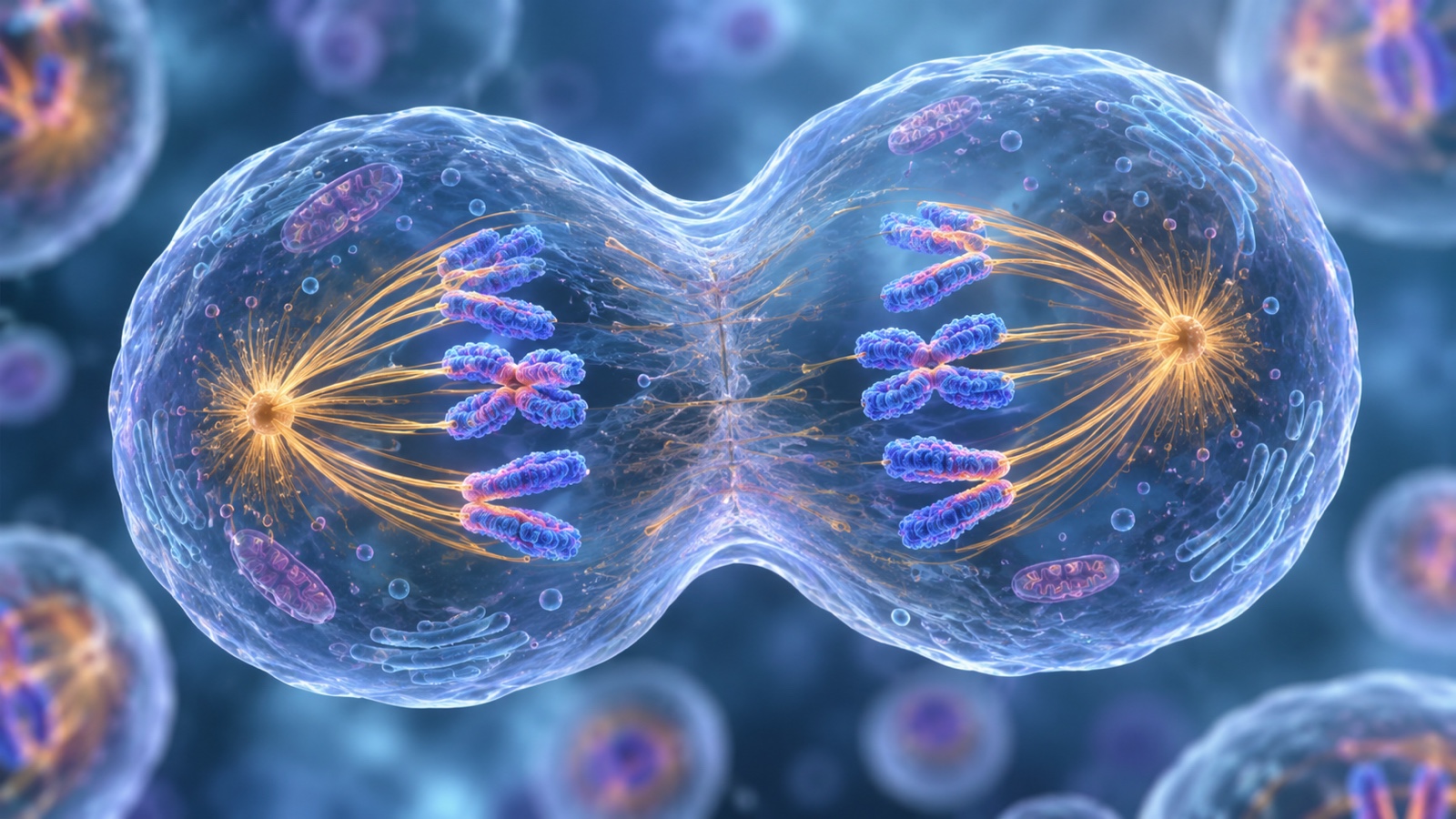
- DNA replication copies genetic material before most cell divisions.
- Replication begins at specific regions called origins.
- The double helix must be opened so each strand can be copied.
- Helicase enzymes help separate the DNA strands.
- DNA polymerases build new DNA strands.
- Polymerases use existing strands as templates.
- New nucleotides are added according to base-pairing rules.
- DNA polymerases synthesize DNA in a 5-prime to 3-prime direction.
- This directional chemistry creates leading and lagging strands at replication forks.
- The leading strand can be synthesized more continuously.
- The lagging strand is made in shorter pieces called Okazaki fragments.
- DNA ligase helps join those fragments.
- Replication is called semiconservative.
- Each new DNA molecule contains one old strand and one newly made strand.
- DNA polymerases proofread many copying errors.
- Additional repair systems correct mistakes that escape proofreading.
- Replication is highly accurate but not perfect.
- Occasional copying errors can become mutations.
- Billions of DNA bases can be copied during one cell cycle.
- Every ordinary cell division requires molecular machinery to copy an information archive containing billions of letters with astonishingly low error rates.
DNA is constantly damaged and repaired
- DNA damage occurs naturally every day.
- Normal metabolism produces reactive molecules that can damage DNA.
- Ultraviolet radiation can create abnormal bonds between neighboring DNA bases.
- Ionizing radiation can break DNA strands.
- Certain chemicals can modify DNA bases.
- Cells contain multiple DNA-repair pathways.
- Base-excision repair fixes many small damaged bases.
- Nucleotide-excision repair removes larger damaged DNA sections.
- Mismatch repair corrects certain copying errors after replication.
- Cells also repair broken DNA strands.
- Double-strand breaks are especially dangerous forms of damage.
- Homologous recombination can repair some double-strand breaks accurately using a matching DNA template.
- Nonhomologous end joining reconnects broken DNA ends more directly.
- Repair failure can lead to mutations or chromosome rearrangements.
- Some inherited cancer-predisposition syndromes involve defective DNA-repair genes.
- BRCA1 and BRCA2 proteins participate in DNA double-strand-break repair.
- Cells can pause the cell cycle when DNA damage is detected.
- Severely damaged cells may trigger programmed cell death.
- DNA maintenance is therefore an active process rather than passive storage.
- Your genome survives decades not because DNA never gets damaged, but because cells run repair crews almost constantly.
Genes work through RNA and proteins
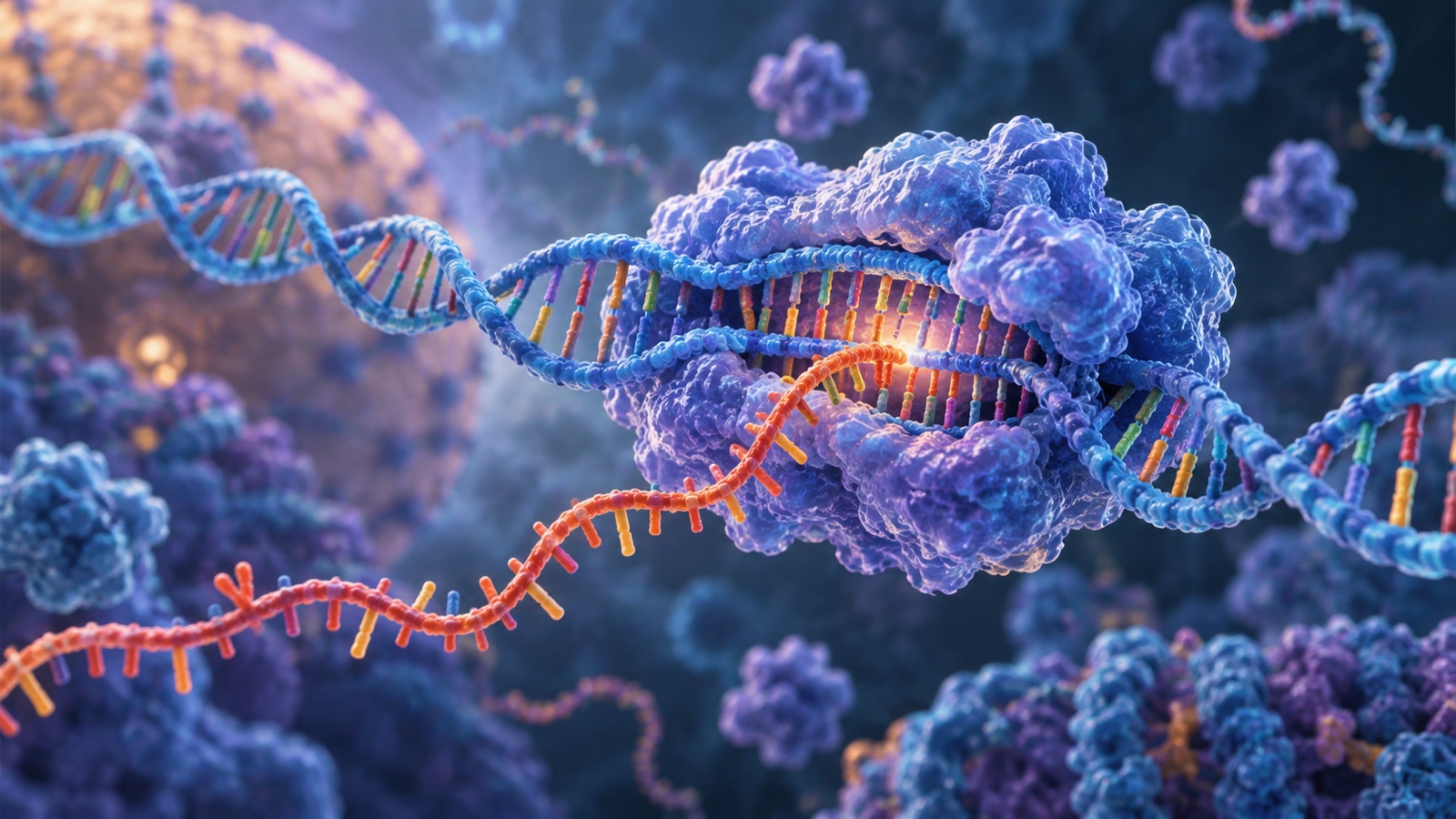
- Transcription copies information from DNA into RNA.
- RNA polymerase performs much of this copying.
- Messenger RNA carries protein-coding information from DNA.
- In eukaryotic cells, messenger RNA is processed before leaving the nucleus.
- A 5-prime cap is added to many messenger RNAs.
- A poly-A tail is added to many messenger RNAs.
- Introns are removed through RNA splicing.
- Mature messenger RNA can leave the nucleus.
- Ribosomes read messenger RNA during translation.
- Ribosomes build proteins from amino acids.
- Three-letter RNA units called codons specify amino acids or stop signals.
- The genetic code is highly conserved across life.
- Several codons can specify the same amino acid.
- This redundancy is called degeneracy of the genetic code.
- Transfer RNA carries amino acids to the ribosome.
- Transfer RNAs use anticodons to recognize messenger-RNA codons.
- Protein production can be regulated at many stages.
- Not every gene is active in every cell.
- A liver cell and a neuron contain almost the same nuclear DNA but use very different sets of genes.
- DNA provides the library, but cell identity depends heavily on which books are opened, copied, translated, and ignored.
Mutations create both disease and biological diversity
- A mutation is a change in DNA sequence.
- Mutations can affect one DNA base or huge chromosome regions.
- A substitution replaces one base with another.
- Insertions add DNA.
- Deletions remove DNA.
- Frameshift mutations can change how downstream codons are read.
- Some mutations have no detectable effect.
- Some alter protein function.
- Some affect gene regulation instead of protein sequence.
- Mutations can occur in body cells.
- Body-cell mutations are called somatic mutations.
- Mutations in egg or sperm lineages can be inherited by offspring.
- Inherited variation contributes to differences among individuals.
- Mutation is also a raw source of evolutionary change.
- Natural selection acts on heritable variation over generations.
- Many common genetic traits reflect combinations of many variants rather than one gene.
- Environment also affects how many traits develop.
- DNA sequence is therefore not a complete destiny map.
- Identical twins can become biologically different over time despite beginning with nearly identical DNA sequences.
- Mutation sounds like a failure word, but without mutation there would be no genetic diversity and no long-term evolution.
Mitochondria, ancestry and 5 final DNA facts
- Mitochondria contain their own small circular DNA molecules separate from nuclear DNA.
- Human mitochondrial DNA is usually inherited primarily through the egg, which makes it useful for tracing maternal lineages.
- Forensic DNA analysis compares variable regions of DNA rather than reading every base in a person's entire genome.
- Humans share the overwhelming majority of their DNA sequence with one another, while millions of smaller variants create individual genetic differences.
- After 145 facts, DNA looks less like a static blueprint and more like a copied, repaired, packaged, regulated, inherited, mutable information system whose meaning depends on the cells reading it.
Quick FAQ
Q: How much DNA is in a human cell?
A: A typical diploid human cell contains roughly 6 billion DNA base pairs across its two chromosome sets.
Q: Does every cell have the same DNA?
A: Most nucleated cells contain nearly the same genome, but some cells accumulate mutations, and mature red blood cells have no nucleus.
Q: Is most DNA made of genes?
A: No. Protein-coding DNA makes up only a small fraction of the human genome.
Q: Are mutations always harmful?
A: No. Many have no effect, some are harmful, and some can be beneficial in a particular environment.
Q: Is DNA destiny?
A: No. Genes influence traits, but development, environment, chance, behavior, and gene regulation also matter.

Ellie is the owner and sole author of Fun Facts, combining her mechanical engineering background with years of research-driven writing to deliver facts you can trust. Every article is thoroughly fact-checked and routinely updated as new science and sources emerge to keep information accurate and current. Her mission is to make learning delightful while upholding high standards of reliability and transparency.