
Baseball can look leisurely until a ball leaves a bat at highway speed and nine defenders have seconds to turn geometry into an out. The sport grew from earlier bat-and-ball games into a deeply statistical American tradition with strange rules, specialized pitches, tiny ballparks, giant stadium moments, and more history than one scorecard can hold. These 145 facts cover the field, equipment, pitching, hitting, records, and culture.
Baseball basics
- Baseball is played by two teams that alternate between batting and fielding.
- Nine defensive players are normally on the field in Major League Baseball.
- The offense scores runs by advancing runners around four bases.
- The bases are first base, second base, third base, and home plate.
- A batter becomes a runner after reaching base legally.
- A complete trip around the bases scores one run.
- Most professional games are scheduled for nine innings.
- Each inning normally gives both teams a turn at bat.
- The visiting team bats in the top half of an inning.
- The home team bats in the bottom half.
- Three outs end a team’s half-inning.
- The team with more runs after the completed game wins.
- Tied MLB games continue into extra innings unless rules or circumstances end them differently.
- Baseball has no game clock controlling ordinary play length.
- Modern MLB does use a pitch timer to regulate pace between pitches.

The baseball field
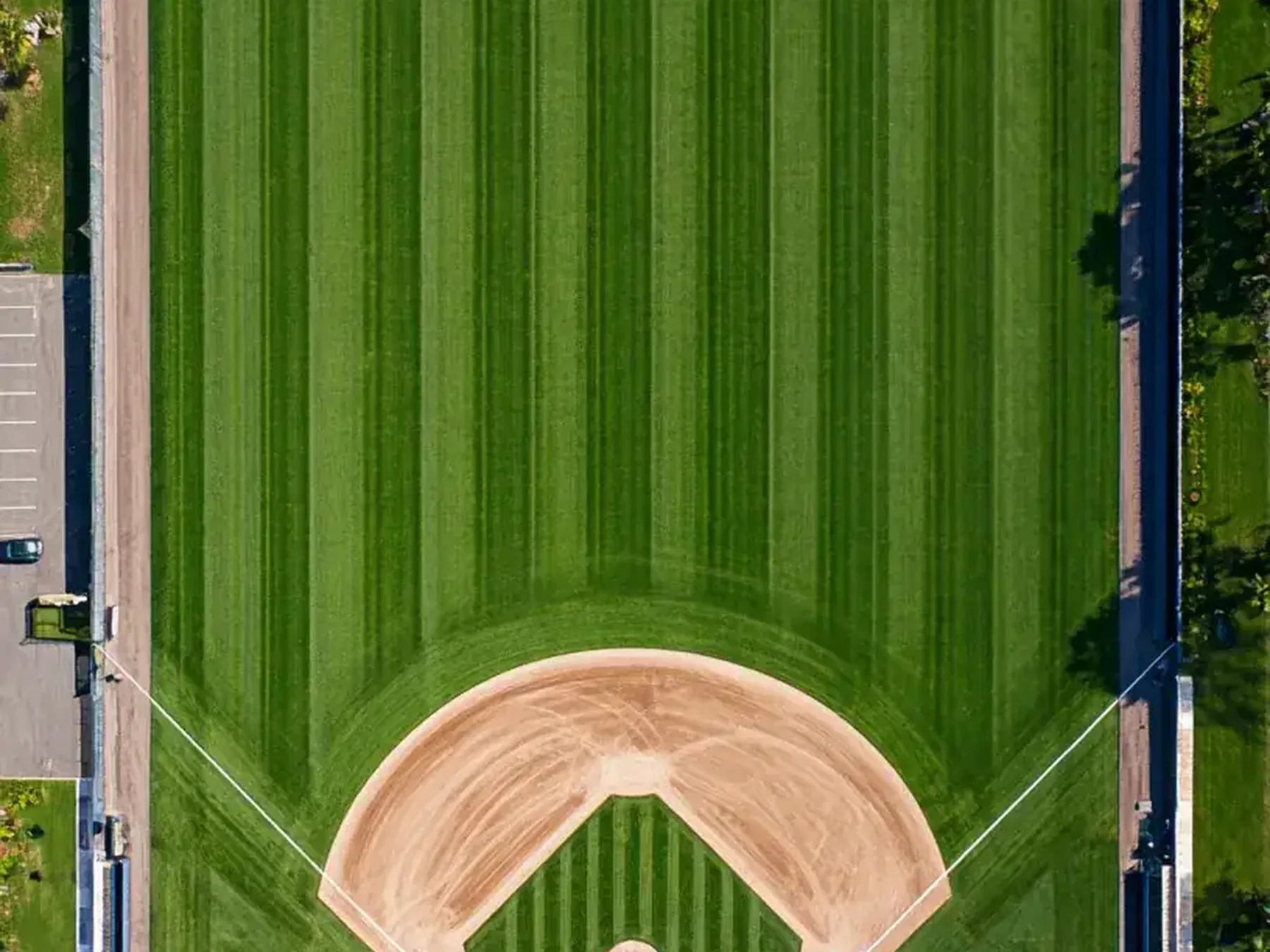
- The four bases form a square commonly called the diamond.
- In professional baseball, bases are 90 feet apart.
- The distance from home plate to second base is about 127 feet 3⅜ inches.
- The pitcher’s rubber is 60 feet 6 inches from the rear point of home plate.
- The pitcher’s mound is raised above the surrounding field.
- Home plate is a five-sided slab rather than a square base.
- Foul lines extend from home plate through first and third base into the outfield.
- A batted ball landing outside those lines is generally foul unless rules make it fair first.
- Outfield dimensions vary from ballpark to ballpark.
- Unlike many sports, Major League Baseball does not require identical outfield-wall shapes.
- This creates famous park-specific features and strategic differences.
- Fenway Park’s Green Monster is a tall left-field wall.
- Wrigley Field is famous for ivy growing on its outfield walls.
- Minute Maid Park once had an unusual center-field incline called Tal’s Hill.
- The official MLB rules define field geometry in detail while allowing some historical ballpark variation.
Balls, bats, and gloves
- An official major-league baseball has a cork-and-rubber center wrapped with yarn.
- The ball is covered with two pieces of white leather.
- Those leather pieces are stitched together with red thread.
- A regulation baseball has 108 double stitches.
- Pitchers use those raised seams to grip and manipulate pitches.
- Major-league bats are made from one piece of solid wood.
- Maple and ash are common professional bat woods.
- Birch is also used for some bats.
- Professional wooden bats can break during swings.
- Aluminum and composite bats are common in amateur baseball.
- Bat performance standards limit how lively non-wood bats can be in organized competition.
- Baseball gloves evolved dramatically from nearly bare hands in the 19th century.
- Modern fielders use position-specific glove shapes.
- Catchers wear heavily padded mitts designed for repeated high-speed pitches.
- First basemen use long mitts shaped to help scoop throws from the dirt.
Balls, strikes, and outs
- Four balls normally award the batter first base on a walk.
- Three strikes normally make the batter out.
- A called strike can occur when a pitch passes through the strike zone without a swing.
- A swinging strike occurs when the batter swings and misses.
- A foul ball usually counts as a strike when the batter has fewer than two strikes.
- An ordinary foul ball does not normally become strike three.
- A foul bunt with two strikes does count as strike three.
- A batter can also strike out when a third strike is not caught cleanly.
- Under specific conditions, the batter may try to reach first on an uncaught third strike.
- A force out occurs when a runner must advance and a fielder controls the ball at the required base first.
- A tag out occurs when a fielder legally touches a runner with the ball or glove holding it.
- A fly ball caught before touching the ground makes the batter out.
- Runners may need to tag up before advancing after a caught fly ball.
- A double play records two outs during one continuous play.
- A triple play records three outs in one continuous play and is much rarer.
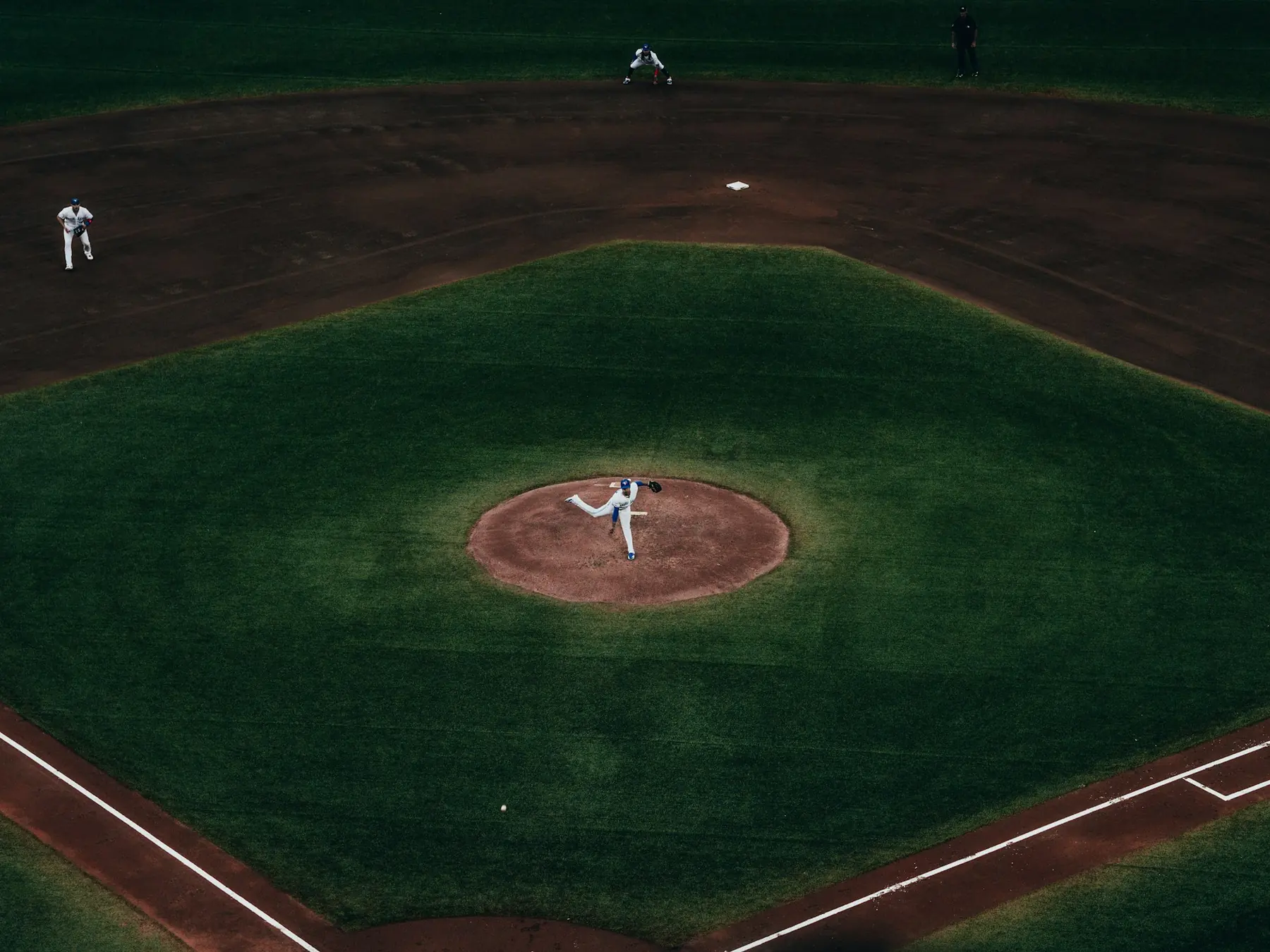
Pitching is controlled physics
- A fastball is designed primarily around speed and relatively direct movement.
- A four-seam fastball is gripped across the seams to produce strong backspin.
- A two-seam fastball often shows more arm-side movement than a four-seamer.
- A sinker is designed to produce downward or running movement.
- A curveball uses topspin and sidespin to create pronounced downward break.
- A slider combines velocity with sharp lateral and downward movement.
- A changeup looks fast from the arm action but arrives more slowly.
- A splitter drops sharply because of its grip and spin characteristics.
- A knuckleball is thrown with very little spin.
- Low spin makes a knuckleball’s path unusually sensitive to airflow around the seams.
- The Magnus effect helps explain how spin changes a baseball’s flight.
- Pitch movement depends on velocity, spin rate, spin direction, seams, and air conditions.
- Pitchers disguise different pitches by making their deliveries look similar.
- Changing speed can be as important as adding movement.
- Modern teams measure pitch velocity, spin, release point, movement, and location electronically.
Hitting and baserunning
- A single lets the batter reach first base safely without an error or fielder’s choice.
- A double sends the batter safely to second.
- A triple sends the batter safely to third.
- A home run allows the batter to circle all four bases and score.
- Most home runs leave the playing field in fair territory.
- An inside-the-park home run never leaves the field.
- A grand slam is a home run hit with all three bases occupied.
- A stolen base occurs when a runner advances during a pitch without help from a hit or error.
- Catchers try to throw out runners attempting steals.
- A sacrifice bunt intentionally trades an out for advancing another runner.
- A sacrifice fly can score a runner after a caught fly ball.
- A hit-and-run sends a runner in motion while the batter attempts contact.
- Base stealers study pitchers’ timing, pickoff moves, and catcher throwing ability.
- Sliding can help runners avoid tags and stop more safely at a base.
- Headfirst and feet-first slides each create different advantages and injury risks.
Baseball statistics
- Baseball has one of the richest statistical traditions in sports.
- Batting average divides hits by official at-bats.
- On-base percentage measures how often a batter reaches base through specified outcomes.
- Slugging percentage weights extra-base hits more heavily than singles.
- OPS adds on-base percentage and slugging percentage.
- ERA stands for earned run average.
- ERA estimates earned runs allowed per nine innings pitched.
- WHIP measures walks plus hits allowed per inning pitched.
- Fielding percentage compares successful plays with total fielding chances.
- Modern analytics use far more than traditional box-score statistics.
- WAR estimates a player’s total value compared with a replacement-level player.
- Different organizations calculate WAR using somewhat different formulas.
- Exit velocity measures how fast a batted ball leaves the bat.
- Launch angle measures the ball’s vertical angle immediately after contact.
- Baseball statistics let fans compare players across eras, although changing rules and conditions complicate simple comparisons.
Baseball history
- Baseball developed from older bat-and-ball games rather than being invented in one moment.
- The old story that Abner Doubleday invented baseball in Cooperstown is not supported by historians.
- The Knickerbocker Rules of 1845 were an important early written ruleset.
- Alexander Cartwright was connected with the New York Knickerbocker Base Ball Club.
- Professional baseball clubs emerged during the 19th century.
- The Cincinnati Red Stockings of 1869 are celebrated as the first openly professional team.
- The National League was founded in 1876.
- The American League became a major league in 1901.
- The first modern World Series was played in 1903.
- The Boston Americans defeated the Pittsburgh Pirates in that series.
- The Negro Leagues provided elite professional baseball opportunities for Black players barred from segregated white leagues.
- Jackie Robinson broke Major League Baseball’s modern color barrier with the Brooklyn Dodgers in 1947.
- Robinson wore number 42.
- MLB permanently retired number 42 across all teams in 1997.
- The National Baseball Hall of Fame documents this history through its museum and research collections.
Famous baseball traditions
- “Take Me Out to the Ball Game” was written in 1908.
- Its lyricists reportedly wrote the song before attending a major-league game.
- The seventh-inning stretch is a long-standing ballpark tradition.
- Fans commonly stand, stretch, and sing during the break.
- Ballparks serve regional foods far beyond traditional hot dogs and peanuts.
- Scorekeeping uses a compact numerical shorthand for fielding positions.
- The pitcher is position 1 and the catcher is position 2 on scorecards.
- A 6-4-3 double play means shortstop to second baseman to first baseman.
- Baseball managers wear the same general uniform style as players.
- That tradition reflects baseball’s early history when managers could also be active players.
- Opening Day is treated as a symbolic beginning of spring by many fans.
- Baseball cards became major collectibles during the 20th century.
- Early trading cards were sometimes packaged with tobacco products.
- The Honus Wagner T206 card became one of the hobby’s most famous rarities.
- Baseball has influenced American language with phrases such as “ballpark figure,” “out of left field,” and “step up to the plate.”
Ten surprising baseball facts
- The familiar baseball diamond is technically a square turned on a point.
- Major-league outfields do not all have the same dimensions.
- The myth that Abner Doubleday invented baseball remains famous despite lacking historical support.
- An inside-the-park home run can score without the ball ever leaving the field.
- A batter can sometimes reach first base after striking out.
- A foul bunt with two strikes can end an at-bat as strike three.
- The 108 double stitches on a baseball directly affect how pitches move through air.
- Modern tracking systems turn every pitch and batted ball into a physics experiment.
- Major League Baseball retired Jackie Robinson’s number 42 across every team.
- For more sports trivia, explore our American football facts and basketball facts.
Quick baseball FAQ
How many players are on a baseball field?
Nine defensive players normally take the field for one team at a time in Major League Baseball.
How far apart are the bases?
Professional baseball bases are 90 feet apart, forming a square commonly called the diamond.
How many stitches are on a baseball?
An official baseball has 108 double stitches joining its two leather cover pieces.
Did Abner Doubleday invent baseball?
No reliable evidence supports that popular story. Baseball evolved gradually from older bat-and-ball games and 19th-century club rules.
Why is number 42 special in baseball?
Jackie Robinson wore 42 when he broke Major League Baseball’s modern color barrier in 1947. MLB retired the number league-wide in 1997.

Ellie is the owner and sole author of Fun Facts, combining her mechanical engineering background with years of research-driven writing to deliver facts you can trust. Every article is thoroughly fact-checked and routinely updated as new science and sources emerge to keep information accurate and current. Her mission is to make learning delightful while upholding high standards of reliability and transparency.