
American football looks chaotic until you realize almost every collision, route, kick, clock stop, and formation fits into a giant rulebook of strategy. The sport grew from 19th-century college games into an American institution built around downs, forward passes, specialized positions, and spectacular engineering. These 145 football facts cover the field, scoring, history, equipment, positions, strategy, NFL traditions, and rules fans constantly debate.
American football basics
- American football is played by two teams trying to advance an oval-shaped ball into the opponent’s end zone.
- Each NFL team can have 11 players on the field at one time.
- Teams alternate between offense, defense, and specialized kicking units.
- The offense controls the ball and tries to score.
- The defense tries to stop the offense, force a turnover, or prevent points.
- Special teams handle most kickoffs, punts, field goals, and extra-point plays.
- A standard NFL game consists of four 15-minute quarters.
- The game clock stops for many events, so a 60-minute game takes much longer than one hour in real time.
- The line of scrimmage is the imaginary line running through the ball before a play begins.
- A play normally starts when the center snaps the ball.
- The quarterback usually receives the snap and decides how the designed play unfolds.
- An offense can advance the ball by running or passing.
- A turnover transfers possession to the other team.
- Interceptions and lost fumbles are two common turnovers.
- The current NFL rulebook is published by NFL Football Operations.
The field is bigger than the “100 yards” you hear about
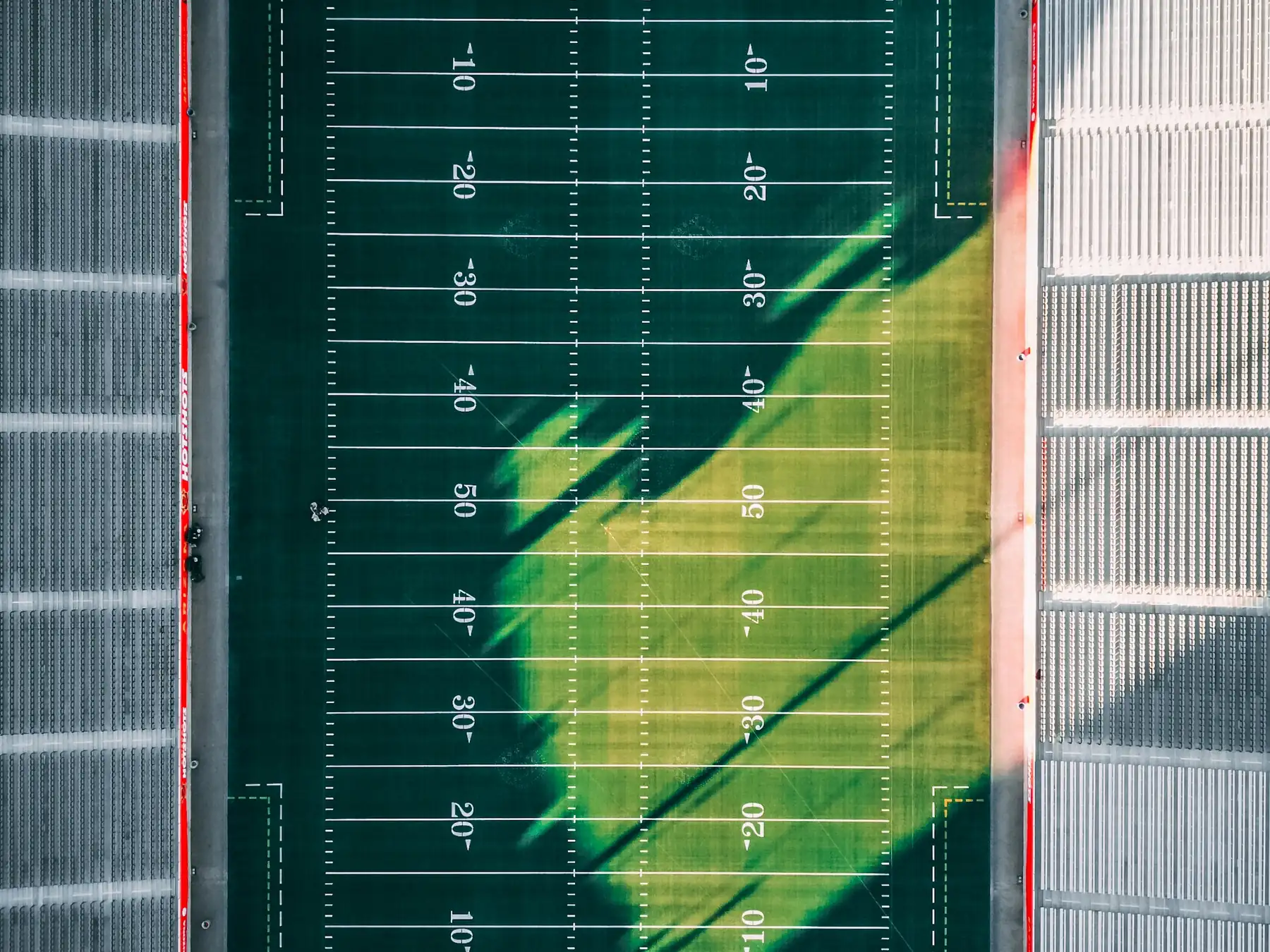
- The playing field between the two goal lines is 100 yards long.
- Each end zone adds another 10 yards.
- That makes the full field 120 yards, or 360 feet, from end line to end line.
- An NFL field is 160 feet wide, or 53⅓ yards.
- Yard lines cross the field at five-yard intervals.
- Short hash marks help officials spot the ball after plays.
- NFL hash marks are closer together than college hash marks.
- The narrower NFL hashes keep most plays relatively close to the center of the field.
- Goalposts stand at the back of each NFL end zone.
- The NFL uprights are 18 feet 6 inches apart.
- The crossbar is 10 feet above the ground.
- The uprights extend far above the crossbar so officials can judge high kicks.
- The 50-yard line marks midfield.
- Field numbers reverse direction after midfield because they show distance from the nearest goal line.
- A football field’s exact markings are carefully standardized rather than painted merely for television.
Downs make football strategy work
- The offense usually receives four downs to gain at least 10 yards.
- A down is one play in that four-play series.
- If the offense gains 10 or more yards before using all four downs, it earns a new first down.
- The line to gain is the point the offense must reach for a new first down.
- Television’s familiar yellow first-down line is a digital graphic and is not physically painted on the field.
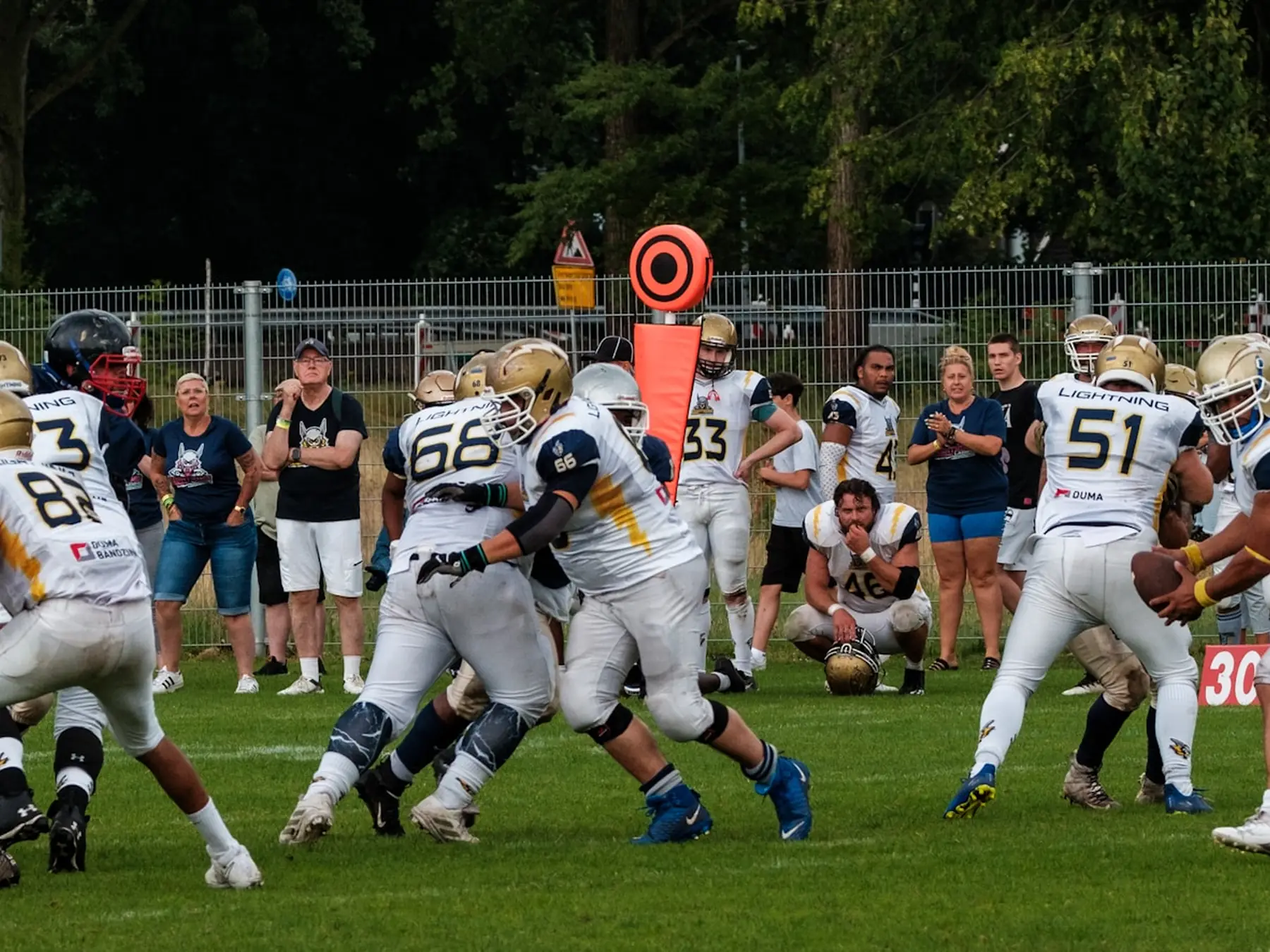
- The official chain crew traditionally uses two poles connected by a 10-yard chain to measure the line to gain.
- First-and-10 means the offense has a fresh set of downs and normally needs 10 yards.
- Second-and-short gives an offense different strategic options than second-and-long.
- Teams often punt on fourth down when they are too far from the end zone to risk giving the opponent good field position.
- A team can choose to attempt a fourth-down conversion instead of punting.
- If it fails to reach the line to gain on fourth down, the opponent normally takes possession at the dead-ball spot.
- Modern analytics have encouraged NFL teams to attempt more fourth-down conversions in some situations.
- Distance, score, field position, time remaining, opponent strength, and timeout availability all affect fourth-down decisions.
- A quarterback sneak is a short-yardage play in which the quarterback immediately drives forward after the snap.
- The down system is one of the clearest differences between American football and sports such as soccer or rugby.
How football scoring works
- A touchdown is worth six points.
- A touchdown occurs when a player establishes possession of a live ball in the opponent’s end zone under the rules.
- After a touchdown, the scoring team gets a try for additional points.
- An NFL extra-point kick is worth one point.
- An NFL two-point conversion is worth two points.
- A field goal is worth three points.
- A successful field goal sends the kicked ball over the crossbar and between the uprights.
- A safety is normally worth two points.
- Safeties commonly occur when an offensive ball carrier is downed in that team’s own end zone.
- After a safety, the team that conceded the safety must put the ball back into play for the opponent.
- An NFL game can end with unusual scores because touchdowns, kicks, safeties, and conversions combine in many ways.
- A team can score exactly one point on certain extremely rare conversion-play safeties.
- The one-point safety is so unusual that many longtime fans have never seen one in an NFL game.
- A defensive return of a turnover on a try can score two points in the NFL.
- Score combinations are one reason football produces final scores that look stranger than those in many other sports.
The forward pass changed the sport
- Early American football looked much more like rugby than the modern passing game.
- The legal forward pass was introduced into American football rules in 1906.
- The change followed a dangerous era of mass formations and serious injuries.
- The Pro Football Hall of Fame’s chronology lists 1906 as the year the forward pass was legalized.
- Early passing rules were more restrictive than modern rules.
- For decades, strategy continued to emphasize running much more heavily than today’s NFL does.
- A legal NFL forward pass must be thrown from behind the line of scrimmage.
- Only one forward pass can be thrown during a down.
- A backward pass, commonly called a lateral, follows different rules from a forward pass.
- An incomplete forward pass normally stops the game clock.
- An incomplete backward pass is generally a live fumble rather than a harmless incompletion.
- Eligible receivers include specified offensive positions and players who line up in eligible locations.
- Most offensive linemen are ineligible to catch ordinary forward passes unless they properly report eligible in situations allowed by NFL rules.
- Pass interference rules restrict certain contact while the ball is in the air.
- Legalizing the forward pass eventually transformed football into a game where open space and downfield passing became central strategy.
Football positions are highly specialized
- The quarterback directs most offensive plays and usually handles the ball after the snap.
- Running backs carry the ball, catch passes, and help protect the quarterback.
- Wide receivers specialize in running pass routes and catching downfield throws.
- Tight ends combine receiving duties with blocking responsibilities.
- The center snaps the ball to begin most offensive plays.
- Guards line up beside the center.
- Offensive tackles line up outside the guards.
- Offensive linemen protect the passer and create running lanes.
- Defensive tackles and defensive ends make up the defensive line in many formations.
- Linebackers can defend runs, rush the passer, or cover receivers.
- Cornerbacks usually cover wide receivers and defend passes near the sidelines.
- Safeties line up deeper and help defend passes and runs.
- Kickers specialize in field goals, extra points, and sometimes kickoffs.
- Punters specialize in kicking the ball away strategically on fourth down.
- Long snappers are specialists whose main job is delivering accurate long snaps on punts and placekicks.
Football equipment is engineered for impact
- An American football is a prolate spheroid rather than a perfect sphere.
- Its pointed ends help make spiral passing possible.
- Throwing a tight spiral stabilizes the ball through angular momentum.
- NFL footballs are traditionally made with a leather outer cover.
- The laces help quarterbacks grip and control the ball.
- Helmets are designed to reduce certain impact forces but cannot eliminate concussion risk.
- A modern helmet contains a hard shell and energy-managing interior components.
- Facemasks protect the face while trying to preserve visibility.
- Mouthguards protect teeth and oral tissues.
- Shoulder pads spread and absorb some impact forces.
- Players also use thigh, knee, hip, and tailbone padding.
- Cleats are selected for traction on natural grass or synthetic surfaces.
- Gloves can improve grip for receivers and other players.
- Equipment standards change as researchers learn more about biomechanics and injury prevention.
- No protective equipment makes high-speed collision sports risk-free.
From college game to NFL
- Rutgers and Princeton played an influential intercollegiate football game on November 6, 1869.
- That 1869 game used rules that looked much more like association football than the modern NFL game.
- Walter Camp became one of the most important architects of American football rules.
- Camp helped establish the line of scrimmage and the system of downs.
- Professional football teams developed in the late 19th and early 20th centuries.
- The organization that became the NFL was founded in 1920 as the American Professional Football Association.
- It changed its name to the National Football League in 1922.
- The NFL held its first scheduled championship game after the 1933 season.
- The NFL and rival American Football League agreed to merge in the 1960s.
- The first game later called the Super Bowl was played in January 1967.
- The Green Bay Packers defeated the Kansas City Chiefs in that first AFL-NFL championship game.
- The name “Super Bowl” was not the original official title of the first game.
- The NFL-AFL merger was fully completed for the 1970 season.
- The Pro Football Hall of Fame maintains an extensive chronology of professional football.
- Modern football rules are the product of more than a century of continuous change rather than one inventor’s finished design.
Strategy, clocks, and tiny details fans love
- The play clock limits how long an offense has to start the next play.
- The game clock and play clock are separate clocks with different jobs.
- Teams use timeouts to stop the game clock and manage strategy.
- Clock management can decide games even when no player gains or loses a yard.
- A quarterback can intentionally spike the ball immediately after the snap to stop the clock if the play meets the rule requirements.
- Kneeling with the ball is a legal way to keep the clock moving late in a game when the offense can safely run out the remaining time.
- Motion before the snap can help reveal whether a defense is playing man or zone coverage.
- Play-action passes imitate running plays to influence defenders before the quarterback throws.
- A screen pass invites defenders upfield before throwing a short pass behind them.
- A blitz sends extra defenders after the quarterback at the cost of leaving fewer players in coverage.
- Zone defense assigns defenders to areas rather than exclusively to individual receivers.
- Man coverage assigns defenders primarily to specific eligible receivers.
- Offenses disguise intentions with formations, shifts, motions, fake handoffs, and route combinations.
- Defenses disguise blitzes and coverages for exactly the same reason.
- At its highest level, football is as much a contest of information and deception as speed and strength.
Ten surprising American football facts
- The yellow first-down line on television does not exist on the actual field.
- The full NFL field is 120 yards long even though everyone casually calls it a 100-yard field.
- The forward pass was once illegal.
- An incomplete lateral can become a live loose ball even when an incomplete forward pass simply ends the play.
- Football has a legal one-point safety scenario, even though it is exceptionally rare.
- A long snapper can spend an NFL career mastering one of the most specialized movements in professional sports.
- The game’s earliest famous college matchup would look unfamiliar to a modern football fan.
- The first Super Bowl was not originally marketed simply as “Super Bowl I.”
- Rule changes continue every year, so current-rule facts should always be checked against the latest official NFL rulebook.
- For more sports trivia, explore our soccer facts, basketball facts, and Random facts.
Quick American football FAQ
How many players are on the field for one NFL team?
Eleven players per team can participate in a normal play, meaning up to 22 players are on the field at once.
How long is an NFL field?
The space between goal lines is 100 yards, plus two 10-yard end zones. The full playing field is therefore 120 yards long and 53⅓ yards wide.
How many points is a touchdown?
Six points. The scoring team then gets a try for either a one-point kick or a two-point offensive conversion.
When was the forward pass legalized?
American football legalized the forward pass in 1906, although early rules were much more restrictive than modern passing rules.
When did the NFL begin?
The league began in 1920 as the American Professional Football Association and adopted the National Football League name in 1922.

Ellie is the owner and sole author of Fun Facts, combining her mechanical engineering background with years of research-driven writing to deliver facts you can trust. Every article is thoroughly fact-checked and routinely updated as new science and sources emerge to keep information accurate and current. Her mission is to make learning delightful while upholding high standards of reliability and transparency.