
Pretzels are bread that took one dramatic twist and built an identity around it. The dough is simple, but an alkaline bath before baking changes the crust so completely that a pretzel tastes nothing like an ordinary roll.
Pretzels are shaped yeast breads with an alkaline crust
- Traditional soft pretzels are yeast-leavened breads.
- The dough usually contains flour, water, yeast, and salt.
- Some recipes add butter or sugar.
- Pretzel dough is typically firmer than sandwich-bread dough.
- Strong gluten helps the strands hold their shape.
- The classic pretzel shape uses a long rope of dough.
- The ends cross before being attached to the lower curve.
- Different bakeries use slightly different twists.
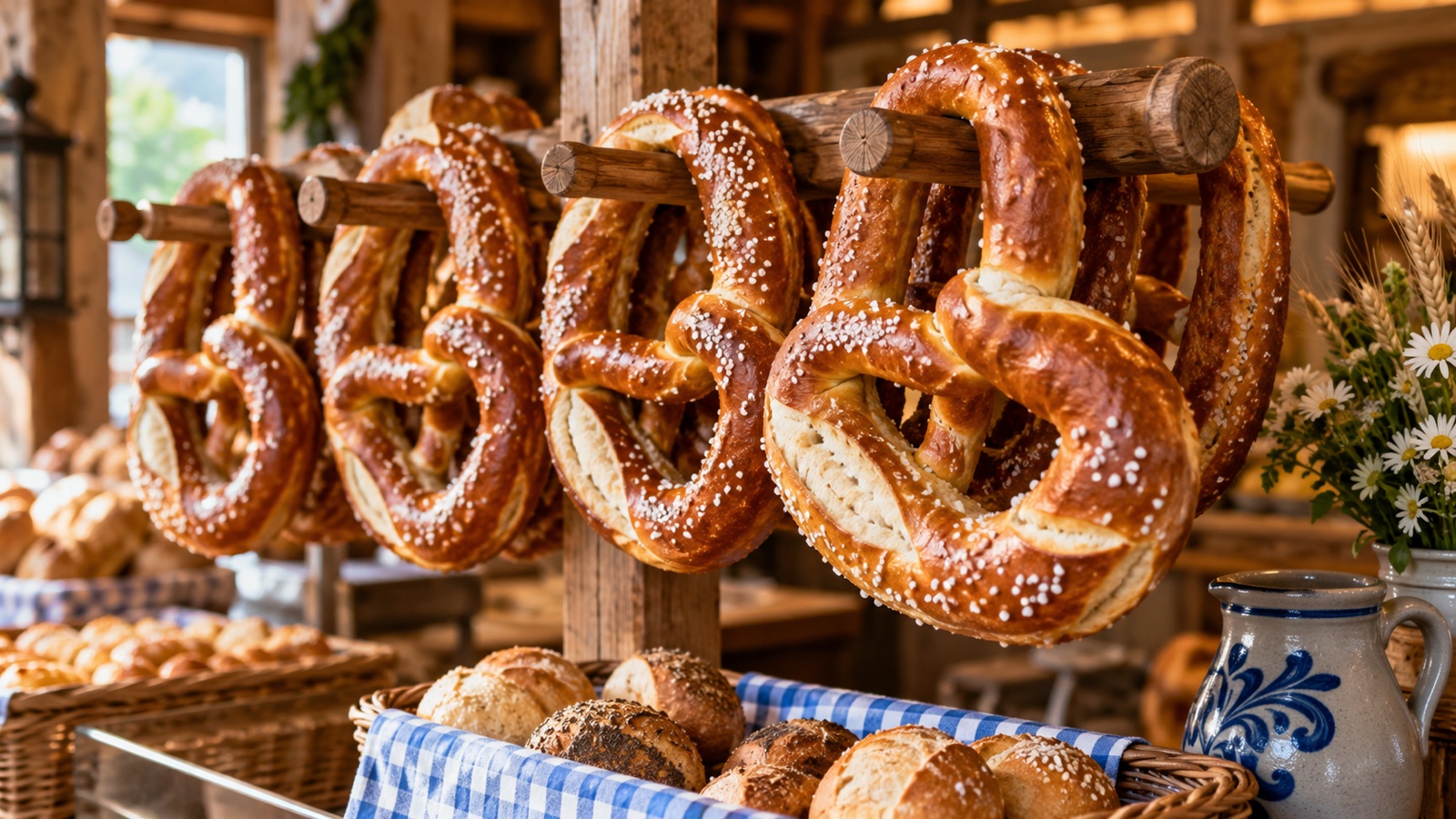
- Some German pretzels have thick bellies and thin arms.
- American mall pretzels are often more uniform.
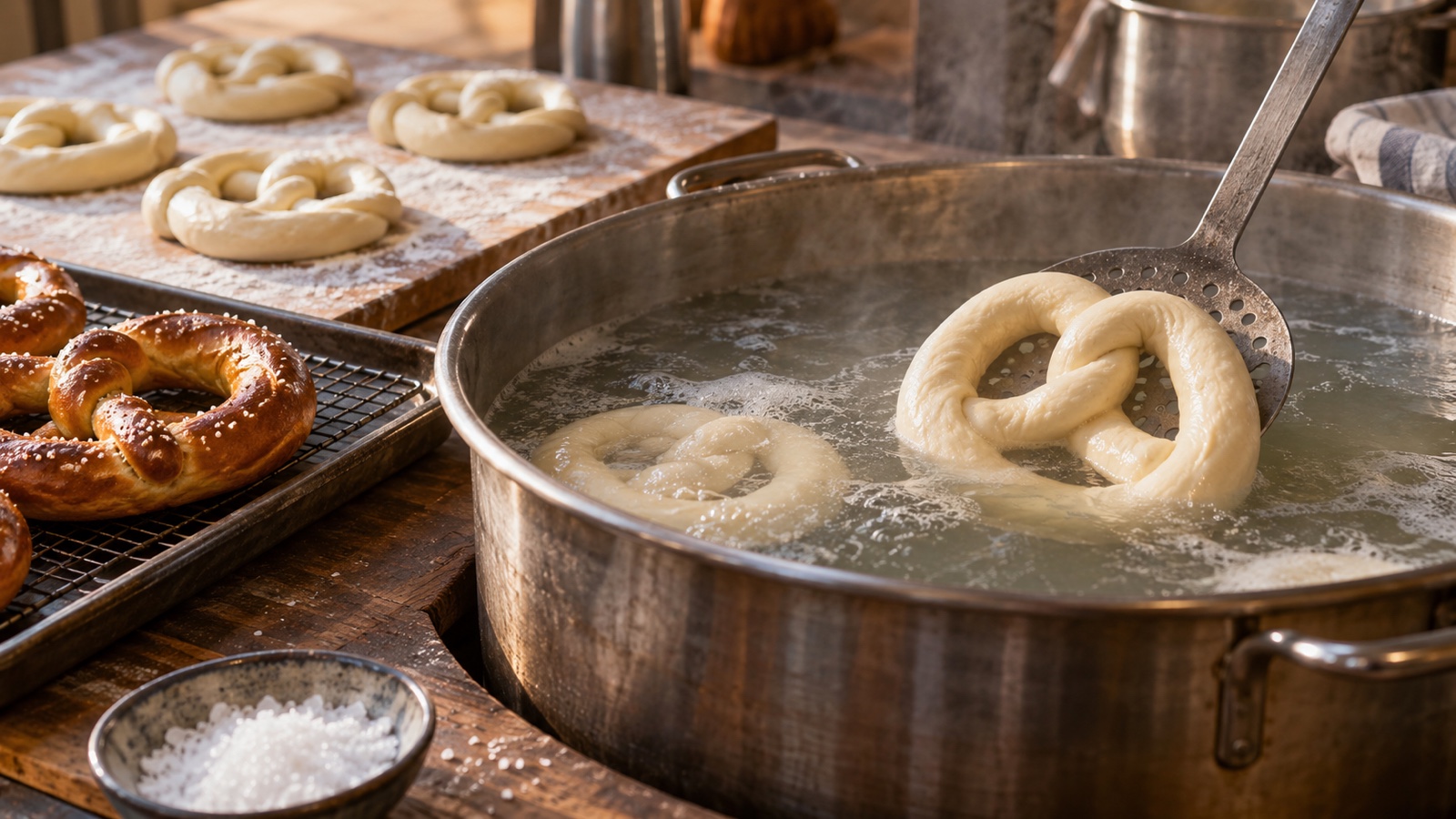
- The shaped dough is dipped before baking.
- Traditional professional pretzels use a food-grade lye solution.
- Lye is sodium hydroxide.
- The dip is brief.
- It changes chemistry mainly at the surface.
- Baking soda is a milder home-kitchen alternative.
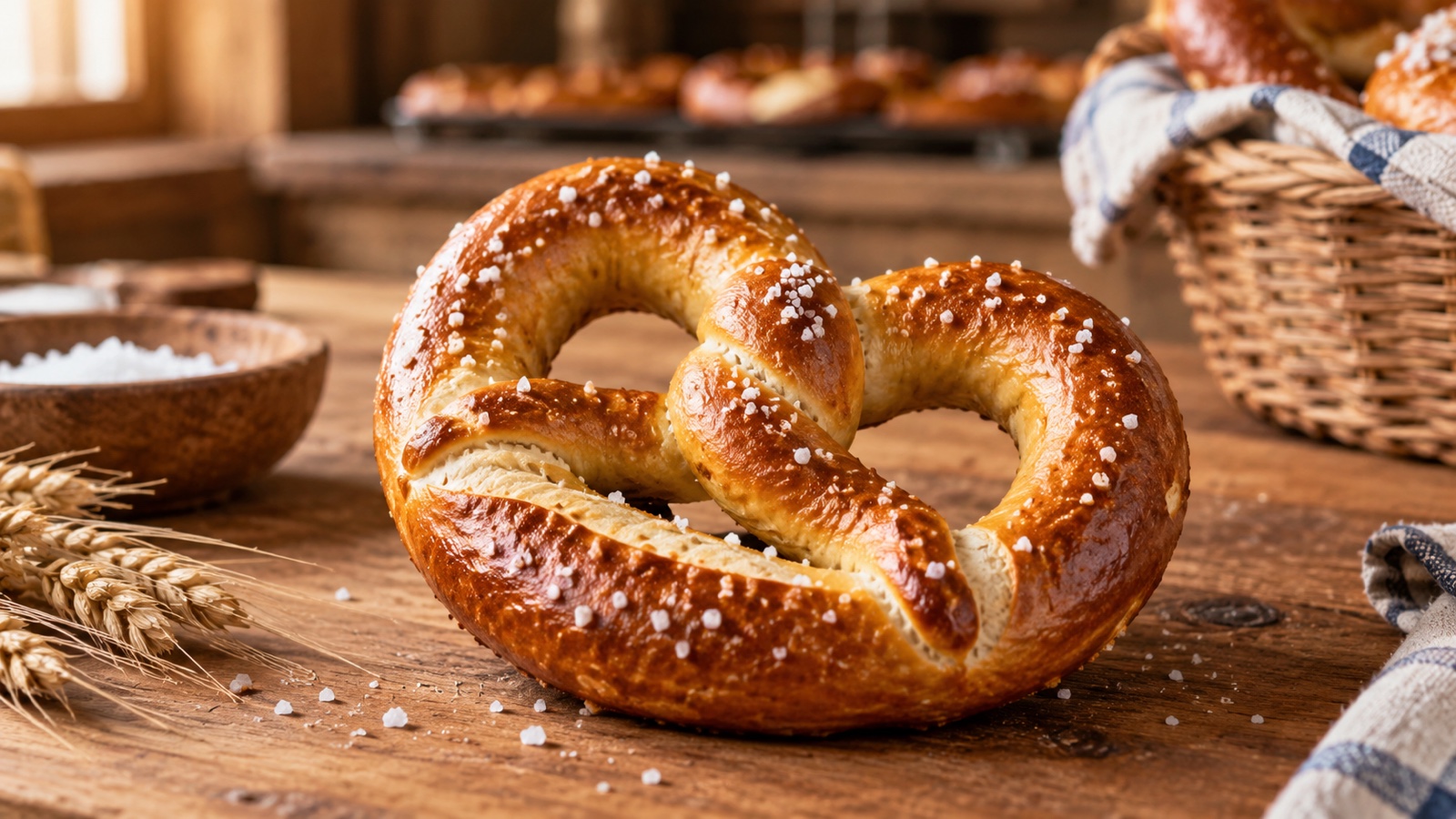
- The alkaline surface browns rapidly in the oven.
- This creates the dark mahogany crust.
- Coarse salt is usually added before baking.
- Pretzel flavor is ordinary bread chemistry after the surface gets an extremely unusual spa treatment.
The lye bath is the secret to the classic crust
- Lye raises the pH of the pretzel surface.
- High pH accelerates Maillard browning.
- Maillard reactions create roasted aromas and dark color.
- The alkaline bath also gelatinizes some surface starch.
- This contributes to the glossy crust.
- The inside remains much closer to ordinary bread chemistry.
- Food-grade lye must be handled carefully before baking.
- Raw lye solution can cause chemical burns.
- Proper baking converts and neutralizes much of the reactive surface chemistry.
- Baking soda is safer but produces a lighter crust.
- Baking baking soda first can make it more alkaline.
- This produces stronger pretzel character at home.
- Boiling pretzels is different from a lye dip.
- Bagels are typically boiled in water.
- Pretzels are traditionally dipped in alkaline solution.
- Egg wash is not required for traditional color.
- Some recipes use it anyway for shine.
- Steam inside the dough keeps the crumb soft.
- The thin arms bake crisper than the thick center.
- A pretzel's signature flavor lives mostly in a paper-thin chemical zone on the outside.
Pretzel history is strongly tied to central Europe
- Pretzels have centuries of history in Europe.
- Germany is especially famous for pretzel traditions.
- The German word Brezel refers to the bread.
- Southern Germany has especially strong pretzel culture.
- Austria and Switzerland also have regional versions.
- Pretzel origins are surrounded by legends.
- One popular story credits medieval monks.
- The exact origin of the shape is uncertain.
- Pretzels became associated with bakers' guilds.
- The twisted form appears in historic bakery symbols.
- Pretzels were also associated with Lent in Christian Europe.
- Simple flour-and-water dough fit fasting rules in some periods.
- German immigrants brought pretzel traditions to Pennsylvania.
- Pennsylvania became a major U.S. pretzel center.
- Pennsylvania Dutch communities helped popularize them.
- Large commercial pretzel bakeries developed there.
- Both soft and hard pretzels became popular in America.
- Philadelphia developed a particularly strong soft-pretzel culture.
- Street pretzels became a familiar urban snack.
- Pretzel history contains enough uncertain origin stories that the bread itself is less twisted than the folklore.
Hard pretzels are baked much drier than soft ones
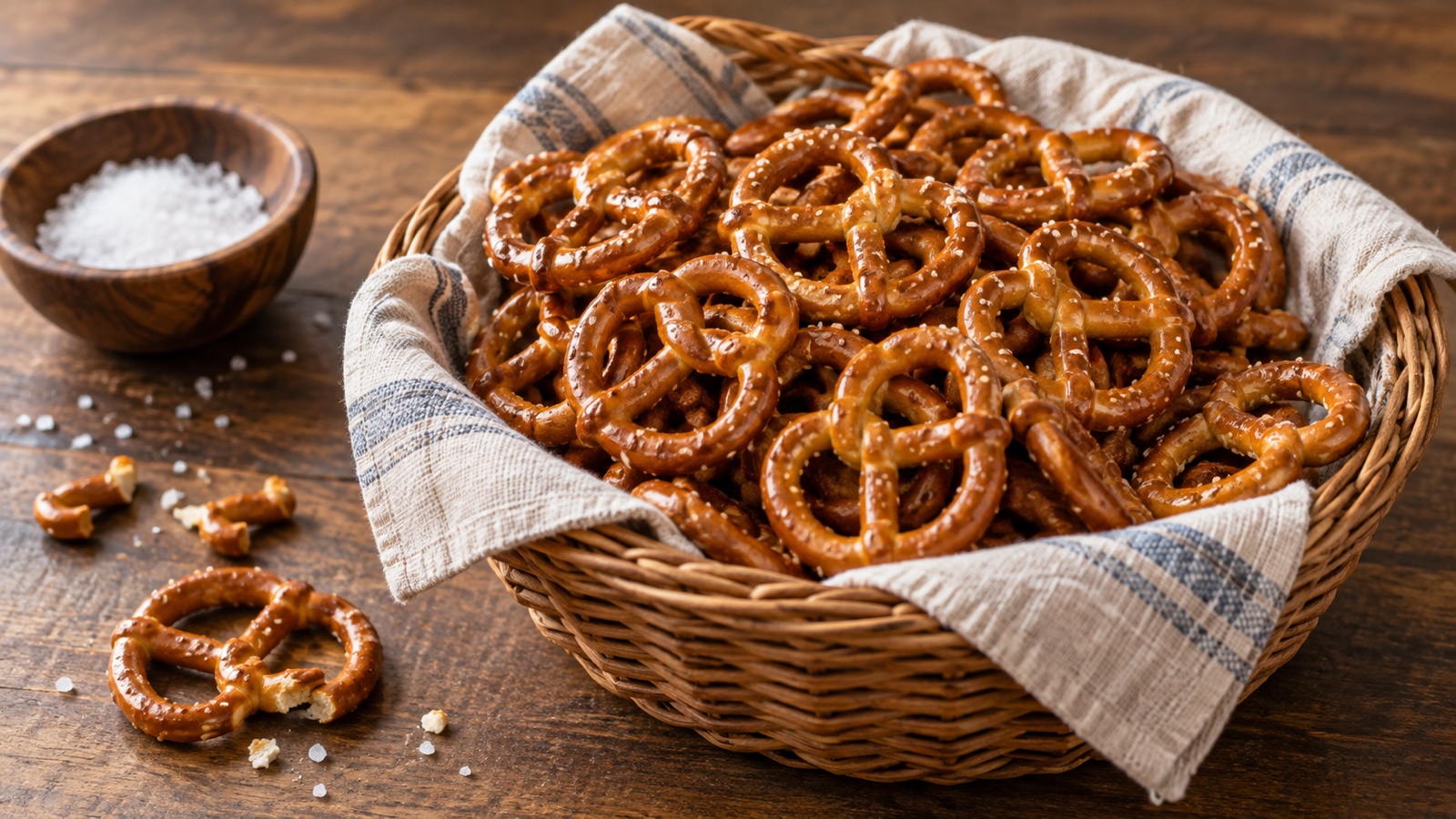
- Hard pretzels contain far less moisture than soft pretzels.
- Low moisture makes them shelf stable.
- They are baked until crisp throughout.
- Hard pretzels can be sticks, twists, rods, or nuggets.
- Pretzel sticks eliminate the traditional loop shape entirely.
- Pretzel rods are thicker than sticks.
- Nuggets are short bite-size pieces.
- Filled pretzel nuggets can contain peanut butter or cheese.
- Hard pretzels are commonly packaged as snacks.
- Salt helps flavor and preserve them.
- Moisture is the main enemy of crispness.
- Open bags absorb humidity.
- Stale pretzels become less brittle.
- Reheating can drive off some absorbed moisture.
- Chocolate-covered pretzels combine salt and sweetness.
- Yogurt-coated pretzels usually use a sweet confectionery coating.
- Seasoned pretzels can include mustard, ranch, garlic, or spice powders.
- Broken pretzel pieces are intentionally sold by some brands.
- More broken surface means more seasoning can stick.
- Hard pretzels are what happens when a bread snack decides moisture is optional.
Soft pretzels are best eaten fresh
- Soft pretzels contain much more water than hard pretzels.
- They stale like other breads.
- Freshness declines noticeably within hours.
- Warm pretzels have softer crumb and stronger aroma.
- Cooling firms the starch structure.
- Reheating temporarily reverses some staling.
- Ovens restore crust better than microwaves.
- Microwaves can make soft pretzels chewy or rubbery if overheated.
- Freezing works well for longer storage.
- Pretzels should cool before freezing.
- Frozen soft pretzels can be reheated directly.
- A light mist of water helps restore surface texture.
- Extra salt can be added before reheating.
- Mustard is a classic pretzel condiment.
- Sweet mustard is common in parts of Germany.
- Cheese sauce is popular in the United States.
- Cinnamon sugar turns soft pretzels into dessert.
- Garlic butter creates a savory variation.
- Pretzel buns use similar dough for sandwiches.
- A soft pretzel is one of those foods that loses half its charm during the drive home, which feels unfair but chemically predictable.
The shape carries cultural symbolism
- The pretzel shape has been interpreted in several symbolic ways.
- One tradition compares the loops with arms crossed in prayer.
- Another links the three openings with Christian symbolism.
- These interpretations are historic traditions rather than proven origin stories.
- Pretzels appear on European bakery signs.
- The shape became a symbol of the baking profession.
- New Year's pretzels are traditional in some German-speaking communities.
- Large sweet pretzels can symbolize luck.
- Pretzels also appear at Oktoberfest celebrations.
- Large Bavarian pretzels pair with beer and sausages.
- Salt encourages thirst, which is convenient at beer festivals.
- Unsalted pretzels are also available.
- Pretzel necklaces are sometimes worn at beer festivals.
- Small hard pretzels can be threaded onto string.
- The edible necklace doubles as a snack.
- Pretzel shapes appear in logos and jewelry.
- The loops are recognizable even without color or texture.
- A simplified pretzel silhouette can identify the food instantly.
- Few breads have a shape famous enough to work as a standalone icon.
- The pretzel managed to turn a dough-knot into branding centuries before anyone used that word.
Nutrition, variations and 25 final pretzel facts
- Pretzels are primarily a carbohydrate food.
- Traditional lean pretzels are relatively low in fat.
- Butter toppings increase fat substantially.
- Coarse salt can make sodium high.
- Unsalted versions lower sodium.
- Whole-grain pretzels provide more fiber.
- Gluten-free pretzels use alternative flours and starches.
- Cheese-filled pretzels add protein and fat.
- Sweet pretzels can contain large amounts of sugar.
- Soft pretzel size varies enormously.
- A giant stadium pretzel can equal several bread servings.
- Pretzel bites increase crust-to-crumb ratio.
- Mini pretzels increase surface area relative to mass.
- More surface means more salt can stick.
- Sourdough pretzels use fermented starter.
- Rye flour can add darker flavor.
- Whole-wheat dough makes a heartier pretzel.
- Pretzel croissants combine laminated pastry with pretzel-style treatment.
- Pretzel bagels combine two boiling-and-baking traditions.
- Chocolate and caramel both pair well with pretzel saltiness.
- Crushed hard pretzels can replace breadcrumbs in coatings.
- They can also form pie crusts.
- Pretzel salt uses large flat crystals that adhere well.
- Fine table salt dissolves faster and gives a different texture.
- After 145 facts, pretzels feel less like twisted bread and more like alkaline chemistry, migration history, geometry, snack engineering, and an excuse to keep mustard nearby.

Ellie is the owner and sole author of Fun Facts, combining her mechanical engineering background with years of research-driven writing to deliver facts you can trust. Every article is thoroughly fact-checked and routinely updated as new science and sources emerge to keep information accurate and current. Her mission is to make learning delightful while upholding high standards of reliability and transparency.