
Vermont looks almost suspiciously good in autumn, but leaf color is only the opening act. The state has Green Mountains, maple sugarhouses, tiny towns, independent-republic history, covered bridges, dairy farms, ski trails, Ben & Jerry’s, and a political tradition where local meetings can still matter enormously.
Vermont basics from the Green Mountain State
- Vermont became the 14th U.S. state on March 4, 1791.
- It was the first state admitted after the original 13.
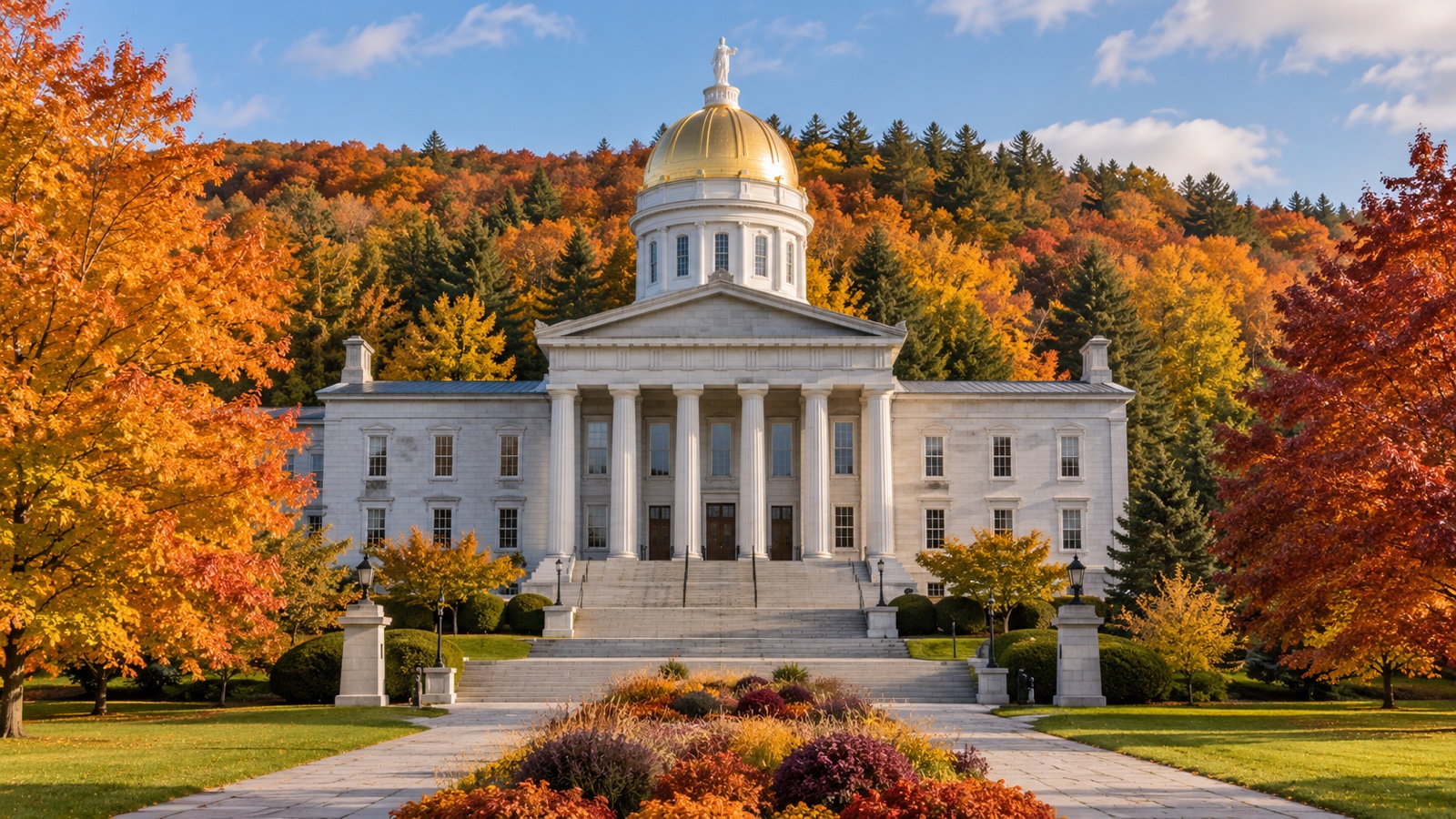
- Montpelier is the state capital.
- Montpelier is the least populous U.S. state capital.
- Burlington is Vermont’s largest city.
- Vermont has 14 counties.
- The postal abbreviation is VT.
- The official nickname is the Green Mountain State.
- The name Vermont comes from French words meaning “green mountain.”
- Vermont borders Massachusetts, New Hampshire, New York, and Quebec, Canada.
- It is one of the six New England states.
- Vermont is the only New England state without Atlantic coastline.
- The entire state uses Eastern Time.
- The state motto is “Freedom and Unity.”
- Vermont is one of America’s least populous states.
- It is also one of the most rural.
- Mount Mansfield is Vermont’s highest point.
- It reaches 4,393 feet above sea level.
- Vermont has no billboard advertising along its highways under state law.
- That helps explain why road trips can feel more like scenery and less like a running argument with fast-food signs.
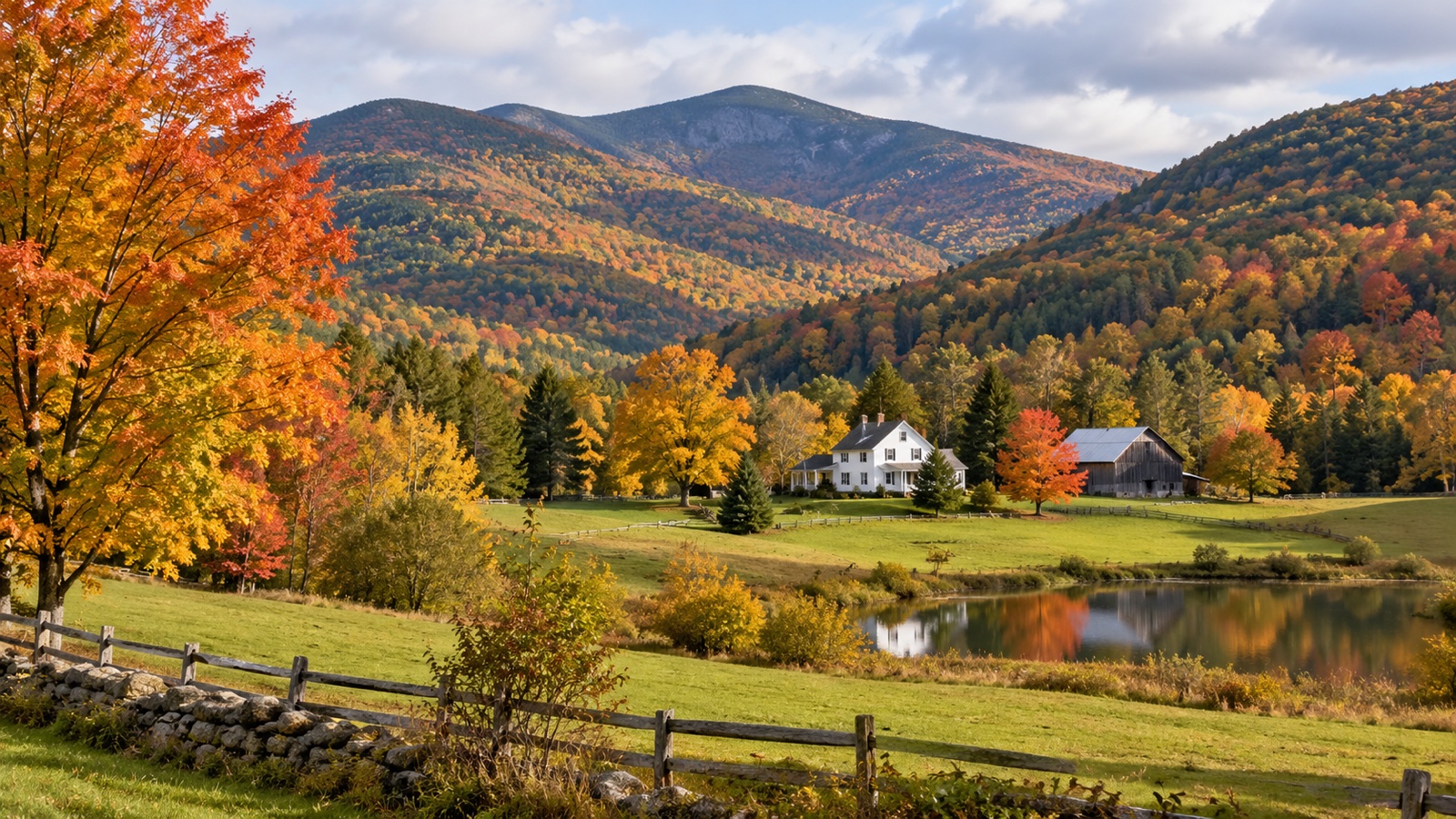
The Green Mountains shape almost everything
- The Green Mountains run north to south through much of Vermont.
- They are part of the Appalachian Mountain system.
- Mount Mansfield is the highest Green Mountain peak.
- Its long ridgeline resembles a human face when viewed from the east.
- Several summit features are named Forehead, Nose, Lips, Chin, and Adam’s Apple.
- The Long Trail follows the main Green Mountain ridge for more than 270 miles.
- It is the oldest long-distance hiking trail in the United States.
- Construction began in 1910.
- The Appalachian Trail shares part of the Long Trail in southern Vermont.
- Lake Champlain forms much of Vermont’s western boundary with New York.
- The lake stretches north into Quebec.
- Lake Champlain is one of the largest freshwater lakes in the United States by surface area.
- The Connecticut River forms most of Vermont’s eastern boundary with New Hampshire.
- The legal boundary generally follows the Vermont bank, placing most of the river in New Hampshire.
- Vermont’s Northeast Kingdom is a rural region in the state’s northeastern corner.
- The name “Northeast Kingdom” was popularized in the mid-20th century.
- Glacial activity shaped many Vermont valleys and lakes.
- Forests cover most of the state today.
- Much of that land had been cleared for farms during the 19th century before forests regrew.
- Vermont looks ancient and untouched in places where the stone walls quietly say, “Actually, this used to be a field.”
Vermont was an independent republic before statehood
- Abenaki peoples have deep connections with the land that is now Vermont.
- European colonial claims overlapped between New York and New Hampshire.
- Land grants issued by New Hampshire created major disputes with New York authorities.
- The Green Mountain Boys formed to resist New York land claims.
- Ethan Allen became their most famous leader.
- In 1775, the Green Mountain Boys helped capture Fort Ticonderoga in New York.
- Vermont declared itself independent in 1777.
- It operated as the Vermont Republic before joining the United States.
- The republic used its own constitution.
- Vermont’s 1777 constitution prohibited adult slavery under its wording, although the reality and enforcement were more complicated than the simple “first to abolish slavery” slogan suggests.
- The constitution also expanded voting rights beyond property-owning men compared with many contemporary governments.
- Vermont operated its own postal and governmental systems during independence.
- New York continued disputing Vermont’s status for years.
- A financial settlement helped resolve New York land claims.
- Vermont entered the Union in 1791.
- Its admission helped balance the number of free and slave states after Kentucky entered the following year.
- Ethan Allen’s name remains attached to schools, roads, monuments, and a furniture company founded much later.
- The Vermont Republic lasted about 14 years.
- Modern political groups occasionally invoke that independent history in state-identity debates.
- Vermont had a whole government before becoming a state, which is an unusually thorough application process.
Maple syrup is chemistry, forestry & breakfast
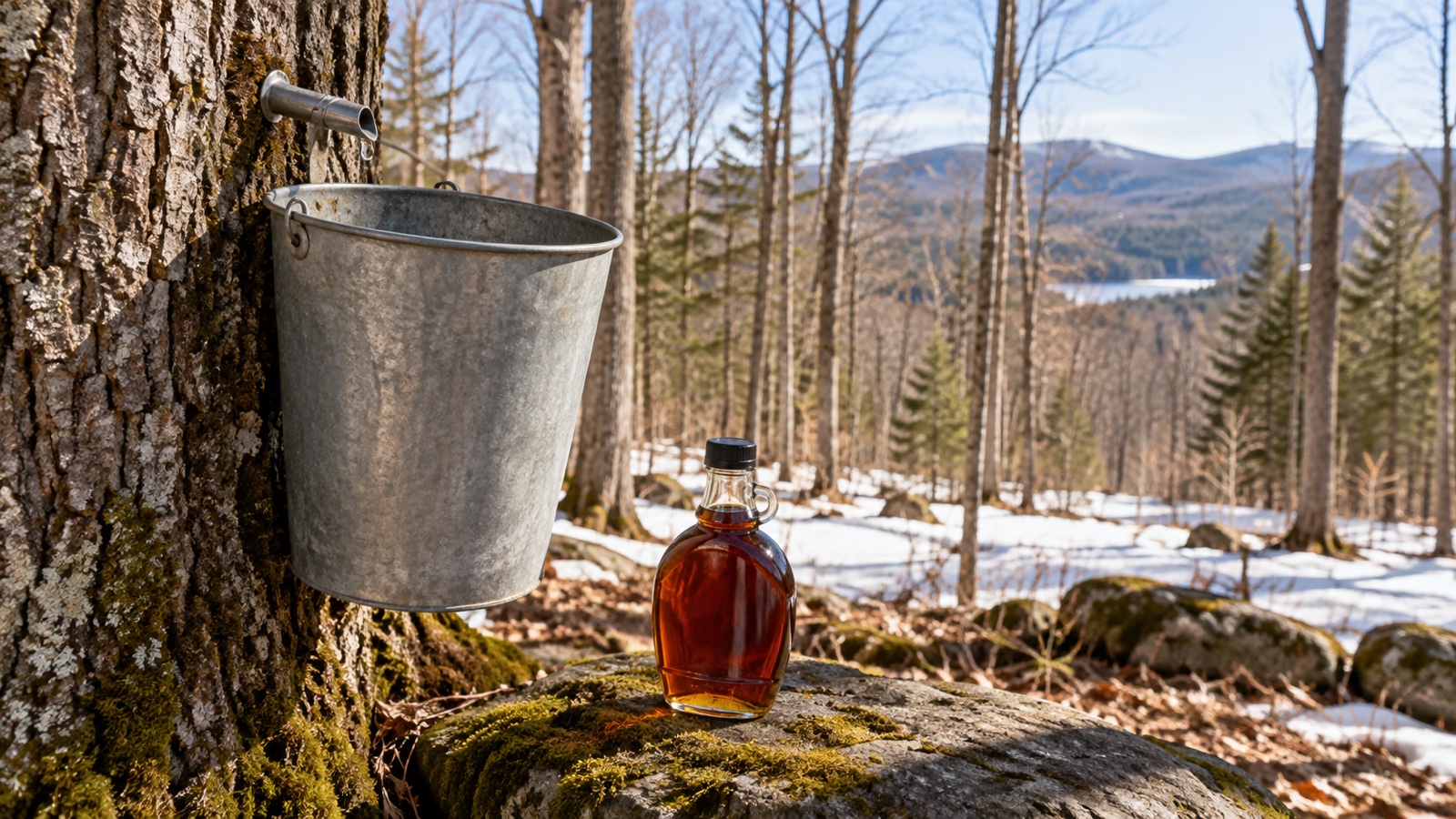
Vermont’s maple obsession makes much more sense once you watch sap season. Producers wait for freezing nights and warmer days, tap trees, collect what looks like nearly clear water, and boil away an astonishing amount of moisture until a gallon of amber syrup finally remains.
- Vermont is the leading U.S. producer of maple syrup.
- Sugar maples are especially valued for syrup production.
- Red maples can also produce usable sap.
- Maple sap is mostly water.
- Fresh sugar-maple sap often contains only a few percent sugar.
- Finished maple syrup contains far more concentrated sugar.
- It usually takes roughly 40 gallons of average-strength sap to make one gallon of syrup.
- The exact ratio changes with sap sugar content.
- Sap flows especially well during late-winter freeze-thaw cycles.
- Nights below freezing and days above freezing create useful pressure changes inside the tree.
- Traditional sugarmakers collected sap in buckets.
- Many modern sugarbushes use networks of plastic tubing.
- Vacuum systems can increase sap collection efficiency.
- Reverse-osmosis equipment can remove some water before boiling.
- That reduces the fuel needed in the evaporator.
- Maple syrup darkens and develops stronger flavor as the season progresses.
- U.S. grading now uses color and flavor descriptors rather than the older Vermont grade system.
- Pure maple syrup is different from pancake syrups based largely on corn syrup or other sweeteners.
- Maple sugar is made by concentrating syrup beyond the standard syrup stage.
- Vermont found a way to turn tree plumbing into a major culinary identity.
Covered bridges, town meetings & village Vermont
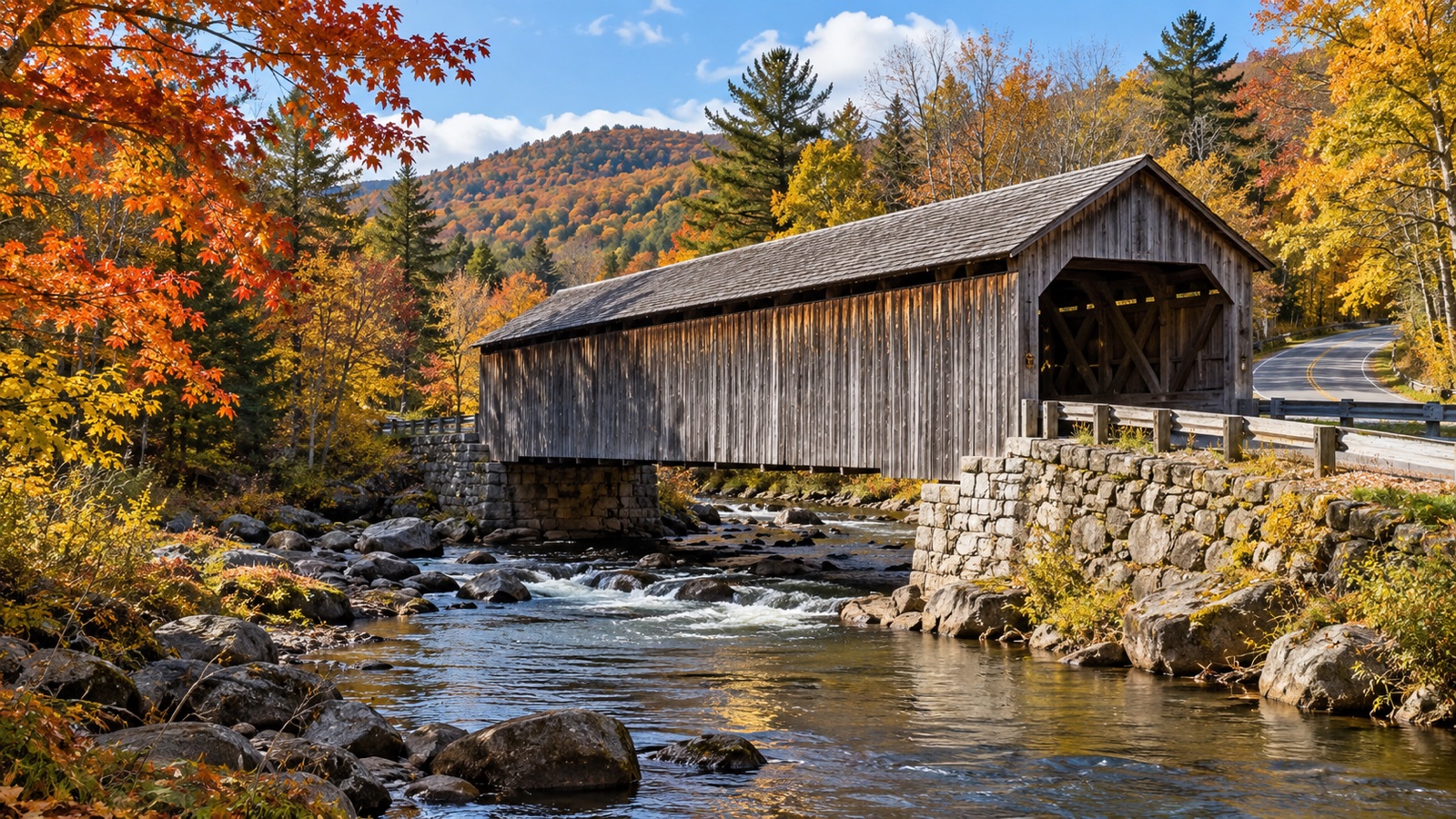
- Vermont preserves more than 100 historic covered bridges.
- Bridge roofs were built mainly to protect structural wood from weather.
- Covered bridges can last much longer than exposed wooden bridges.
- The Windsor-Cornish Covered Bridge crosses from Vermont into New Hampshire.
- It is one of the longest wooden covered bridges in the United States.
- Woodstock is known for historic architecture and a classic village center.
- Stowe sits near Mount Mansfield and is a major four-season resort community.
- Manchester is known for historic inns, shopping, and nearby mountain scenery.
- Vermont towns traditionally use town meetings for local government decisions.
- Town Meeting Day is held in March.
- Some communities still gather in person to debate budgets and local issues.
- Other towns use Australian-ballot voting for some or all decisions.
- Vermont’s local-government structure gives towns considerable importance.
- Small village greens often sit near churches, town halls, or historic homes.
- Church steeples became iconic parts of Vermont village landscapes.
- General stores still function as social centers in some small towns.
- Rural post offices and libraries are important community institutions.
- Vermont banned roadside billboards in 1968.
- The ban contributes to unusually uncluttered highway views.
- A Vermont road sign mostly has to compete with mountains, which is a tough advertising market anyway.
Dairy farms, skiing & Vermont-made brands
Vermont has managed to make cows, ski lifts, ice cream, cheddar, flannel-adjacent aesthetics, and artisanal everything feel like one coherent economy. Tourism matters, but so do farms, food producers, colleges, forestry, manufacturing, and plenty of businesses that never put a barn on the label.
- Dairy farming has been central to Vermont agriculture for generations.
- Holstein cows are common on Vermont dairy farms.
- Milk production supports cheese, yogurt, butter, and other food businesses.
- Vermont cheddar became a nationally recognized regional product.
- Cabot Creamery is a farmer-owned cooperative with Vermont roots.
- Ben & Jerry’s was founded in Burlington in 1978.
- Ben Cohen and Jerry Greenfield opened their first shop in a renovated gas station.
- The company’s factory in Waterbury became a major visitor attraction.
- The Flavor Graveyard commemorates discontinued ice cream flavors.
- Vermont has a long skiing history.
- Stowe, Killington, Sugarbush, Jay Peak, and Mount Snow are major ski areas.
- Killington has one of the largest ski areas in the eastern United States.
- Snowmaking is important because natural snowfall varies through the season.
- Nordic skiing and snowshoeing are also popular.
- Burton Snowboards was founded in Vermont during snowboarding’s early growth.
- Jake Burton Carpenter helped popularize modern snowboarding.
- The company was long headquartered in Burlington.
- Vermont’s craft-beer industry is unusually prominent for the state’s small population.
- Several Vermont breweries became nationally influential in hoppy and farmhouse beer styles.
- Apparently cold winters are easier when the state keeps inventing things to eat, drink, or slide downhill on.
Famous Vermonters & 25 final Green Mountain facts
- Calvin Coolidge was born in Plymouth Notch, Vermont.
- Coolidge took the presidential oath of office there in 1923 after Warren Harding died.
- His father, a notary public, administered the oath in the family home.
- Chester A. Arthur was also born in Vermont.
- Arthur became the 21st U.S. president.
- John Deere was born in Rutland, Vermont.
- He later moved west and developed the steel plow business bearing his name.
- Joseph Smith, founder of the Latter Day Saint movement, was born in Sharon, Vermont.
- Rudyard Kipling lived for several years in Dummerston.
- Kipling wrote “The Jungle Book” while living in Vermont.
- Poet Robert Frost lived in Vermont during important later years.
- His former farm in Ripton became associated with the Bread Loaf School of English.
- The University of Vermont is in Burlington.
- UVM was chartered in 1791, the same year Vermont entered the Union.
- Middlebury College was founded in 1800.
- The state bird is the hermit thrush.
- The state flower is red clover.
- The state tree is the sugar maple.
- The Morgan horse is Vermont’s state animal.
- The Morgan breed traces to a stallion owned by Vermont teacher and horseman Justin Morgan.
- Lake Champlain folklore includes a lake monster nicknamed Champ.
- No scientific evidence confirms a large unknown monster living in the lake.
- Champ remains a cheerful local legend and sports mascot inspiration anyway.
- Vermont was the first state to establish civil unions for same-sex couples through legislation in 2000.
- After 145 facts, Vermont still seems like a state determined to prove rural, progressive, historic, snowy, and extremely maple-flavored can coexist.
Quick FAQ
Q: What is Vermont famous for?
A: Maple syrup, Green Mountains, fall foliage, covered bridges, skiing, dairy farms, Ben & Jerry’s, small towns, and its history as an independent republic.
Q: What is the capital of Vermont?
A: Montpelier is the capital, while Burlington is the largest city.
Q: Was Vermont once its own country?
A: Yes. Vermont operated as an independent republic from 1777 until it joined the United States in 1791.
Q: Does Vermont make the most maple syrup in the U.S.?
A: Yes. Vermont is consistently the leading U.S. maple-syrup producer.
Q: Why is Vermont called the Green Mountain State?
A: The Green Mountains run through much of the state, and the name Vermont itself comes from French words meaning “green mountain.”

Ellie is the owner and sole author of Fun Facts, combining her mechanical engineering background with years of research-driven writing to deliver facts you can trust. Every article is thoroughly fact-checked and routinely updated as new science and sources emerge to keep information accurate and current. Her mission is to make learning delightful while upholding high standards of reliability and transparency.