
Narwhals are real whales carrying a spiral tooth through Arctic sea ice, which already sounds like folklore before the biology starts. They dive more than a mile deep, hunt in darkness with echolocation, migrate through ice-choked seas, communicate in clicks and whistles, and once supplied European “unicorn horns” to people who had absolutely no idea what they bought.
Narwhals are Arctic toothed whales
- The narwhal's scientific name is Monodon monoceros.
- Narwhals are toothed whales.
- They belong to the family Monodontidae.
- The beluga whale is their closest living relative.
- Narwhals live naturally in Arctic waters.
- Major populations occur around Canada and Greenland.
- They also occur in waters near Svalbard and parts of the Russian Arctic.
- Narwhals rarely travel far south compared with many whale species.
- Adult males are generally larger than females.
- Adults commonly measure around 13 to 16 feet long excluding the tusk.
- They can weigh more than 3,000 pounds.
- The body is mottled gray, black, and white.
- Young calves are darker.
- Older animals become increasingly pale.
- Very old males can appear nearly white.
- Narwhals lack a tall dorsal fin.
- A low dorsal ridge runs along the back instead.
- The lack of a large fin may help movement beneath sea ice.
- A thick blubber layer insulates the body.
- Calling a narwhal a sea unicorn is understandable, but the actual phrase “deep-diving Arctic whale with a giant sensory tooth” is arguably better.
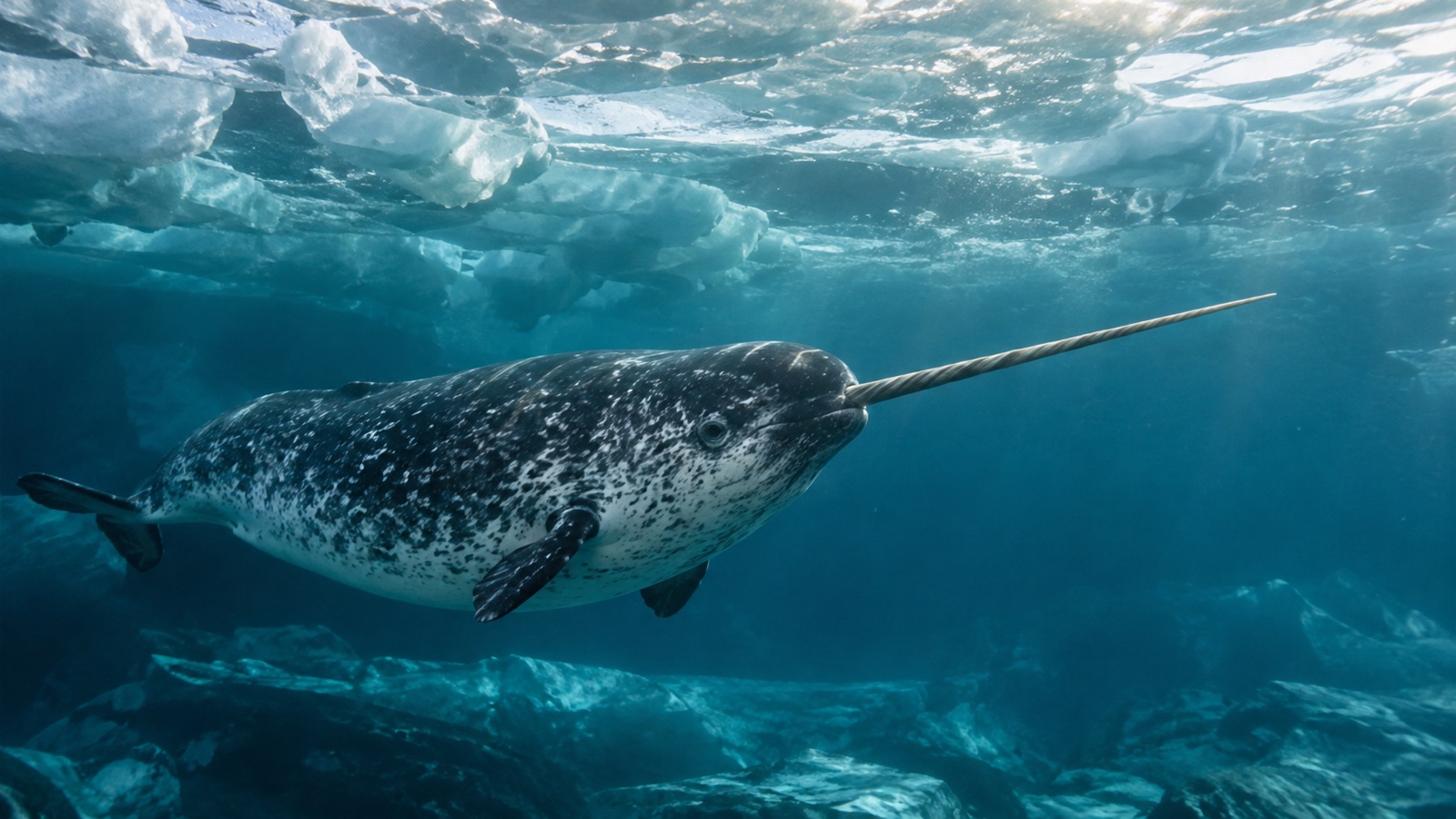
The famous tusk is an extraordinary tooth
- The narwhal tusk is an elongated canine tooth.
- It usually grows from the left side of the upper jaw.
- Most adult males develop a visible tusk.
- Some females also grow tusks.
- A small number of males grow two tusks.
- The tusk can reach roughly 8 to 10 feet in exceptional animals.
- It grows in a left-handed spiral.
- The spiral pattern does not mean the tooth is hollow like a drill bit.
- The tusk contains dentin and other normal tooth tissues.
- Its outer surface has microscopic channels and nerve connections.
- The tusk is richly innervated.
- Experiments suggest it can detect changes in the surrounding environment.
- Possible sensory roles include detecting salinity or other water conditions.
- The exact importance of sensory function in daily life remains under study.
- Males sometimes rub or cross tusks in a behavior called tusking.
- Tusking may serve social, display, maintenance, or sensory roles.
- The tusk can also function in male competition.
- Researchers have documented males striking fish with tusks before capturing them.
- That does not mean spearing fish is the tusk's sole or primary function.
- Narwhal tusk biology is much more interesting once you stop forcing one simple answer onto a ten-foot tooth.
Medieval Europeans sold tusks as unicorn horns
- Narwhal tusks entered European trade centuries ago.
- Many Europeans did not know their true animal source.
- Tusks were sold or displayed as supposed unicorn horns.
- Unicorn horns were often called alicorns.
- They were believed to possess magical or medicinal powers.
- Some people thought a unicorn horn could detect or neutralize poison.
- Royal collections valued narwhal tusks enormously.
- Complete tusks could sell for extraordinary sums.
- One narwhal tusk became part of the British royal regalia as the so-called Unicorn Horn.
- Other tusks were carved into ceremonial objects.
- Knowledge of narwhals gradually spread through Arctic exploration and natural history.
- European scientists eventually understood that the “horn” was a whale tooth.
- The revelation did not immediately erase centuries of unicorn folklore.
- Inuit peoples already had direct knowledge of narwhals as real Arctic animals.
- European confusion reflected distance from the habitat rather than mystery to the people living there.
- Narwhal ivory remained valuable after the unicorn explanation disappeared.
- Modern international trade is regulated.
- Harvest and export rules vary among Arctic jurisdictions.
- Legal Indigenous subsistence use should not be confused with illegal wildlife trafficking.
- The funniest part of the unicorn story is not that people believed in unicorns; it is that real Arctic whale anatomy was apparently too weird to be the obvious explanation.
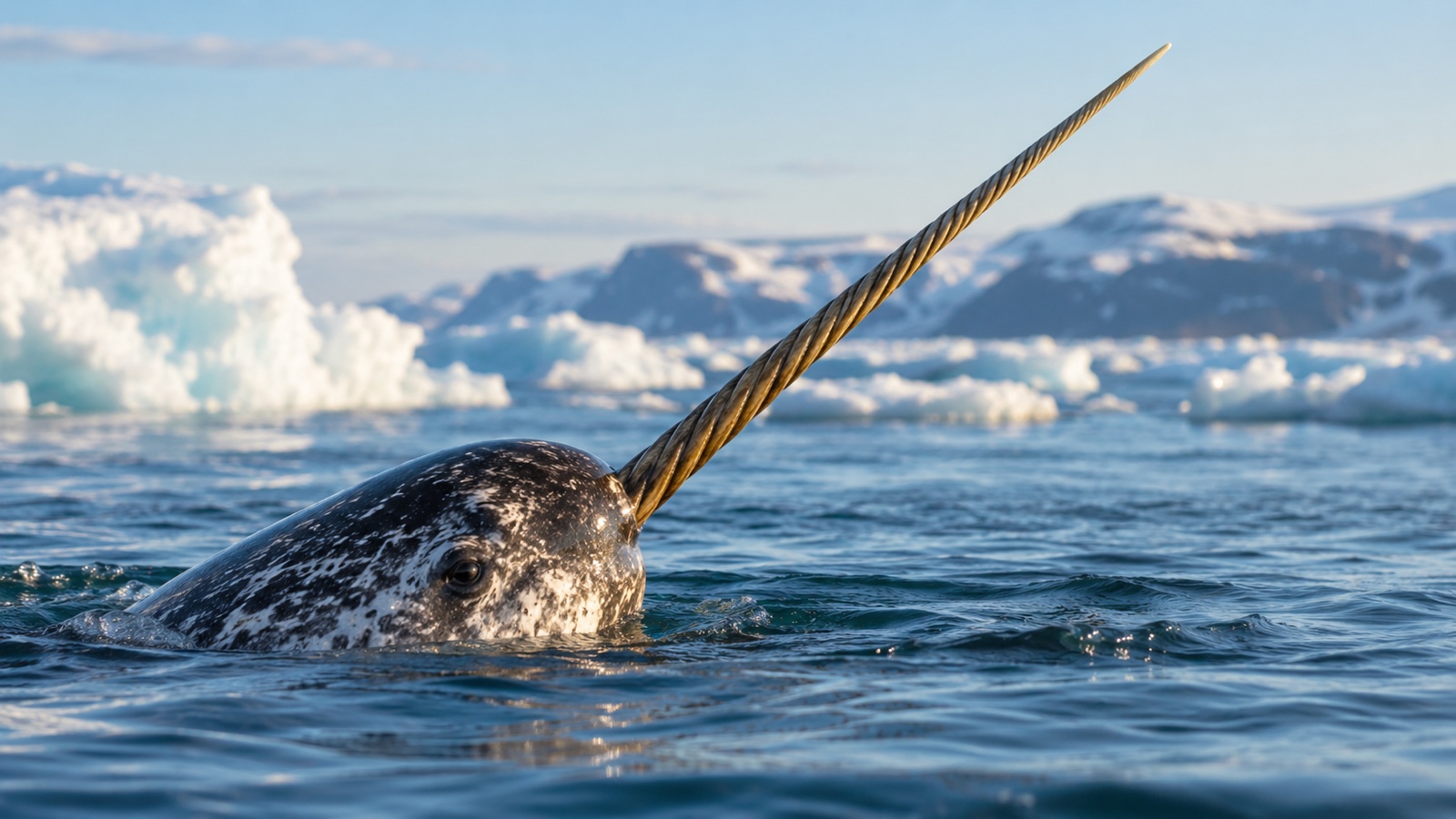
Narwhals make some of the deepest dives among whales
Winter narwhals repeatedly leave narrow cracks in sea ice and descend into black water where pressure is immense and light disappears. Their bodies store large amounts of oxygen, slow circulation strategically, tolerate high carbon dioxide, and compress safely while hunting far below the surface.
- Narwhals are exceptional deep divers.
- They regularly dive hundreds of feet.
- Winter dives can exceed 3,000 feet.
- Some recorded dives approach or exceed a mile in depth.
- Individual dives can last more than 20 minutes.
- Narwhals store oxygen in blood and muscle.
- High myoglobin concentrations help muscles hold oxygen.
- Heart rate slows during diving.
- Blood flow can be directed toward essential organs.
- The rib cage and lungs tolerate pressure changes.
- Collapsing air spaces help limit nitrogen absorption at depth.
- Narwhals hunt in darkness during Arctic winter.
- They use echolocation to find prey.
- Clicks are produced in the head and focused forward.
- Returning echoes reveal distance, direction, and object properties.
- Narwhals can produce very narrow sonar beams.
- Echolocation lets them navigate and hunt where vision is nearly useless.
- They surface through cracks and openings in sea ice.
- Missing a breathing hole can be fatal.
- A narwhal's commute can involve a one-mile vertical dive beneath a frozen ceiling with one planned breathing crack, which makes traffic feel less serious.
Winter food lives deep beneath the ice
- Narwhals eat fish and squid.
- Greenland halibut are important winter prey in some regions.
- Arctic cod are also eaten.
- Polar cod can contribute to the diet.
- Squid and shrimp-like crustaceans are consumed as well.
- Diet varies seasonally and geographically.
- Narwhals often feed intensively in deep wintering areas.
- They may feed less during portions of the summer migration.
- Prey is captured by suction and jaw movement.
- Narwhals have reduced dentition compared with many toothed whales.
- The prominent tusk is not used like a row of stabbing teeth during ordinary feeding.
- They can suck fish into the mouth.
- Echolocation guides the final approach to prey.
- Deep prey layers can shift with water temperature and ocean conditions.
- Sea-ice cover influences food-web dynamics.
- Changes in Arctic fish distribution can alter narwhal feeding opportunities.
- Researchers study diet through stomach contents, tissue chemistry, tagging, and observation.
- Stable isotopes can provide clues about long-term feeding patterns.
- Satellite tags reveal where narwhals spend time and how deep they dive.
- A narwhal's dinner reservation is frequently several thousand feet downstairs and requires sonar.
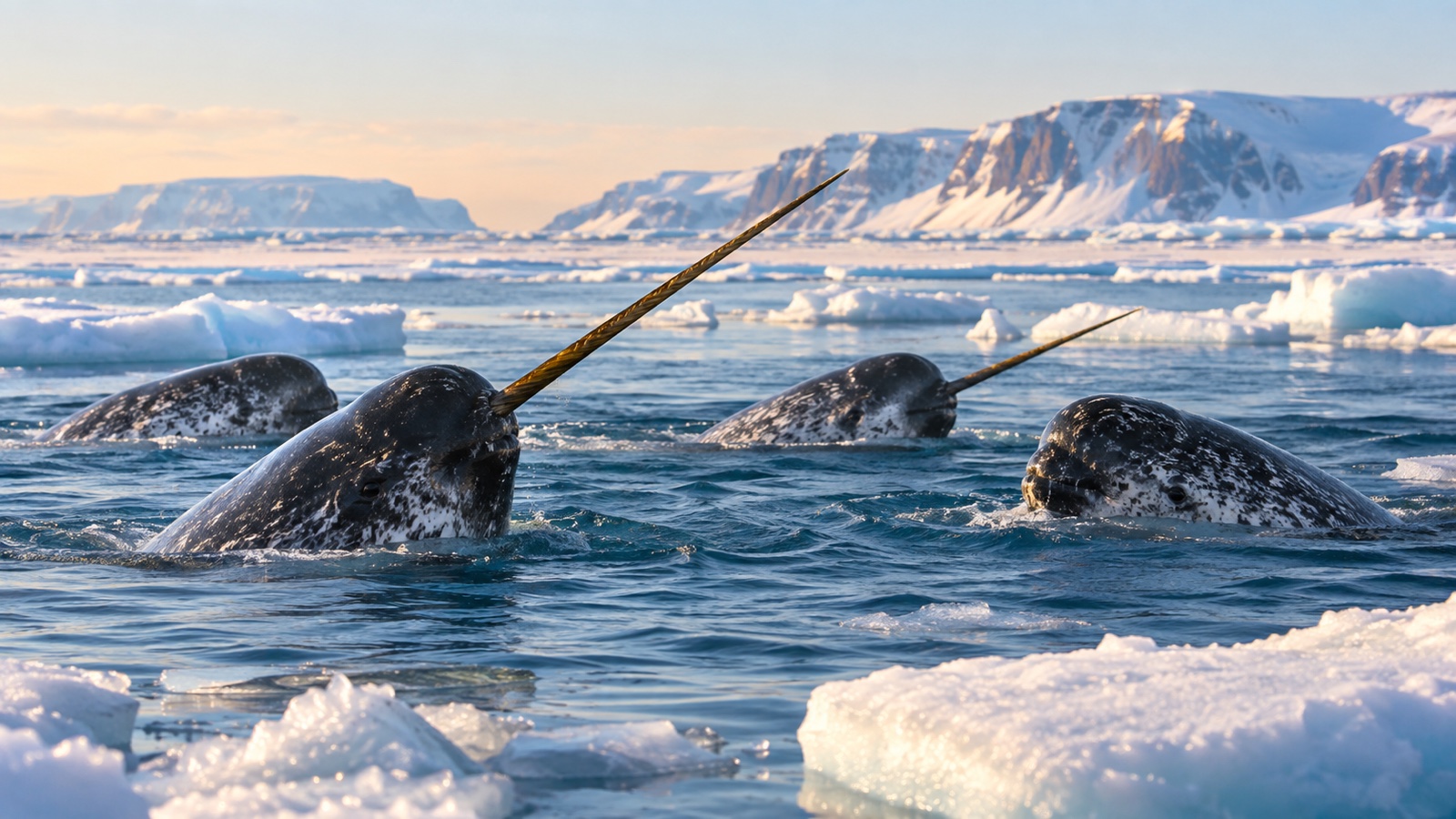
Pods migrate between summer bays and winter pack ice
Narwhals are highly seasonal travelers. Summer can bring groups into relatively ice-free bays and fjords, while fall migration leads them toward offshore winter grounds covered by dense pack ice where only a small fraction of open water may remain.
- Narwhals are social whales.
- They commonly travel in pods.
- Pods can contain several to dozens of animals.
- Seasonal aggregations can include hundreds or more.
- Groups may separate by age or sex at times.
- Summer habitats often include fjords and coastal bays.
- Winter habitats can lie beneath dense offshore pack ice.
- Narwhals follow recurring migration routes.
- Many populations show strong fidelity to traditional seasonal areas.
- Sea-ice formation helps trigger autumn movements.
- Rapid freeze-up can trap whales unexpectedly.
- Mass entrapments are called savssats in Greenlandic usage.
- Whales caught in small openings may be vulnerable to hunters, predators, exhaustion, and suffocation.
- Narwhals communicate with clicks, whistles, knocks, and pulsed calls.
- Social sounds differ from high-frequency echolocation clicks used in hunting.
- Calves learn migration routes from adults.
- Long-lived females may carry valuable knowledge about habitat and ice conditions.
- Social structure remains difficult to study because narwhals spend much of life in remote ice-covered seas.
- Drones, acoustic recorders, genetics, and satellite tags are improving research.
- A pod that disappears beneath Arctic ice for months is not being mysterious on purpose; researchers simply picked a very inconvenient animal to follow.
Calves, Inuit culture and 25 final narwhal facts
- Female narwhals usually give birth to one calf.
- Gestation lasts roughly 14 months.
- Calving generally occurs during spring or early summer.
- Newborns are about 5 feet long.
- Calves are dark gray or brownish.
- They nurse on high-fat milk.
- Young remain close to mothers during early life.
- Females reproduce slowly, often with several years between calves.
- Slow reproduction makes adult female survival especially important.
- Inuit communities in Canada and Greenland have hunted narwhals for generations.
- Narwhal hunting provides culturally important food.
- Muktuk, skin with attached blubber, is a valued traditional food.
- Narwhal meat can also feed people and sled dogs.
- Ivory has artistic, practical, and economic uses.
- Harvest is managed under regional rules and quotas.
- Indigenous knowledge contributes detailed observations of ice, migration, behavior, and body condition.
- Killer whales prey on narwhals.
- Polar bears can kill narwhals trapped near breathing holes or ice edges.
- Greenland sharks may scavenge or possibly prey on vulnerable narwhals.
- Climate change is rapidly altering Arctic sea ice.
- Less ice can open new shipping routes through narwhal habitat.
- Underwater shipping noise may interfere with communication or cause behavioral changes.
- Narwhals can be highly sensitive to ship noise and disturbance.
- Changing prey, ice timing, hunting access, and industrial activity affect populations differently across the Arctic.
- After 145 facts, narwhals feel less like mythical unicorns and more impressive as themselves: deep-diving, sonar-guided Arctic whales carrying giant sensory teeth through one of Earth's fastest-changing environments.

Quick FAQ
Q: Is a narwhal tusk a horn?
A: No. It is an elongated canine tooth, usually the upper left canine of a male.
Q: Do female narwhals have tusks?
A: Most do not, but a minority of females grow a visible tusk.
Q: How deep can narwhals dive?
A: They regularly dive thousands of feet, and recorded dives can approach or exceed a mile in depth.
Q: Did narwhal tusks inspire unicorn legends?
A: Narwhal tusks were definitely traded in medieval Europe as supposed unicorn horns, reinforcing existing unicorn beliefs.
Q: What do narwhals eat?
A: Fish and squid, including Greenland halibut, Arctic cod, polar cod, and other prey depending on season and region.

Ellie is the owner and sole author of Fun Facts, combining her mechanical engineering background with years of research-driven writing to deliver facts you can trust. Every article is thoroughly fact-checked and routinely updated as new science and sources emerge to keep information accurate and current. Her mission is to make learning delightful while upholding high standards of reliability and transparency.