
Hungary is landlocked, yet it has beach towns around a giant lake, cave baths, river islands, thermal spas, and enough water culture to make the missing sea feel less urgent. Add paprika, Rubik’s Cube, grand cafés, ruin bars, horse traditions, wine cellars, and Budapest glowing over the Danube, and the trivia gets crowded fast.
Hungary sits in the heart of the Carpathian Basin
- Hungary is a landlocked country in Central Europe.
- Budapest is the national capital and largest city.
- Hungary borders Austria, Slovakia, Ukraine, Romania, Serbia, Croatia, and Slovenia.
- The national currency is the Hungarian forint.
- Hungary is a member of the European Union but does not use the euro as its national currency.
- Hungarian is the official language.
- Hungarian belongs to the Uralic language family rather than the Indo-European family.
- Its closest major linguistic relatives are Finnish and Estonian only at a very distant family level.
- Modern Hungarian is not mutually intelligible with Finnish or Estonian.
- Hungary’s flag has horizontal red, white, and green stripes.
- The country's coat of arms includes a crown known as the Holy Crown of Hungary.
- Hungary is divided into 19 counties plus the capital district of Budapest.
- The country uses Central European Time.
- It observes European summer-time clock changes.
- Most of Hungary lies within the broad Carpathian Basin.
- Large portions of the country are relatively flat.
- The Great Hungarian Plain covers much of the east and southeast.
- Kékes is Hungary's highest point.
- It rises 3,327 feet in the Mátra Mountains.
- Hungary has no coastline, yet somehow developed a national vacation culture that still includes swimsuits, beach snacks, and inflatable flamingos.
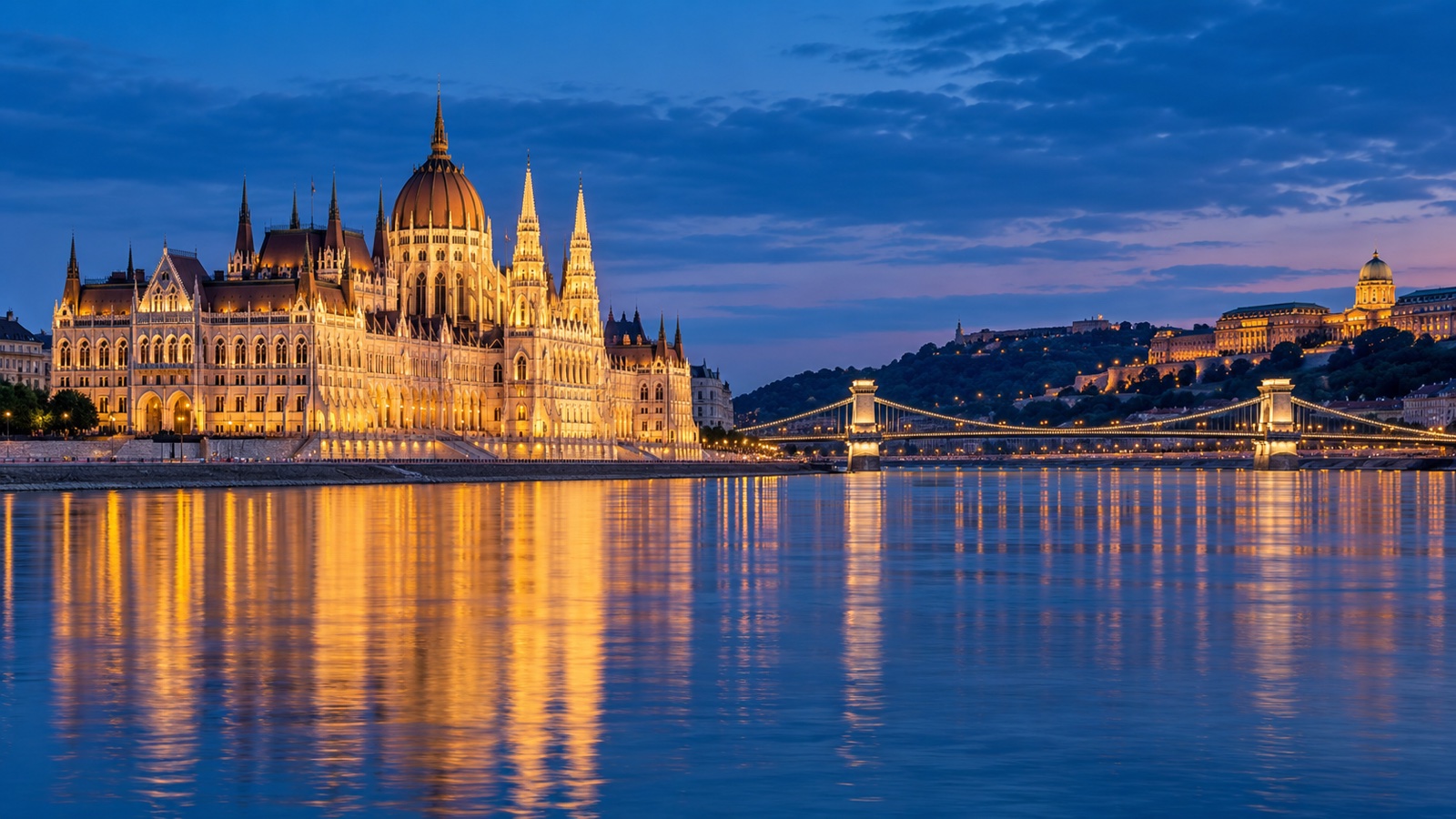
The Danube splits Budapest and connects Hungary to Europe
- The Danube River crosses Hungary from north to south.
- It flows through central Budapest.
- The Danube is Europe's second-longest river after the Volga.
- It eventually empties into the Black Sea.
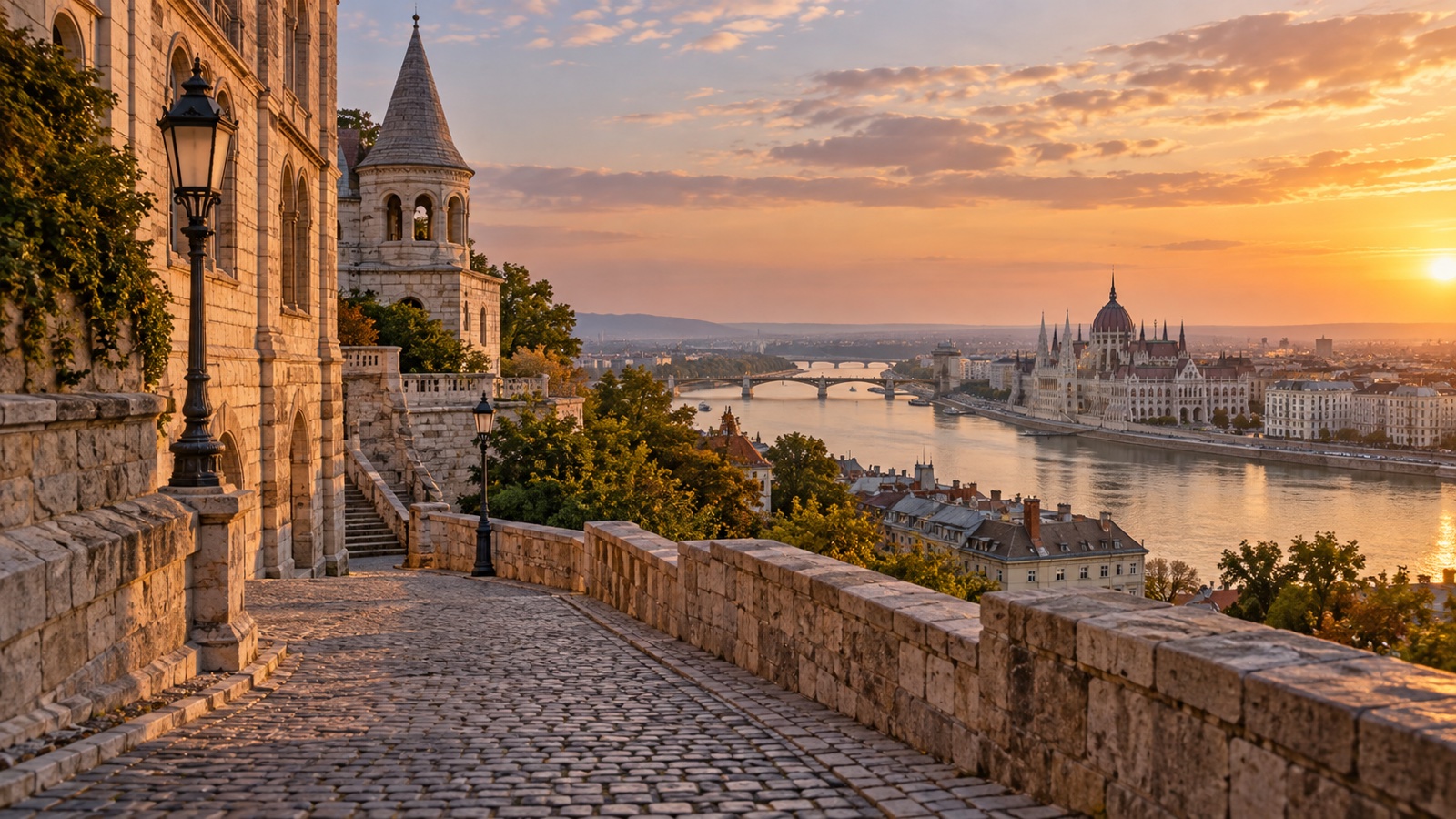
- Buda lies on the hilly western side of the river.
- Pest lies on the flatter eastern side.
- Buda, Pest, and Óbuda officially united to form Budapest in 1873.
- The Chain Bridge became the first permanent bridge connecting Buda and Pest.
- It opened in 1849.
- The bridge helped accelerate economic and social integration between the two sides.
- Margaret Island sits in the Danube within Budapest.
- The island contains parks, recreation facilities, gardens, and historic ruins.
- The Danube Bend north of Budapest curves through forested hills.
- Visegrád overlooks the river from a historic hilltop fortress.
- Esztergom sits near the Slovak border along the Danube.
- Its basilica is one of Hungary's largest churches.
- The Tisza is Hungary's other major river.
- It flows across the eastern part of the country.
- Extensive flood-control systems reshape both major river valleys.
- Budapest's best views are basically the Danube forcing architecture to compete for attention on both banks.
Lake Balaton is the Hungarian Sea
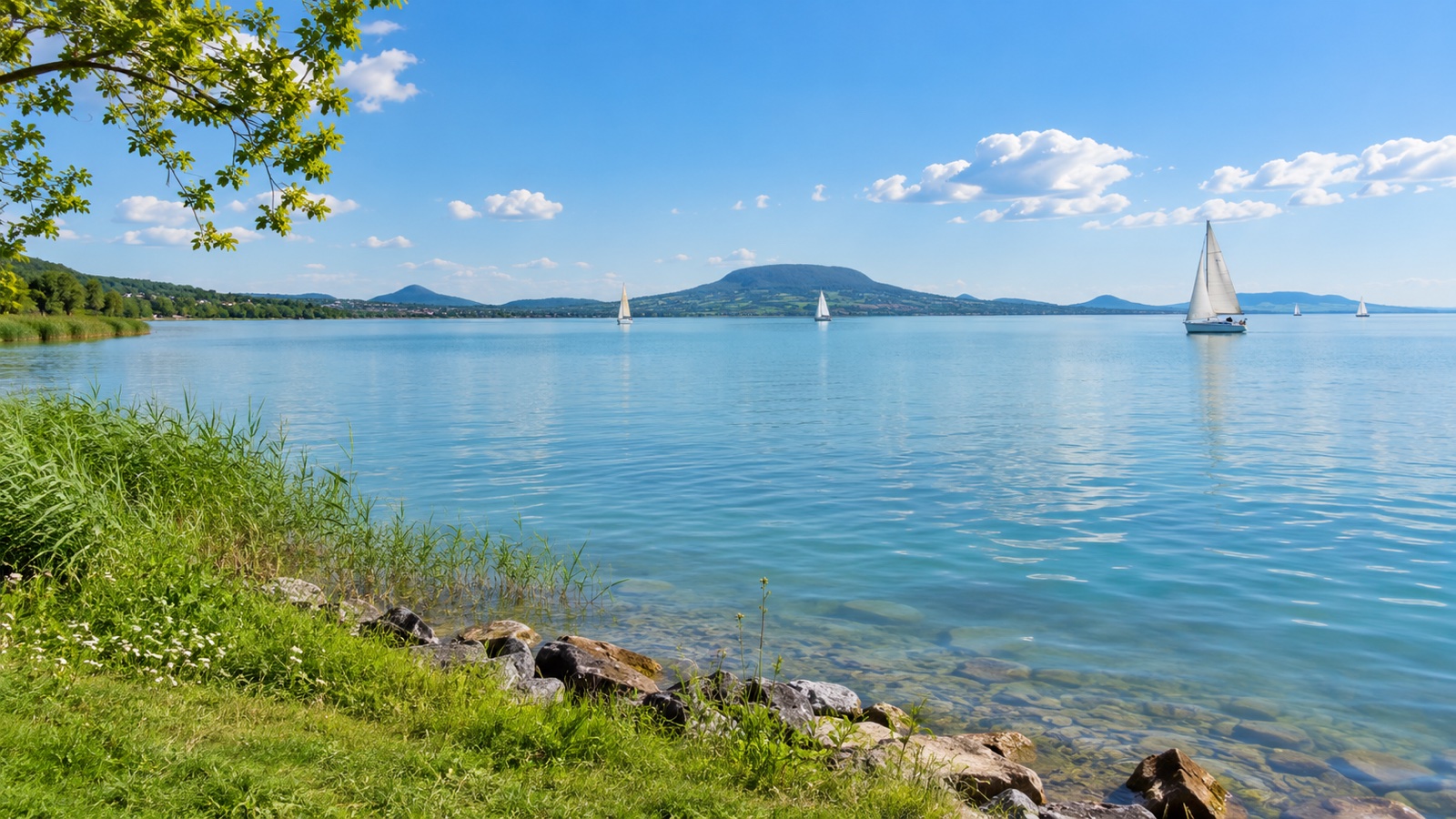
- Lake Balaton is the largest lake in Central Europe.
- It lies in western Hungary.
- The lake is long and relatively shallow.
- Its average depth is only about 10 feet.
- Shallow water warms quickly in summer.
- That makes Balaton a major swimming and vacation destination.
- Hungarians often nickname it the Hungarian Sea.
- Resort towns line much of the shoreline.
- Siófok is one of the lake's largest resort centers.
- Balatonfüred is famous for historic villas and spa traditions.
- The Tihany Peninsula projects into the lake from the north shore.
- Tihany Abbey was founded in the 11th century.
- The abbey's founding charter contains one of the oldest surviving written records with Hungarian-language words.
- Volcanic hills rise north of Lake Balaton.
- Those hills support vineyards.
- Badacsony is particularly famous for wine and volcanic scenery.
- The Kis-Balaton wetland system is important for birds and water management.
- Winter ice occasionally forms on the lake during sufficiently cold years.
- Sailing is popular even though Hungary has no access to an ocean.
- Lake Balaton is what happens when a landlocked country refuses to let geography cancel beach season.
Thermal water bubbles under much of the country
Hungary's bath obsession is not just spa marketing. The geology of the Carpathian Basin allows hot groundwater to rise relatively close to the surface, and Hungarians have been building bathing traditions around it since Roman and Ottoman times.
- Hungary has hundreds of thermal springs and wells.
- Budapest is especially famous for thermal baths.
- Széchenyi Thermal Bath is one of Europe's largest spa complexes.
- Its outdoor pools remain open through cold winter weather.
- People sometimes play chess while sitting in the warm outdoor pools.
- Gellért Baths became famous for Art Nouveau interiors.
- Rudas Baths include a surviving Ottoman-era domed bathing hall.
- Ottoman Turks controlled Buda for much of the 16th and 17th centuries.
- Several Budapest bath traditions developed or expanded during that period.
- Hévíz near Lake Balaton contains a large naturally warm thermal lake.
- People bathe outdoors in Lake Hévíz even during cool weather.
- Miskolctapolca became famous for thermal bathing inside natural cave spaces.
- Egerszalók is known for mineral deposits formed by flowing thermal water.
- Thermal water contains different dissolved minerals depending on its underground route.
- Health claims for spa water vary and should not be treated as universal medical cures.
- Bath culture in Hungary is social and recreational as well as therapeutic.
- Many towns operate public thermal pools rather than only luxury resorts.
- Geothermal water is also used for heating and agriculture in some areas.
- Hungary's underground heat is a natural resource as well as a tourism attraction.
- I respect any country where outdoor winter chess can reasonably require a swimsuit.
A medieval kingdom eventually became part of Austria-Hungary
- Magyar tribes entered the Carpathian Basin near the end of the ninth century.
- Prince Árpád became a foundational figure in Hungarian national history.
- Stephen I became Hungary's first Christian king around the year 1000.
- Stephen was later canonized as a saint.
- The Holy Crown became a powerful symbol of Hungarian monarchy.
- The medieval Kingdom of Hungary controlled territory larger than modern Hungary.
- Mongol armies devastated much of Hungary in 1241 and 1242.
- King Béla IV encouraged stone castle construction after the invasion.
- The Ottoman Empire defeated Hungarian forces at Mohács in 1526.
- King Louis II died after the battle.
- Hungary was eventually divided among Ottoman, Habsburg, and Transylvanian-controlled territories.
- Habsburg power expanded after Ottoman withdrawal.
- The Hungarian Revolution of 1848 challenged Habsburg rule.
- Lajos Kossuth became one of its best-known leaders.
- The revolution was defeated with Russian military assistance.
- The Austro-Hungarian Compromise of 1867 created the Dual Monarchy.
- Hungary gained substantial internal autonomy within Austria-Hungary.
- Budapest grew rapidly during the late 19th century.
- The Hungarian Parliament Building was constructed during that era.
- Nothing says constitutional compromise like building one of Europe's largest parliament buildings immediately afterward.
The 20th century redrew Hungary repeatedly
Hungary's modern history is one reason borders and national identity remain emotionally charged. World wars, the Treaty of Trianon, fascist alliances, the Holocaust, Soviet occupation, a crushed 1956 uprising, and communist rule all reshaped the country within a few generations.
- Austria-Hungary collapsed after World War I.
- The Treaty of Trianon in 1920 dramatically reduced Hungary's territory.
- Millions of ethnic Hungarians found themselves living outside the new Hungarian borders.
- Trianon remains a major historical memory in Hungarian politics and identity.
- Hungary allied with Axis powers during World War II.
- German forces occupied Hungary in March 1944.
- Hundreds of thousands of Hungarian Jews were deported to Auschwitz-Birkenau in 1944.
- Hungarian authorities collaborated significantly in deportations and persecution.
- Raoul Wallenberg and other rescuers helped save some Budapest Jews.
- The Arrow Cross regime carried out murderous persecution in Budapest.
- Soviet forces captured Budapest after a brutal siege.
- A communist government consolidated power after the war.
- Hungarians launched a nationwide uprising against communist rule in October 1956.
- Soviet forces invaded and crushed the revolution in November.
- Thousands were killed and many more fled the country.
- Imre Nagy, the revolutionary prime minister, was later executed.
- János Kádár led Hungary for much of the following communist era.
- Hungary began political transition away from communist rule in 1989.
- The Republic of Hungary was proclaimed on October 23, 1989.
- Hungary joined NATO in 1999 and the European Union in 2004.
Paprika, Rubik's Cube, composers and 25 final Hungary facts
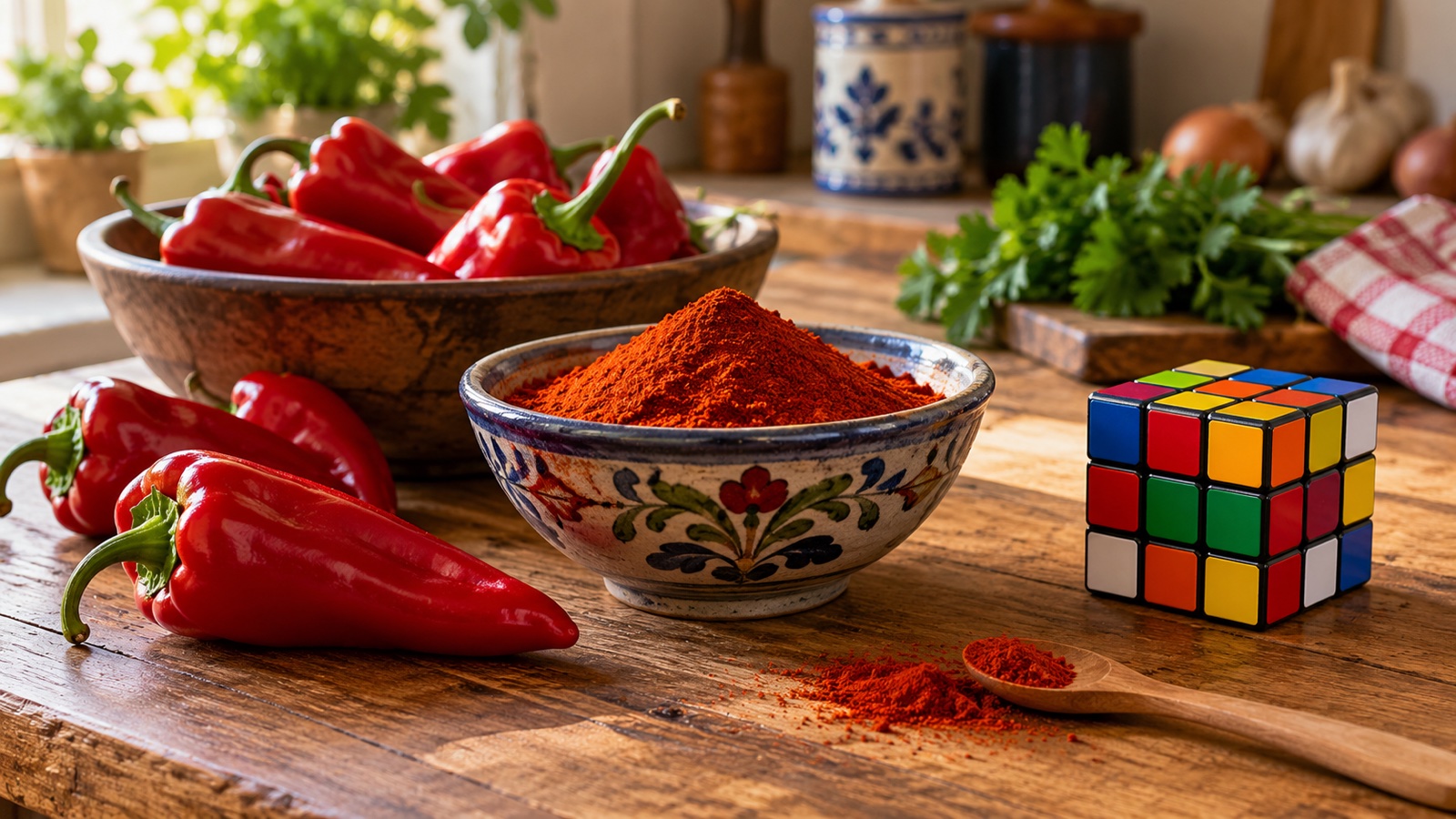
- Paprika is one of Hungary's signature seasonings.
- Paprika is made from dried ground peppers.
- Hungarian paprika ranges from mild and sweet to hot.
- Szeged and Kalocsa are famous paprika-producing regions.
- Gulyás, or goulash, is traditionally a soup or stew associated with cattle herders.
- Hungarian goulash is often more soup-like than thick versions served abroad.
- Pörkölt is a thicker meat stew commonly seasoned with paprika.
- Lángos is fried flatbread often topped with garlic, sour cream, or cheese.
- Dobos torte layers sponge cake with chocolate buttercream and caramel.
- Tokaji is a famous wine from northeastern Hungary.
- Tokaji Aszú is a sweet wine made partly from grapes affected by noble rot.
- Ernő Rubik invented the Rubik's Cube in Budapest during the 1970s.
- The puzzle was initially called the Magic Cube in Hungary.
- John von Neumann was born in Budapest and became a foundational mathematician in computing and game theory.
- Leó Szilárd was a Hungarian-born physicist who conceived the nuclear chain-reaction idea.
- Edward Teller was born in Budapest and became a major nuclear physicist in the United States.
- Albert Szent-Györgyi won a Nobel Prize for work involving vitamin C.
- Béla Bartók became one of Hungary's most important composers and ethnomusicologists.
- Franz Liszt was born in the Kingdom of Hungary and became one of the 19th century's greatest pianists.
- Hungarian water polo has an exceptional Olympic tradition.
- The country's men's water-polo team has won multiple Olympic gold medals.
- Football legend Ferenc Puskás captained Hungary's famous 1950s national team.
- The Hungarian Parliament Building stands on the Danube in Budapest.
- Its enormous Gothic Revival design contains the Holy Crown of Hungary.
- After 145 facts, Hungary still feels like a country that turned thermal water, paprika, mathematics, music, and a twisty plastic cube into global exports.
Quick FAQ
Q: What is Hungary famous for?
A: Budapest, thermal baths, the Danube, Lake Balaton, paprika, goulash, Tokaji wine, Rubik's Cube, classical music, water polo, and grand historic architecture.
Q: What is the capital of Hungary?
A: Budapest is both the capital and largest city.
Q: Is Hungarian related to German or Slavic languages?
A: No. Hungarian belongs to the Uralic language family, while German is Germanic and neighboring Slovak, Croatian, and Serbian are Slavic.
Q: Does Hungary have a sea?
A: No. Hungary is landlocked, but Lake Balaton is so large and culturally important that Hungarians often nickname it the Hungarian Sea.
Q: Was the Rubik's Cube invented in Hungary?
A: Yes. Hungarian architect and professor Ernő Rubik invented the puzzle in Budapest during the 1970s.

Ellie is the owner and sole author of Fun Facts, combining her mechanical engineering background with years of research-driven writing to deliver facts you can trust. Every article is thoroughly fact-checked and routinely updated as new science and sources emerge to keep information accurate and current. Her mission is to make learning delightful while upholding high standards of reliability and transparency.