
A candy cane is basically a peppermint walking stick that somehow became Christmas shorthand. The fun part is how much of its famous “history” is actually legend: the crook, red stripes, peppermint flavor, and religious symbolism arrived through different stages, while sugar chemistry did the hard work all along.
Candy cane basics hiding in plain sight
- A traditional candy cane is a hard sugar candy shaped like a hooked walking stick.
- The classic modern version is white with red stripes.
- Peppermint is the flavor most strongly associated with candy canes.
- Candy canes are especially popular during the Christmas season.
- The curved top is commonly called the crook or hook.
- Straight peppermint sticks and hooked candy canes are closely related confections.
- The candy begins as a hot concentrated sugar syrup.
- Water is boiled away until the syrup reaches a very high sugar concentration.
- The finished candy becomes hard because the cooked sugar cools into a glassy solid.
- Hard candy is mostly amorphous rather than a large crystal structure.
- Controlling unwanted sugar crystallization is important for a smooth candy texture.
- Corn syrup or other interfering sugars can help reduce crystallization in some recipes.
- Peppermint oil is highly concentrated, so relatively small amounts can flavor a large candy batch.
- Food coloring creates the familiar red stripes.
- Other colors and flavors are now common even when the candy keeps its cane shape.
- Miniature candy canes are made with the same general hard-candy principles as full-size ones.
- Large novelty candy canes can be much heavier and thicker than standard versions.
- The hook makes candy canes easy to hang from Christmas tree branches.
- A broken candy cane is chemically identical to the unbroken one, just emotionally less festive.
- I have never seen a candy cane survive a stocking without becoming at least three candy fragments.

The real history is less tidy than the legend
If you have heard that one choir director invented candy canes in exactly 1670 to keep children quiet, you have heard the internet’s favorite version. It is a charming story, but historians do not have strong contemporary evidence proving that neat origin.
- Hard sugar candies existed in Europe before the modern candy cane developed.
- Plain white sugar sticks are generally considered predecessors of candy canes.
- A popular story places an early hooked sugar stick in Cologne, Germany, around 1670.
- The story says a cathedral choirmaster gave bent sugar sticks to children during a Christmas service.
- It is often claimed the crook was meant to resemble a shepherd’s staff.
- Contemporary documentation for that specific story is weak or absent.
- The tale appears much more confidently in later retellings than in 17th-century records.
- That means it should be treated as tradition rather than a proven invention date.
- Early sugar sticks would likely have been plain white rather than striped red and white.
- Peppermint was not necessarily the defining flavor of the earliest forms.
- Hooked sugar candies became increasingly associated with Christmas in Europe and North America.
- Written references to candy canes appear in the 19th century.
- Christmas-tree traditions helped give hooked candy a practical place as an edible ornament.
- American confectioners produced candy canes by the late 19th century.
- Red striping became common later than the basic white cane shape.
- Early photographs and illustrations show that the modern stripe pattern was not always present.
- By the early 20th century, red-and-white peppermint canes were increasingly recognizable.
- Mass production made candy canes inexpensive enough for broad holiday distribution.
- No single surviving document gives us a clean “first candy cane ever” moment.
- Food history is often annoyingly allergic to origin stories that fit on a gift tag.
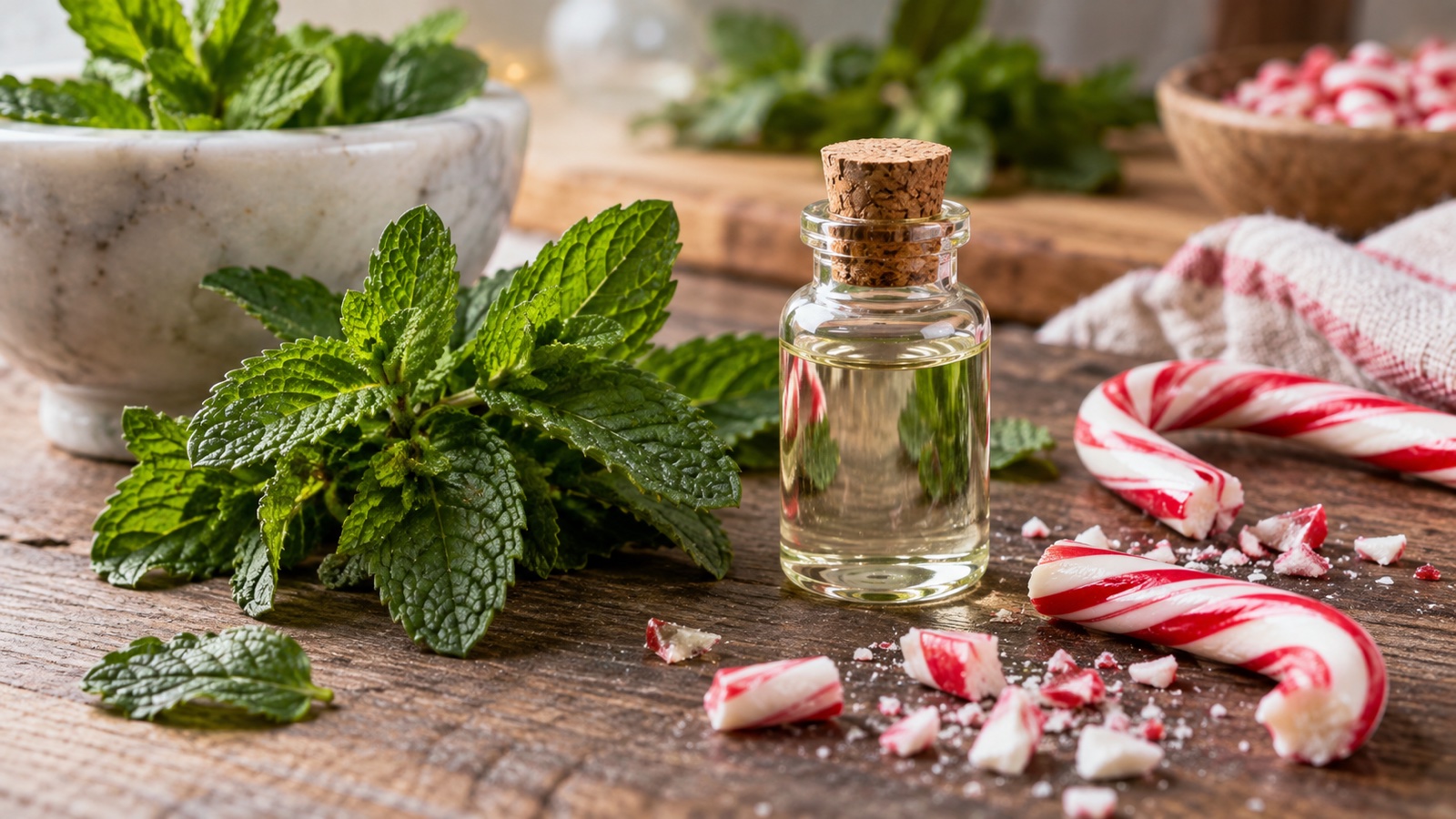
Peppermint, menthol & why the flavor feels cold
- Peppermint is a hybrid mint traditionally identified as Mentha × piperita.
- It arose from a cross between watermint and spearmint.
- Peppermint oil contains menthol and other aromatic compounds.
- Menthol activates cold-sensitive receptors in the mouth and skin.
- That receptor response creates a cooling sensation without actually lowering tissue temperature much.
- The same compound helps make peppermint gum and toothpaste feel cool.
- Peppermint oil is far more concentrated than fresh mint leaves.
- Commercial candy flavorings are measured carefully because too much oil can become unpleasantly intense.
- Peppermint’s sharp aroma cuts through concentrated sugar sweetness.
- That contrast is one reason peppermint works well in hard candy.
- Wintergreen candy tastes minty but comes from different flavor compounds than peppermint.
- Spearmint is also chemically and aromatically distinct from peppermint.
- Mint flavor became strongly associated with Christmas confections in the United States.
- Peppermint bark combines mint candy pieces with chocolate.
- Crushed candy canes are often used as a peppermint-bark topping.
- Chocolate and peppermint pair well because strong cocoa flavors stand up to menthol’s cooling intensity.
- Peppermint can make hot cocoa taste cooler in the mouth even though the drink remains hot.
- That sensory contradiction is part temperature perception and part aroma.
- Mint flavor can linger after the sugar has dissolved because aromatic compounds remain noticeable.
- A candy cane is therefore a tiny neuroscience demonstration disguised as stocking filler.
How candy canes are cooked, pulled & striped
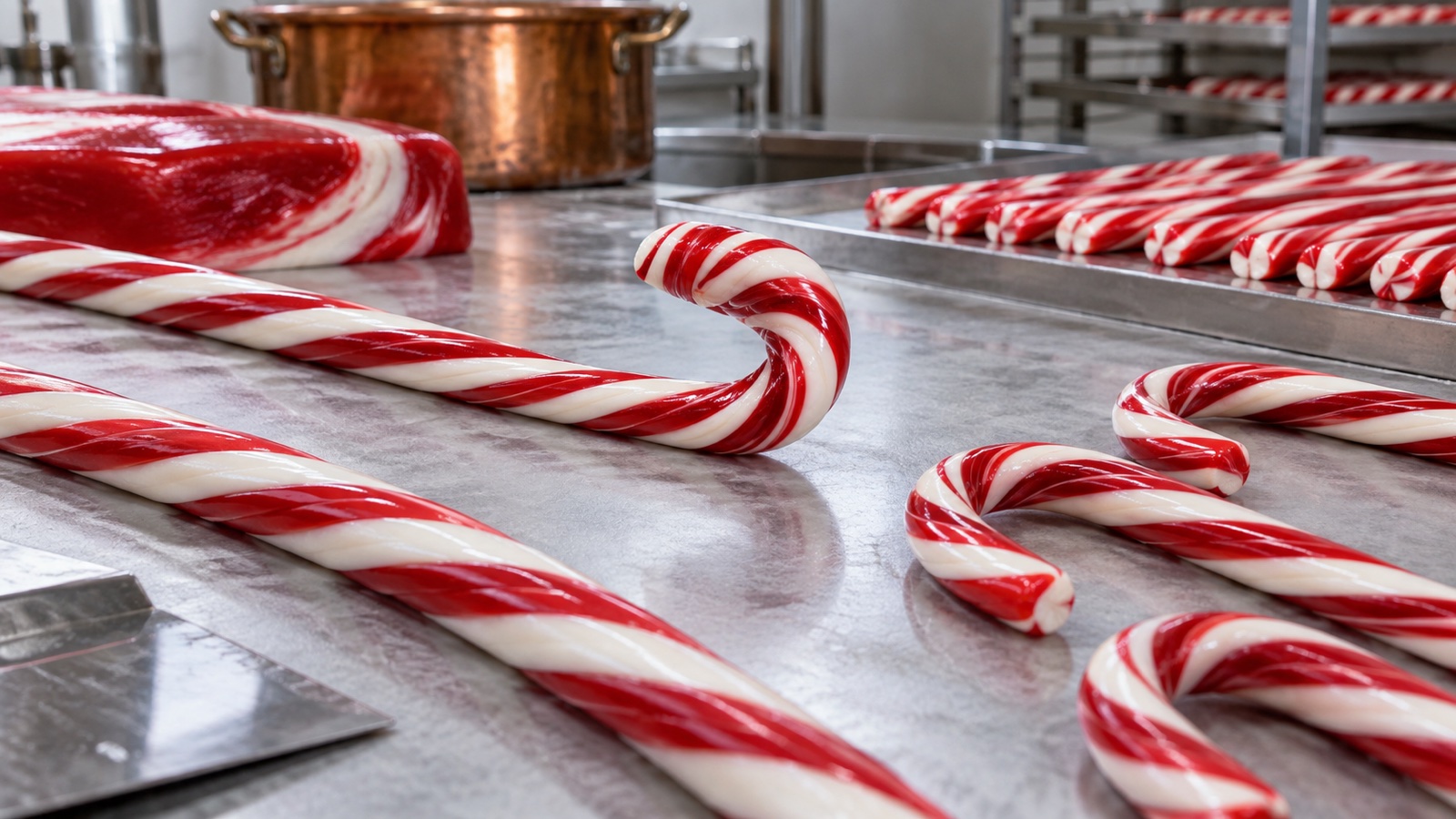
Watching candy makers work hot sugar is equal parts baking show and industrial hazard. The mixture has to be cooked, cooled enough to handle, divided, colored, flavored, pulled, layered into stripes, rolled to an even diameter, cut, and bent before it becomes too rigid.
- Hard candy syrup is cooked to roughly the hard-crack temperature range.
- That range is around 300°F, depending on recipe and conditions.
- At that stage, very little water remains in the syrup.
- The syrup must cool somewhat before candy workers can manipulate it safely.
- Fresh cooked candy remains hot enough to cause severe burns.
- Professional candy tables can be designed to help control cooling.
- A portion of the batch can be colored red for the stripe.
- The white portion is commonly pulled repeatedly.
- Pulling incorporates many tiny air bubbles into the candy.
- Those microscopic bubbles scatter light and make the candy look opaque white.
- Unpulled cooked sugar can remain comparatively clear or translucent.
- Flavoring is added while the candy is still workable.
- Red candy can be stretched into long strips.
- Those strips are laid against the larger white candy mass.
- Twisting and rolling the combined mass creates spiral stripes.
- Consistent rolling keeps the cane thickness even.
- Long candy ropes are cut into individual lengths.
- The top is bent into a hook while the candy is still warm and flexible.
- Once cooled, the glassy sugar becomes brittle.
- The bend window is short enough to make candy-cane production look like delicious assembly-line choreography.
Machines made the Christmas classic easier to mass-produce
- Traditional candy canes required substantial hand labor.
- Workers once had to bend each warm stick individually.
- The narrow temperature window made that step difficult to automate.
- American confectioner Bob McCormack founded a candy business that became strongly associated with candy-cane production.
- His company was known as Bobs Candies.
- McCormack’s brother-in-law Gregory Keller developed machinery that helped automate candy-cane bending.
- The device became known as the Keller Machine.
- Mechanizing the crook-making step increased production speed dramatically.
- Other machinery handles rolling, cutting, wrapping, and packaging in modern factories.
- Automated equipment still has to control candy temperature carefully.
- If sugar cools too soon, it becomes too brittle to bend.
- If it remains too hot, shapes can slump or distort.
- Individual wrapping helps protect candy from moisture and contamination.
- Hard candy readily absorbs moisture from humid air.
- Absorbed water can make the surface sticky.
- Packaging also helps prevent breakage during shipping.
- Boxes often use dividers or trays to protect fragile hooks.
- Candy-cane factories can produce enormous seasonal volumes months before December.
- Retailers stock them early because holiday demand arrives long before Christmas week.
- The candy may look handmade, but modern volume requires extremely disciplined sugar engineering.
Religious symbolism, J-shapes & stories that came later
Candy canes have accumulated a whole symbolic biography: white for purity, red for sacrifice, the hook for a shepherd’s staff, and an upside-down cane for the letter J in Jesus. Those can be meaningful devotional interpretations, but they are not well supported as the historical design brief that created candy canes.
- The candy-cane crook is often interpreted as a shepherd’s staff in Christian settings.
- That symbolism fits Christmas Nativity imagery involving shepherds.
- An upside-down candy cane resembles a capital letter J.
- Some Christian lessons use that J shape as a reference to Jesus.
- White candy is sometimes interpreted as a symbol of purity.
- Red stripes are sometimes interpreted as symbols of Christ’s blood or sacrifice.
- Three narrow stripes are occasionally assigned Trinitarian symbolism.
- Those detailed color-and-stripe explanations are devotional interpretations rather than firmly documented invention history.
- The earliest sugar sticks appear to have been plain white.
- Red striping became prominent much later.
- That timeline makes claims that the original red stripes were designed with one exact theological code unlikely.
- A tradition can gain meaningful symbolism after its physical form develops.
- Families and churches may use candy canes as visual teaching objects during Advent or Christmas.
- Secular households may enjoy exactly the same candy with no religious interpretation.
- Candy canes therefore operate comfortably as food, decoration, religious symbol, and commercial icon.
- The hook can hang over a mug of cocoa.
- It can also hang from a Christmas tree.
- Mini canes fit easily into stockings, gift bows, and table place settings.
- Red and white became so strongly linked with peppermint candy that other sweets now borrow the pattern.
- The stripes may carry different meaning to different people, which is more honest than pretending history issued one official legend.
Flavors, recipes & 25 final candy-cane facts
- Candy canes now come in fruit, cinnamon, chocolate, sour, and novelty flavors.
- Some brands use unusual colors so shoppers can tell flavors apart.
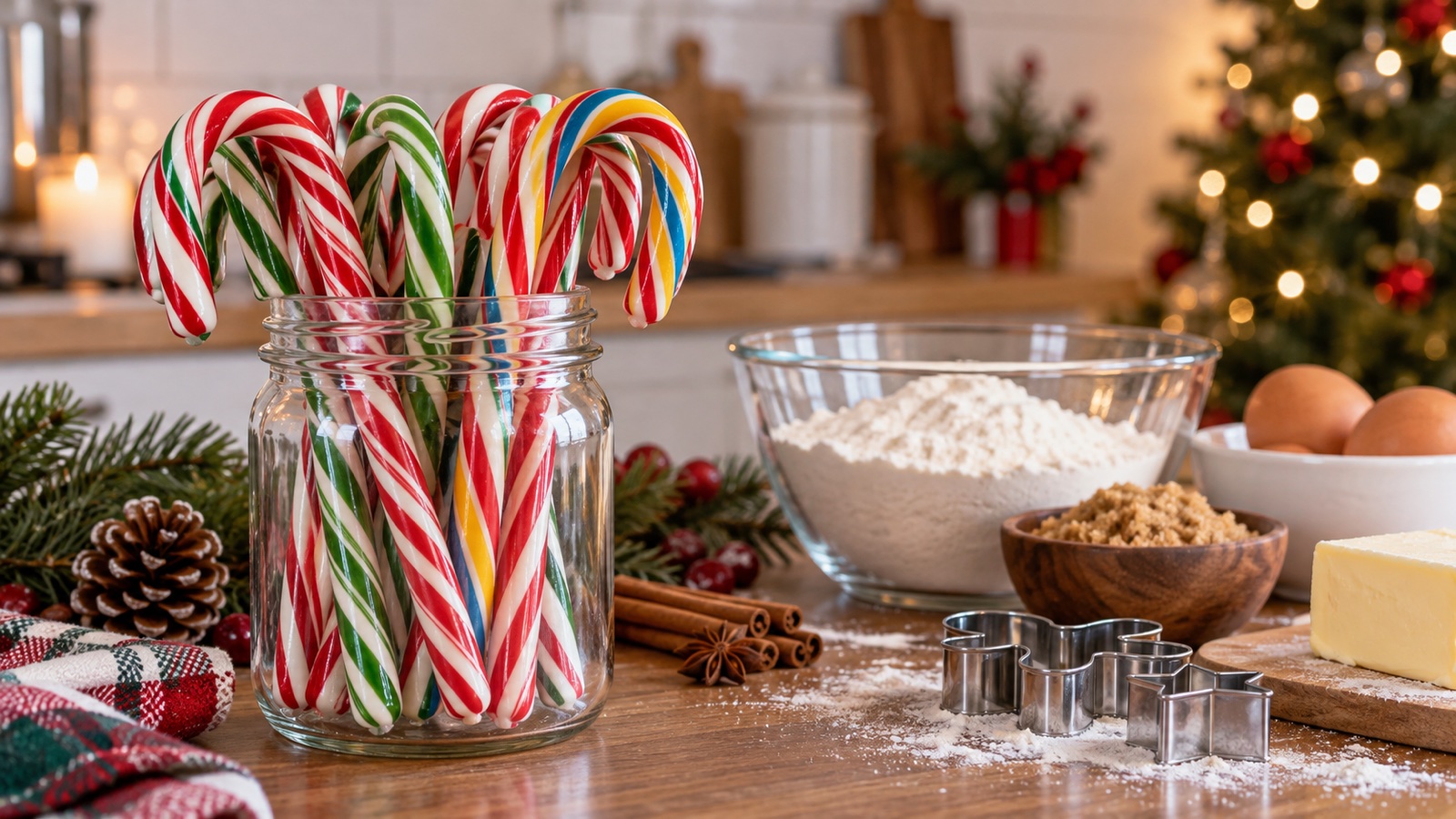
- Blue, green, rainbow, and multicolored canes are common seasonal variations.
- Peppermint remains the visual and flavor standard against which those variations are judged.
- Crushed candy canes can be folded into cookie dough.
- They can be sprinkled over brownies, cupcakes, and cheesecakes.
- Small pieces melt readily into hot chocolate.
- Dissolving candy canes add both sugar and peppermint flavor to drinks.
- Crushed canes can become sticky in humid air because sugar absorbs moisture.
- Storing them airtight slows that problem.
- Candy canes can be ground into a coarse peppermint topping with a food processor.
- Putting them inside a sturdy bag before crushing reduces the amount of peppermint shrapnel in the kitchen.
- Hard candy can damage teeth if bitten aggressively.
- Letting pieces dissolve is gentler than trying to prove your molars are stronger than cooked sugar.
- Candy cane pieces can present choking risks for very young children.
- Sugar-free candy canes use alternative sweeteners but are still hard candies.
- Some sugar alcohols used in sugar-free candy can cause digestive discomfort in large amounts.
- Peppermint candy pieces make a striking border on frosted cakes.
- They should be added near serving time if moisture in frosting would otherwise dissolve them.
- Candy cane “dust” can tint white icing pink as red coloring dissolves.
- National Candy Cane Day is informally celebrated in the United States on December 26.
- It is not a federal holiday, which is probably for the best because banks do not need peppermint hours.
- The candy’s crook remains its defining shape even when colors and flavors change.
- A perfectly straight peppermint stick is delicious, but nobody mistakes it for a Christmas tree ornament.
- After 145 facts, the candy cane still wins the holiday-design award for making a piece of sugar recognizable from across the room.
Quick FAQ
Q: Who invented the candy cane?
A: No single inventor is securely documented. A famous story credits a 17th-century Cologne choirmaster with bent sugar sticks, but strong contemporary evidence for that exact origin is lacking.
Q: Why are candy canes red and white?
A: The modern color pattern became common after earlier plain white sugar sticks. Religious meanings are often assigned to the colors today, but those explanations are later interpretations rather than proven original design reasons.
Q: Why does peppermint feel cold?
A: Menthol activates cold-sensitive receptors in your mouth, creating a cooling sensation without actually making the tissue dramatically colder.
Q: How are candy canes made white?
A: Candy makers pull part of the cooked sugar repeatedly, incorporating tiny air bubbles that scatter light and make the candy look opaque white.
Q: Why are candy canes curved?
A: The crook became a defining traditional shape and makes the candy easy to hang. Shepherd-staff symbolism is popular, but the precise historical reason for the first bend is not securely documented.

Ellie is the owner and sole author of Fun Facts, combining her mechanical engineering background with years of research-driven writing to deliver facts you can trust. Every article is thoroughly fact-checked and routinely updated as new science and sources emerge to keep information accurate and current. Her mission is to make learning delightful while upholding high standards of reliability and transparency.