
Snow is far stranger than frozen rain. A snow crystal grows directly from water vapor inside a cloud, its six-sided structure comes from molecular geometry, and tiny changes in temperature and humidity can turn the same substance into plates, needles, columns, stars, or fluffy aggregates. These 145 snow facts explore snowflakes, storms, skiing, glaciers, color, sound, insulation, records, forecasting, and winter science.
Snow basics
- Snow is precipitation made of ice crystals that form in clouds.
- A snow crystal begins when water vapor deposits onto a tiny particle or existing ice nucleus.
- Snow is not simply a raindrop that froze while falling.
- The crystals grow as additional water vapor joins the ice structure.
- Individual ice crystals can fall alone or stick together into snowflakes.
- Fresh snow contains far more air than solid ice by volume.
- That trapped air helps make new snow light and fluffy.
- Snow can fall when surface temperatures are slightly above freezing.
- What matters is the temperature and humidity through the atmosphere the flakes travel through.
- Snow can partially melt on the way down and still reach the ground.
- Dry snow contains relatively little liquid water.
- Wet snow contains more liquid water and packs together easily.
- Snow cover reflects a large fraction of incoming sunlight.
- This high reflectivity is called albedo.
- NOAA explains that snowflakes grow inside clouds from water vapor rather than from frozen raindrops.
Why snowflakes have six sides
- Ordinary ice has a hexagonal crystal structure.
- Water molecules arrange themselves in repeating patterns as they freeze.
- Those molecular arrangements favor six-fold symmetry in growing snow crystals.
- That is why classic stellar snowflakes have six main arms.
- A normal snow crystal does not grow five or seven evenly spaced primary arms.
- The six arms experience nearly the same broad atmospheric conditions at the same time.
- That shared environment helps the branches develop similar overall patterns.
- The microscopic details on opposite arms are not perfectly identical.
- Snow crystals are three-dimensional even when photographs make them look flat.
- Some grow as thin plates.
- Others grow as hollow columns.
- Some become needle-like crystals.
- Some crystals combine plates and columns into capped-column shapes.
- Complex stellar dendrites are only one category within a much larger family of snow-crystal forms.
- The familiar six-point paper snowflake is scientifically inspired, even though real snow crystals are much more varied.
Temperature changes crystal shape
- Snow-crystal shape depends strongly on cloud temperature.
- Humidity, especially the amount of water vapor available for deposition, also matters.
- Thin plates tend to grow in some temperature ranges.
- Columns and needles dominate other temperature ranges.
- Very humid air can encourage elaborate branching.
- Drier conditions tend to produce simpler crystals.
- A falling crystal can pass through several temperature and humidity layers.
- Its growth pattern can therefore change during its descent.
- A crystal may begin as a column and later grow plates on its ends.
- Small environmental differences can produce dramatically different final shapes.
- Laboratories can grow snow crystals under controlled conditions.
- Scientists use those experiments to study how ice surfaces grow molecule by molecule.
- The broad relationship between temperature and snow-crystal habit is called a snow-crystal morphology diagram.
- Weather conditions inside a cloud leave a physical record in the crystal’s architecture.
- A snowflake can therefore act like a tiny diary of the air it traveled through.
No two snowflakes?
- The saying that no two snowflakes are alike is a useful simplification rather than a mathematical law.
- Large complex snowflakes have so many possible growth histories that exact duplicates are extraordinarily unlikely.
- Very simple microscopic ice crystals can look nearly identical.
- Two crystals could share the same broad shape without matching at every molecular detail.
- Each flake follows a slightly different path through turbulent air.
- That means it experiences a unique sequence of temperature and humidity changes.
- Even nearby crystals can encounter different microscopic conditions.
- Collisions can break branches.
- Riming can coat a crystal with frozen cloud droplets.
- Several crystals can collide and stick together into one aggregate flake.
- The fluffy flakes people catch on gloves are often aggregates rather than single perfect crystals.
- Snowflake photographer Wilson Bentley helped popularize the beauty of individual crystal forms.
- Bentley photographed thousands of snow crystals beginning in the 19th century.
- He used a microscope attached to a camera.
- His images helped make the uniqueness of snow crystals part of popular culture.
Snow can be many textures
- Powder snow is loose, low-density snow prized by many skiers.
- Heavy wet snow contains more water and can cling to trees and power lines.
- Wind can pack snow into firm slabs.
- A crust can form when a surface layer melts and refreezes.
- Graupel consists of snow crystals coated with supercooled droplets that freeze onto them.
- Graupel looks like soft white pellets.
- It is different from ordinary hail.
- Sleet in U.S. weather terminology consists of ice pellets formed from refrozen melted precipitation.
- Freezing rain remains liquid until droplets strike cold surfaces and freeze.
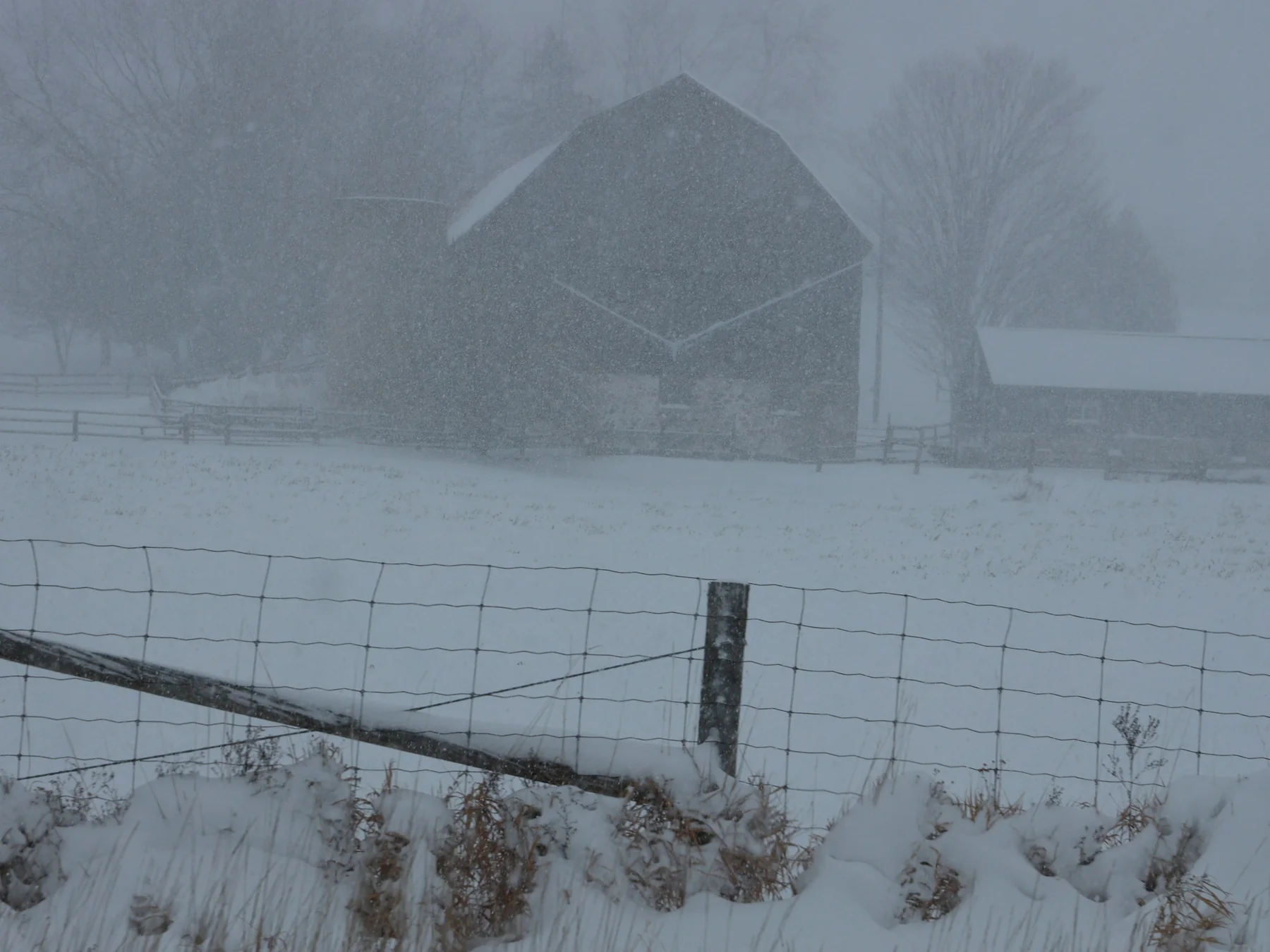
- Blowing snow is snow lifted and transported by wind.
- A blizzard is defined by wind and visibility conditions, not by a required amount of fresh snowfall.
- In the United States, blizzard criteria include sustained winds or frequent gusts of at least 35 mph and very low visibility for at least three hours.
- Ground blizzards can occur when strong winds lift old snow even with little or no new precipitation.
- Snowdrifts form where wind deposits transported snow.
- One storm can leave bare patches beside drifts several feet deep.
Why snow looks white
- Individual ice crystals are mostly transparent.
- A snowbank looks white because light scatters repeatedly among countless ice-air boundaries.
- Visible wavelengths are scattered broadly rather than one color being absorbed strongly.
- The mixed scattered light appears white to human eyes.
- Snow can look blue in deep holes or thick compacted layers.
- Longer red wavelengths are absorbed slightly more strongly during long paths through ice.
- Shorter blue light can therefore dominate light that travels through deep snow.
- Sunset can tint snow orange, pink, or red.
- Dust can turn snow tan or brown.
- Algae can color old snow red, pink, or green.
- So-called watermelon snow is associated with cold-adapted algae.
- Dark particles on snow absorb more solar energy than clean snow.
- That can speed melting.
- Soot deposited on snow and ice can therefore affect climate and water resources.
- Snow is white by scattering, not because frozen water contains a white pigment.
Snow changes sound
- Fresh fluffy snow can make a neighborhood seem unusually quiet.
- Pores between snow crystals absorb and scatter sound.
- That reduces some reflections from the ground.
- As snow becomes compacted or icy, its acoustic behavior changes.
- A hard icy surface can reflect sound more efficiently.
- Snow also makes different sounds underfoot at different temperatures.
- Very cold snow often squeaks or crunches loudly.
- Pressure from a boot fractures and rearranges ice grains.
- Near the melting point, a thin film of liquid water reduces friction between grains.
- That can make warmer snow sound softer.
- Skiers sometimes use snow sound as an informal clue to surface conditions.
- Snow can also alter how traffic noise travels across a landscape.
- Falling snow usually has a modest direct effect on sound compared with deep fresh snow cover.
- The quiet after a snowstorm is therefore partly real physics and partly reduced human activity.
- Fresh snow transforms a landscape acoustically as well as visually.
Snow is an insulator
- Fresh snow contains abundant trapped air.
- Air is a poor conductor of heat.
- A snow layer can therefore insulate the ground below.
- Soil beneath deep snow can remain much warmer than the winter air above.
- That protects plant roots from extreme temperature swings.
- Small mammals can occupy spaces beneath the snowpack.
- This hidden environment is called the subnivean zone.
- Mice, voles, and other animals can travel through subnivean tunnels.
- Snow shelters them from wind.
- It also hides them from some predators.
- Owls and foxes can still detect prey beneath snow by sound and other cues.
- Igloos work partly because compacted snow contains insulating air spaces.
- An occupied snow shelter can be far warmer inside than the outdoor air.
- Ventilation remains important because people produce carbon dioxide and moisture.
- Snow can be both dangerously cold and surprisingly useful as thermal insulation.
Snow stores water
- Mountain snowpack acts as a natural seasonal water reservoir.
- Snow accumulates during cold months.
- Spring and summer melting releases water gradually.
- Many rivers depend heavily on snowmelt.
- Farm irrigation can rely on mountain snowpack far upstream.
- Hydropower planning also depends on snow-water forecasts.
- Snow depth alone does not tell managers how much water is stored.
- Snow water equivalent measures the depth of liquid water contained in a snowpack.
- Dense wet snow can hold much more water than the same depth of dry powder.
- Snowpack sensors and manual surveys measure seasonal water storage.
- Earlier melt can shift river-flow timing.
- Rain falling on snow can accelerate melting and sometimes contribute to flooding.
- Long-term warming is reducing snowpack in many regions.
- Changes in snow affect ecosystems, drinking water, agriculture, recreation, and wildfire conditions.
- For millions of people, winter snow is part of the water supply they will use months later.
Ten surprising snow facts
- Snowflakes grow from water vapor in clouds rather than starting as frozen raindrops.
- Their six-fold symmetry comes from the molecular structure of ordinary ice.
- A fluffy flake can be a cluster of many individual crystals stuck together.
- Graupel is rimed snow, not simply tiny hail.
- A blizzard can happen with little new snowfall if old snow is blown hard enough.
- Snow can fall while the thermometer at ground level reads above freezing.
- Fresh snow can muffle sound because its porous structure absorbs acoustic energy.
- Deep snow can insulate plants and animals from colder air above.
- Mountain snowpack functions as a major seasonal water reservoir.
- For more sky science, explore our cloud facts, lightning facts, and rainbow facts.
Quick snow FAQ
Why do snowflakes have six sides?
Water molecules arrange into a hexagonal crystal lattice in ordinary atmospheric ice, so growing crystals naturally express six-fold symmetry.
Can it snow above 32°F?
Yes. Snow can survive a shallow layer of above-freezing air near the ground, especially when the air is dry enough for evaporative cooling.
Are any two snowflakes identical?
Simple crystals can look nearly identical, but exact duplicates among large complex flakes are extraordinarily unlikely because each follows a different atmospheric path.
Why does snow squeak when it is very cold?
Cold ice grains are harder and have less lubricating meltwater, so pressure from a boot fractures and rubs the crystals in ways that produce a sharper crunch.
What is snow water equivalent?
It is the amount of liquid water contained in a snowpack, a key measurement for forecasting water supply and flood risk.

Ellie is the owner and sole author of Fun Facts, combining her mechanical engineering background with years of research-driven writing to deliver facts you can trust. Every article is thoroughly fact-checked and routinely updated as new science and sources emerge to keep information accurate and current. Her mission is to make learning delightful while upholding high standards of reliability and transparency.