
Chess looks quiet, but every game is a branching explosion of possibilities involving memory, pattern recognition, calculation, psychology, clocks, traps, sacrifices, and centuries of evolving rules. The queen was once a much weaker piece, pawns can transform, kings are never actually captured, and a game can end without either player winning. These 145 chess facts explore the board, pieces, checkmate, castling, en passant, promotion, openings, notation, clocks, world championships, famous players, computers, ratings, puzzles, and the history of a game played almost everywhere on Earth.
Chess basics
- Chess is a strategy game played by two opponents.
- The board has 64 squares.
- Those squares form an eight-by-eight grid.
- Each player begins with 16 pieces.
- White moves first under modern rules.
- Players then alternate moves.
- Each side begins with one king.
- Each side begins with one queen.
- Each side also has two rooks, two bishops, two knights, and eight pawns.
- The objective is checkmate, not physically capturing the king.
- A checkmated king is under attack with no legal escape.
- A player may never make a move that leaves their own king in check.
- A game can end in a draw.
- FIDE governs international competitive chess.
- The official FIDE Laws of Chess define the modern over-the-board rules.
The board has a correct orientation
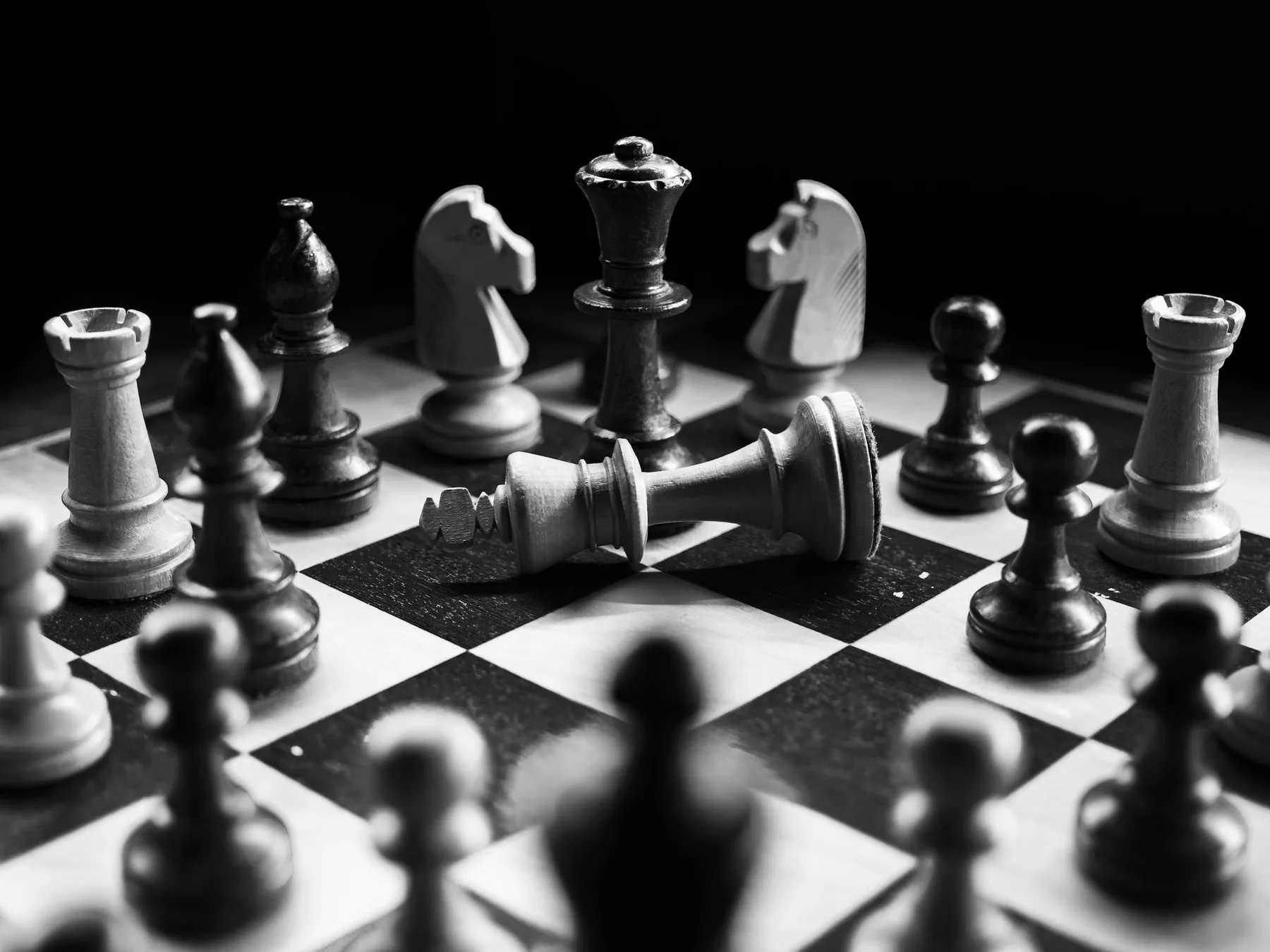
- A chessboard alternates light and dark squares.
- The board must be oriented with a light square at each player’s right-hand corner.
- A common memory aid is “white on right.”
- Files are the vertical columns from White’s viewpoint.
- They are labeled a through h.
- Ranks are horizontal rows.
- They are numbered 1 through 8.
- Every square has a unique coordinate.
- The square e4 means file e, rank 4.
- White’s pieces begin on ranks 1 and 2.
- Black’s pieces begin on ranks 8 and 7.
- Queens begin on squares matching their own color.
- The white queen starts on d1, a light square.
- The black queen starts on d8, a dark square.
- One wrong board orientation changes every coordinate even if the physical pieces seem arranged symmetrically.
Every piece moves differently
- The king moves one square in any direction.
- The queen moves any number of unobstructed squares horizontally, vertically, or diagonally.
- A rook moves any number of unobstructed squares horizontally or vertically.
- A bishop moves any number of unobstructed squares diagonally.
- A knight moves in an L-shaped pattern.
- A knight can jump over other pieces.
- No other ordinary chess piece can jump over an occupied square.
- Pawns move forward but capture diagonally.
- A pawn normally advances one square.
- From its starting square, a pawn may move two squares if both are empty.
- Pawns cannot move backward.
- White pawns travel toward rank 8.
- Black pawns travel toward rank 1.
- Bishops remain on the same color of square for the entire game.
- Each piece’s movement pattern creates a different geometry of attack and defense.
Castling moves two pieces at once
- Castling is the only standard chess move that moves two pieces for one player.
- It involves the king and one rook.
- The king moves two squares toward the rook.
- The rook jumps to the square immediately beyond the king.
- Kingside castling is written O-O.
- Queenside castling is written O-O-O.
- A player cannot castle if the king has previously moved.
- A player cannot castle with a rook that has previously moved.
- The squares between king and rook must be empty.
- The king may not be in check when castling.
- The king may not cross a square under enemy attack.
- The king may not end on an attacked square.
- The rook may pass through an attacked square because the restriction applies to the king.
- Castling usually improves king safety while activating a rook.
- The move developed historically as chess sped up and players needed a practical way to connect rooks and protect the king.
En passant confuses almost everyone once
- En passant is a special pawn capture.
- The name is French for “in passing.”
- It becomes possible when an enemy pawn moves two squares from its starting position.
- The moving pawn must land beside one of your pawns.
- Your pawn may capture it as though it had moved only one square.
- The capture must be made immediately on the next move.
- If you play another move first, the en passant opportunity disappears.
- The capturing pawn moves diagonally forward one square.
- The enemy pawn is removed from the adjacent square it actually reached.
- The rule prevents the two-square first move from letting a pawn bypass an enemy pawn’s control completely.
- En passant was added after the double-step pawn move developed.
- It is legal but relatively uncommon.
- It can expose files unexpectedly.
- It can even create or remove checks through discovered lines.
- A rare move that looks like cheating to beginners is actually one of chess’s oldest balancing mechanisms.
Pawns can become queens
- A pawn promotes when it reaches the farthest rank.
- White promotes on rank 8.
- Black promotes on rank 1.
- The pawn must immediately become another piece.
- It can promote to a queen.
- It can also become a rook, bishop, or knight.
- It cannot remain a pawn.
- It cannot promote to a king.
- A player may choose a piece even if that original piece is still on the board.
- This means a player can legally have two queens.
- Three or more queens are theoretically possible too.
- Choosing something other than a queen is called underpromotion.
- Knight underpromotion can deliver checks a queen cannot.
- Rook or bishop underpromotion can sometimes avoid stalemate.
- A humble pawn can therefore become the most powerful piece on the board if it survives the entire journey.
Checkmate is not the only ending
- A player can resign before being checkmated.
- Competitive players often resign when defeat is clearly unavoidable.
- Stalemate is a draw.
- Stalemate occurs when the player to move has no legal move but is not in check.
- A game is drawn if neither side can possibly checkmate with the remaining material.
- King versus king is an automatic dead position.
- King and bishop versus king cannot force checkmate.
- King and knight versus king cannot force checkmate.
- Players can agree to a draw under permitted competitive rules.
- Threefold repetition can allow a draw claim.
- Fivefold repetition can end a game automatically under current FIDE rules.
- The fifty-move rule can allow a draw claim after 50 moves by each player without a pawn move or capture.
- A 75-move version can produce an automatic draw under current FIDE rules, subject to checkmate priority.
- Running out of time can lose a game.
- However, if the opponent has no possible way to checkmate, a flag fall results in a draw rather than a win.
Chess clocks changed the game
- Early serious chess games could last extremely long without formal time limits.
- Sandglasses were used in some 19th-century competitions.
- Mechanical chess clocks later became standard.
- A chess clock contains two timers linked so only one runs at a time.
- After moving, a player presses their clock.
- This stops their timer and starts the opponent’s.
- Digital clocks allow more complex time controls.
- An increment adds time after each move.
- A delay waits before deducting time from a player’s remaining clock.
- Classical chess gives players substantial thinking time.
- Rapid chess uses shorter controls.
- Blitz is faster still.
- Bullet chess is an informal popular term for extremely fast games, often one minute per player online.
- Time pressure changes the value of practical decisions.
- A position that is theoretically winning may become impossible to convert if the player has only seconds left.
Computers transformed chess
- People began imagining chess-playing machines centuries before electronic computers.
- The 18th-century Mechanical Turk appeared to play chess automatically.
- It was actually a hoax with a hidden human operator.
- Real computer chess developed during the 20th century.
- Alan Turing designed a chess algorithm before he had a computer powerful enough to run it normally.
- IBM’s Deep Blue defeated world champion Garry Kasparov in a 1997 match.
- The victory became a milestone in artificial-intelligence history.
- Modern chess engines are vastly stronger than the best human players.
- Stockfish is a leading open-source engine.
- AlphaZero demonstrated a different machine-learning approach to chess.
- Engines changed opening preparation.
- They also transformed post-game analysis.
- Online chess sites automatically detect suspicious patterns that may indicate computer assistance.
- Engine use during an ordinary competitive game is cheating unless specifically permitted by the format.
- Computers did not kill chess; they created an era where humans can study with superhuman analytical partners.
Ten surprising chess facts
- The king is never actually captured in standard chess.
- Castling moves two pieces in one turn.
- A rook is allowed to cross an attacked square during castling, but the king is not.
- En passant is legal only immediately after the opponent’s two-square pawn move.
- A pawn can legally promote to a second queen even if the first queen remains on the board.
- Stalemate is a draw rather than a loss.
- A player can lose on time even while having more material.
- The famous Mechanical Turk chess machine was a hidden-human hoax.
- Modern engines are far stronger than any human chess player.
- For more game trivia, explore our video-game facts and Random facts.
Quick chess FAQ
How many pieces are in a chess game?
Thirty-two at the start, with 16 pieces for each player.
Does White always move first?
Yes under modern standard chess rules.
What is checkmate?
A position where the king is under attack and the player has no legal move that removes the threat.
What is en passant?
A special pawn capture available immediately after an adjacent enemy pawn advances two squares from its starting position.
Can you have two queens in chess?
Yes. Any pawn reaching the farthest rank can promote to a queen even if the original queen is still on the board.

Ellie is the owner and sole author of Fun Facts, combining her mechanical engineering background with years of research-driven writing to deliver facts you can trust. Every article is thoroughly fact-checked and routinely updated as new science and sources emerge to keep information accurate and current. Her mission is to make learning delightful while upholding high standards of reliability and transparency.