
Video games grew from laboratory experiments and blinking oscilloscope dots into a global medium spanning phones, consoles, computers, virtual reality, museums, competitive arenas, and enormous online worlds. Their history is filled with accidental mascots, hardware limits that became art styles, cartridges you really should not blow into, and design tricks players barely notice. These 145 facts explore the technology, history, genres, controllers, graphics, sound, esports, and culture behind gaming.
Video game basics
- A video game is an interactive electronic game displayed through a visual system.
- Video games can run on consoles, computers, phones, tablets, arcade machines, and specialized hardware.
- A game engine provides reusable systems for rendering, physics, audio, input, and other functions.
- Not every video game uses a commercial game engine.
- Game code determines rules, logic, interactions, and responses to player input.
- Graphics can be two-dimensional, three-dimensional, text-based, abstract, or photorealistic.
- Players interact using controllers, keyboards, mice, touchscreens, motion sensors, cameras, or other devices.
- A game loop repeatedly processes input, updates the game state, and draws results.
- Frame rate measures how many images a game produces each second.
- Resolution describes the number of pixels used to display an image.
- Higher resolution does not automatically make a game more fun or artistically effective.
- Latency measures delay between an action and the system’s response.
- Low latency is especially important in fast competitive games.
- Single-player games focus on one player’s experience.
- Multiplayer games let two or more people compete or cooperate.

Early electronic games
- Experiments resembling video games appeared before commercial home consoles existed.
- The Cathode-Ray Tube Amusement Device was patented in the United States in 1948.
- It used analog electronics and a cathode-ray tube rather than a digital computer.
- Alexander Douglas created a tic-tac-toe program called OXO in 1952.
- OXO ran on the EDSAC computer at the University of Cambridge.
- William Higinbotham created Tennis for Two in 1958.
- Tennis for Two displayed a simple tennis-like game on an oscilloscope.
- It was demonstrated to visitors at Brookhaven National Laboratory.
- Spacewar! was created at MIT in 1962.
- It ran on a DEC PDP-1 minicomputer.
- Spacewar! featured two spacecraft battling near a gravity-producing star.
- The game spread to other research institutions with compatible computers.
- Early computer games were often made by researchers and students rather than commercial studios.
- Expensive computer hardware limited who could experience them.
- The Computer History Museum preserves major artifacts from this early video-game history.
The first home console era
- Ralph Baer is often called the father of home video games.
- Baer developed prototypes for playing electronic games on ordinary televisions.
- His “Brown Box” prototype helped lead to the Magnavox Odyssey.
- The Magnavox Odyssey was released in 1972.
- It became the first commercial home video-game console.
- The Odyssey used removable circuit cards to configure different games.
- Its graphics were extremely simple by modern standards.
- Some Odyssey games used plastic overlays placed directly on the television screen.
- The system did not use a microprocessor.
- It also lacked modern sound effects generated by the console.
- Pong became an arcade sensation in the early 1970s.
- Atari released the original Pong arcade game in 1972.
- The game simplified table tennis into two paddles and a moving square ball.
- Its minimal rules made it immediately understandable to new players.
- Home versions of Pong helped normalize video games as living-room entertainment.
Cartridges changed home gaming
- Early dedicated consoles could play only games built into the hardware.
- Interchangeable game cartridges let one machine run many different programs.
- The Fairchild Channel F, released in 1976, was an early programmable cartridge-based console.
- The Atari Video Computer System launched in 1977.
- It was later widely known as the Atari 2600.
- The Atari 2600 used removable cartridges containing game data.
- Its success helped establish the cartridge business model.
- Limited memory forced developers to use remarkable programming tricks.
- Early console graphics were built from tiny sprites, simple shapes, and repeated patterns.
- Programmers sometimes reused the same memory for multiple visual purposes.
- The recognizable pixel-art look partly grew from severe hardware limitations.
- Cartridge contacts can oxidize or become dirty over time.
- Blowing into game cartridges was a famous player habit.
- Moisture from breath can actually promote corrosion rather than providing a safe cleaning method.
- Cleaning contacts properly is better than treating an old cartridge like a birthday candle.

Arcades create a gaming boom
- Arcades became major social gaming spaces during the late 1970s and 1980s.
- Space Invaders was released in Japan in 1978.
- Its accelerating enemies created increasing tension as a level progressed.
- Asteroids arrived in 1979.
- It used vector graphics rather than ordinary raster sprites.
- Pac-Man debuted in Japan in 1980.
- Pac-Man was designed by Toru Iwatani at Namco.
- The character’s simple circular design became one of gaming’s most recognizable icons.
- Donkey Kong debuted in arcades in 1981.
- It introduced the character who became Mario to a wide audience.
- The hero was initially called Jumpman.
- Mario later received his familiar name and plumber identity.
- High-score tables made arcade performance public and competitive.
- Players could leave initials beside their best scores.
- Arcade design rewarded games that were easy to understand but difficult to master.
The crash and Nintendo revival
- The North American video-game market suffered a major crash in 1983.
- Too many low-quality games and competing systems contributed to collapsing consumer confidence.
- Retailers were left with large inventories that became difficult to sell.
- Atari’s E.T. the Extra-Terrestrial became a symbol of the crash.
- The game was rushed to market for the 1982 holiday season.
- Unsold Atari products were famously buried at a landfill in Alamogordo, New Mexico.
- An excavation in 2014 confirmed that cartridges really were buried there.
- Nintendo released the Family Computer, or Famicom, in Japan in 1983.
- A redesigned version launched in North America as the Nintendo Entertainment System.
- The NES reached U.S. test markets in 1985.
- Nintendo marketed the system carefully to avoid the damaged image of earlier game consoles.
- The company enforced licensing rules for games released on its platform.
- Super Mario Bros. became one of the NES’s defining games.
- The NES helped revive the North American home-console market.
- Nintendo’s influence shaped controller design, platform licensing, mascots, and game genres for decades.
Controllers evolved with games
- Early game controllers often used knobs, switches, or simple joysticks.
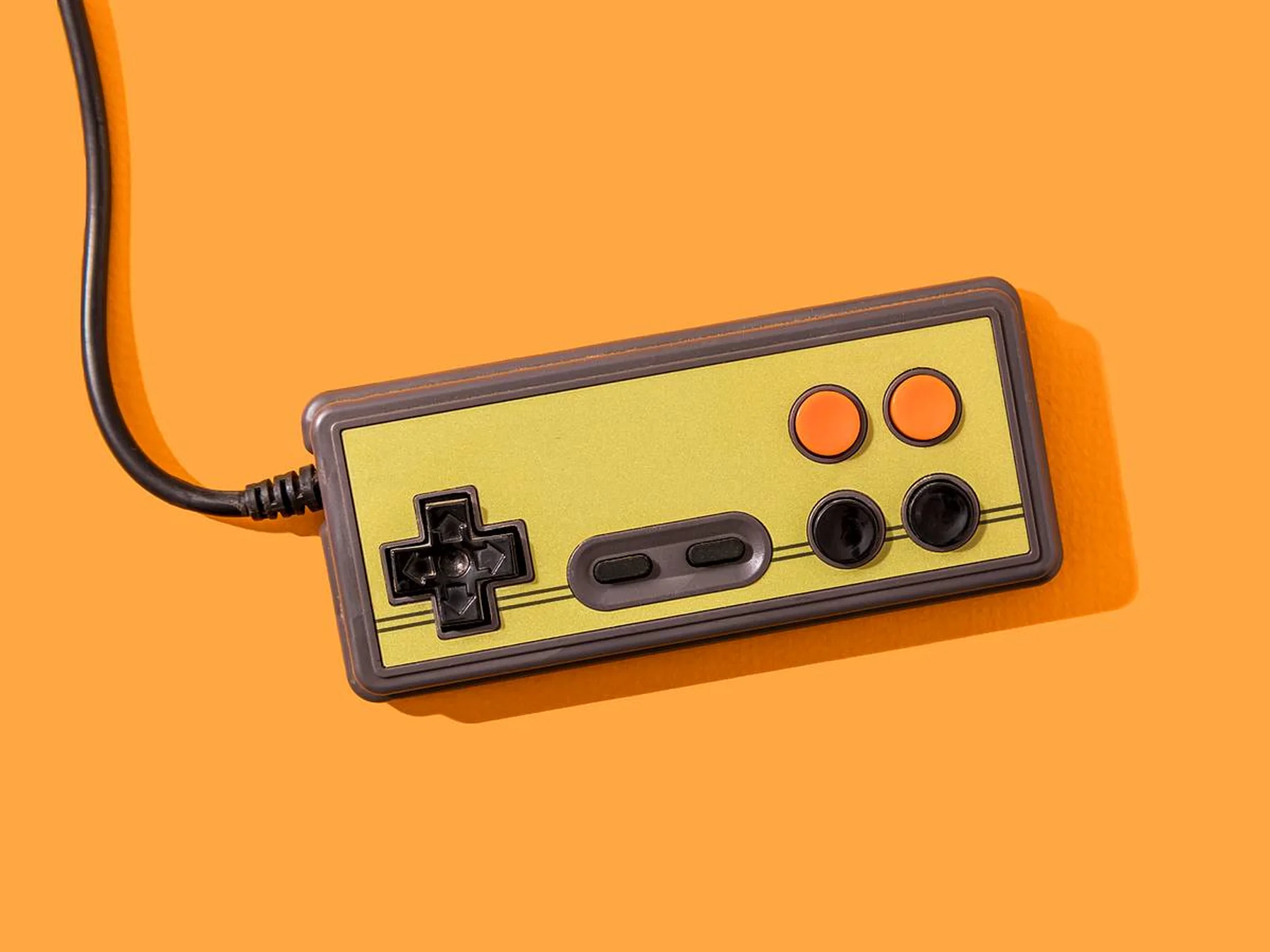
- The directional pad, or D-pad, became a standard feature on gamepads.
- Nintendo popularized the cross-shaped D-pad on handhelds and home controllers.
- Additional face buttons let games support more complex actions.
- Shoulder buttons put controls under players’ index fingers.
- Analog sticks allow continuous directional input rather than only eight digital directions.
- The Nintendo 64 controller prominently used an analog stick for 3D movement.
- Sony’s Dual Analog and DualShock controllers made twin analog sticks highly influential.
- Vibration feedback lets games communicate through touch.
- Motion controls detect controller orientation or movement.
- The Nintendo Wii made motion-controlled gaming a mass-market phenomenon.
- Touchscreens became major gaming interfaces through phones and handheld systems.
- Adaptive controllers can make games more accessible to players with disabilities.
- Modern controllers may include microphones, speakers, gyroscopes, touchpads, and advanced haptic motors.
- Controller design reflects the kinds of actions game designers expect players to perform.

How 3D graphics transformed games
- Three-dimensional games existed long before consoles could render detailed polygonal worlds.
- Wireframe graphics represented 3D objects using lines instead of filled surfaces.
- Polygons became the basic building blocks for many 3D game models.
- Textures place detailed images across polygon surfaces.
- Lighting calculations help create depth, mood, and material appearance.
- Perspective projection makes distant objects appear smaller.
- Texture filtering reduces harsh pixel changes as surfaces move farther from the camera.
- Anti-aliasing helps smooth jagged visual edges.
- Level of detail systems can use simpler models for distant objects.
- This saves processing power where fine details would barely be visible.
- Real-time rendering must create frames quickly enough for interactive play.
- Pre-rendered graphics can look more detailed because they do not need to be calculated instantly.
- Ray tracing models paths of light to create realistic reflections, shadows, and illumination.
- Modern games often combine traditional rasterization with selected ray-traced effects.
- The graphics processor, or GPU, performs huge numbers of parallel calculations needed for modern game visuals.
Online games and esports
- Multiplayer computer gaming existed across networks before the public Web.
- MUDs were text-based multiplayer virtual worlds that flourished on early computer networks.
- MUD stands for Multi-User Dungeon or closely related expansions.
- Online games require systems to synchronize player actions across network delays.
- Lag is the visible effect of unwanted network or processing delay.
- Game servers often act as authoritative referees for shared online worlds.
- Matchmaking systems try to find suitable opponents or teammates.
- Massively multiplayer online games can support large persistent player communities.
- Esports turns competitive video gaming into organized spectator competition.
- Competitive gaming tournaments existed decades before modern streaming platforms.
- Arcade score competitions were early forms of public video-game competition.
- Real-time strategy, fighting, shooter, sports, and multiplayer battle-arena games became major esports genres.
- Professional players train reaction time, teamwork, strategy, and game-specific mechanics.
- Streaming platforms let viewers watch live gameplay from anywhere with internet access.
- Video games now function simultaneously as software, sport, art, social space, storytelling medium, and business.
Ten surprising video-game facts
- Video games were being demonstrated before humans had reached the Moon.
- The first home console could not generate the rich sound or graphics even basic toys can today.
- Mario began his career under the name Jumpman.
- The Atari landfill legend turned out to contain a real burial of cartridges.
- Pixel art began partly as a clever response to tiny memory and crude displays.
- Blowing into a cartridge can add moisture that is bad for its contacts.
- The internet enabled online gaming before the World Wide Web existed.
- Some early multiplayer worlds were made almost entirely of text.
- Modern game controllers contain more computing and sensing technology than entire early consoles.
- For more gaming history, explore our Tech facts, computer facts, and internet facts.
Quick video-game FAQ
What was the first video game?
There is no single answer because different early machines meet different definitions. Important milestones include OXO in 1952, Tennis for Two in 1958, and Spacewar! in 1962.
What was the first home video-game console?
The Magnavox Odyssey, released in 1972, is recognized as the first commercial home video-game console.
Why did the video-game market crash in 1983?
The North American market was hurt by an oversupply of consoles and games, inconsistent quality, retailer problems, competition from home computers, and collapsing consumer confidence.
Why do games need high frame rates?
Higher frame rates can make motion look smoother and reduce the time between game updates and displayed feedback, although visual quality depends on many other factors too.
What is esports?
Esports is organized competitive video gaming, often involving professional players, teams, tournaments, live audiences, broadcasts, and online streaming.

Ellie is the owner and sole author of Fun Facts, combining her mechanical engineering background with years of research-driven writing to deliver facts you can trust. Every article is thoroughly fact-checked and routinely updated as new science and sources emerge to keep information accurate and current. Her mission is to make learning delightful while upholding high standards of reliability and transparency.