
Belgium is small enough to cross in a few hours yet complicated enough to have three official languages, three regions, three communities, multiple parliaments, a king, medieval cities, surrealist painters, comic-book heroes, world-famous beer, elaborate chocolate, and one of Europe’s busiest political capitals. These 145 Belgium facts explore Brussels, Flanders, Wallonia, language, federal government, monarchy, independence, World Wars, EU institutions, waffles, fries, beer, chocolate, comics, art, the Atomium, and the surprising history packed into one compact country.
Belgium basics
- Belgium is a country in western Europe.
- Its official name is the Kingdom of Belgium.
- Brussels is the federal capital.
- Belgium borders France, the Netherlands, Germany, and Luxembourg.
- The North Sea forms a short coastline in the northwest.
- Belgium has three official languages.
- They are Dutch, French, and German.
- The country uses the euro.
- Belgium is a constitutional parliamentary monarchy.
- It is also a federal state.
- Belgium became independent in 1830.
- The country has ten provinces.
- Brussels-Capital Region is not part of any province.
- The highest point is Signal de Botrange, about 694 meters above sea level.
- The official Belgium.be guide to the federal state explains the country’s unusually layered political structure.
Three regions and three communities
- Belgium’s federal system divides power among several levels of government.
- There are three regions.
- They are the Flemish Region, Walloon Region, and Brussels-Capital Region.
- Regions handle many territory-based responsibilities.
- Those include areas such as housing, environment, agriculture, and regional economic policy.
- Belgium also has three language communities.
- They are the Flemish Community, French Community, and German-speaking Community.
- Communities handle people-related matters such as culture and education.
- The boundaries of regions and communities do not line up perfectly.
- Brussels is officially bilingual in French and Dutch.
- Most Brussels residents use French more commonly in everyday life.
- The German-speaking Community lies in eastern Belgium near Germany.
- Flemish regional and community institutions are largely merged.
- The French Community often uses the name Fédération Wallonie-Bruxelles.
- Belgian federalism evolved through repeated state reforms rather than being designed in one moment.
Belgium became independent in 1830
- Much of modern Belgium was ruled by different European powers before independence.
- The region belonged at times to the Spanish and Austrian Habsburgs.
- Revolutionary and Napoleonic France later controlled it.
- After Napoleon’s defeat, the area became part of the United Kingdom of the Netherlands.
- Tensions grew between southern and northern parts of that kingdom.
- Religious, political, economic, and linguistic differences all contributed.
- A revolution began in Brussels in 1830.
- Belgian rebels declared independence.
- A National Congress drafted a constitution.
- The constitution was approved in 1831.
- Belgium chose a constitutional monarchy rather than a republic.
- Prince Leopold of Saxe-Coburg became the first King of the Belgians.
- He took the oath on July 21, 1831.
- Belgium celebrates National Day on July 21.
- International recognition and borders were finalized through diplomacy over the following years.
Why the monarch is King of the Belgians
- The Belgian monarch’s traditional title is King of the Belgians.
- That wording emphasizes a constitutional relationship with citizens rather than ownership of territory.
- Belgian kings do not exercise personal political power independently.
- Government ministers take political responsibility for official royal acts.
- Belgium’s current monarch is King Philippe.
- He became king in 2013.
- He succeeded his father, King Albert II.
- Queen Mathilde is Belgium’s queen consort.
- The monarch formally signs laws alongside responsible ministers.
- Royal consultations can matter during government formation.
- Belgian coalition negotiations can take a long time because of party and linguistic complexity.
- The king meets political leaders during those processes.
- The monarchy also performs diplomatic and ceremonial roles.
- Belgian royal history began only after independence.
- The dynasty is younger than many of the medieval cities and institutions inside the country it represents.
Brussels is more than Belgium’s capital
- Brussels is one of Europe’s major political centers.
- The European Commission is based there.
- The Council of the European Union meets primarily in Brussels.
- The European Council also meets there.
- The European Parliament holds much of its committee and plenary work in Brussels, although its official plenary seat is Strasbourg.
- NATO headquarters is in Brussels.
- Thousands of diplomats, officials, journalists, lobbyists, and international workers live in the region.
- Brussels is officially bilingual.
- Street signs appear in both French and Dutch.
- The city is surrounded geographically by Dutch-speaking Flanders.
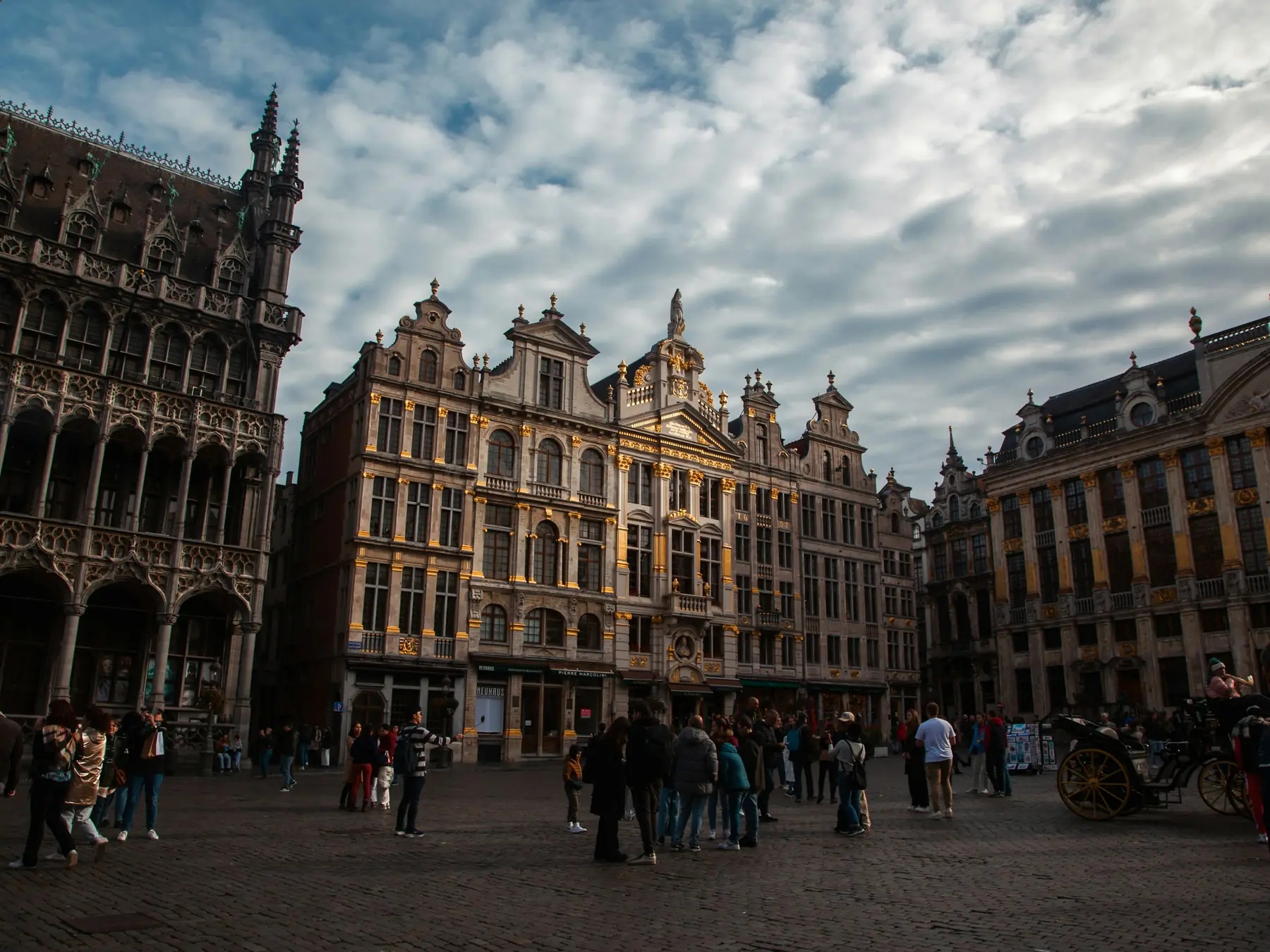
- The historic center includes the Grand-Place.
- The Grand-Place is a UNESCO World Heritage site.
- Its ornate guildhalls were rebuilt after a French bombardment in 1695.
- Brussels is also famous for Art Nouveau architecture.
- Its international institutions make the city both a national capital and a practical capital of European diplomacy.
Flanders and Wallonia are very different landscapes
- Flanders occupies northern Belgium.
- Dutch is its official regional language.
- People often call the local Dutch varieties Flemish.
- Flemish is not one completely separate standardized language from Dutch.
- Belgian Dutch has distinctive accents, vocabulary, and usage.
- Wallonia occupies southern Belgium.
- French is dominant across most of Wallonia.
- A small eastern area is officially German-speaking.
- Northern Belgium is generally flatter.
- Southern Belgium includes the wooded Ardennes uplands.
- Historically, Wallonia industrialized early around coal and steel.
- Flanders later became the stronger economic region by many modern measures.
- Those economic changes influenced federal politics.
- Regional identity is strong in both north and south.
- Belgium’s internal diversity helps explain why its government looks complicated to outsiders.
Belgium was devastated in two world wars
- Belgium declared neutrality before World War I.
- Germany invaded Belgium in August 1914.
- The invasion helped bring Britain into the war.
- Much of Belgium was occupied for most of the conflict.
- Flanders became a major battlefield.
- Ypres was surrounded by repeated battles.
- Poison gas was used on a large scale near Ypres in 1915.
- The word Ypres is connected with the chemical weapon name mustard gas through wartime terminology.
- Belgium was invaded again by Germany in 1940.
- The country fell after 18 days of fighting.
- King Leopold III surrendered with the army.
- The government continued the war from exile.
- Belgium was liberated by Allied forces beginning in 1944.
- The Battle of the Bulge affected eastern and southern Belgium during the winter of 1944-45.
- War cemeteries and memorials remain prominent parts of the Belgian landscape.
Belgian beer is a cultural tradition
- Belgium has an unusually diverse beer culture.
- Beer styles include lambic, gueuze, saison, witbier, dubbel, tripel, and many others.
- Lambic fermentation traditionally involves microorganisms from the surrounding environment.
- Gueuze blends young and older lambic before bottle conditioning.
- Trappist beer is brewed within or under the control of a Trappist monastery under specific certification rules.
- Not every Belgian abbey-style beer is Trappist.
- Belgian beer often has its own recommended glass shape.
- Glassware can emphasize aroma, foam, or serving tradition.
- Belgian beer culture was added to UNESCO’s Representative List of the Intangible Cultural Heritage of Humanity in 2016.
- Monastic brewing traditions influenced Belgian beer history.
- Farmhouse brewing shaped saison traditions.
- Industrial lager is also widely consumed.
- Belgian beer is not one flavor profile.
- The country’s brewing reputation comes from diversity as much as any individual style.
- Beer cafés can offer menus with hundreds of different labels.
Waffles, fries, and chocolate
- Belgium has more than one major waffle tradition.
- Brussels waffles are light, rectangular, and crisp.
- Liège waffles are denser, sweeter, and made with pearl sugar.
- Calling all Belgian waffles one single recipe misses important regional differences.
- Fries are deeply embedded in Belgian food culture.
- They are commonly sold at dedicated fry stands called friteries or frituren.
- Belgian fries are often served with mayonnaise or a large range of sauces.
- The exact origin of french fries is disputed.
- Belgian claims of invention are famous but not conclusively proven.
- Belgium became a major center of chocolate production in the 19th and 20th centuries.
- Jean Neuhaus developed the filled chocolate praline in Brussels in 1912.
- The ballotin box was created soon afterward to protect delicate pralines.
- Belgian chocolatiers became known for molded shells, ganaches, pralines, and luxury presentation.
- Mussels with fries are a classic Belgian dish.
- Food in Belgium reflects French, Dutch, German, regional, and colonial-era influences rather than one simple national cuisine.
Ten surprising Belgium facts
- Belgium has three official languages.
- Its federal system includes both three regions and three language communities.
- Brussels is officially bilingual even though French is more commonly spoken.
- The monarch is styled King of the Belgians rather than simply King of Belgium.
- Belgium’s National Day marks Leopold I taking the constitutional oath in 1831.
- NATO and several major European Union institutions are headquartered or primarily based in Brussels.
- Belgian beer culture is recognized by UNESCO as intangible cultural heritage.
- Liège waffles and Brussels waffles are genuinely different styles.
- The claim that Belgium definitely invented french fries is famous but historically disputed.
- For more European trivia, explore our Netherlands facts, France facts, and Culture facts.
Quick Belgium FAQ
What is the capital of Belgium?
Brussels, which is also a major center for the European Union and NATO.
What languages are spoken in Belgium?
Dutch, French, and German are official languages. Dutch dominates Flanders, French dominates most of Wallonia, and Brussels is officially French-Dutch bilingual.
Is Belgium a monarchy?
Yes. Belgium is a constitutional parliamentary monarchy and federal state.
What is the difference between Flanders and Wallonia?
Flanders is the Dutch-speaking northern region, while Wallonia covers the mainly French-speaking south plus the German-speaking area in the east.
Did Belgium invent french fries?
Belgium has an exceptionally strong fry tradition and famous origin stories, but historians do not have conclusive evidence proving one uncontested national invention.

Ellie is the owner and sole author of Fun Facts, combining her mechanical engineering background with years of research-driven writing to deliver facts you can trust. Every article is thoroughly fact-checked and routinely updated as new science and sources emerge to keep information accurate and current. Her mission is to make learning delightful while upholding high standards of reliability and transparency.