
Surfing is part sport, part ocean science, and part cultural tradition with deep Polynesian roots. A rider has to read waves that are changing every second, generate speed without a motor, balance on a board shaped for a particular kind of break, and respect forces created by storms thousands of miles away. These 145 surfing facts explore Hawaiian history, boards, waves, maneuvers, competition, big-wave riding, safety, wildlife, technology, and the Olympics.
Surfing basics
- Surfing means riding a moving wave using a board or another wave-riding craft.
- Modern competitive surfing is usually performed on shortboards.
- Longboard surfing remains a major discipline of its own.
- Surfers usually paddle with their arms to catch an unbroken wave.
- They rise from lying down to standing in a movement called the pop-up.
- A surfer rides along the open face of the wave rather than simply straight toward shore when possible.
- The unbroken part ahead of the surfer is often called the shoulder.
- The breaking whitewater behind the rider is the foam or wash.
- A wave that breaks from the surfer’s right to left is described differently depending on the rider’s perspective.
- Surfers call a wave a right when it peels to the rider’s right while facing shore.
- A left peels to the rider’s left.
- A peak can sometimes offer a right and left from the same takeoff area.
- Wave quality depends on swell, wind, tide, bottom shape, and coastline orientation.
- No two rides are exactly identical because the ocean surface never repeats perfectly.
- The International Surfing Association is recognized by the IOC as surfing’s world governing authority.
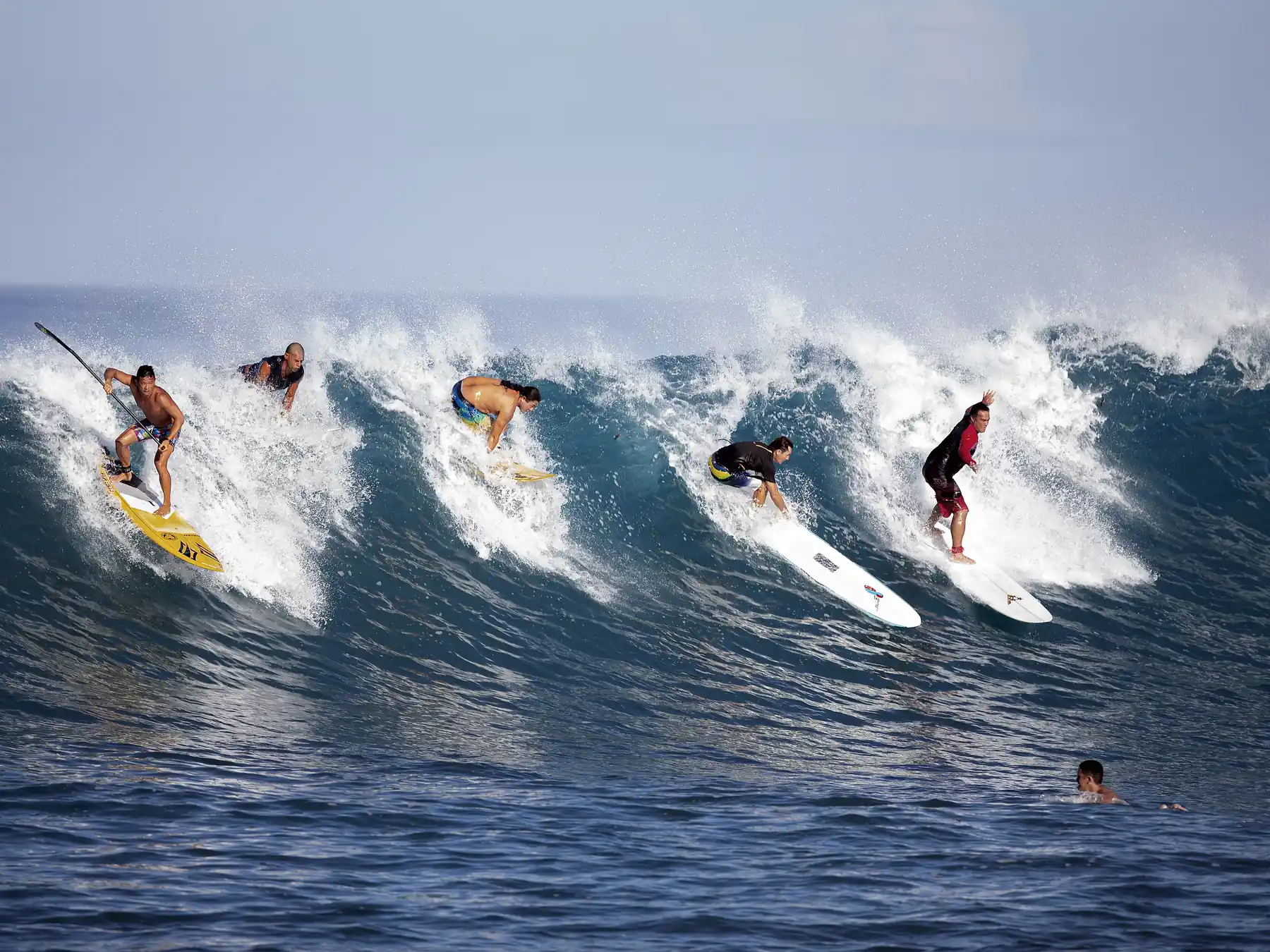
Surfing has deep Polynesian roots
- Wave riding existed in Polynesia long before Europeans reached the Pacific islands.
- Hawaiian culture developed especially sophisticated surfing traditions.
- Surfing in Hawaiian is commonly associated with the term heʻe nalu.
- Surfing had social, recreational, spiritual, and status dimensions in old Hawaiʻi.
- Traditional boards were made from local woods.
- Different board forms were associated with different riders and uses.
- Some traditional Hawaiian boards were much longer and heavier than modern boards.
- Surf breaks could carry social and cultural significance.
- European visitors described Hawaiian surfing during the 18th century.
- Colonialism, disease, missionary influence, and social disruption contributed to surfing’s decline in 19th-century Hawaiʻi.
- The sport never disappeared completely.
- A Hawaiian revival helped restore surfing around the turn of the 20th century.
- Waikīkī became a major center of that revival.
- Native Hawaiian surfers shared the sport with visitors from around the world.
- Modern global surfing grew from Indigenous Pacific traditions rather than being invented by California beach culture.
Duke Kahanamoku spreads surfing worldwide
- Duke Kahanamoku was born in Honolulu in 1890.
- He became an Olympic swimming champion.
- Kahanamoku won gold in the 100-meter freestyle at the 1912 Stockholm Olympics.
- He won additional Olympic medals across several Games.
- Duke was also an exceptional surfer.
- He gave surfing demonstrations while traveling internationally.
- His exhibitions helped introduce surfing to audiences in mainland North America and Australia.
- A famous Australian demonstration occurred at Freshwater Beach near Sydney in 1914 and 1915.
- Kahanamoku shaped his own wooden surfboard for the demonstration.
- He became known as the father of modern surfing.
- That nickname recognizes his global promotion rather than suggesting he invented the ancient sport.
- Duke later worked as sheriff of Honolulu.
- He appeared in films.
- He advocated for surfing to become an Olympic sport.
- More than a century after his Olympic swimming career began, surfing finally debuted on the Olympic program.
How waves become surfable
- Most surfable ocean waves begin with wind transferring energy to the sea surface.
- Distant storms can generate swell that travels thousands of kilometers.
- Swell transports energy rather than the same water mass traveling all the way to shore.
- Wave period measures time between successive wave crests.
- Long-period swell generally carries more organized energy than short local chop of similar height.
- As swell reaches shallow water, the seafloor begins affecting it.
- The lower part of the wave slows through interaction with the bottom.
- The wave grows steeper.
- Eventually it becomes unstable and breaks.
- The depth at which a wave breaks depends partly on wave height and bottom slope.
- Bathymetry means the underwater shape and depth of the seafloor.
- Small differences in bathymetry can determine whether a break is excellent or unsurfable.
- Refraction bends waves as different parts slow in different depths.
- Refraction can focus swell energy onto points and reefs.
- Surf forecasting is therefore a combination of meteorology, oceanography, and local geography.
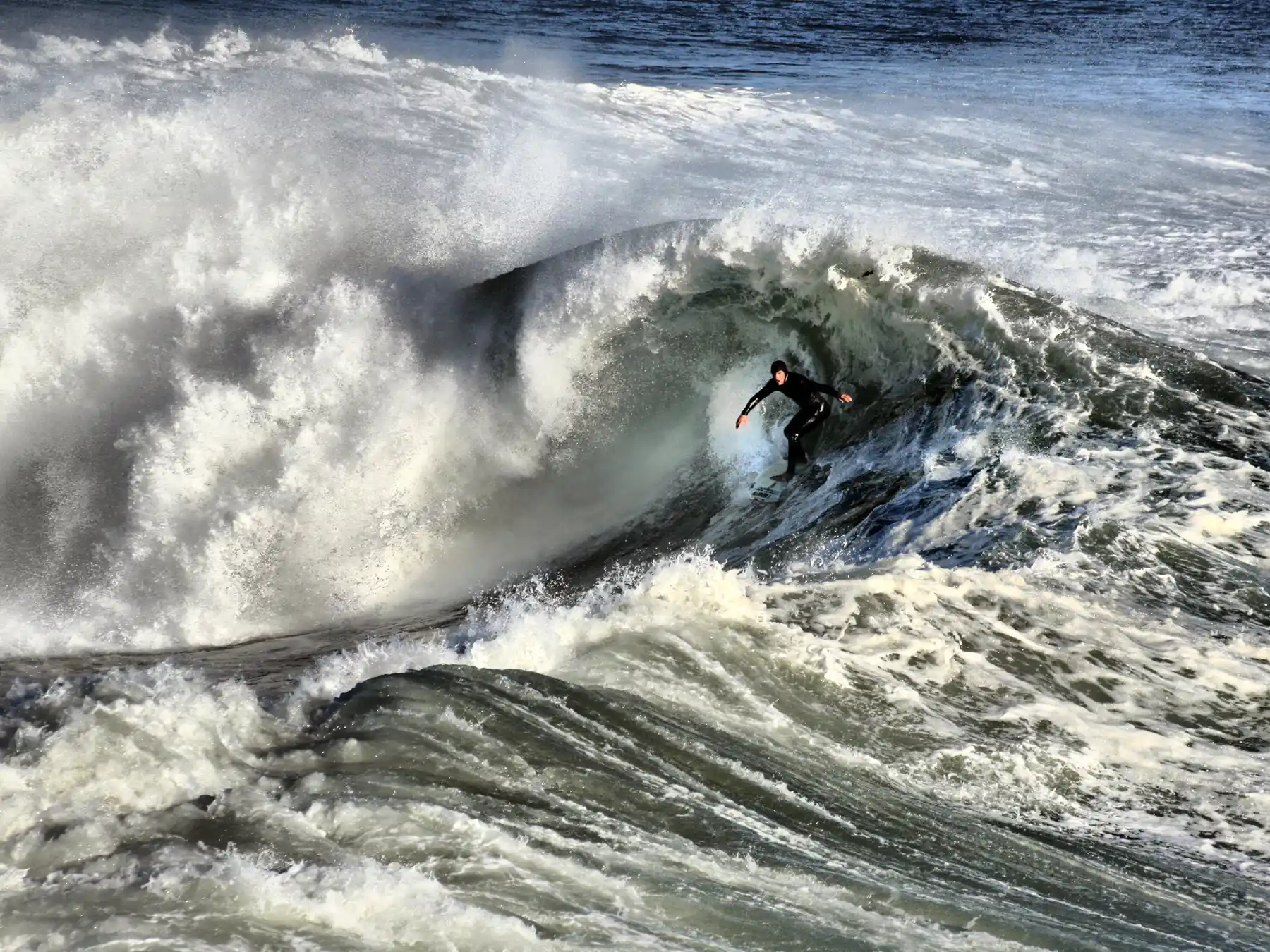
Beach, reef, and point breaks
- A beach break forms over sand.
- Sandbars shift with currents and storms.
- That means a beach break can change shape from week to week.
- A reef break forms over rock or coral reef.
- Reef bathymetry is relatively fixed compared with sand.
- Reef breaks can therefore produce more consistent wave shapes.
- They can also be hazardous because the bottom may be shallow and hard.
- A point break peels along a projecting coastline or headland.
- Point breaks can produce unusually long rides.
- River mouths can create surf breaks through sand deposition.
- Jetties and harbor structures can alter local wave patterns too.
- A-frame peaks break in both directions from a central high point.
- Closeouts break across most of the wave at nearly the same time.
- Surfers prefer waves that peel progressively because the open face remains rideable.
- The quality of a surf spot is a product of underwater geometry as much as the visible beach.
Surfboard design
- Modern surfboards are usually built around a lightweight foam core.
- Fiberglass cloth and resin form a hard outer shell on many boards.
- Expanded-polystyrene cores are often paired with epoxy resin.
- Polyurethane foam is commonly paired with polyester resin.
- Board length changes paddling, stability, turning, and maneuverability.
- Width adds planing area and stability.
- Thickness affects buoyancy and volume.
- Rocker is the curve from nose to tail.
- More rocker can help a board fit steep curved waves.
- Less rocker can increase speed and paddling efficiency on flatter waves.
- Rails are the shaped edges of the board.
- Bottom contours manage water flow.
- Fins provide directional control and influence turning.
- Single-fin, twin-fin, thruster, and quad setups create different handling characteristics.
- The thruster, a three-fin setup popularized by Simon Anderson in 1981, became a dominant high-performance design.
Why surfers wax their boards
- A wet fiberglass surfboard can be extremely slippery.
- Surf wax creates tacky texture under a rider’s feet and torso.
- Surfers apply wax mainly to the deck.
- Different wax formulas are designed for different water temperatures.
- Warm-water wax is generally harder.
- Cold-water wax remains tacky at lower temperatures.
- Some surfers apply a harder base coat first.
- A softer top coat adds grip.
- Wax develops bumps through repeated application and use.
- Old dirty wax can be scraped off and replaced.
- Traction pads provide another grip surface, especially near the tail.
- A leash connects the surfer’s ankle to the board.
- Leashes became widely accepted in the 1970s.
- A leash reduces the chance of swimming all the way to shore after every wipeout.
- It does not make a loose surfboard harmless because a stretched leash can recoil and boards can still strike people.
The barrel is moving geometry
- A barrel forms when a steep breaking wave throws its lip outward from the face.
- The falling lip creates a hollow tube of air and water.
- Surfers also call a barrel a tube.
- Getting covered by the breaking lip while remaining on the open face is called getting barreled.
- Barrel riding requires matching the speed of the peeling wave.
- Too much speed can send the rider out in front.
- Too little speed can let the lip overtake the rider.
- Surfers use body position and rail pressure to control speed.
- They may drag a hand in the face to slow down.
- Pumping generates speed through repeated board movement.
- A bottom turn redirects speed from the bottom of the wave back toward the face.
- A cutback turns the surfer back toward the breaking power source.
- An aerial sends board and rider above the lip.
- Modern judging rewards speed, power, flow, commitment, difficulty, and variety.
- The most photogenic part of a wave is also one of the most mechanically demanding places to ride.
Competition and the Olympics
- Surf contests place several athletes in the water during timed heats.
- Judges score individual waves.
- Only a surfer’s best scoring rides count toward the heat total under typical formats.
- Priority rules determine which surfer has first right to a wave in many contests.
- Interference penalties discourage competitors from blocking a rider with priority.
- The International Surfing Association was founded in 1964.
- Its first men’s and women’s world champions were crowned that year.
- The IOC recognized the ISA as surfing’s governing authority.
- Surfing was approved for the Tokyo 2020 Olympic program in 2016.
- The delayed Tokyo Games were held in 2021.
- Surfing made its Olympic debut at Tsurigasaki Beach in Japan.
- Brazil’s Italo Ferreira won the first Olympic men’s surfing gold medal.
- Carissa Moore of the United States won the first Olympic women’s surfing gold.
- The Paris 2024 surfing competition was held at Teahupoʻo in Tahiti, French Polynesia, far from metropolitan Paris.
- Olympic surfing fulfilled a dream Duke Kahanamoku had publicly supported more than a century earlier.
Ten surprising surfing facts
- Surfing has ancient Polynesian roots and was not invented in California.
- Duke Kahanamoku spread surfing internationally while also winning Olympic swimming medals.
- Ocean swell can travel thousands of kilometers from the storm that created it.
- The same beach can surf completely differently as sandbars shift.
- A surfboard’s rocker is its nose-to-tail curve.
- Surf wax comes in different formulas for different water temperatures.
- The three-fin thruster design became a high-performance standard after 1981.
- Surfing made its Olympic debut at the delayed Tokyo 2020 Games in 2021.
- Paris 2024 surfing took place in Tahiti rather than continental France.
- For more ocean trivia, explore our ocean facts, swimming facts, and Olympics facts.
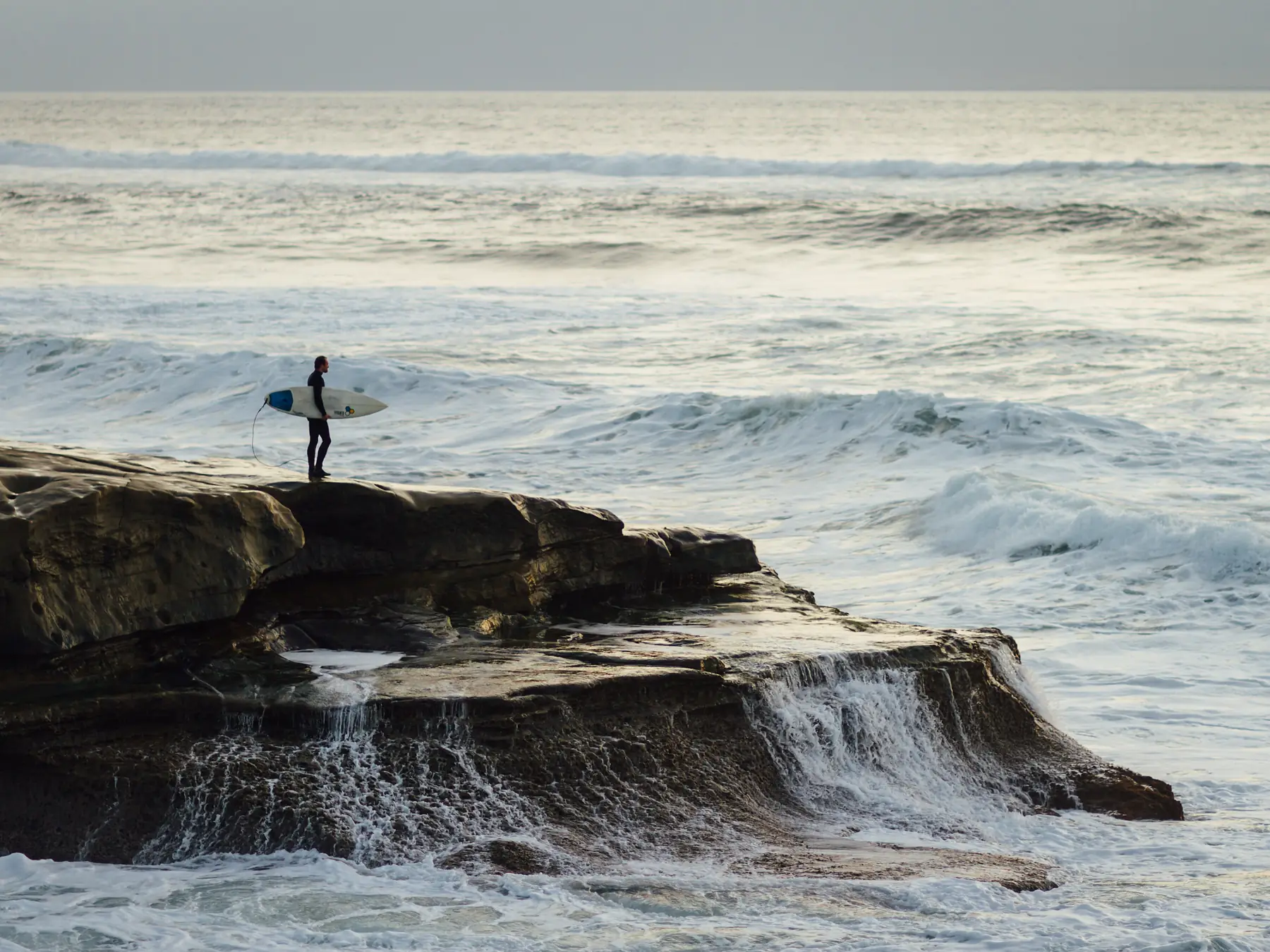
Quick surfing FAQ
Where was surfing invented?
No single person invented it. Wave riding has deep Polynesian roots, with Hawaiʻi developing especially rich and well-documented surfing traditions.
What makes a good surfing wave?
A favorable combination of swell direction and period, wind, tide, water depth, bottom shape, and a breaking pattern that leaves an open face.
Why do surfers put wax on boards?
Wax creates traction on the deck so hands, chest, and feet do not slide easily on the wet board.
When did surfing become an Olympic sport?
It was approved in 2016 and debuted at the Tokyo 2020 Games, which were held in 2021.
What is a barrel?
The hollow tube formed when a steep wave throws its breaking lip outward and the surfer rides inside the enclosed space.

Ellie is the owner and sole author of Fun Facts, combining her mechanical engineering background with years of research-driven writing to deliver facts you can trust. Every article is thoroughly fact-checked and routinely updated as new science and sources emerge to keep information accurate and current. Her mission is to make learning delightful while upholding high standards of reliability and transparency.