
Squirrels are so common that it is easy to miss how weird they are. They can descend trees headfirst, rotate their ankles backward, bury thousands of food items, plant forests by forgetting some of them, glide between trees, survive deep winters, and communicate with tails that function like furry semaphore flags.
Squirrels are a much bigger family than park acorn thieves
- Squirrels belong to the rodent family Sciuridae.
- The squirrel family includes tree squirrels, ground squirrels, chipmunks, marmots, prairie dogs, and flying squirrels.
- More than 200 squirrel species live around the world.
- Native squirrels occur on every continent except Antarctica and Australia.
- Humans have introduced some squirrel species outside their natural ranges.
- Eastern gray squirrels are native to eastern North America.
- Fox squirrels are among North America's largest tree squirrels.
- American red squirrels are smaller and highly territorial around food stores.
- Eurasian red squirrels are a different species from American red squirrels.
- Gray squirrels introduced to Britain compete with native Eurasian red squirrels.
- Some gray squirrels carry squirrelpox virus with little illness.
- The same virus can be deadly to Eurasian red squirrels.
- Black squirrels are usually melanistic color variants of gray or fox squirrels rather than a separate species.
- Albino squirrels lack normal melanin pigment.
- White squirrels are not always albino because some have dark eyes and localized pigment genes.
- Squirrel body size ranges from tiny tropical species to marmots weighing many pounds.
- Most familiar tree squirrels have long bushy tails.
- The word squirrel traces through old French and Latin to a Greek term associated with the animal's shadowing tail.
- Squirrels are rodents, so their front incisors grow continuously.
- Apparently nature decided one family needed both prairie dogs and flying squirrels, then let the taxonomy department explain itself.
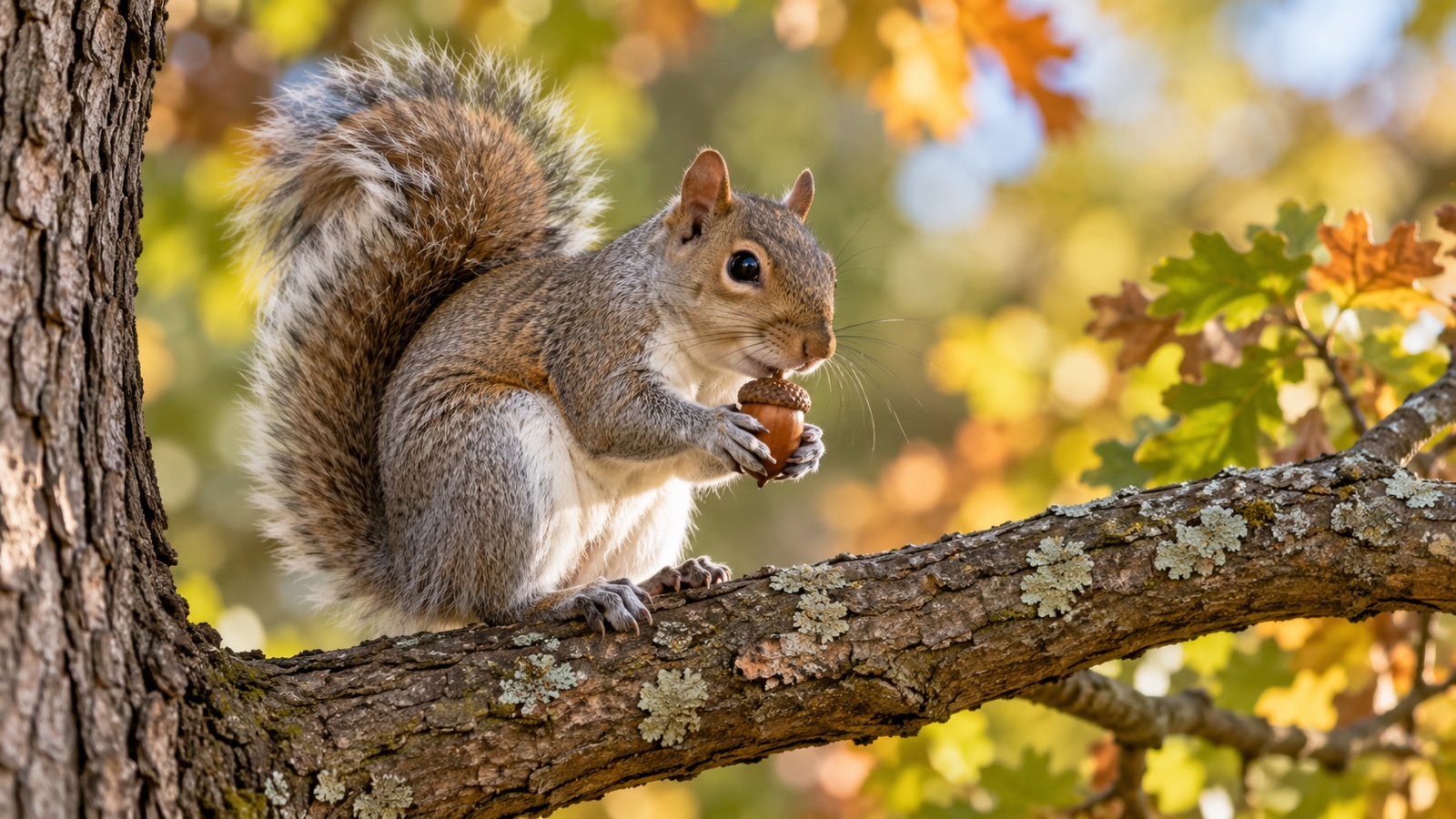
Tree squirrels are built for vertical life
- Tree squirrels have sharp curved claws for gripping bark.
- Their hind legs are powerful jumping tools.
- Flexible ankle joints let many tree squirrels rotate their hind feet dramatically.
- That rotation helps them descend trunks headfirst.
- Many mammals cannot climb down a vertical trunk as easily as they climb up.
- Squirrels can leap several times their body length between branches.
- The tail helps with balance during jumps.
- A squirrel can shift its tail position in midair.
- The tail also acts as a counterbalance during sharp turns.
- Dense tail fur provides insulation in cold weather.
- Squirrels can wrap tails over their bodies while resting.
- The tail can shade the body in hot sun.
- Tail movements also communicate alarm, irritation, and attention.
- Tree squirrels have excellent depth perception.
- Their large eyes provide a wide field of view.
- Good peripheral vision helps detect predators.
- Whiskers help squirrels judge tight spaces and nearby surfaces.
- Squirrels use scent as well as vision to navigate their environment.
- They can survive falls that would seriously injure much larger mammals because low body mass limits impact force.
- A squirrel running down a tree face-first looks reckless until you realize its ankles are doing something ours absolutely cannot.
Food caching turns squirrels into accidental foresters
- Many squirrels eat nuts, seeds, fruits, buds, fungi, and other plant foods.
- Some species also eat insects, eggs, or small animals opportunistically.
- Tree squirrels often cache food for later use.
- Scatter-hoarding species bury individual food items in many locations.
- Larder-hoarding species concentrate food in one or a few stores.
- Eastern gray squirrels are famous scatter hoarders.
- They can create thousands of individual caches during a productive season.
- Squirrels recover caches using spatial memory and smell.
- They do not simply sniff randomly until an acorn appears.
- Experiments show squirrels remember broad cache locations.
- They may organize caches by food type or value.
- Squirrels sometimes pretend to bury food when competitors are watching.
- Deceptive caching can reduce theft by other animals.
- Other squirrels frequently steal caches.
- Not every buried nut is recovered.
- Forgotten acorns and seeds can germinate.
- Scatter-hoarding therefore helps disperse trees and shrubs.
- Oak regeneration can benefit from squirrels moving acorns away from parent trees.
- Squirrels may reject damaged or insect-infested nuts after inspecting them.
- The squirrel version of losing your keys sometimes results in an oak forest, which makes my own forgetfulness look unproductive.
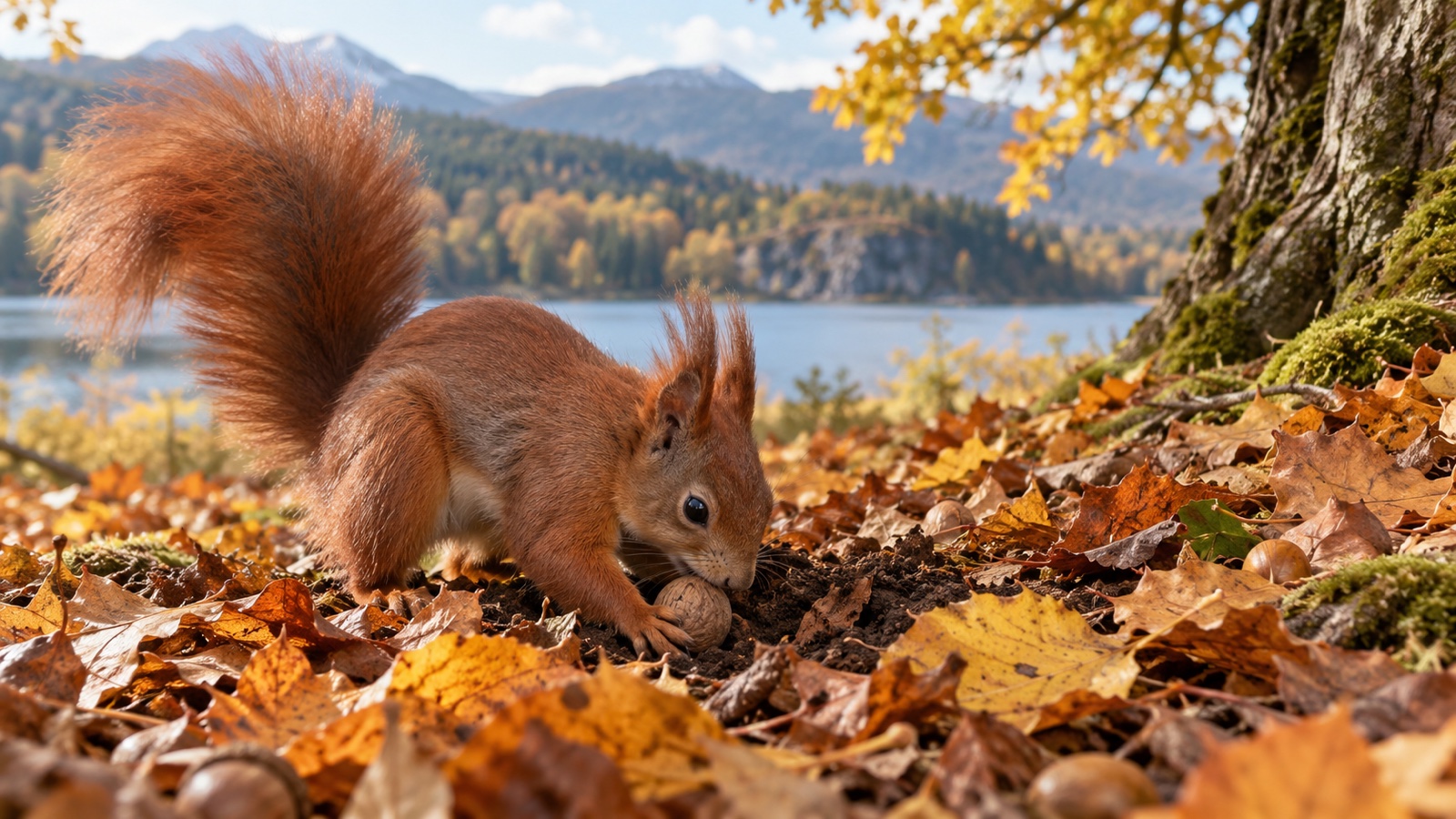
Their teeth never stop growing
A squirrel does not chew wood because it is bored with acorns. Rodent incisors grow continuously, and normal gnawing keeps them worn to a workable length. If the teeth become misaligned, they can overgrow dangerously because the natural grinding system stops working.
- Squirrels have one pair of upper and one pair of lower incisors.
- The incisors grow continuously throughout life.
- Hard orange or yellow enamel covers the front surface of many squirrel incisors.
- Iron-rich pigments contribute to that orange coloration.
- The backs of the incisors wear faster than the fronts.
- Uneven wear helps maintain a chisel-like cutting edge.
- Gnawing keeps the teeth from becoming too long.
- Squirrels may chew bark, wood, bone, antlers, or other hard materials.
- Chewed antlers and bones can also provide minerals.
- Squirrels have a gap called a diastema between incisors and cheek teeth.
- They do not have canine teeth.
- Powerful jaw muscles support repeated gnawing.
- Squirrels can open hard nutshells by working their incisors into weak points.
- They rotate nuts while gnawing to reach the edible interior.
- Different squirrel species specialize on different seed sizes and shell hardness.
- Red squirrels can leave piles of cone scales called middens.
- These middens mark long-used feeding sites.
- Some red-squirrel food caches can contain thousands of cones.
- Misaligned teeth can become life-threatening in wild squirrels.
- A squirrel's orange front teeth are not dirty; they are reinforced cutting tools with their own built-in sharpening system.
Flying squirrels glide rather than truly fly
- Flying squirrels cannot produce powered flight like bats or birds.
- They glide between trees.
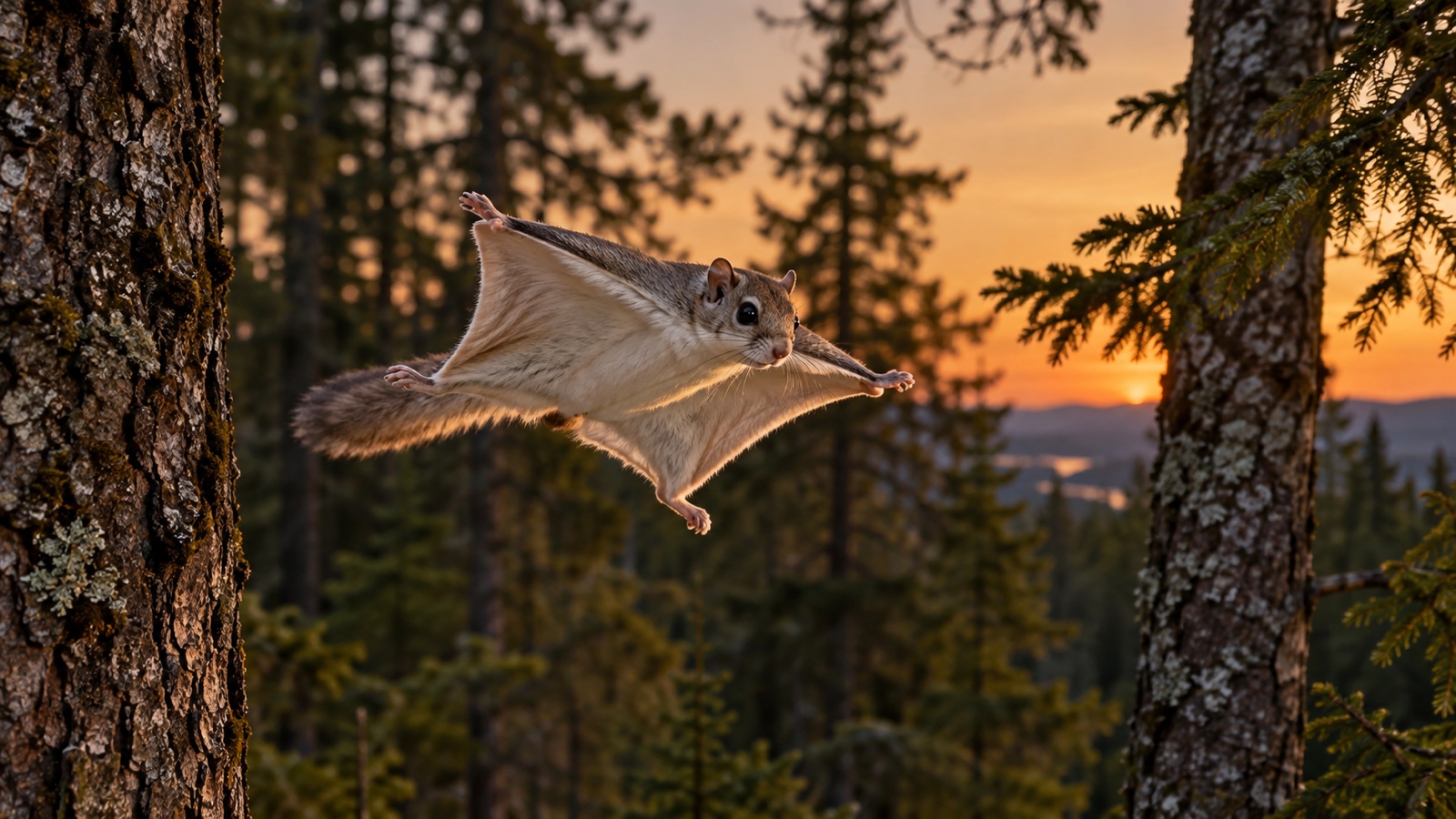
- A membrane called a patagium stretches between the limbs.
- Extending the legs spreads the membrane into an airfoil.
- Flying squirrels steer by changing limb and tail position.
- They can alter direction substantially during a glide.
- The tail helps stabilize and brake before landing.
- Many flying squirrels land feet-first on vertical tree trunks.
- They then quickly move around the trunk to avoid pursuing predators.
- North America has northern and southern flying squirrels as familiar species.
- Both are primarily nocturnal.
- Large eyes help them function in low light.
- Flying squirrels often use tree cavities as nests.
- They may share nests during cold weather.
- Some flying squirrels fluoresce pink under ultraviolet light.
- The biological purpose of that fluorescence, if any, is still uncertain.
- Asia contains giant flying squirrels much larger than North American species.
- Some giant flying squirrels can glide well over 100 feet under favorable conditions.
- Gliding lets squirrels cross gaps without descending to predator-rich ground.
- Calling them flying squirrels is technically inaccurate, but “highly competent controlled-falling squirrels” was never going to sell.
Squirrel society includes alarms, nests and seasonal family life
Squirrels are not one uniformly social or solitary group. Prairie dogs live in complex colonies, many tree squirrels tolerate neighbors but defend resources, flying squirrels may share winter nests, and mothers of most species handle the hard work of raising young.
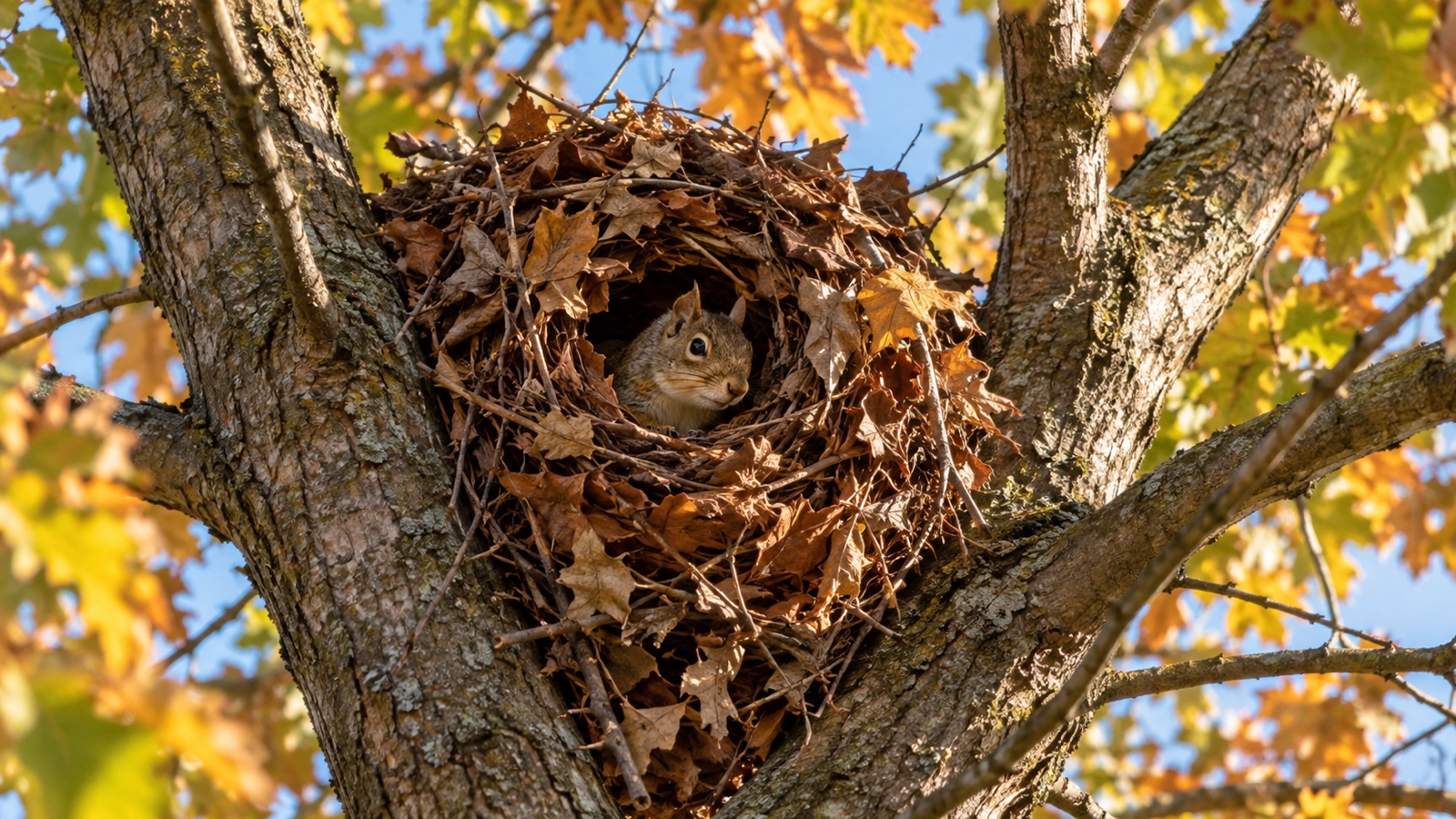
- Tree squirrels build leafy nests called dreys.
- Dreys are usually made from twigs, leaves, bark, and softer inner material.
- Tree cavities provide more protected nest sites.
- Squirrels may use several nests within one home range.
- Females create sheltered nursery nests for babies.
- Baby squirrels are called kits, kittens, or pups.
- Newborn tree squirrels are hairless and helpless.
- Their eyes remain closed for several weeks.
- Mothers nurse and protect the young.
- Most male tree squirrels provide little or no parental care.
- Young gradually leave the nest and learn to forage.
- Tree squirrels communicate with calls and tail movements.
- Alarm calls can warn nearby squirrels of predators.
- Some species use different alarm patterns for aerial and ground threats.
- Tail flicking can signal agitation.
- Squirrels also scent-mark branches and objects.
- Gray squirrels may make barking, chattering, squealing, and kuk-like sounds.
- Individuals can recognize familiar neighbors through repeated interactions.
- Winter social behavior often becomes more tolerant when shared shelter saves heat.
- A squirrel argument can involve more tail choreography than some Broadway productions.
Urban survival and 25 final squirrel facts
- Many tree squirrels thrive in parks, campuses, cemeteries, and suburbs.
- Mature urban trees provide food, nests, escape routes, and travel corridors.
- People also provide bird seed, picnic scraps, and intentional feeding.
- Human foods can be nutritionally poor even when squirrels eagerly eat them.
- Feeding squirrels can increase crowding and bold behavior.
- Squirrels can chew into attics when they find vulnerable openings.
- They may gnaw electrical wires.
- Trimming branches away from roofs can reduce easy access.
- Sealing holes should be timed carefully so dependent babies are not trapped inside.
- Road traffic kills many urban squirrels.
- Hawks are important squirrel predators.
- Owls prey especially on nocturnal or resting squirrels.
- Foxes, coyotes, bobcats, snakes, and domestic animals can also prey on squirrels.
- Squirrels use sudden zigzagging movement partly to evade predators.
- That evasive strategy is less useful against cars traveling in a straight lane.
- Ground squirrels can hibernate deeply.
- During true hibernation, body temperature and metabolism drop dramatically.
- Most familiar gray and fox squirrels do not truly hibernate.
- They remain active through winter and depend heavily on stored food.
- Some Arctic ground squirrels can supercool their body fluids below 32°F during hibernation.
- Marmots are large ground squirrels.
- Groundhogs are a species of marmot.
- Prairie dogs are also squirrels despite their canine-sounding name.
- Squirrels help forests, feed predators, spread fungi and seeds, and occasionally destroy a perfectly good bird feeder.
- After 145 facts, the ordinary park squirrel looks less ordinary and more like a tiny forester with self-sharpening teeth, a GPS-like memory, and absolutely no respect for your tomato garden.
Quick FAQ
Q: Do squirrels remember where they bury nuts?
A: Yes. They use spatial memory and smell to recover caches, although some buried food is forgotten and may grow into new plants.
Q: Do squirrels hibernate?
A: Some ground squirrels truly hibernate. Most familiar tree squirrels such as gray and fox squirrels remain active in winter.
Q: Can flying squirrels really fly?
A: No. They glide using a skin membrane stretched between their limbs and steer with body and tail movements.
Q: Why are squirrel teeth orange?
A: Iron-rich compounds strengthen the enamel on the front of many squirrel incisors and give it a yellow-orange color.
Q: Are prairie dogs squirrels?
A: Yes. Prairie dogs are ground squirrels in the family Sciuridae.

Ellie is the owner and sole author of Fun Facts, combining her mechanical engineering background with years of research-driven writing to deliver facts you can trust. Every article is thoroughly fact-checked and routinely updated as new science and sources emerge to keep information accurate and current. Her mission is to make learning delightful while upholding high standards of reliability and transparency.