
Manatees look like animals built entirely around naps and salad, but their biology is quietly impressive. They replace worn teeth throughout life, grasp plants with split lips, hear underwater boats, migrate to warm refuges, move between fresh and salt water, and share distant ancestry with elephants, which is not the family resemblance I would have guessed.
Manatees are large aquatic herbivorous mammals
- Manatees belong to the mammal order Sirenia.
- Three living manatee species are generally recognized.
- The West Indian manatee is Trichechus manatus.
- The Amazonian manatee is Trichechus inunguis.
- The African manatee is Trichechus senegalensis.
- Dugongs are the only other living sirenian species.
- Manatees and dugongs are not seals.
- They are also not closely related to whales.
- Their closest living land relatives include elephants and hyraxes within a larger mammalian group.
- West Indian manatees include Florida and Antillean regional populations.
- Florida manatees live in the southeastern United States.
- West Indian manatees also range through the Caribbean and parts of Central and South America.
- African manatees live in western African coastal and river systems.
- Amazonian manatees live entirely in freshwater.
- Adult manatees can weigh more than 1,000 pounds.
- Large individuals can weigh well over that amount.
- The body is rounded and streamlined.
- A broad paddle-shaped tail provides propulsion.
- Front flippers steer and manipulate the environment.
- A manatee is essentially an aquatic herbivore the size of a sofa, which makes its calm movement even more impressive.
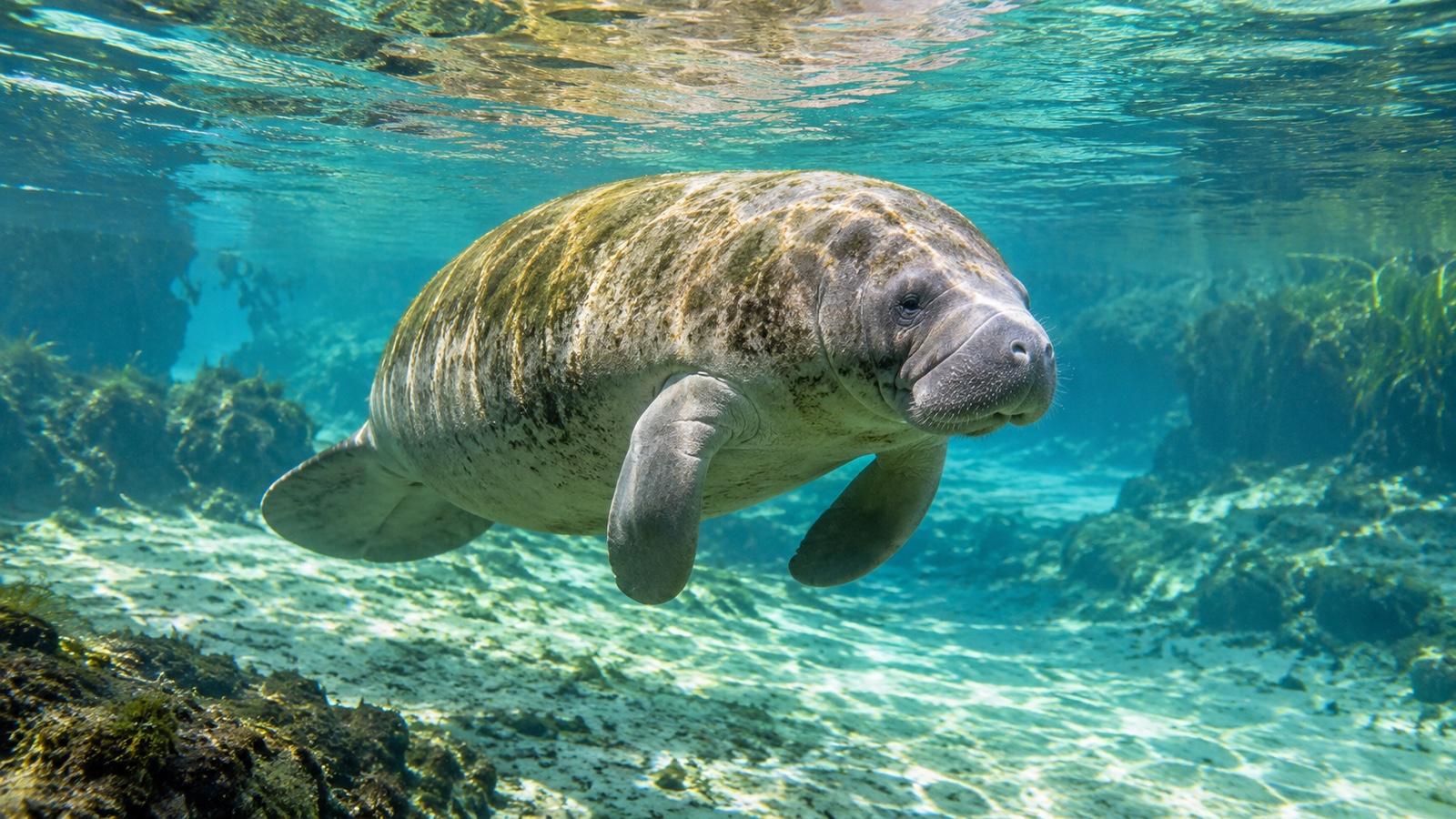
Their split upper lip works like a pair of grasping fingers
- Manatees have a large flexible upper lip.
- The upper lip is divided into left and right muscular halves.
- Each half can move somewhat independently.
- The lip grasps aquatic vegetation.
- It can pull leaves and stems into the mouth.
- Stiff bristles around the mouth provide tactile information.
- Manatee facial bristles are specialized sensory hairs.
- Similar tactile hairs occur across much of the body.
- Researchers think these hairs help detect water movement and contact.
- Manatees can manipulate objects gently with the lips.
- They use the front flippers to position food as well.
- West Indian manatees eat seagrasses and freshwater plants.
- They also consume algae and other vegetation opportunistically.
- Manatees can spend several hours per day feeding.
- An adult may eat a substantial fraction of its body weight in vegetation each day.
- Exact intake varies with food quality, body size, season, and activity.
- They crop plants rather than chewing with front incisors.
- Manatees lack the prominent front teeth humans use for biting food.
- The muscular lips do much of the harvesting work.
- A prehensile split lip turns “eating salad” into a surprisingly technical motor skill.
New molars move forward like a conveyor belt
- Manatee teeth wear down rapidly on abrasive plants and sediment.
- Instead of keeping one permanent adult set, manatees replace cheek teeth continuously.
- New teeth form at the back of each tooth row.
- They slowly move forward through the jaw.
- Worn teeth at the front eventually fall out.
- This system is sometimes called marching molars.
- Elephants also replace grinding teeth in a broadly similar forward-moving sequence.
- The replacement system can operate throughout much of a manatee's life.
- Seagrass often contains gritty sediment.
- Silica in plants can also contribute to wear.
- Grinding surfaces break tough vegetation into smaller pieces.
- Manatees have large hindgut fermentation chambers.
- Microbes help digest cellulose.
- The large intestine plays an important role in fermentation.
- Plant digestion can generate gas.
- Digestive gas contributes to buoyancy.
- Constipation or digestive problems can therefore affect how a manatee floats.
- Veterinarians monitor gastrointestinal health carefully in rescued animals.
- Fresh plant foods require very different chewing machinery from a carnivore's teeth.
- Manatees solved dental wear with a lifetime subscription service that automatically ships replacements from the back.
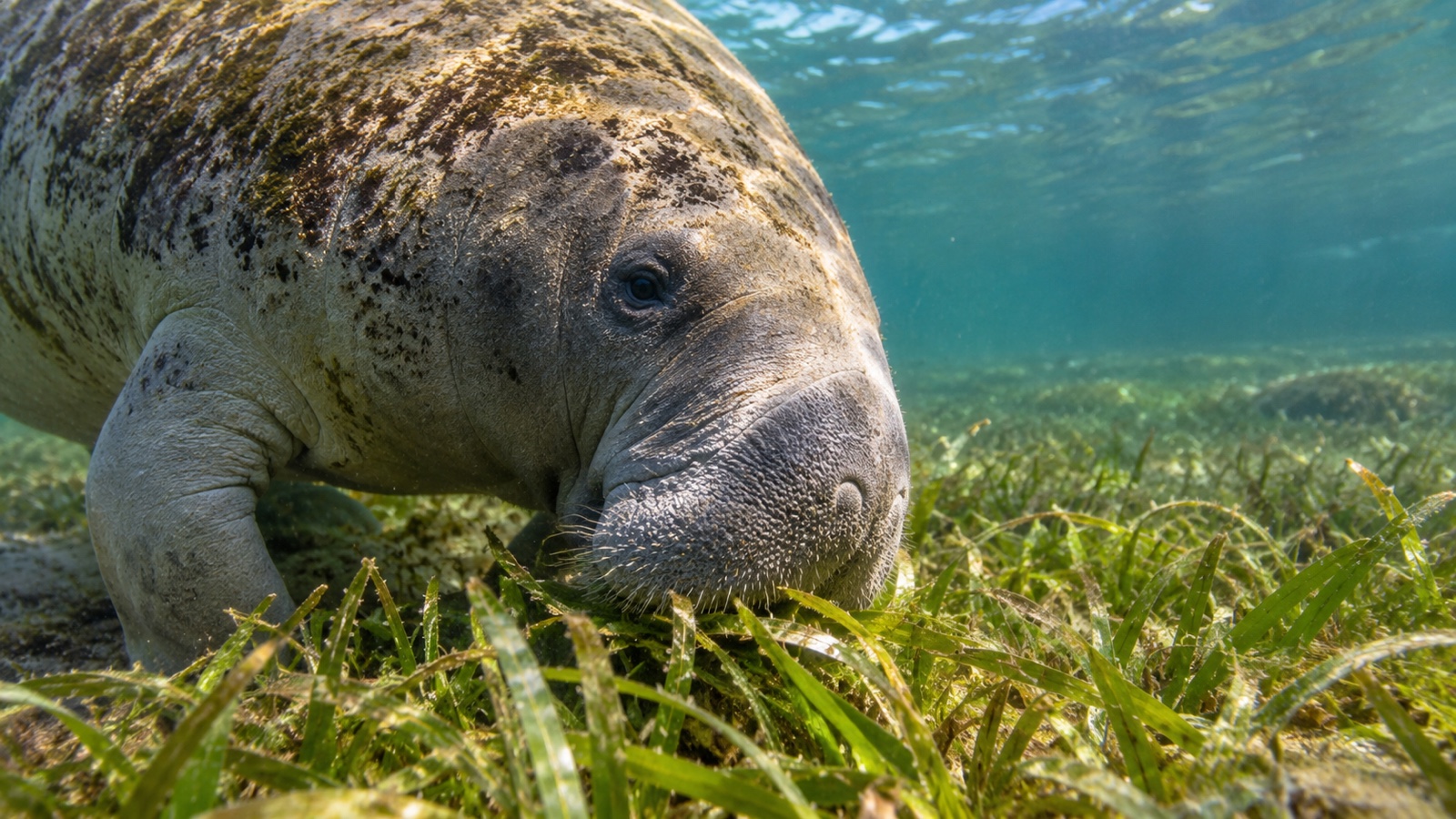
Warm water is a survival requirement
Manatees are big, but they are surprisingly vulnerable to cold because they have relatively little insulating blubber for a marine mammal and a low metabolic rate. Florida manatees seek warm springs and power-plant outflows when winter water temperatures fall.
- Florida manatees experience cold stress when water temperatures drop too low.
- Temperatures below about 68°F can become dangerous during prolonged exposure.
- Cold stress can damage skin and internal organs.
- Natural warm springs provide important winter refuges.
- Crystal River and Blue Spring are famous Florida manatee winter sites.
- Some manatees also use warm-water discharges from power plants.
- Those artificial refuges changed historical winter distribution patterns.
- Retiring power plants creates a conservation challenge where manatees have become dependent on discharge warmth.
- Restoring natural warm-water habitat is therefore important.
- Florida manatees migrate with changing seasons.
- During warm months, some travel far north along the Atlantic coast.
- Individuals have been documented in states well north of Florida.
- They return south or to warm refuges before cold becomes dangerous.
- Manatees can move between saltwater and freshwater.
- They need access to fresh water for drinking.
- They may drink from rivers, springs, or freshwater runoff.
- People should not provide hoses or handouts to wild manatees.
- Intentional watering or feeding can teach animals to approach boats and docks.
- That habituation can increase injury risk.
- A thousand-pound tropical mammal can survive hurricanes but still need a heated winter address, which is a reminder that body size does not equal cold tolerance.
Manatees can sleep underwater and surface automatically to breathe
- Manatees are air-breathing mammals.
- They normally surface every few minutes while active.
- While resting, they can remain underwater much longer.
- Resting dives can approach 15 to 20 minutes in some situations.
- Breathing frequency increases during active swimming.
- Nostrils sit on the top of the snout.
- Muscular valves close the nostrils underwater.
- Manatees can exchange a large proportion of lung air in one breath.
- Long lungs extend through much of the body cavity.
- The lungs help with both respiration and buoyancy control.
- Dense bones also help counteract buoyancy.
- Manatee ribs and other bones are unusually heavy.
- This condition is called pachyostosis in broad anatomical terms.
- Heavy bones help a slow grazer remain submerged without constant effort.
- Manatees can rest on the bottom or suspend in the water column.
- They can sleep while submerged.
- Automatic surfacing behavior lets them breathe during rest.
- Manatees are capable of bursts of speed despite usually moving slowly.
- They can reach roughly 15 to 20 miles per hour briefly.
- The slow cruise speed is a lifestyle choice backed by physiology, not a hard mechanical limit.
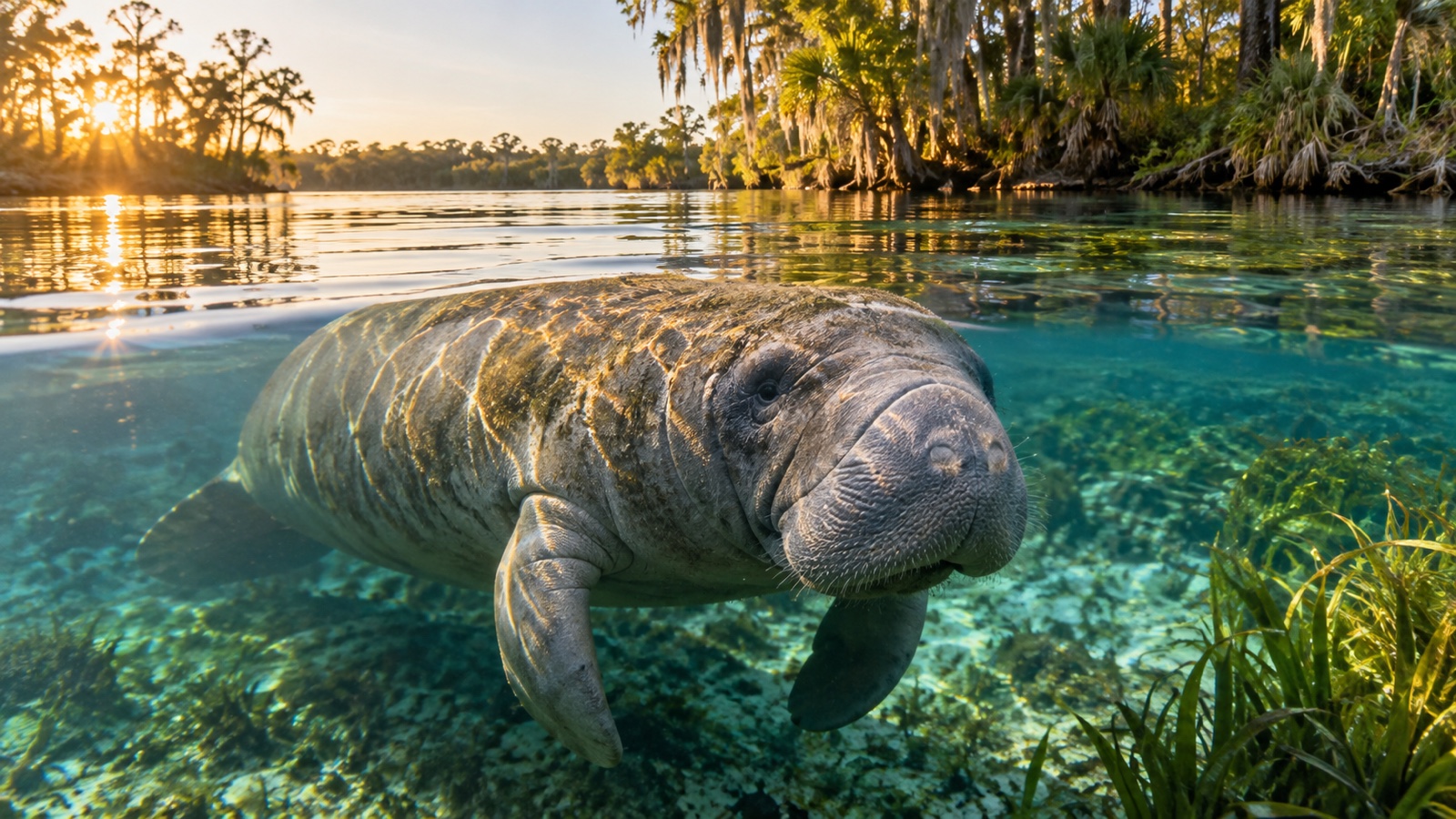
Calves stay close to their mothers for years
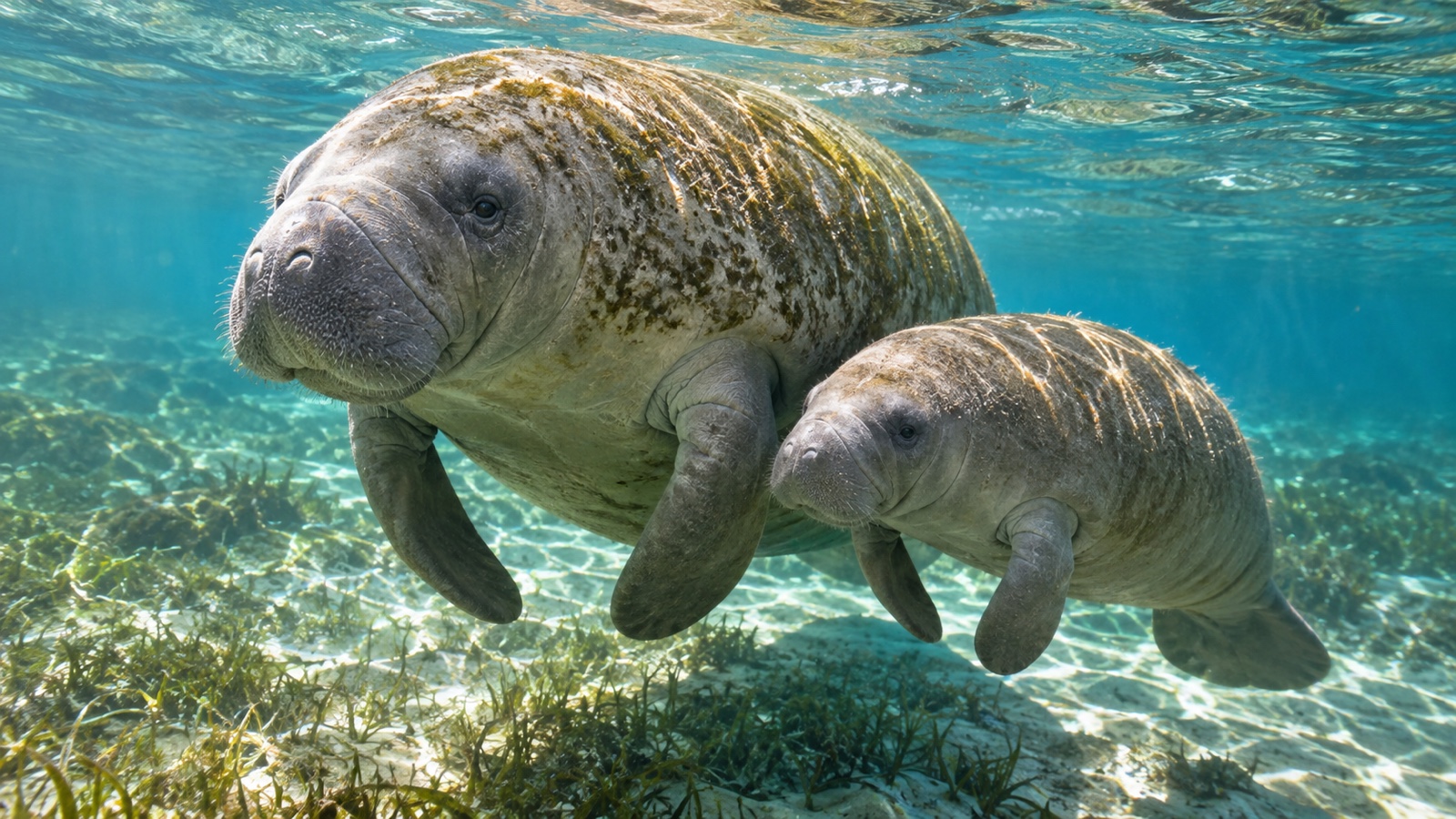
Manatee mothers do all the parenting, and calves depend on them for far more than milk. A young manatee learns travel routes, feeding grounds, warm-water refuges, freshwater sources, and safe habitat by following a mother whose mental map can determine its future survival.
- Female manatees usually give birth to one calf.
- Twin births occur but are uncommon.
- Pregnancy lasts roughly 12 to 14 months.
- A newborn calf can weigh around 60 to 70 pounds.
- Calves begin swimming soon after birth.
- They nurse from teats located behind the mother's front flippers.
- A calf may position beneath or beside the mother while nursing.
- Young begin nibbling plants while still dependent on milk.
- Mothers and calves maintain frequent physical contact.
- Vocal communication helps maintain contact.
- Manatees produce chirps, squeaks, and squeals.
- Calves can recognize maternal calls.
- The mother guides the calf through seasonal movements.
- Calves can remain with mothers for one to two years or longer.
- That long association allows extensive learning.
- Females do not normally reproduce every year.
- Long pregnancy and parental care create a slow reproductive rate.
- Slow reproduction makes adult survival especially important to population growth.
- Losing a mature breeding female can affect more than one generation.
- Manatee childhood is essentially a two-year field course in “where the salad, warm springs, and safe drinking water are.”
Boat strikes, seagrass and 25 final manatee facts
- Boat collisions are a major source of injury and death for Florida manatees.
- Propellers can cut deep parallel scars into the skin.
- Blunt impacts from hulls and lower units can cause fatal internal injuries.
- Many adult Florida manatees carry visible boat-strike scars.
- Slow-speed zones reduce collision risk in important habitat.
- Boaters should watch for circular “footprints” and snouts at the surface.
- Polarized sunglasses can improve visibility into the water.
- Entanglement in fishing line and crab-trap gear also injures manatees.
- Discarded line should be recycled or disposed of securely.
- Seagrass loss can create severe food shortages.
- Pollution can fuel algal blooms that shade and kill seagrass.
- Florida's Indian River Lagoon experienced major seagrass collapse in the early 2020s.
- Hundreds of manatees died during an unusual mortality event linked largely to starvation and ecosystem decline.
- Habitat restoration is more durable than long-term emergency feeding.
- Red-tide toxins can also kill manatees.
- They may inhale aerosolized toxins or ingest contaminated vegetation.
- Manatees are legally protected in the United States.
- Touching, chasing, riding, feeding, or harassing wild manatees can violate federal law.
- Observing passively gives animals control over the encounter.
- Manatee grazing influences aquatic plant communities.
- Their feces recycle nutrients.
- Manatees have relatively small brains for their body size, but brain size alone does not measure an animal's ecological competence or learning ability.
- They can learn routes, recognize individuals, solve simple tasks, and remember feeding or refuge locations.
- Wild manatees can live for many decades when they avoid major threats.
- After 145 facts, manatees look less like sleepy sea cows and more like long-lived, route-learning aquatic herbivores with marching molars, grasping lips, automatic breathing, elephant cousins, and a survival strategy tied tightly to healthy warm-water ecosystems.
Quick FAQ
Q: Are manatees related to seals?
A: No. Manatees are sirenians and are more closely related to elephants and hyraxes than to seals.
Q: What do manatees eat?
A: Mostly aquatic vegetation such as seagrasses and freshwater plants, with diet varying by habitat and species.
Q: Do manatees replace their teeth?
A: Yes. New molars form at the back and slowly move forward, replacing worn teeth throughout much of life.
Q: Why do Florida manatees gather at springs in winter?
A: They are vulnerable to cold stress and seek water warmer than surrounding rivers or coastal areas.
Q: Should I give a wild manatee food or water?
A: No. Feeding or watering can habituate animals to people and boats, raising collision and harassment risks.

Ellie is the owner and sole author of Fun Facts, combining her mechanical engineering background with years of research-driven writing to deliver facts you can trust. Every article is thoroughly fact-checked and routinely updated as new science and sources emerge to keep information accurate and current. Her mission is to make learning delightful while upholding high standards of reliability and transparency.