
Kwanzaa is younger than plenty of people’s grandparents, which is part of what makes it interesting. Created in 1966, the weeklong African American cultural holiday deliberately built new traditions around African heritage, family, community, creativity, responsibility, and seven principles meant to matter beyond December.
What Kwanzaa is, and what it is not
- Kwanzaa is an African American and Pan-African cultural holiday.
- It was created in the United States in 1966.
- The celebration begins every year on December 26.
- It ends on January 1.
- Kwanzaa therefore lasts seven days.
- Each day highlights one of seven guiding principles.
- The holiday was created by Maulana Karenga.
- Karenga was a scholar and activist involved in the Black cultural nationalist movement of the 1960s.
- Kwanzaa emerged during a period of major civil-rights activism and Black cultural renewal.
- Its purpose included strengthening African American connections with African heritage and community values.
- Kwanzaa is not an ancient African festival.
- It draws inspiration from African harvest celebrations and cultural traditions rather than copying one single ceremony.
- Kwanzaa is not inherently a religious holiday.
- People from different religious backgrounds can celebrate it.
- Some families observe Kwanzaa alongside Christmas.
- Others may observe it alongside Hanukkah or other religious traditions.
- Some families celebrate Kwanzaa without another December holiday.
- No religious conversion or membership is required to understand its principles.
- The holiday is centered especially on Black family, heritage, and community life.
- I like that its founders never pretended seven days of candles would matter much if the values disappeared on January 2.
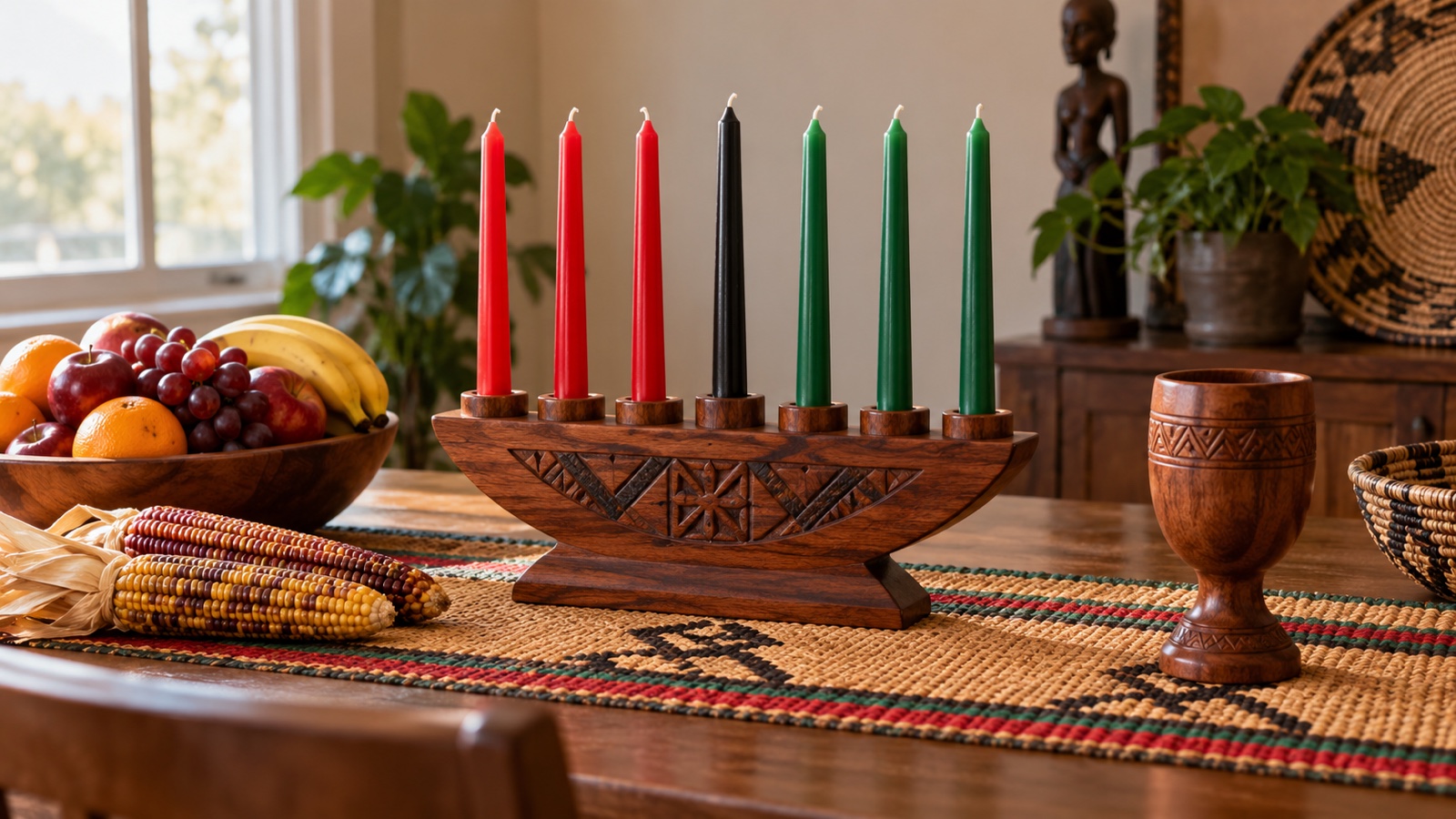
The name Kwanzaa comes from a harvest idea
Kwanzaa’s vocabulary comes largely from Swahili, even though Swahili is an East African language and most ancestors of African Americans came from West and Central Africa. The choice reflected a 1960s Pan-African goal of using an African language that already connected people across national and ethnic lines.
- The name Kwanzaa comes from the Swahili phrase “matunda ya kwanza.”
- That phrase means “first fruits.”
- Harvest and first-fruits festivals inspired parts of the holiday’s structure.
- Many African societies have traditions celebrating harvest, community, ancestors, and gratitude.
- Kwanzaa does not claim those diverse traditions are all identical.
- Swahili was selected as a Pan-African cultural language for much of Kwanzaa’s terminology.
- Swahili is widely spoken in East and Central Africa.
- It also functions as a regional lingua franca across national boundaries.
- The seven principles are collectively called the Nguzo Saba.
- “Nguzo” can mean pillars or principles in this context.
- “Saba” means seven in Swahili.
- Kwanzaa uses seven as a recurring organizing number.
- There are seven days of celebration.
- There are seven principles.
- There are seven primary symbolic elements in the traditional framework.
- The kinara holds seven candles.
- The repeated structure makes the holiday easy to teach day by day.
- Swahili greetings and vocabulary give the celebration a shared cultural language.
- Pronunciation and family usage can vary, especially among people learning the terms for the first time.
- The vocabulary is there to carry ideas, not to turn the dinner table into a spelling bee.
The seven principles, Nguzo Saba
- December 26 focuses on Umoja, meaning unity.
- Umoja emphasizes unity in family, community, nation, and people.
- December 27 focuses on Kujichagulia, meaning self-determination.
- Kujichagulia emphasizes defining, naming, creating, and speaking for oneself.
- December 28 focuses on Ujima, meaning collective work and responsibility.
- Ujima asks people to treat community problems as shared concerns.
- December 29 focuses on Ujamaa, meaning cooperative economics.
- Ujamaa emphasizes building and supporting businesses and economic systems that strengthen the community.
- December 30 focuses on Nia, meaning purpose.
- Nia encourages collective purpose directed toward building and developing community.
- December 31 focuses on Kuumba, meaning creativity.
- Kuumba asks people to leave their communities more beautiful and beneficial than they found them.
- January 1 focuses on Imani, meaning faith.
- Imani emphasizes faith in family, community, leaders, teachers, and the broader struggle for justice and progress.
- The principles are intended for use beyond the seven holiday dates.
- Families may discuss how each principle appeared during the previous year.
- Children can be invited to give examples from school, home, sports, or friendships.
- Community groups may organize service projects connected to Ujima or Kuumba.
- Supporting Black-owned businesses can be connected with Ujamaa.
- The principles turn Kwanzaa from a decorative holiday into a weeklong conversation about how people want to live together.
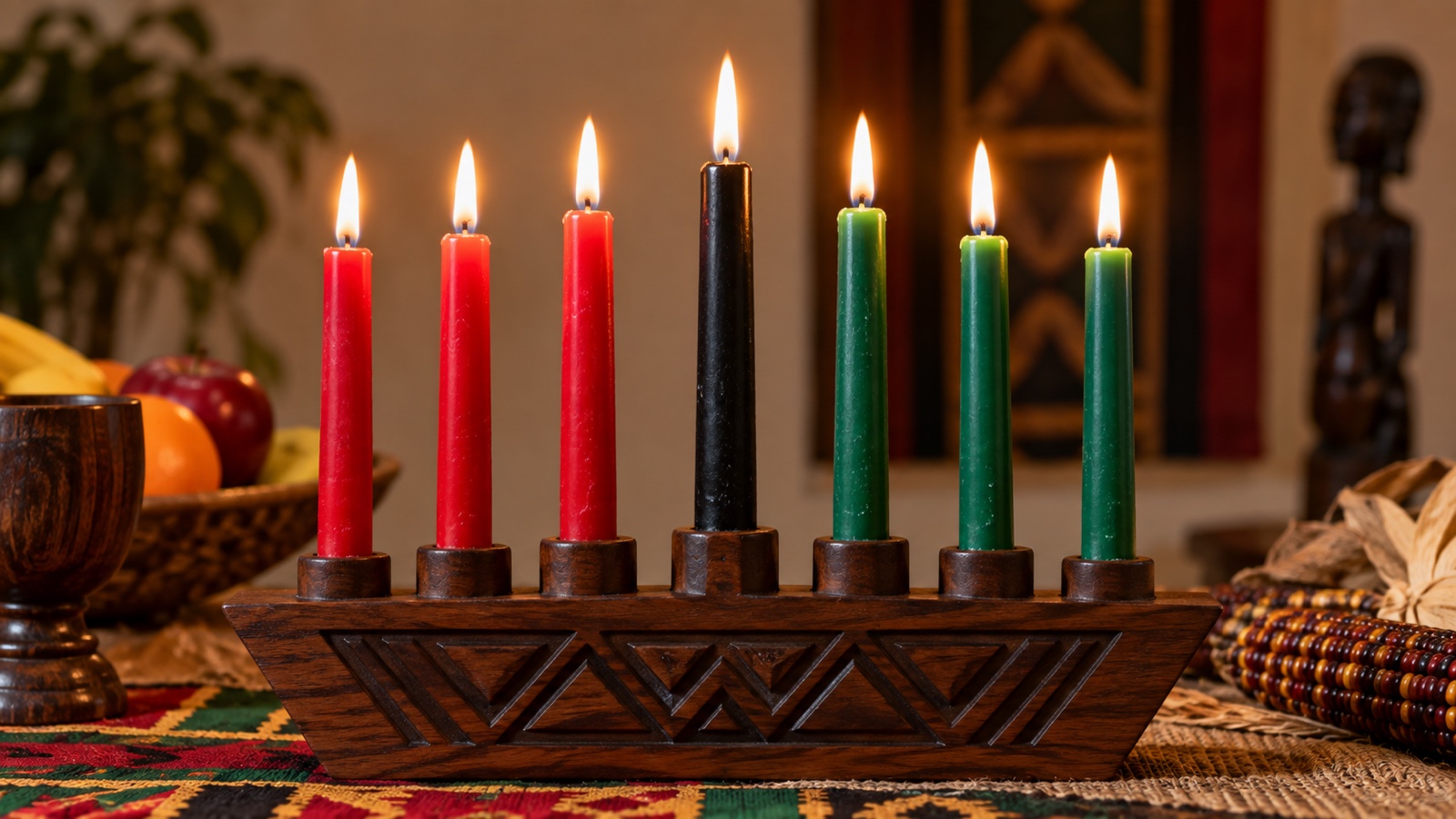
The kinara, seven candles & Pan-African colors
The kinara is the visual centerpiece most people recognize, but it is not a menorah and should not be described as one. Both hold ceremonial candles, yet their histories, numbers, meanings, and religious contexts are completely different.
- The candleholder used during Kwanzaa is called a kinara.
- A kinara holds seven candles.
- The seven candles are collectively called mishumaa saba.
- One candle is black.
- Three candles are red.
- Three candles are green.
- The black candle is placed in the center of the kinara.
- The red candles are traditionally placed on one side.
- The green candles are placed on the other side.
- Black, red, and green are Pan-African colors.
- The color combination is associated with the Pan-African flag adopted by the Universal Negro Improvement Association in 1920.
- In Kwanzaa symbolism, black represents the people.
- Red represents struggle.
- Green represents the future and hope that can grow from struggle.
- The black center candle is lit first on December 26.
- An additional candle is lit on each following day.
- Families may follow traditional alternating sequences for red and green candles.
- Specific household lighting practices can vary.
- Candle lighting is commonly paired with discussion of that day’s principle.
- Seven little flames make a nice picture, but the conversation is the actual point.
The seven symbols on a Kwanzaa table
- The seven primary Kwanzaa symbols are called the Nguzo Saba’s material or symbolic elements in traditional descriptions.
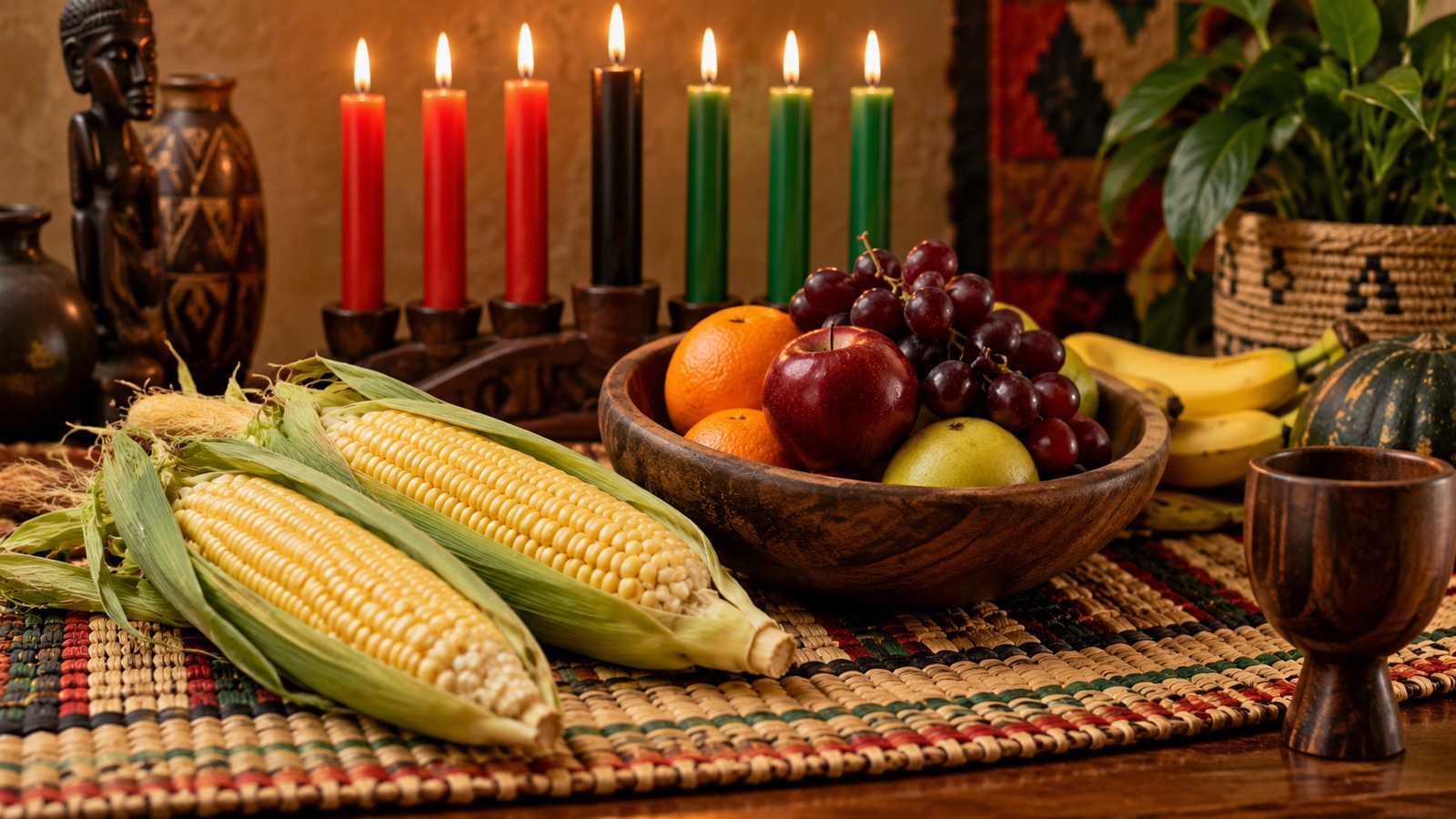
- The mkeka is a woven mat.
- It represents the foundation on which community and tradition are built.
- The kinara is the seven-candle holder.
- Mishumaa saba are the seven candles.
- Mazao are crops, fruits, or vegetables representing harvest and productive work.
- Muhindi means corn.
- Ears of corn symbolize children and the future in traditional Kwanzaa practice.
- Some arrangements include one ear for each child in the household.
- Families without children may still display corn as a community symbol.
- Kikombe cha Umoja is the unity cup.
- The unity cup is used during libation or shared ceremonial moments.
- Zawadi means gifts.
- Kwanzaa gifts traditionally emphasize meaning, growth, heritage, or achievement.
- Books are especially fitting gifts because they support learning.
- Handmade items can express Kuumba, the principle of creativity.
- African art, fabric, sculpture, baskets, or cultural objects may also decorate the table.
- Not every household uses every symbol in exactly the same visual style.
- Families can build a Kwanzaa display with heirlooms and locally made objects rather than buying a matching commercial set.
- The symbolism works best when people know why an object is there rather than simply arranging it for a photo.
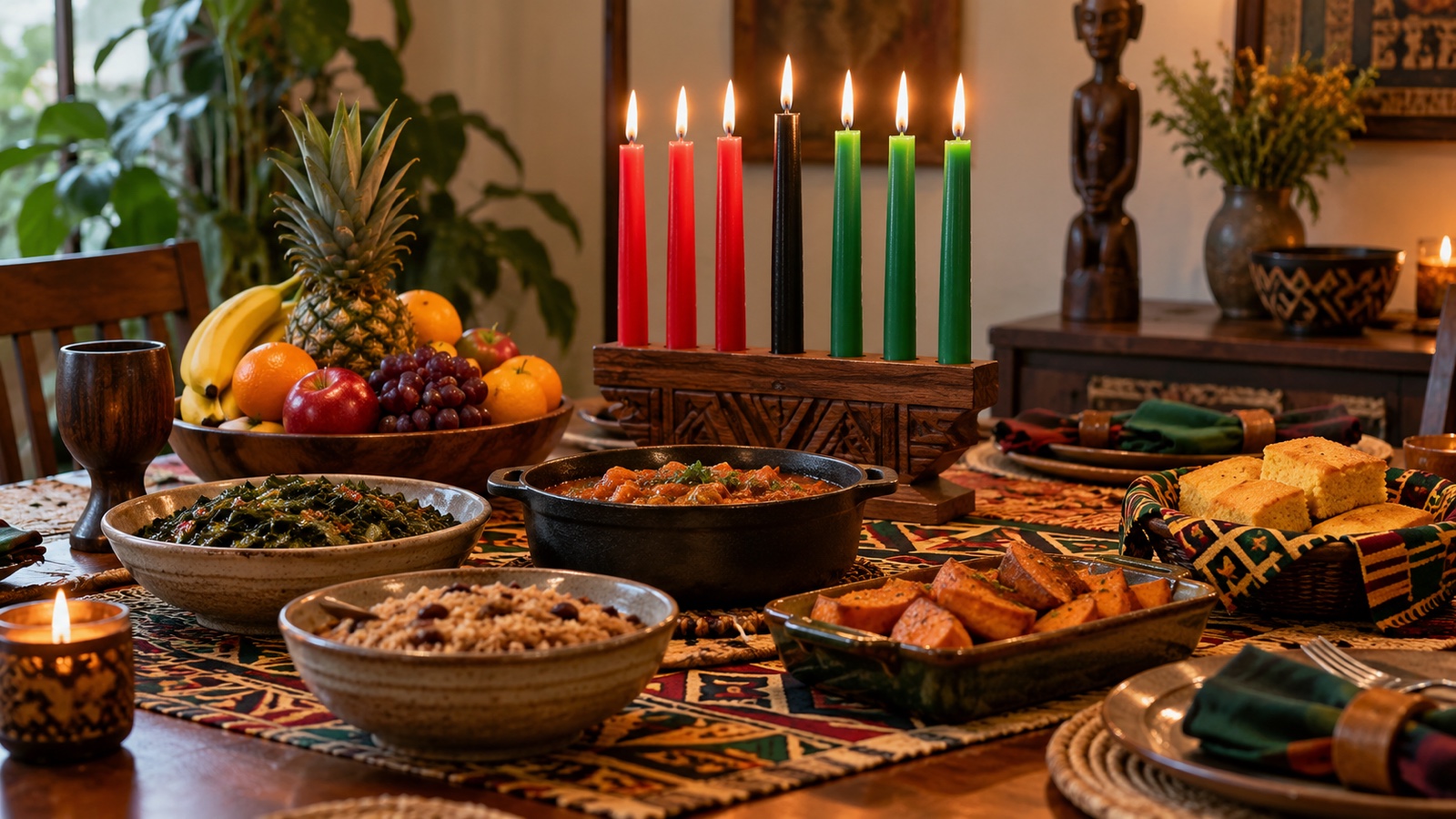
Karamu, food, music & gathering
Kwanzaa does not come with one official dinner menu, which makes sense for a holiday designed around a vast African diaspora. A family table might reflect African American foodways, Caribbean heritage, West African recipes, Southern traditions, or several branches of one family at once.
- The major Kwanzaa communal feast is called Karamu.
- Karamu is traditionally held on December 31.
- The feast can include food, music, dance, poetry, storytelling, speeches, and remembrance.
- There is no single mandatory Karamu menu.
- Families often choose foods that connect with African, African American, Caribbean, or broader diaspora traditions.
- Black-eyed peas may appear on Kwanzaa tables.
- Greens, sweet potatoes, rice dishes, beans, stews, and cornbread are also common in many American celebrations.
- Jollof rice or other West African dishes may be included by some families and community groups.
- Caribbean dishes can reflect another branch of African diaspora culture.
- Food traditions should not be treated as interchangeable simply because they have African roots.
- Music might include jazz, gospel, soul, African drumming, contemporary music, or family favorites.
- Poetry can connect the gathering with Black literary traditions.
- Storytelling gives elders a chance to share family and community history.
- Children may perform songs, dances, readings, or short presentations about the principles.
- Libation ceremonies can honor ancestors.
- The unity cup may be used as part of a libation.
- Families differ in exactly how ceremonial elements are performed.
- Community Karamu events can bring together people who do not celebrate every night at home.
- Restaurants, museums, churches, libraries, and cultural organizations sometimes host Kwanzaa programs.
- I would argue any seven-day values discussion improves when somebody eventually brings mac and cheese.
History, celebrations today & 25 Kwanzaa facts worth knowing
- The first Kwanzaa celebration took place during the 1966–1967 holiday season.
- The holiday spread through Black cultural organizations, families, schools, and community institutions.
- Its growth was connected with wider interest in African heritage during and after the Black Power era.
- Kwanzaa became increasingly familiar to the broader U.S. public during the late 20th century.
- The U.S. Postal Service issued its first Kwanzaa postage stamp in 1997.
- Artist Synthia Saint James created the artwork for that first stamp.
- Later U.S. stamps have featured different Kwanzaa designs.
- Presidents of the United States have issued Kwanzaa greetings.
- Governors, mayors, and other public officials also recognize the holiday.
- Museums and cultural centers host candle lightings and educational programs.
- Schools may teach the seven principles as part of lessons on African American culture and December holidays.
- Kwanzaa is celebrated outside the United States by some people in the African diaspora.
- It remains especially rooted in the African American experience that produced it.
- The holiday has always included a deliberate educational component.
- Children can learn the Swahili names of the principles one day at a time.
- Adults can use the same principles to evaluate work, money, family, art, and community decisions.
- Kwanzaa gifts traditionally favor educational or culturally meaningful items over purely commercial excess.
- That does not mean a gift must be homemade or inexpensive to be appropriate.
- The intention behind the gift matters more than following a shopping rule.
- Kwanzaa decorations frequently use red, black, green, natural fibers, African fabrics, and harvest produce.
- The holiday does not require rejecting American identity to honor African heritage.
- It was created specifically within the African American experience.
- Families can adapt celebrations while still learning the original names and meanings of the principles.
- The strongest Kwanzaa traditions tend to be participatory: lighting, talking, cooking, creating, remembering, and planning together.
- After 145 facts, Kwanzaa makes the most sense not as seven extra holiday obligations but as seven chances to ask what kind of community you are helping build.
Quick FAQ
Q: When is Kwanzaa?
A: Kwanzaa begins December 26 and ends January 1 every year.
Q: Who created Kwanzaa?
A: Maulana Karenga created the African American cultural holiday in 1966.
Q: Is Kwanzaa a religious holiday?
A: No. It is a cultural holiday, so people of different religions can celebrate it, including families who also observe Christmas or other religious traditions.
Q: What are the seven Kwanzaa principles?
A: Umoja, Kujichagulia, Ujima, Ujamaa, Nia, Kuumba, and Imani, commonly translated as unity, self-determination, collective work and responsibility, cooperative economics, purpose, creativity, and faith.
Q: What do the red, black, and green candles mean?
A: In Kwanzaa symbolism, black represents the people, red represents struggle, and green represents hope and the future.

Ellie is the owner and sole author of Fun Facts, combining her mechanical engineering background with years of research-driven writing to deliver facts you can trust. Every article is thoroughly fact-checked and routinely updated as new science and sources emerge to keep information accurate and current. Her mission is to make learning delightful while upholding high standards of reliability and transparency.