
Croatia has more than a thousand islands, Roman palaces that became living city streets, waterfalls that look edited, medieval walls, mountain parks, truffles, tiny stone villages, and a coastline that makes road-trip timing collapse because every overlook deserves another stop. The Adriatic is the headline, not the whole article.
Croatia curls around the northern and eastern Adriatic
- Croatia is located in southeastern and Central Europe along the Adriatic Sea.
- Zagreb is the national capital and largest city.
- Croatia borders Slovenia, Hungary, Serbia, Bosnia and Herzegovina, and Montenegro.
- It also shares a maritime boundary with Italy.
- Croatia joined the European Union in 2013.
- It adopted the euro as its currency in 2023.
- Croatia also joined the Schengen Area in 2023.
- Croatian is the official language.
- Croatian is a South Slavic language.
- It is closely related to Serbian, Bosnian, and Montenegrin.
- The national flag is red, white, and blue.
- Its central coat of arms features a red-and-white checkerboard shield.
- The checkerboard is called the šahovnica.
- Five smaller historical shields form a crown above the main shield.
- Croatia uses Central European Time.
- It observes European summer-time clock changes.
- The Dinaric Alps run along much of the inland Adriatic region.
- Dinara is Croatia’s highest mountain.
- Its highest Croatian summit reaches 6,007 feet.
- Croatia's shape is the geographic equivalent of trying to wrap one country around another without spilling the sea.
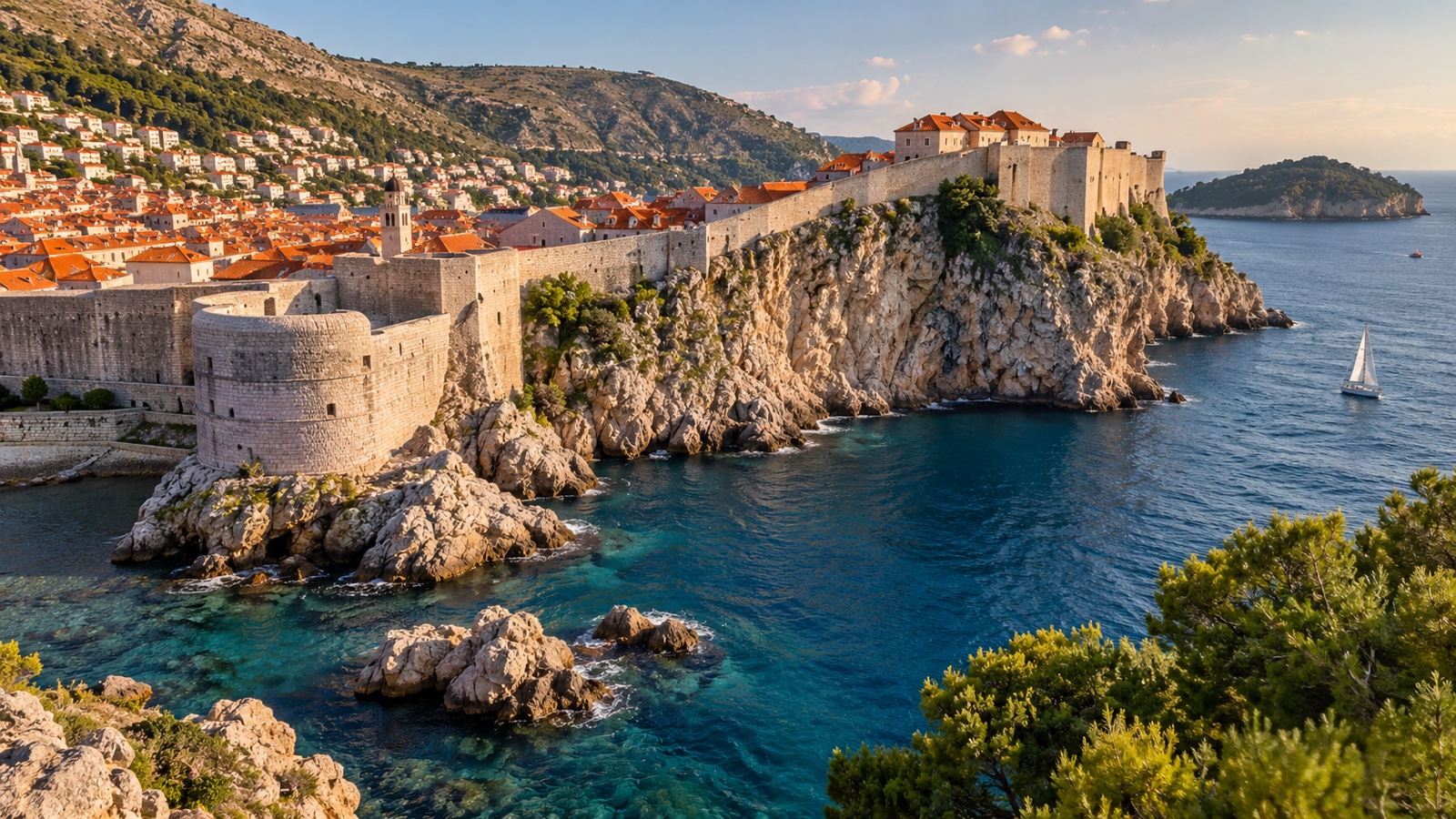
The coast has more than a thousand islands and islets
- Croatia has more than 1,000 islands, islets, rocks, and reefs.
- Only a fraction of those islands are permanently inhabited.
- Cres is one of Croatia's largest islands.
- Krk is another of the largest.
- Brač is famous for pale limestone and the beach Zlatni Rat.
- Zlatni Rat's narrow shape changes with waves, currents, and wind.
- Hvar is known for historic towns, lavender, vineyards, and nightlife.
- Korčula has a beautifully preserved walled old town.
- Vis was restricted to many foreign visitors during part of the Yugoslav era because of its military importance.
- That relative isolation helped limit some development.
- Pag is known for stark limestone landscapes, sheep cheese, and lace.
- Mljet contains a heavily forested national park.
- The Kornati archipelago includes scores of dry rocky islands and reefs.
- Kornati National Park protects much of that seascape.
- The Adriatic is part of the Mediterranean Sea.
- Its waters are relatively shallow in the north and deeper toward the south.
- Karst limestone contributes to clear coastal water because many rivers carry less suspended sediment than muddy river systems.
- Bora winds can blow violently from inland mountains toward the Adriatic.
- The jugo is a warmer humid wind from the southeast.
- Croatia has enough islands that “island hopping” requires at least one serious spreadsheet if you are the kind of person I am.
Plitvice and Krka turn limestone into waterfalls
- Plitvice Lakes National Park is Croatia's oldest and largest national park.
- The park contains a chain of interconnected lakes.
- Water flows between them through waterfalls and cascades.
- Natural travertine barriers help create the stepped lake system.
- Travertine forms as calcium carbonate precipitates from mineral-rich water.
- Mosses, algae, microorganisms, and water chemistry all contribute to barrier growth.
- The lakes can appear turquoise, green, gray, or blue depending on light and conditions.
- Swimming is not allowed in the protected Plitvice lakes.
- Wooden boardwalks cross wetlands and water channels.
- Plitvice is a UNESCO World Heritage Site.
- Krka National Park protects a river and waterfall landscape farther south.
- Skradinski buk is one of Krka's most famous waterfall complexes.
- Historic watermills were built along the Krka River.
- The park also contains monasteries and archaeological sites.
- Croatia's karst landscapes contain numerous caves and underground rivers.
- Rainwater dissolves limestone over long periods.
- That process creates sinkholes, caves, springs, and disappearing streams.
- Velebit is Croatia's longest mountain range.
- Northern Velebit National Park protects high karst terrain and forests.
- Croatia seems to have looked at limestone and asked it to perform every possible geological trick.
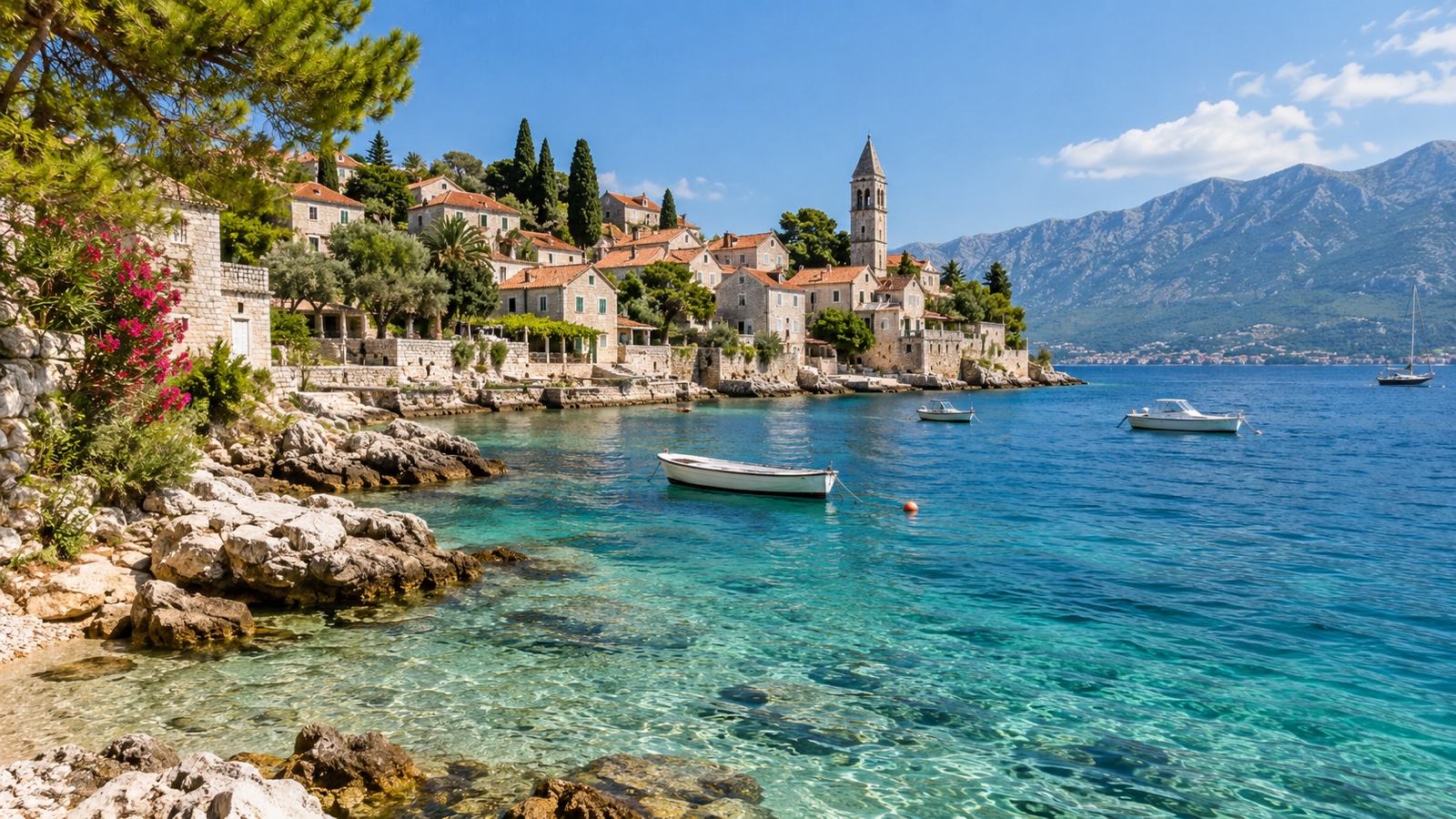
Roman emperors and medieval republics left enormous landmarks
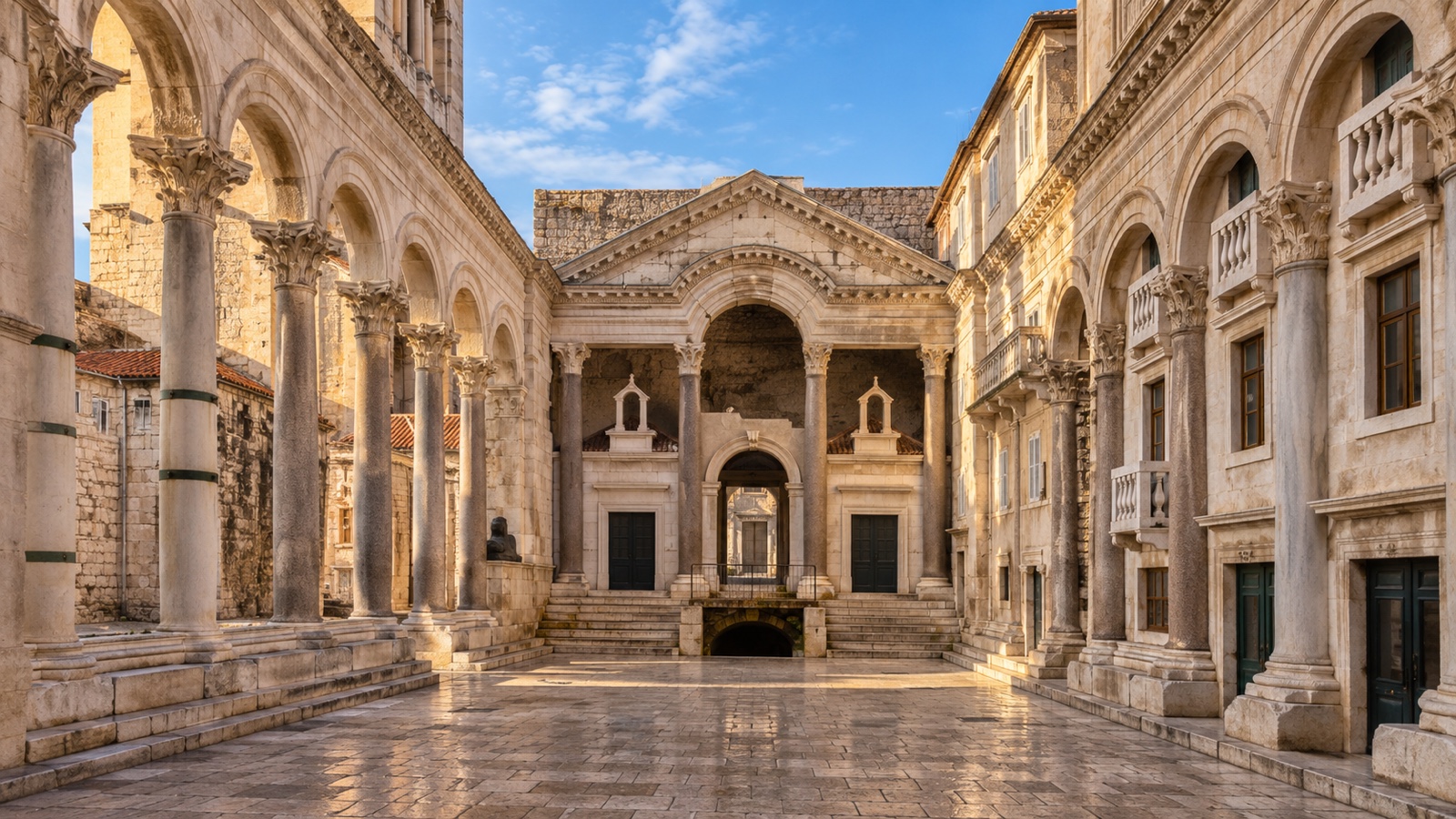
One of my favorite Croatian facts is that Diocletian's Palace is not really a palace you enter, tour, and leave. The Roman complex became part of central Split itself, with homes, shops, restaurants, churches, and streets woven into walls built around 1,700 years ago.
- Roman emperor Diocletian was born in the Roman province of Dalmatia.
- He built a massive retirement complex near modern Split around the beginning of the fourth century.
- Parts of Diocletian's Palace survive at the heart of Split.
- The complex blends Roman military-camp organization with luxury residence architecture.
- The Peristyle remains a central monumental courtyard.
- Diocletian's mausoleum was later converted into the Cathedral of Saint Domnius.
- That creates the unusual situation of a Christian cathedral occupying the tomb of an emperor associated with Christian persecution.
- Pula contains one of the best-preserved Roman amphitheaters in the world.
- The Pula Arena was built during the Roman imperial period.
- It still hosts concerts, festivals, and public events.
- Zadar has Roman ruins alongside medieval and modern architecture.
- Dubrovnik developed as the center of the Republic of Ragusa.
- The maritime republic survived for centuries through diplomacy and trade.
- Dubrovnik's old city is enclosed by massive defensive walls.
- Visitors can walk along much of the wall circuit.
- The Republic of Ragusa abolished its slave trade in the early 15th century.
- Its society still had deep class inequalities and forms of servitude.
- Dubrovnik suffered a devastating earthquake in 1667.
- The city was shelled during the Croatian War of Independence in 1991.
- Restoration repaired extensive war damage while preserving the historic city.
Modern Croatia emerged from the breakup of Yugoslavia
- Croatian lands spent centuries under several different political systems and empires.
- Parts were ruled by the Habsburg monarchy.
- Dalmatian coastal cities experienced strong Venetian influence.
- Croatia joined the State of Slovenes, Croats and Serbs after Austria-Hungary collapsed in 1918.
- That state quickly joined Serbia to form the Kingdom of Serbs, Croats and Slovenes.
- The country was later renamed Yugoslavia.
- During World War II, the fascist Ustaše regime ruled the Axis-backed Independent State of Croatia.
- The Ustaše murdered Serbs, Jews, Roma, antifascists, and political opponents.
- Yugoslav Partisans fought Axis forces and collaborators.
- Socialist Yugoslavia emerged after the war under Josip Broz Tito.
- Tito was born in Kumrovec in present-day Croatia.
- Yugoslavia pursued a non-aligned foreign policy outside both Cold War military blocs.
- Croatia declared independence from Yugoslavia in 1991.
- War followed amid the violent breakup of Yugoslavia.
- Serb forces and the Yugoslav People's Army controlled substantial Croatian territory during the conflict.
- Civilians on all sides suffered displacement and war crimes.
- Vukovar was devastated after a long siege in 1991.
- Croatian forces retook most occupied territory in 1995.
- Eastern Slavonia was reintegrated peacefully through a UN-administered process completed in 1998.
- Modern Croatian history is recent enough that ruins, memorials, veterans, and family memories still sit directly beside the tourism boom.
The necktie, a mechanical pencil and remarkable inventors have Croatian links
Croatia's invention claims need a little nuance because historic borders and ethnic identities were complicated, but the country has legitimate connections to the necktie, mechanical pencils, electrical engineering, fingerprint science, torpedoes, and one famous inventor whose birthplace is now in Croatia.
- The modern word “cravat” comes from a French word associated with Croats.
- Croatian soldiers in 17th-century Europe became noted for wearing knotted neck cloths.
- Those neck cloths influenced European fashion.
- Croatia celebrates Cravat Day on October 18.
- Slavoljub Eduard Penkala developed an influential mechanical pencil in Zagreb.
- He patented an automatic mechanical pencil in 1906.
- Penkala also worked on fountain pens and aviation.
- Nikola Tesla was born in Smiljan, now in Croatia, in 1856.
- Tesla was an ethnic Serb born in the Austrian Empire and later became a U.S. citizen.
- His work helped develop modern alternating-current electrical systems.
- Faust Vrančić was a Renaissance polymath born in Šibenik.
- He published a famous drawing of a parachute-like device.
- Ivan Vučetić, born on Hvar, became an important pioneer of fingerprint identification in Argentina.
- Rijeka has important historical connections with the development of the self-propelled torpedo.
- Naval officer Giovanni Luppis and engineer Robert Whitehead worked on an early practical torpedo there.
- Andrija Mohorovičić was a Croatian geophysicist.
- He identified the boundary between Earth's crust and mantle using seismic waves.
- That boundary is called the Mohorovičić discontinuity, or Moho.
- Ruđer Bošković was an 18th-century scientist, mathematician, and philosopher born in Dubrovnik.
- Croatia has contributed enough hard-to-pronounce scientific names that “Moho” feels almost merciful.
Truffles, football, Dalmatian dogs and 25 final Croatia facts
- Istria is a peninsula shared by Croatia, Slovenia, and a tiny part of Italy.
- Croatian Istria is famous for truffles.
- White and black truffles grow in its forests.
- Trained dogs are commonly used to locate underground truffles.
- Istria also produces olive oil and wine.
- Malvazija Istarska is an important regional white-wine grape.
- Plavac Mali is a major red-wine grape from Dalmatia.
- Paški sir is a hard sheep's-milk cheese from the island of Pag.
- Sea salt and aromatic island vegetation influence the sheep-farming environment.
- Peka is a cooking method in which meat or seafood and vegetables roast under a heavy bell-like lid covered with hot coals.
- Black risotto gets its dark color from cuttlefish or squid ink.
- Strukli are filled pastry or dough dishes associated especially with northern Croatia.
- Football is Croatia's most popular sport.
- Croatia reached the men's FIFA World Cup final in 2018.
- It finished third at the 2022 World Cup.
- Luka Modrić won the Ballon d'Or in 2018.
- Croatia also has strong traditions in water polo, handball, basketball, skiing, and tennis.
- The Dalmatian dog breed is historically associated by name with Croatia's Dalmatia region.
- The exact ancient origin of the breed is less certain than the regional name suggests.
- Dalmatian pelicans can be found in parts of southeastern Europe, but the bird's name does not mean it is simply the bird version of Croatia's dog.
- The kuna was Croatia's currency before the euro.
- “Kuna” means marten, recalling historic use of marten pelts in trade and taxation.
- Game of Thrones used Dubrovnik and other Croatian locations as filming sites.
- The Sea Organ in Zadar makes music using waves pushing air through pipes beneath waterfront steps.
- After 145 facts, Croatia still feels like a place where even the sidewalk can play music while you wait for sunset.
Quick FAQ
Q: What is Croatia famous for?
A: Dubrovnik, Adriatic islands, Plitvice waterfalls, Split and Diocletian's Palace, football, truffles, wine, Roman ruins, the necktie, and a spectacular limestone coastline.
Q: What is the capital of Croatia?
A: Zagreb is both the capital and largest city.
Q: Does Croatia use the euro?
A: Yes. Croatia adopted the euro on January 1, 2023.
Q: How many islands does Croatia have?
A: Croatia counts more than 1,000 islands, islets, rocks, and reefs, though only a relatively small number are permanently inhabited.
Q: Was Nikola Tesla Croatian?
A: Tesla was an ethnic Serb born in Smiljan, in today's Croatia, when the area was part of the Austrian Empire. He later became a U.S. citizen.

Ellie is the owner and sole author of Fun Facts, combining her mechanical engineering background with years of research-driven writing to deliver facts you can trust. Every article is thoroughly fact-checked and routinely updated as new science and sources emerge to keep information accurate and current. Her mission is to make learning delightful while upholding high standards of reliability and transparency.