
Bhutan gets packaged as the “happiest country,” which is catchy but much too neat. The real place is more interesting: Himalayan valleys, fortress-monasteries, constitutional forest protection, spicy cheese dishes, sacred unclimbed peaks, archery obsession, hydropower, endangered cranes, a young democracy, and a policy system that asks what development should actually be for.
Bhutan is the Land of the Thunder Dragon
- Bhutan is a landlocked country in the eastern Himalayas.
- It borders India to the south, east, and west.
- China's Tibet Autonomous Region lies to the north.
- Thimphu is the national capital and largest city.
- Bhutan's name in Dzongkha is Druk Yul.
- Druk Yul is commonly translated as “Land of the Thunder Dragon.”
- The dragon is called the Druk.
- A white dragon appears across the center of Bhutan's national flag.
- The flag's yellow field symbolizes the civil tradition and monarchy.
- The orange field symbolizes Buddhist spiritual tradition.
- The dragon holds jewels representing national wealth and security.
- Dzongkha is the official language.
- English is widely used in schools and government.
- Numerous other languages are spoken across Bhutan's valleys and regions.
- The national currency is the Bhutanese ngultrum.
- The ngultrum is pegged at par with the Indian rupee.
- Indian rupees are also widely accepted in Bhutan under applicable rules.
- Bhutan uses Bhutan Time year-round.
- It is six hours ahead of Coordinated Universal Time.
- A country whose flag includes a jewel-clutching thunder dragon has set a very high bar for everyone else's graphic design.
The country climbs from subtropical forest to permanent snow
- Bhutan's southern foothills are low, warm, and humid.
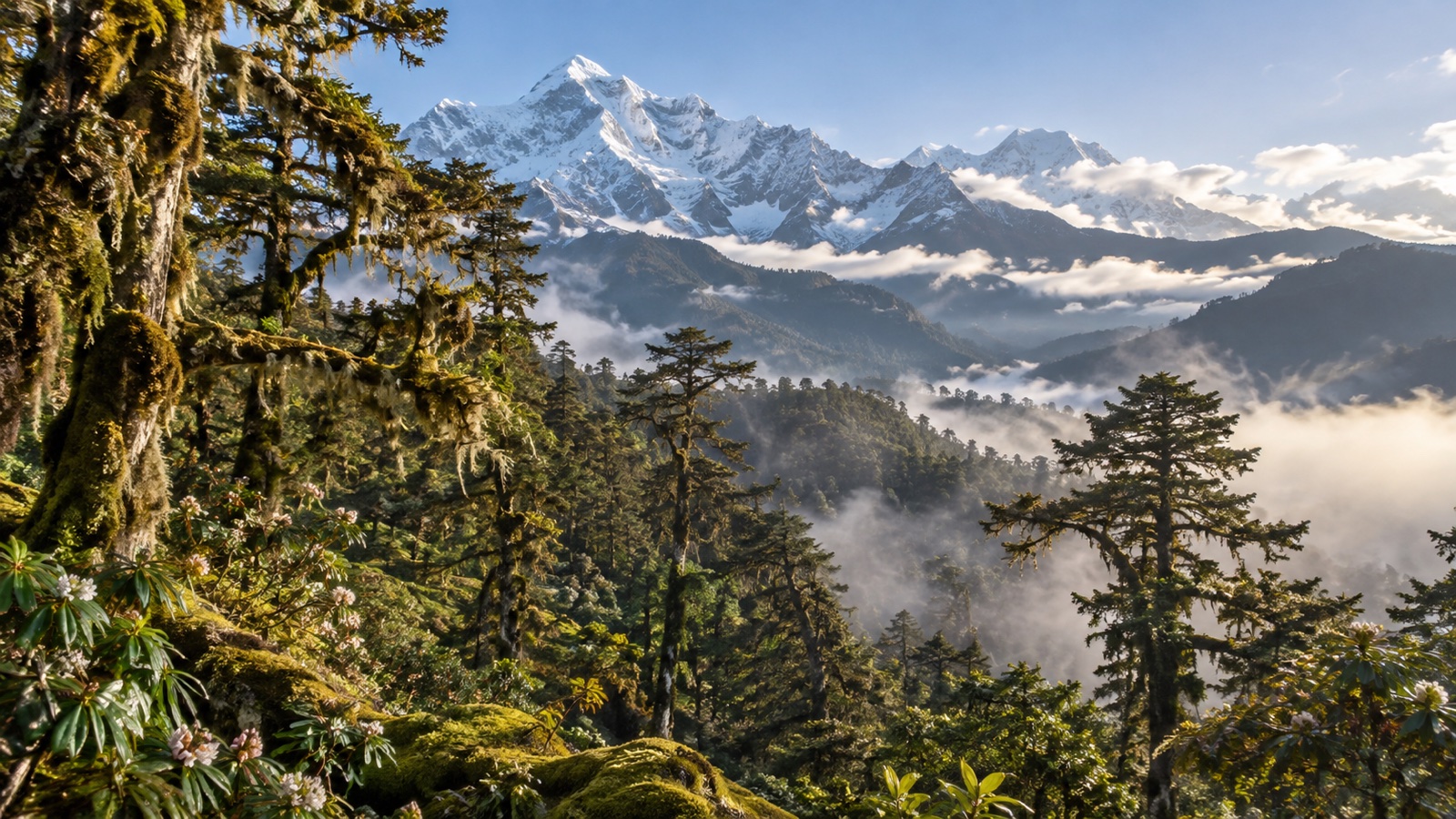
- Central Bhutan contains forested valleys and high mountain passes.
- Northern Bhutan rises into the Greater Himalayas.
- Several peaks exceed 23,000 feet.
- Gangkhar Puensum is generally regarded as Bhutan's highest mountain.
- It rises about 24,836 feet above sea level.
- Gangkhar Puensum is widely considered the world's highest unclimbed mountain.
- Bhutan prohibits mountaineering on its high sacred peaks.
- The current ban reflects spiritual respect as well as conservation policy.
- Bhutan's mountains create sharp climate differences over short distances.
- Monsoon rains are especially important in summer.
- Southern areas receive far more rain than some interior valleys.
- Winter snow can close high mountain roads.
- Bhutan has no coastline.
- Its rivers flow south toward India's Brahmaputra system.
- Steep rivers create enormous hydropower potential.
- Glacial lakes occur in high Himalayan valleys.
- Glacial lake outburst floods are a climate-related hazard.
- Melting glaciers can increase instability in some moraine-dammed lakes.
- Bhutan's vertical geography makes a weather app feel less useful than knowing which side of which mountain you are standing on.
Forests are protected by the constitution
- Bhutan's constitution requires at least 60 percent of the country's land to remain under forest cover for all time.
- Actual forest cover is comfortably above that constitutional minimum.
- Protected areas cover a large share of Bhutan.
- Biological corridors link several protected landscapes.
- Those corridors help wildlife move between parks and seasonal habitats.
- Bhutan sits within a global biodiversity hotspot.
- Bengal tigers live in Bhutan.
- Tigers have been recorded at unusually high elevations there.
- Snow leopards inhabit northern alpine regions.
- Asian elephants live in southern forests.
- Red pandas occur in temperate forests.
- Golden langurs live in parts of central and southern Bhutan.
- The golden langur is an endangered primate with a limited geographic range.
- The takin is Bhutan's national animal.
- Takins are large goat-antelope relatives with stocky bodies and curved horns.
- A popular Bhutanese legend links the takin with the saint Drukpa Kunley.
- Black-necked cranes winter in several Bhutanese valleys.
- Phobjikha Valley is especially famous for the cranes.
- Local conservation efforts help protect crane habitat and migration areas.
- Bhutan's wildlife list reads like someone mixed a tiger documentary, a Himalayan field guide, and one animal designed by committee.
Gross National Happiness is a policy idea, not a claim that everyone smiles all day
Bhutan's Gross National Happiness idea is usually turned into a cute headline about being “the happiest country on Earth.” That is not what it means. It is a development philosophy that asks government to consider well-being, culture, environment, governance, community, and material conditions alongside conventional economic growth.
- Gross National Happiness is commonly abbreviated GNH.
- The concept became closely associated with Bhutan's fourth king, Jigme Singye Wangchuck.
- GNH does not replace every use of gross domestic product.
- Bhutan still measures economic output, income, trade, and other conventional statistics.
- GNH provides an additional framework for judging development.
- The framework includes psychological well-being.
- It also considers health and education.
- Time use is another GNH dimension.
- Cultural diversity and resilience are included.
- Good governance is included.
- Community vitality is included.
- Ecological diversity and resilience are included.
- Living standards are included.
- Researchers use surveys to measure GNH-related indicators.
- The results can identify groups with different levels of well-being and deprivation.
- Bhutan therefore does not officially claim every citizen is happier than every person elsewhere.
- Economic problems, youth unemployment, migration, mental health, inequality, and rural access remain real national issues.
- The framework has influenced international conversations about measuring progress beyond GDP.
- The United Nations has hosted broader discussions of happiness and well-being in development policy.
- My favorite GNH fact is that the interesting question is not “Are Bhutanese people always happy?” but “Why do we assume one economic number tells us whether life is going well?”
Dzongs combine fortress, monastery and government functions
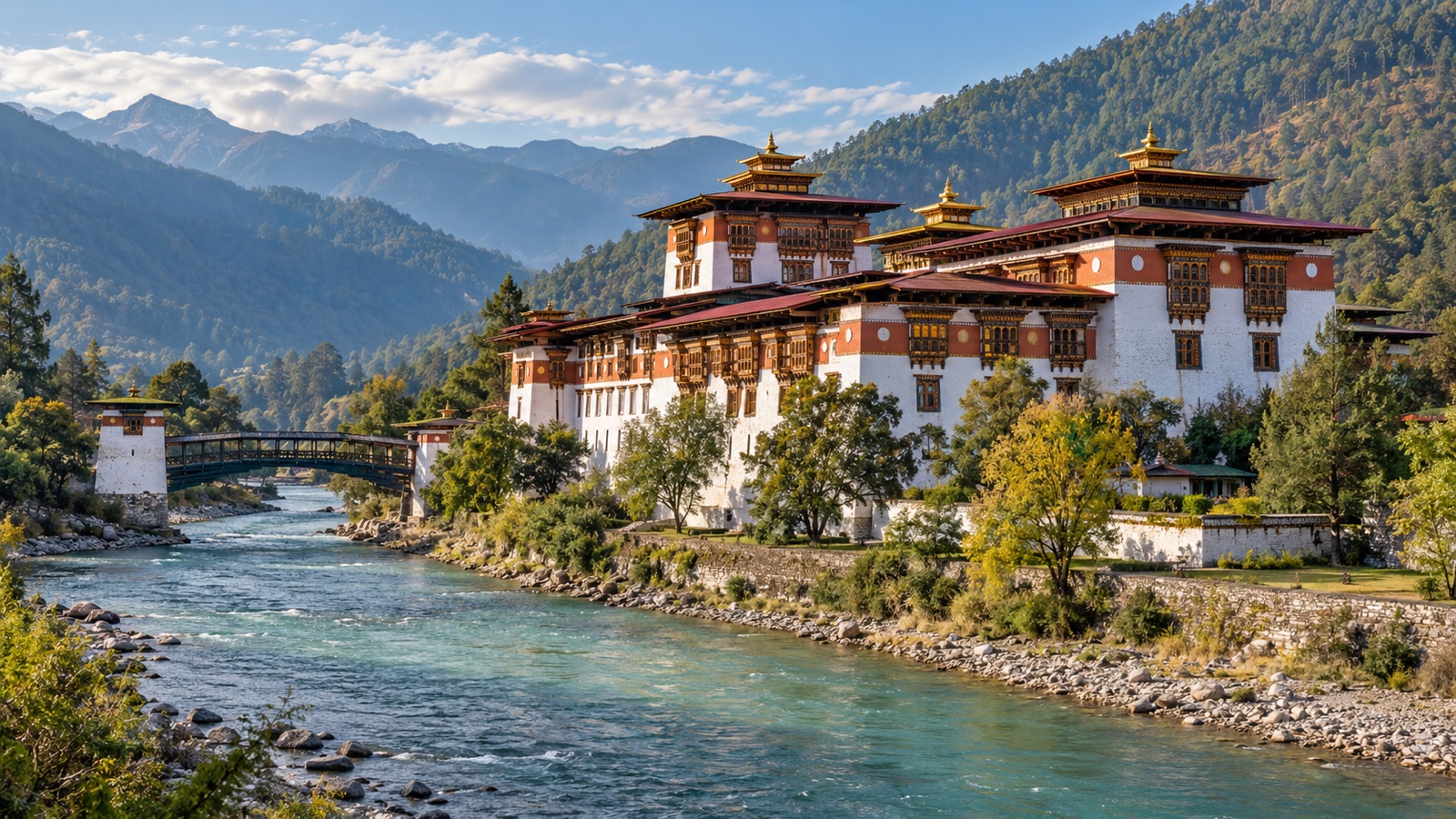
- Dzongs are monumental fortress-monastery complexes found throughout Bhutan.
- Many dzongs contain both administrative offices and monastic spaces.
- Thick walls, courtyards, towers, and elaborate painted woodwork define the style.
- Punakha Dzong stands at the meeting of two rivers.
- It served as Bhutan's administrative center before Thimphu.
- Punakha remains important for royal and religious ceremonies.
- Paro Dzong overlooks the Paro Valley.
- Its formal name is Rinpung Dzong.
- Tashichho Dzong in Thimphu houses important government and monastic institutions.
- Traditional Bhutanese architecture avoids visible nails in many historic timber systems.
- Buildings often use whitewashed walls, carved timber windows, and painted motifs.
- Modern construction rules encourage traditional exterior design elements in many urban areas.
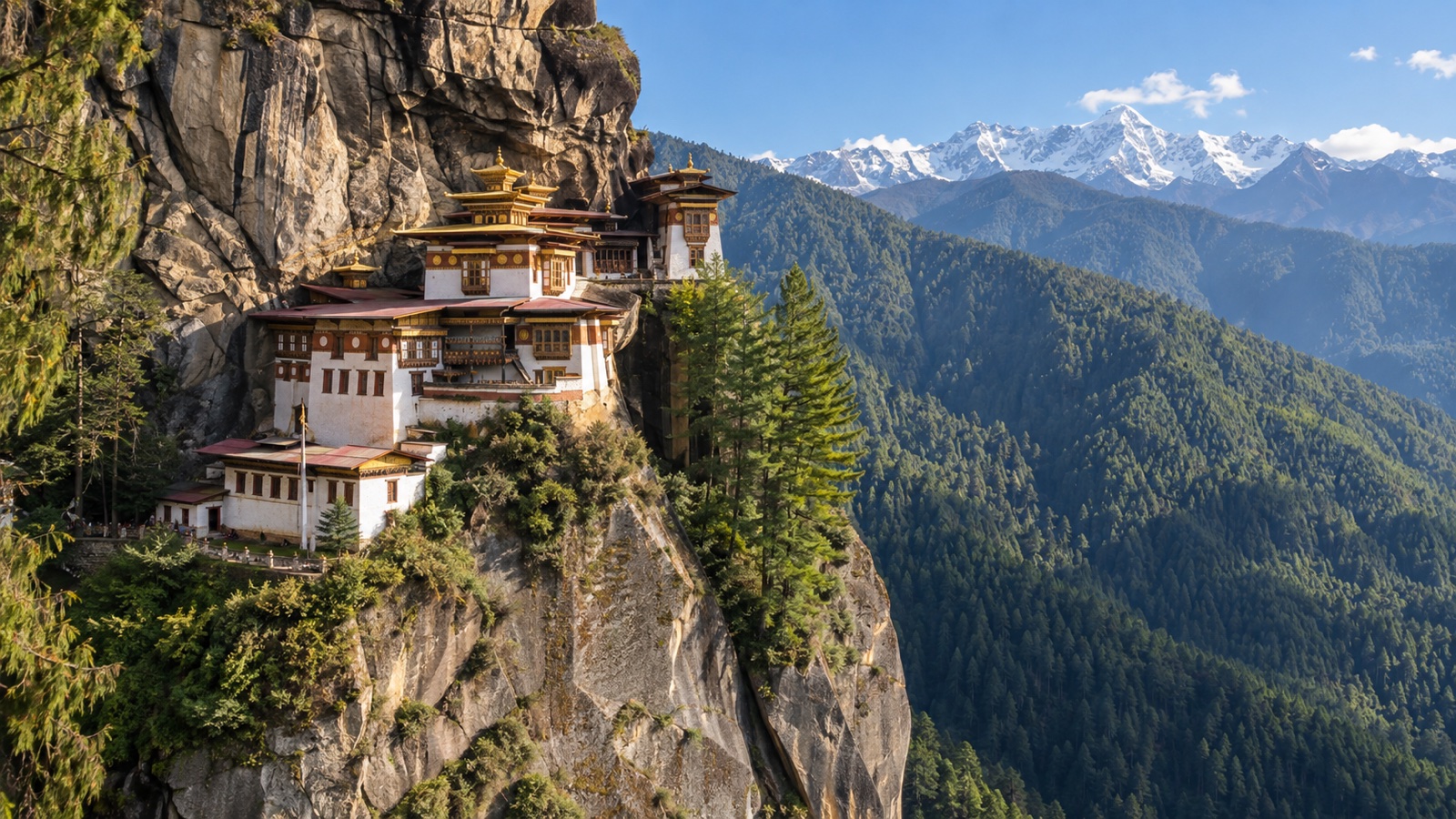
- Taktsang Monastery is commonly called Tiger's Nest.
- It clings to a cliff high above the Paro Valley.
- The monastery complex is one of Bhutan's most famous landmarks.
- Legend says Guru Rinpoche reached the site on the back of a tigress.
- Guru Rinpoche, or Padmasambhava, is a central figure in Himalayan Vajrayana Buddhism.
- Visitors reach Tiger's Nest primarily by hiking.
- The high cliff location makes the final staircases feel substantially less symbolic when your legs are tired.
- Bhutanese architecture has mastered the art of making government offices look like places where a dragon might reasonably handle paperwork.
Bhutan became a constitutional democracy in 2008
Bhutan's shift to democracy was unusual because the monarchy itself pushed much of the transition. The fourth king transferred powers, encouraged constitutional reform, and eventually abdicated in favor of his son before Bhutan held its first parliamentary elections under the new system.
- Bhutan was unified as a distinct state during the 17th century.
- Shabdrung Ngawang Namgyal became a foundational political and religious leader.
- He helped establish the dual system of religious and civil administration.
- The hereditary Wangchuck monarchy began in 1907.
- Ugyen Wangchuck became the first hereditary king.
- Bhutan was never formally colonized by a European power.
- British India exercised significant influence over Bhutan's external relations after 19th-century conflicts.
- India and Bhutan signed a friendship treaty after Indian independence.
- The treaty relationship was updated in 2007.
- Bhutan joined the United Nations in 1971.
- Television and internet service were officially introduced in Bhutan in 1999.
- The fourth king began decentralizing political power during his reign.
- He announced plans to move toward constitutional monarchy and parliamentary democracy.
- Jigme Khesar Namgyel Wangchuck became the fifth king in 2006.
- Bhutan's first nationwide parliamentary elections were held in 2008.
- The constitution was adopted in 2008.
- The king remains head of state under the constitutional system.
- The elected prime minister leads the government.
- Bhutan has held repeated peaceful elections and transfers between political parties.
- A monarchy voluntarily creating more democracy is not the usual political plot twist, which is why Bhutan's transition is worth knowing.
Chilies, archery, festivals and 25 final Bhutan facts
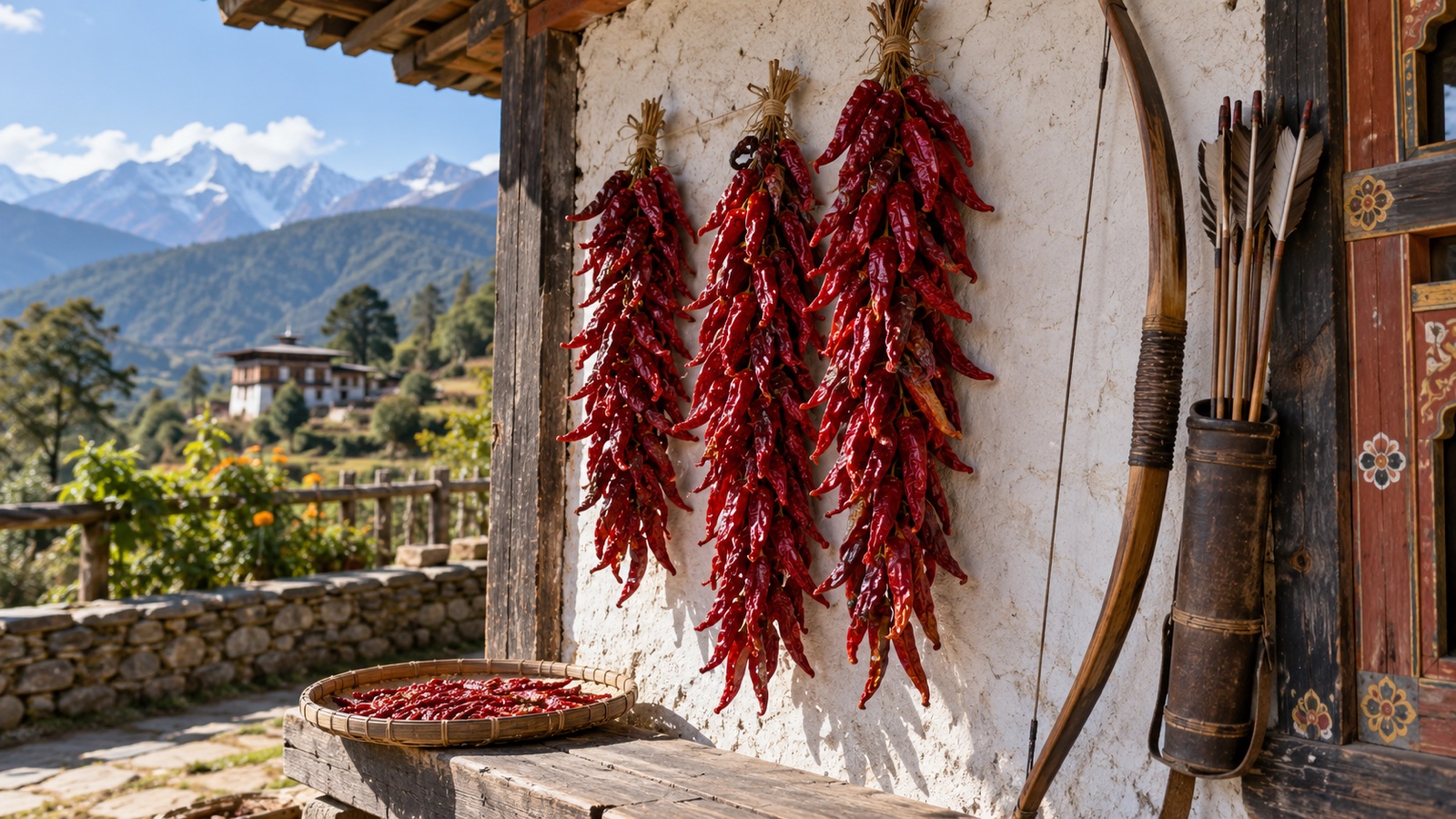
- Ema datshi is one of Bhutan's signature dishes.
- It combines chilies with cheese.
- In Bhutanese cooking, chilies often function as a main vegetable rather than just a seasoning.
- Datshi refers to a cheese used in several dishes.
- Kewa datshi combines potatoes and cheese.
- Shamu datshi combines mushrooms and cheese.
- Red rice is widely eaten in Bhutan.
- Highland regions also produce buckwheat and barley.
- Butter tea is consumed in Himalayan communities.
- Ara is a traditional alcoholic drink made from grains such as rice, maize, millet, wheat, or barley.
- Archery is Bhutan's national sport.
- Traditional archery targets can be separated by roughly 460 feet.
- Modern compound bows are also used in competition.
- Archery matches include songs, dancing, teasing, and team celebration.
- Darts called khuru are another popular traditional game.
- Tsechus are major religious festivals held in districts around Bhutan.
- Masked dances called cham form important parts of many tsechus.
- Dancers may represent deities, teachers, animals, and moral stories.
- The gho is a traditional robe worn by Bhutanese men in formal settings.
- The kira is traditional formal dress worn by Bhutanese women.
- Thimphu is famous for managing major central intersections without conventional traffic lights.
- Traffic police direct vehicles at a prominent city-center junction.
- Paro Airport sits in a narrow mountain valley and requires specially trained pilots.
- Bhutan earns substantial revenue from hydropower exports, especially to India.
- After 145 facts, Bhutan feels less like a happiness slogan and more like a country constantly negotiating how much of the modern world it wants, how quickly, and on whose terms.
Quick FAQ
Q: Is Bhutan really the happiest country in the world?
A: That popular claim oversimplifies Gross National Happiness. GNH is a policy framework for measuring several dimensions of well-being, not a ranking that says every Bhutanese person is happier than everyone else.
Q: What is the capital of Bhutan?
A: Thimphu is both the capital and largest city.
Q: Why doesn't Bhutan allow climbing its highest mountains?
A: High peaks have deep spiritual significance, and Bhutan prohibits mountaineering on sacred summits as part of cultural and environmental policy.
Q: What is Bhutan famous for?
A: Gross National Happiness, Himalayan monasteries, Tiger's Nest, dzongs, forest conservation, archery, takins, black-necked cranes, chilies and cheese, hydropower, and the thunder-dragon flag.
Q: Is Bhutan a monarchy or a democracy?
A: Both in the constitutional sense. Bhutan is a democratic constitutional monarchy with an elected parliament and government alongside a hereditary king as head of state.

Ellie is the owner and sole author of Fun Facts, combining her mechanical engineering background with years of research-driven writing to deliver facts you can trust. Every article is thoroughly fact-checked and routinely updated as new science and sources emerge to keep information accurate and current. Her mission is to make learning delightful while upholding high standards of reliability and transparency.