
Arkansas is the state where you can dig for diamonds, soak in historic hot springs, paddle one of America’s first protected rivers, and still end the day arguing about the proper way to pronounce the state name. I went looking for “Natural State” trivia and found far more personality than the nickname promises.
Arkansas basics that are easy to mix up
- Arkansas became the 25th U.S. state on June 15, 1836.
- Little Rock is the state capital.
- Little Rock is also Arkansas’s largest city.
- Arkansas’s official nickname is the Natural State.
- The state postal abbreviation is AR.
- Arkansas has 75 counties.
- People who live in Arkansas are called Arkansans.
- The state motto is “Regnat populus,” meaning “The people rule.”
- The Arkansas pronunciation is legally recognized as “AR-kan-saw,” not “ar-KAN-zus.”
- Arkansas and Kansas share part of their names but pronounce the final syllables differently.
- The names ultimately trace through French spellings of Indigenous names.
- Arkansas borders Missouri, Tennessee, Mississippi, Louisiana, Texas, and Oklahoma.
- The Mississippi River forms much of Arkansas’s eastern boundary.
- The state lies entirely within the Central Time Zone.
- Arkansas is part of both the American South and the Interior Highlands.
- The Ozark and Ouachita mountains cover much of the north and west.
- The flatter Mississippi Alluvial Plain dominates much of eastern Arkansas.
- Arkansas has an official state flag featuring a diamond shape.
- The diamond reflects the state’s genuine diamond deposits.
- I respect a state flag that manages to include geology without looking like homework.
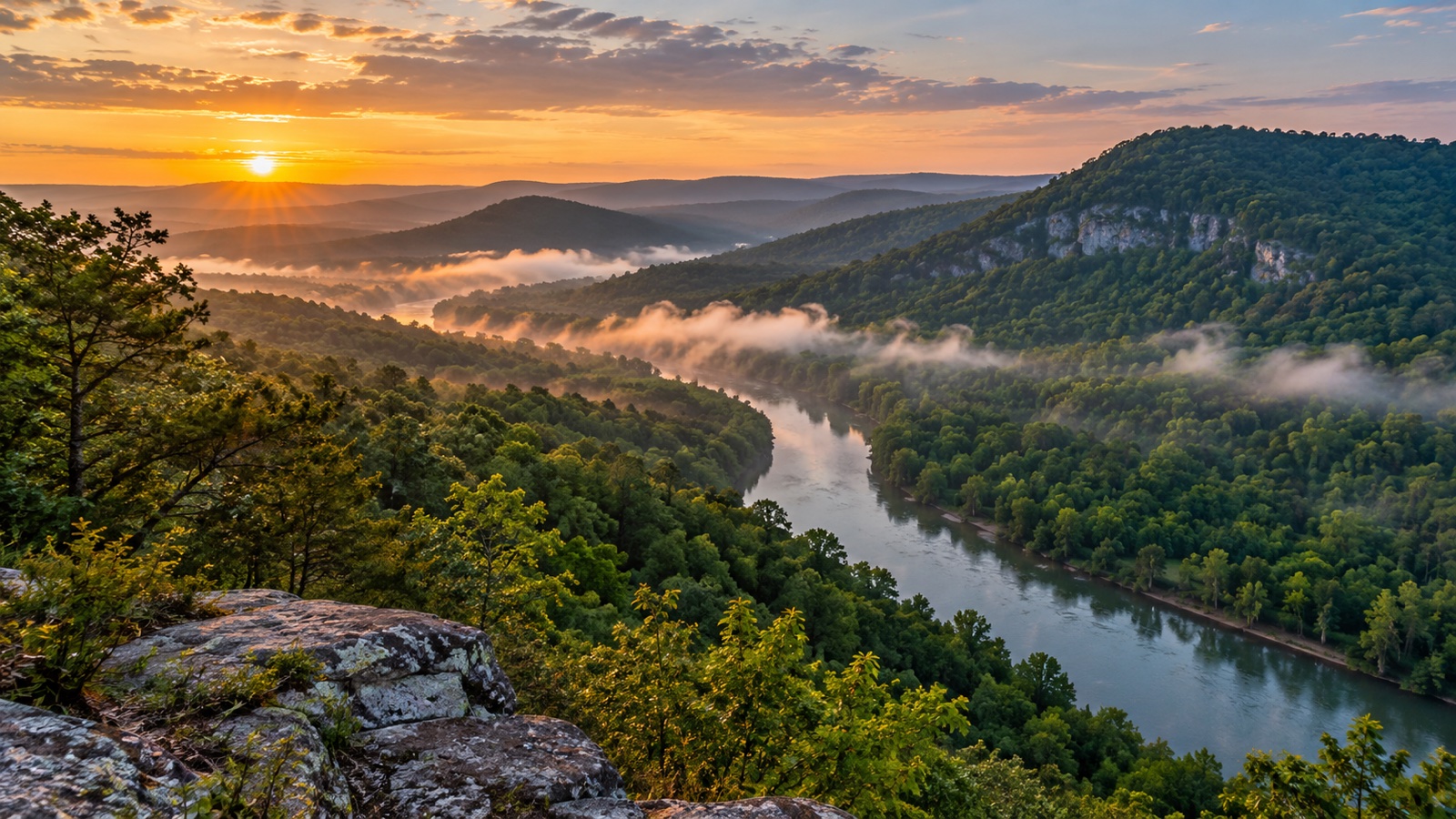
Mountains, rivers & landscapes
- The Ozark Mountains extend across northern Arkansas and into neighboring states.
- The Boston Mountains form the highest and most rugged part of the Arkansas Ozarks.
- The Ouachita Mountains run generally east to west, which is unusual among major U.S. mountain ranges.
- Magazine Mountain is Arkansas’s highest point.
- Its highest summit reaches 2,753 feet above sea level.
- Mount Magazine State Park protects the summit area.
- The Arkansas River crosses the state from west to east.
- It eventually joins the Mississippi River.
- The White River is famous for trout fishing below several dams.
- The Buffalo National River was established in 1972.
- It became the first national river designated in the United States.
- The Buffalo River flows freely for more than 130 miles through the Ozarks.
- Tall limestone bluffs line many sections of the Buffalo.
- The Mulberry River is another well-known Arkansas paddling stream.
- The Cossatot River includes some of the state’s most challenging whitewater.
- The Mississippi Alluvial Plain is often called the Delta region in Arkansas.
- Its rich soils support extensive agriculture.
- Crowley’s Ridge rises unexpectedly above the otherwise flat eastern lowlands.
- The ridge is largely made from windblown loess soils over older sediments.
- Arkansas manages to fit mountain roads, swampy lowlands, prairie, forest, and giant rivers into one state.
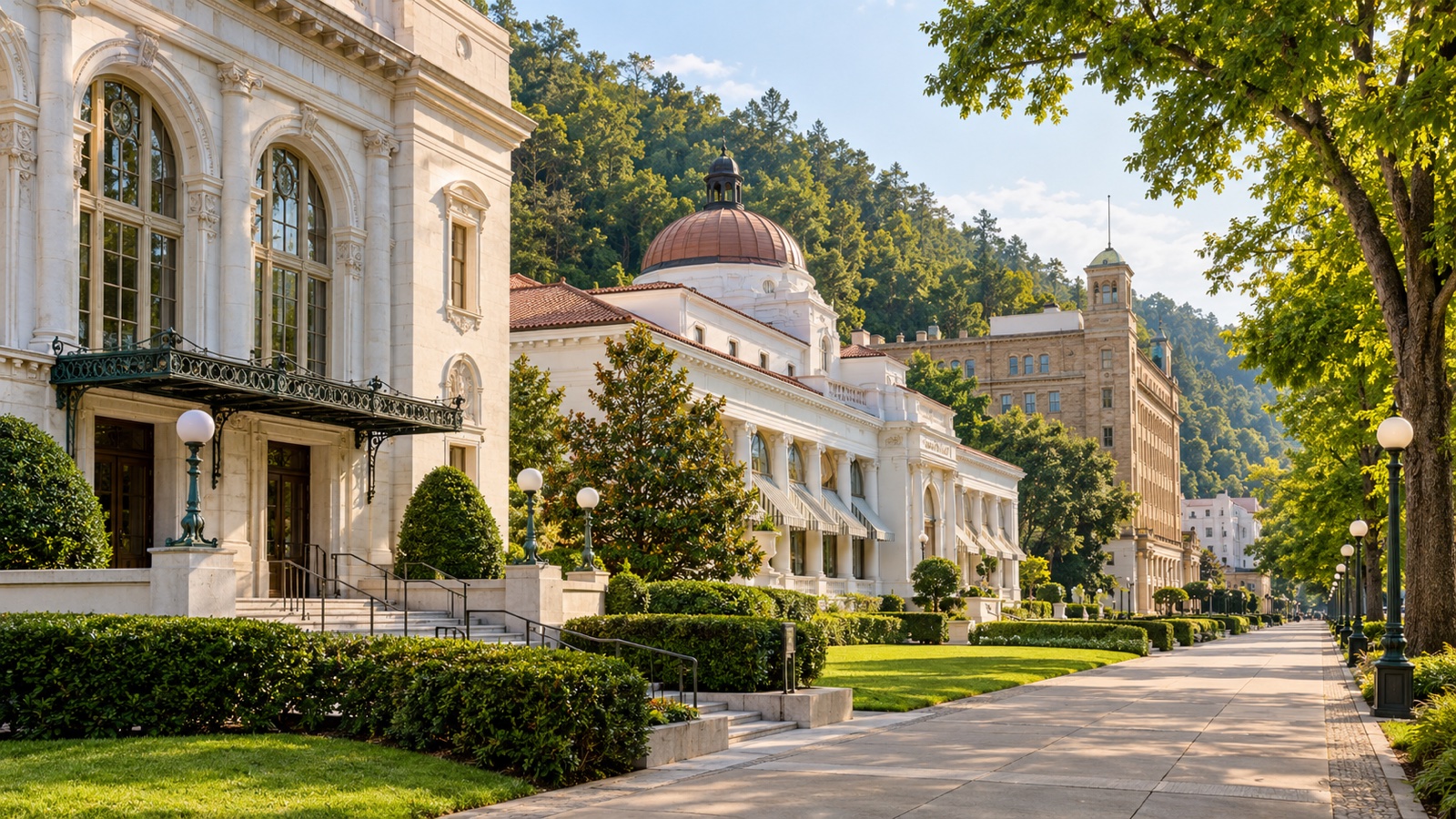
Hot Springs is much more than a town name
- Hot Springs National Park surrounds naturally heated springs in the Ouachita Mountains.
- The thermal water emerges at roughly 143°F.
- The water is heated deep underground by Earth’s natural geothermal gradient rather than by nearby volcanic magma.
- Rainwater slowly seeps underground before returning to the surface as hot spring water.
- People used the springs long before the creation of the national park system.
- The federal government reserved the Hot Springs area in 1832.
- That happened decades before Yellowstone became the first national park.
- Hot Springs Reservation later became Hot Springs National Park in 1921.
- Bathhouse Row preserves a line of historic bathhouses.
- Several bathhouses were built during the late 19th and early 20th centuries.
- Visitors once traveled to Hot Springs seeking treatments for many illnesses.
- Modern medicine no longer supports many of the extravagant cure claims once attached to mineral bathing.
- People can still soak in thermal water at approved bathhouse facilities.
- Park visitors can fill containers with spring water at designated fountains.
- The water is naturally hot enough that cooling it before drinking is the sensible move.
- Hot Springs became known for horse racing as well as bathing.
- Oaklawn Racing Casino Resort traces its horse-racing history to 1904.
- The city also developed a colorful gambling and organized-crime history during the 20th century.
- Gangsters including Al Capone are associated with visits to Hot Springs.
- A spa town with gangsters, thoroughbreds, and 143°F water is not the Arkansas storyline I expected either.
Yes, you can really hunt for diamonds
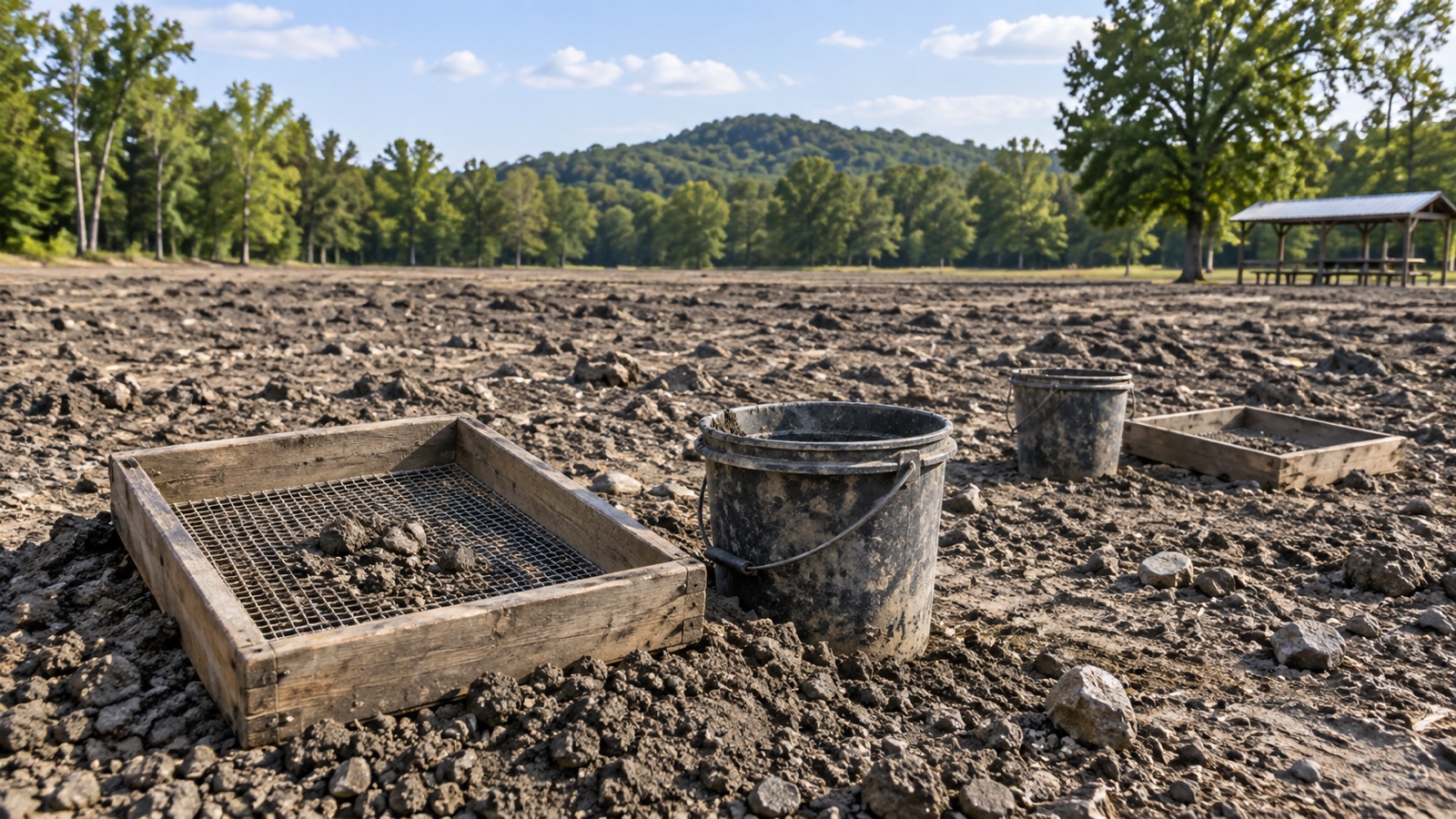
Crater of Diamonds is the fact that makes Arkansas sound like somebody designed a state park after reading a treasure-hunt novel. Visitors can search a volcanic field for real diamonds, and the park lets finders keep what they discover.
- Crater of Diamonds State Park is near Murfreesboro, Arkansas.
- It protects a volcanic field where diamonds occur naturally.
- Visitors are allowed to search the designated diamond-search area.
- Diamonds found by visitors can be kept.
- The park’s search field covers more than 37 acres.
- The diamond-bearing rock formed from an ancient volcanic pipe.
- Weathering releases diamonds and other minerals into the surface soil.
- People search by walking the field, dry sifting soil, or washing material through screens.
- Rain can make surface searching productive because water washes soil away from heavier stones.
- Most diamonds found at the park are small.
- White, brown, and yellow diamonds have all been found there.
- The Uncle Sam diamond was discovered at the site in 1924.
- It weighed more than 40 carats before cutting.
- It remains the largest diamond ever found in the United States.
- The site operated commercially before becoming a state park.
- Arkansas’s official state gem is the diamond.
- Quartz crystals are also abundant in western Arkansas.
- The Ouachita Mountains are internationally known for clear quartz crystal deposits.
- Rockhounds can visit commercial crystal mines that allow digging.
- Arkansas apparently took “Natural State” seriously enough to hide jewelry underground.
Forests, wildlife & outdoor Arkansas
- Forests cover more than half of Arkansas.
- Oak and hickory forests are widespread in upland areas.
- Pine forests are especially important in southern Arkansas.
- Ouachita National Forest extends across western Arkansas and into Oklahoma.
- Ozark-St. Francis National Forests protect large areas of northern and eastern Arkansas.
- White-tailed deer are common throughout the state.
- Black bears live in forested regions of Arkansas.
- Arkansas once lost nearly all of its black bears but successfully restored populations during the 20th century.
- Elk were reintroduced to northwestern Arkansas during the 1980s.
- Today, elk can be seen around the Buffalo National River region.
- American alligators live in southern Arkansas wetlands.
- Bald eagles winter along Arkansas rivers and reservoirs.
- Arkansas lies along the Mississippi Flyway used by millions of migratory birds.
- The state is especially famous among duck hunters for flooded timber habitat.
- Stuttgart is widely known for waterfowl hunting and rice farming.
- The ivory-billed woodpecker became the subject of intense Arkansas searches after a controversial 2004 sighting report.
- No conclusive modern evidence has established a surviving population of the species.
- The state flower is the apple blossom.
- The state tree is the loblolly pine.
- The state insect is the honeybee.
Little Rock, civil rights & Arkansas history
Arkansas history can turn serious very quickly, especially in Little Rock. One of the most important school-desegregation confrontations in American history happened at Central High School, where nine Black teenagers faced organized resistance simply for attending class.
- Indigenous peoples lived in the Arkansas region for thousands of years before European colonization.
- The Quapaw, Osage, and Caddo are among the Indigenous nations deeply connected with the region.
- Spanish explorer Hernando de Soto traveled through the area in the 1540s.
- French explorers and traders later established a colonial presence.
- Arkansas Post began as a French trading post in 1686.
- It became one of the earliest European settlements in the lower Mississippi Valley.
- The United States acquired the region through the Louisiana Purchase in 1803.
- Arkansas Territory was created in 1819.
- Arkansas entered the Union as a slave state in 1836.
- The state seceded from the United States in 1861 during the Civil War.
- Several major Civil War battles were fought in Arkansas.
- Pea Ridge was a strategically important Union victory in 1862.
- Arkansas was readmitted to the Union in 1868.
- Little Rock Central High School became a national civil-rights landmark in 1957.
- Nine Black students known as the Little Rock Nine enrolled after federal court-ordered desegregation.
- Arkansas Governor Orval Faubus initially used the National Guard to block their entry.
- President Dwight Eisenhower federalized the Arkansas National Guard and sent federal troops to enforce desegregation.
- Daisy Bates was a major civil-rights leader who supported the Little Rock Nine.
- Central High School remains an operating public high school as well as a National Historic Site.
- Its continued use as a school makes the history feel much less distant than a museum case.
Food, music, famous Arkansans & 25 final facts
- Arkansas is one of the nation’s leading rice-producing states.
- Rice fields are especially common in the eastern Arkansas Delta.
- Soybeans are another major Arkansas crop.
- Poultry production is a major part of the state economy.
- Tyson Foods is headquartered in Springdale.
- Walmart is headquartered in Bentonville.
- Sam Walton opened the first Walmart store in Rogers in 1962.
- Bentonville is also home to Crystal Bridges Museum of American Art.
- The museum was founded by Alice Walton and opened in 2011.
- J.B. Hunt Transport Services is headquartered in Lowell.
- Former President Bill Clinton was born in Hope, Arkansas.
- Johnny Cash was born in Kingsland, Arkansas.
- Cash grew up in Dyess, a New Deal agricultural resettlement community.
- His childhood home in Dyess has been preserved.
- Blues musician Albert King was born in Indianola, Mississippi, but spent important early years working and performing in Arkansas.
- Arkansas’s Delta region has deep blues, gospel, and country-music traditions.
- Mountain folk music remains an important Ozark cultural tradition.
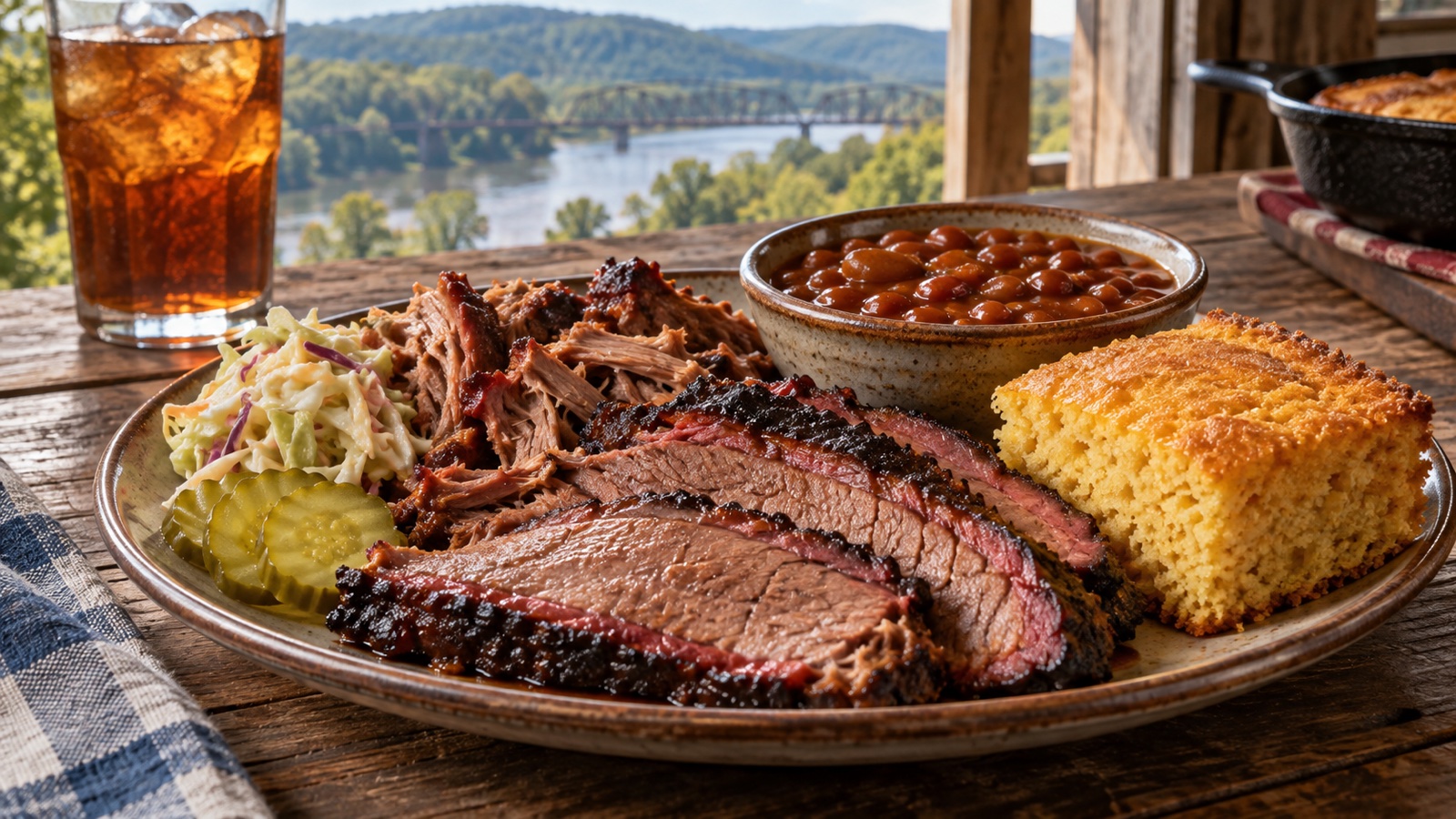
- Fried catfish is a familiar Arkansas menu staple.
- Chocolate gravy is a distinctive breakfast tradition in parts of Arkansas and the Ozarks.
- Possum pie is an Arkansas dessert made with layered cream cheese, chocolate pudding, whipped topping, and a nut crust rather than actual possum.
- The state vegetable is the South Arkansas Vine Ripe Pink Tomato.
- The state grain is rice.
- The state beverage is milk.
- Arkansas has a town named Fifty-Six and another named Toad Suck.
- After 145 facts, I am still stuck on the idea that Arkansas lets ordinary park visitors leave with a diamond if they are lucky enough to find one.
Quick FAQ
Q: What is Arkansas famous for?
A: Arkansas is known for the Ozarks, Hot Springs National Park, the Buffalo National River, diamond hunting, rice farming, Walmart, and major civil-rights history in Little Rock.
Q: How do you pronounce Arkansas?
A: The standard state pronunciation is “AR-kan-saw.” State law formally recognized that pronunciation in the 19th century.
Q: Can you really find diamonds in Arkansas?
A: Yes. Visitors can search the field at Crater of Diamonds State Park and keep diamonds they find.
Q: What is the capital of Arkansas?
A: Little Rock is both the capital and largest city.
Q: Why is Arkansas called the Natural State?
A: The nickname highlights its mountains, forests, rivers, hot springs, lakes, wildlife, and extensive outdoor recreation.

Ellie is the owner and sole author of Fun Facts, combining her mechanical engineering background with years of research-driven writing to deliver facts you can trust. Every article is thoroughly fact-checked and routinely updated as new science and sources emerge to keep information accurate and current. Her mission is to make learning delightful while upholding high standards of reliability and transparency.