
Magnetism can make a compass turn, hold a note to a refrigerator, spin a motor, guide particles around Earth, and produce auroras in the night sky. It is not a mysterious separate force either. Magnetism is part of electromagnetism, the same fundamental interaction behind electricity and light.
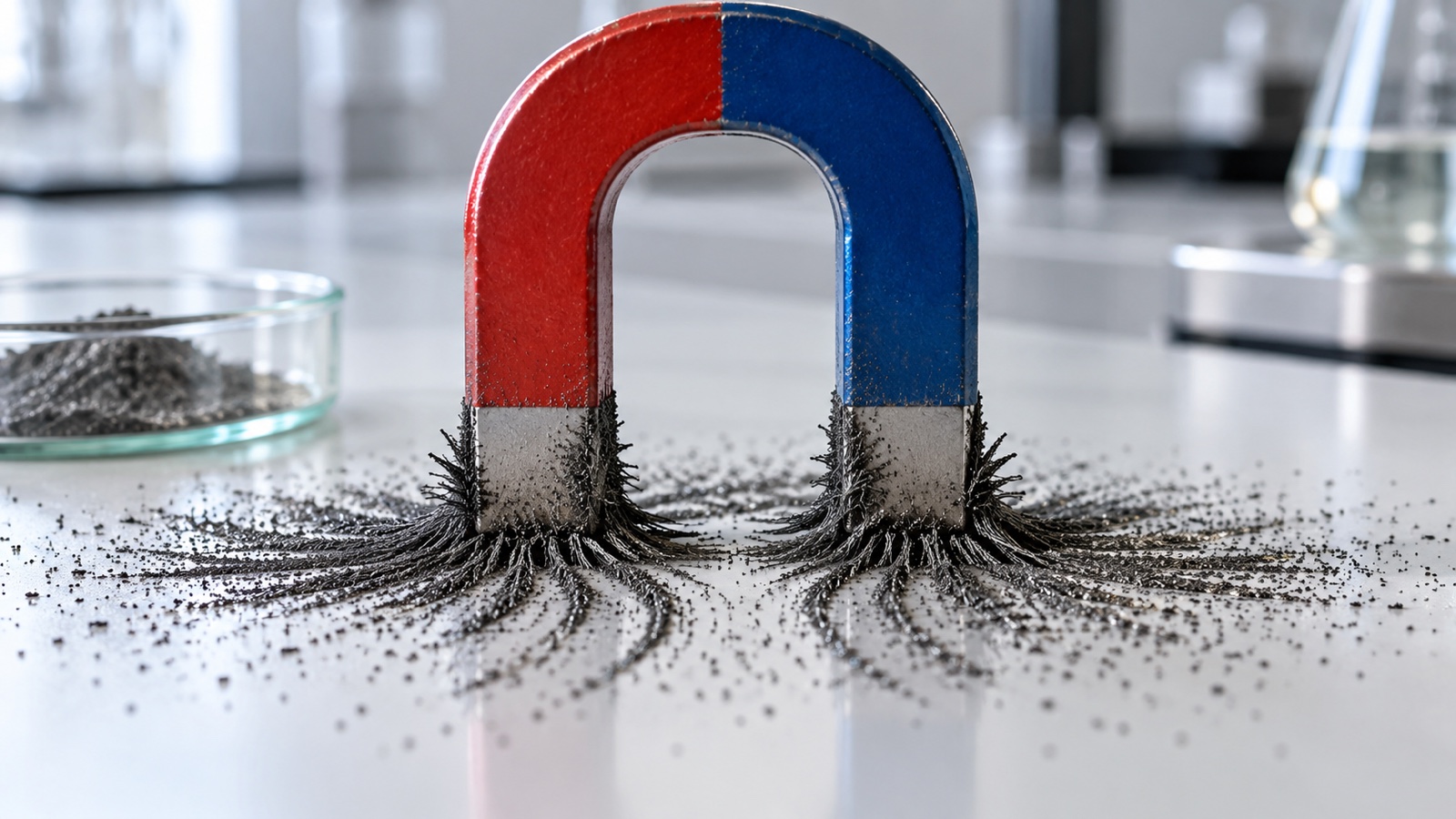
Magnets have north and south poles
- Every ordinary bar magnet has a north-seeking pole and a south-seeking pole.
- Like magnetic poles repel each other.
- Opposite magnetic poles attract each other.
- Cutting a bar magnet in half does not isolate a single pole.
- Each smaller piece normally becomes a new magnet with both north and south poles.
- Isolated magnetic monopoles have not been confirmed experimentally.
- Magnetic field lines form closed loops in ordinary classical descriptions.
- Outside a bar magnet, field lines are drawn from north toward south.
- Inside the magnet, the lines complete the loop from south toward north.
- Magnetic-field strength and direction vary with location.
- The field is strongest near the poles of a simple bar magnet.
- Magnetic fields are represented by the symbol B in many physics equations.
- The SI unit of magnetic flux density is the tesla.
- One tesla is a strong field by everyday standards.
- Earth's surface magnetic field is only tens of microteslas.
- Small refrigerator magnets are far stronger than Earth's field at close range.
- Magnetic force can act without physical contact.
- The force still weakens rapidly with distance from a small magnet.
- A compass works because its magnetic needle experiences torque in Earth's field.
- A tiny compass needle, an MRI scanner, and the Sun's magnetism all obey the same basic electromagnetic laws at wildly different scales.
Moving electric charges create magnetic fields
- Electric current creates a magnetic field around a conductor.
- Hans Christian Ørsted demonstrated the connection between current and magnetism in 1820.
- A current-carrying straight wire produces circular magnetic-field lines around it.
- The right-hand rule predicts the field direction around a conventional current.
- A loop of current creates a field resembling that of a small bar magnet.
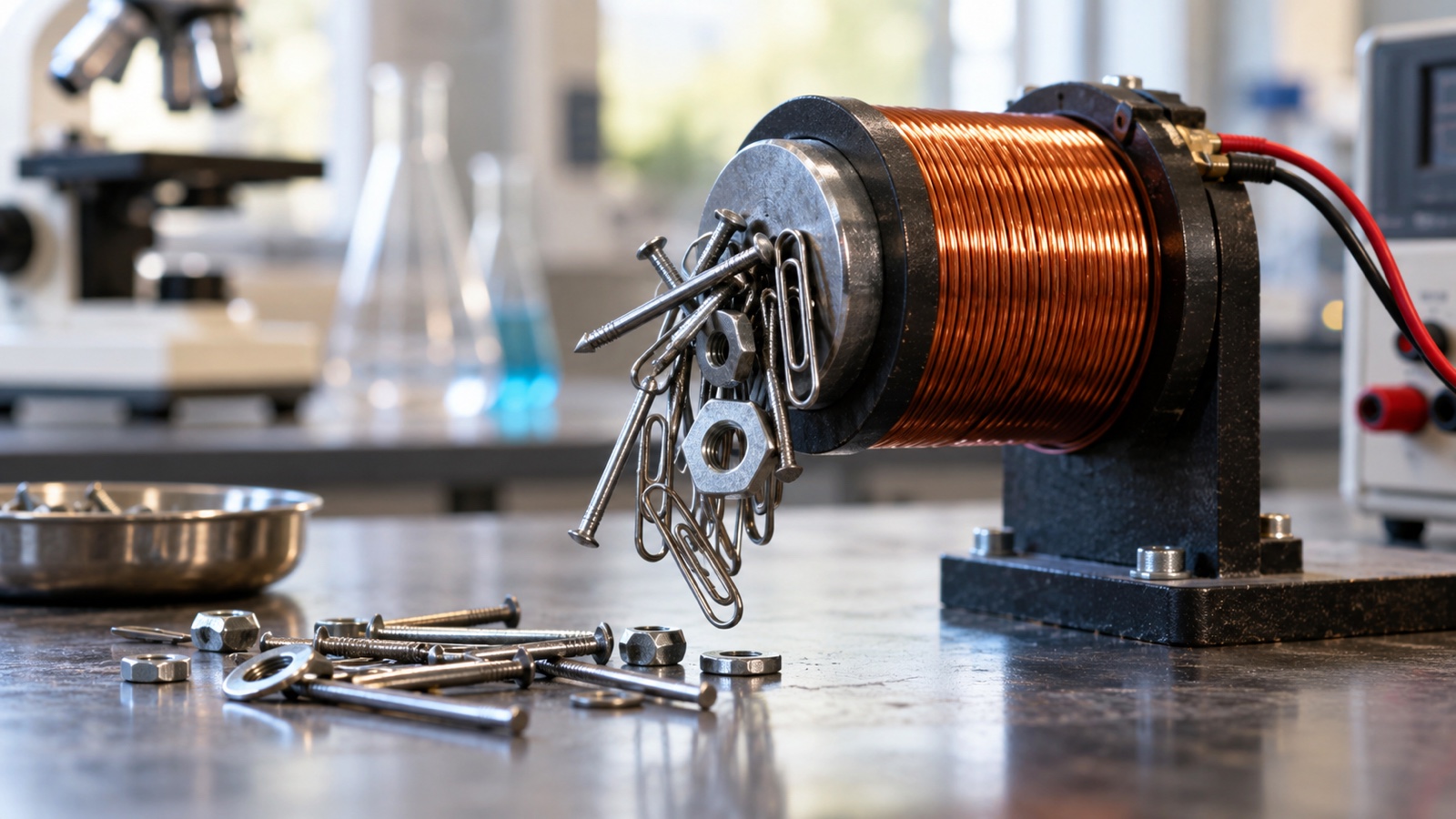
- A coil of current is called a solenoid.
- A solenoid can produce a strong and fairly uniform field inside its central region.
- Adding an iron core can strengthen an electromagnet dramatically.
- Electromagnets can be switched on and off by controlling current.
- Electromagnets are used in relays.
- They are used in industrial lifting magnets.
- They are used in speakers and many actuators.
- Electric motors rely on magnetic forces.
- Generators rely on changing magnetic flux to produce voltage.
- A current-carrying wire placed in a magnetic field can experience force.
- The force depends on current, field strength, and geometry.
- Charged particles moving through magnetic fields can curve.
- Magnetic force on a moving point charge is perpendicular to its velocity and the field direction.
- Because of that perpendicular force, a magnetic field can bend a particle's path without directly changing its speed in an ideal case.
- Magnetism is not electricity's unrelated cousin. It appears whenever electric charges move and is woven directly into the same electromagnetic field.
Ferromagnetic materials can become strongly magnetized
- Iron is strongly ferromagnetic below its Curie temperature.
- Cobalt is ferromagnetic under ordinary conditions.
- Nickel is also ferromagnetic under ordinary conditions.
- Ferromagnetism comes from quantum-mechanical interactions among electron magnetic moments.
- Magnetic regions inside a ferromagnetic material are called domains.
- Within a domain, many atomic magnetic moments align collectively.
- An unmagnetized iron object can contain domains pointing in many directions.
- An applied field can cause domains favorably aligned with the field to grow.
- This can leave a material magnetized even after the external field is removed.
- Permanent magnets are made from materials that resist losing their magnetization.
- Neodymium-iron-boron magnets are among the strongest widely available permanent magnets.
- Samarium-cobalt magnets also provide strong permanent magnetism.
- Magnetic hardness describes resistance to demagnetization.
- Soft magnetic materials are easy to magnetize and demagnetize.
- Transformer cores often use soft magnetic materials.
- Permanent magnets need much greater coercivity.
- Heating a ferromagnet can weaken its ordered magnetic state.
- Above the Curie temperature, ordinary ferromagnetic order disappears.
- Different ferromagnetic materials have different Curie temperatures.
- The difference between an iron nail and a strong permanent magnet is not that one contains magnetism and the other does not. It is largely about how their internal magnetic domains are organized.
Not all magnetic materials behave the same way
- Diamagnetic materials are weakly repelled by magnetic fields.
- Diamagnetism occurs in all materials to some extent.
- In most materials it is overwhelmed by stronger magnetic effects.
- Paramagnetic materials are weakly attracted to magnetic fields.
- Paramagnetism usually comes from unpaired electron magnetic moments.
- Paramagnetic magnetization generally disappears when the external field is removed.
- Ferromagnetic materials can retain magnetization.
- Antiferromagnetic materials have neighboring magnetic moments aligned in opposing patterns.
- Ferrimagnetic materials also have opposing magnetic moments but with unequal cancellation.
- Ferrites are important ferrimagnetic materials used in electronics.
- Water is weakly diamagnetic.
- Graphite is diamagnetic.
- Bismuth is strongly diamagnetic compared with many ordinary materials.
- Strong magnetic fields can levitate certain diamagnetic materials.
- Even small living organisms have been levitated in extremely strong laboratory magnetic fields.
- Magnetic susceptibility describes how a material responds to an applied magnetic field.
- Magnetic behavior depends on electron structure and interactions.
- It cannot be predicted from color or appearance.
- Most everyday objects are not strongly attracted to a refrigerator magnet.
- “Magnetic” is not a yes-or-no property. Materials can be ferromagnetic, ferrimagnetic, paramagnetic, diamagnetic, antiferromagnetic, or nearly indifferent under everyday conditions.
Earth behaves approximately like a giant magnet
- Earth has a global magnetic field.
- The field is generated mainly by moving electrically conducting liquid in the outer core.
- This process is called the geodynamo.
- Earth's outer core is rich in molten iron.
- Convection and planetary rotation help organize core flow.
- Earth's field resembles a tilted dipole at large scales.
- It is more complicated than a perfect bar-magnet field.
- A compass north-seeking end points roughly toward geographic north.
- Magnetic north and geographic north are not the same location.
- Magnetic poles move over time.
- The magnetic north pole has migrated substantially in recent decades.
- Magnetic declination is the angle between magnetic north and true north.
- Declination depends on location.
- Navigation charts account for changing magnetic declination.
- Earth's magnetic field has reversed polarity many times in geological history.
- These reversals are recorded in magnetic minerals in rocks.
- Mid-ocean ridge rocks preserve symmetrical magnetic stripes from past reversals.
- Those stripes helped confirm seafloor spreading.
- Earth's magnetic field helps deflect many charged particles from the solar wind.
- A compass seems like a simple direction finder, but it is really responding to electric currents thousands of miles beneath your feet.

Auroras reveal magnetic fields in action
- The solar wind is a stream of charged particles flowing from the Sun.
- Earth's magnetic field redirects many of these particles.
- The surrounding magnetic region is called the magnetosphere.
- Solar storms can disturb the magnetosphere.
- Some charged particles are guided toward polar regions.
- There they collide with atoms and molecules in the upper atmosphere.
- Those collisions can excite atmospheric particles.
- When the particles return to lower-energy states, they emit light.
- This produces auroras.
- Green auroral light often comes from excited atomic oxygen.
- Red auroras can also involve oxygen at different altitudes and conditions.
- Blue and purple colors often involve nitrogen.
- Aurora borealis is the northern lights.
- Aurora australis is the southern lights.
- Strong geomagnetic storms can push auroras farther from the poles.
- Geomagnetic storms can also affect satellites and power systems.
- Solar activity can induce currents in long conductors on Earth.
- Power-grid operators monitor space weather partly for this reason.
- Other planets with magnetic fields also produce auroras.
- An aurora is essentially a giant natural display showing charged particles being steered by planetary magnetism into the upper atmosphere.
Magnetism powers technology from motors to medical imaging
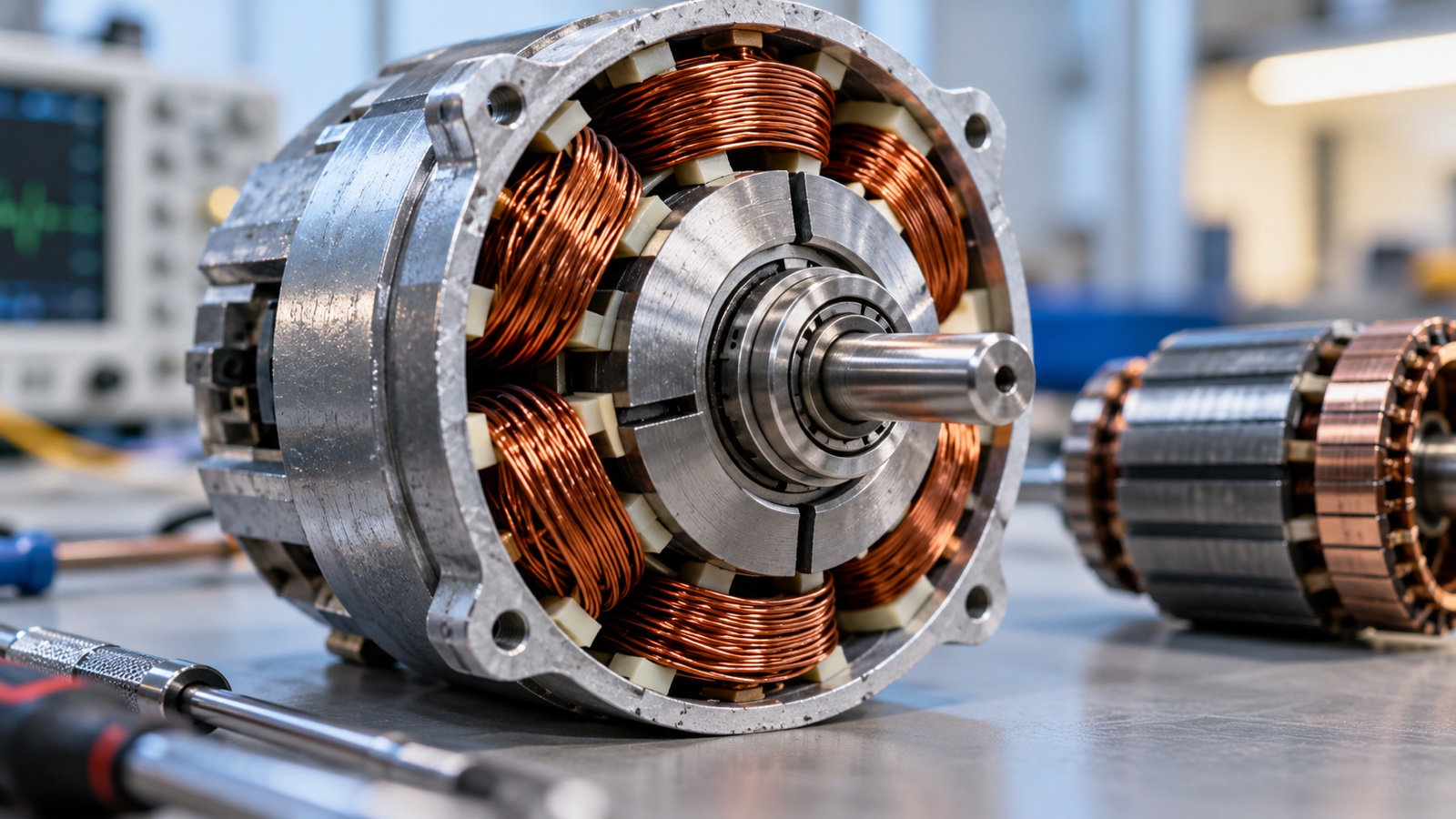
- Electric motors convert electrical energy into mechanical motion using magnetic forces.
- Generators reverse the idea by converting mechanical motion into electrical energy.
- Transformers use changing magnetic fields to transfer electrical energy between coils.
- Speakers use magnets and current-carrying coils to move cones and create sound.
- Hard disk drives store information in tiny magnetized regions.
- Magnetic stripe cards store information magnetically.
- Induction cooktops create changing magnetic fields that heat compatible cookware.
- Wireless charging uses magnetic coupling between coils.
- MRI stands for magnetic resonance imaging.
- MRI scanners use very strong magnetic fields.
- They align nuclear magnetic moments, especially those of hydrogen nuclei.
- Radiofrequency pulses disturb that alignment.
- Detected signals are reconstructed into images.
- MRI does not use ionizing X-rays.
- Strong MRI magnets can attract ferromagnetic objects dangerously.
- Strict screening is therefore essential around MRI suites.
- Maglev trains can use magnetic forces for levitation and propulsion.
- Particle accelerators use magnets to steer charged-particle beams.
- Fusion experiments use powerful magnetic fields to confine hot plasma.
- Modern technology repeatedly uses magnetism to turn invisible fields into motion, stored data, medical images, heat, levitation, and precise particle control.
Quantum origins and 5 final magnetism facts
- Electron spin and orbital motion both contribute to atomic magnetic moments.
- Spin is an intrinsic quantum property and should not be pictured literally as a tiny electron ball physically spinning.
- Quantum mechanics explains why some materials develop collective magnetic order while others do not.
- Electric and magnetic fields transform into one another depending on the observer's state of motion, reflecting their unity in relativity.
- After 145 facts, magnetism looks less like a refrigerator trick and more like a quantum, electrical, planetary, and technological phenomenon connecting compasses, auroras, motors, MRI scanners, stars, and charged particles.
Quick FAQ
Q: Does every magnet have two poles?
A: Every ordinary magnet observed so far has north and south poles. Isolated magnetic monopoles have not been confirmed.
Q: Why does a compass point north?
A: Its magnetic needle aligns with Earth's magnetic field.
Q: Are all metals magnetic?
A: No. Only certain materials respond strongly to everyday magnets.
Q: What creates Earth's magnetic field?
A: Moving electrically conducting fluid in Earth's outer core drives the geodynamo.
Q: Is MRI radiation dangerous like X-rays?
A: MRI does not use ionizing X-rays, but its powerful magnetic and radiofrequency fields require strict safety controls.

Ellie is the owner and sole author of Fun Facts, combining her mechanical engineering background with years of research-driven writing to deliver facts you can trust. Every article is thoroughly fact-checked and routinely updated as new science and sources emerge to keep information accurate and current. Her mission is to make learning delightful while upholding high standards of reliability and transparency.