
Gravity is so familiar that it is easy to forget how strange it really is. It shapes planets, bends light, drives tides, controls orbits, holds atmospheres, makes waterfalls fall, and even changes the passage of time.
Gravity acts between anything with mass or energy
- Gravity is one of the four fundamental interactions in physics.
- Every object with mass contributes to gravitational attraction.
- Energy also contributes to gravity in general relativity.
- Gravity is far weaker than electromagnetism at the scale of individual particles.
- Gravity dominates planets, stars, and galaxies because it always attracts on ordinary scales.
- Electric charges can cancel, but positive mass does not normally cancel gravity in the same way.
- The strength of gravitational attraction depends on the masses involved.
- It also depends on the distance between them.
- In Newtonian gravity, force falls with the square of distance.
- Doubling the separation reduces gravitational force to one quarter.
- Tripling the separation reduces it to one ninth.
- Newton's law of universal gravitation works extremely well for many everyday and astronomical problems.
- Einstein's general relativity gives a deeper description of gravity.
- General relativity treats gravity as curvature of spacetime.
- Matter and energy influence that curvature.
- Objects then follow paths through curved spacetime.
- A falling object is not being pulled by an invisible rope.
- In relativity, free-falling objects follow the straightest available paths through curved spacetime.
- Gravity has effectively infinite range, although its influence weakens with distance.
- The force pinning your feet to the floor is the same interaction that organizes galaxy clusters across billions of light-years.
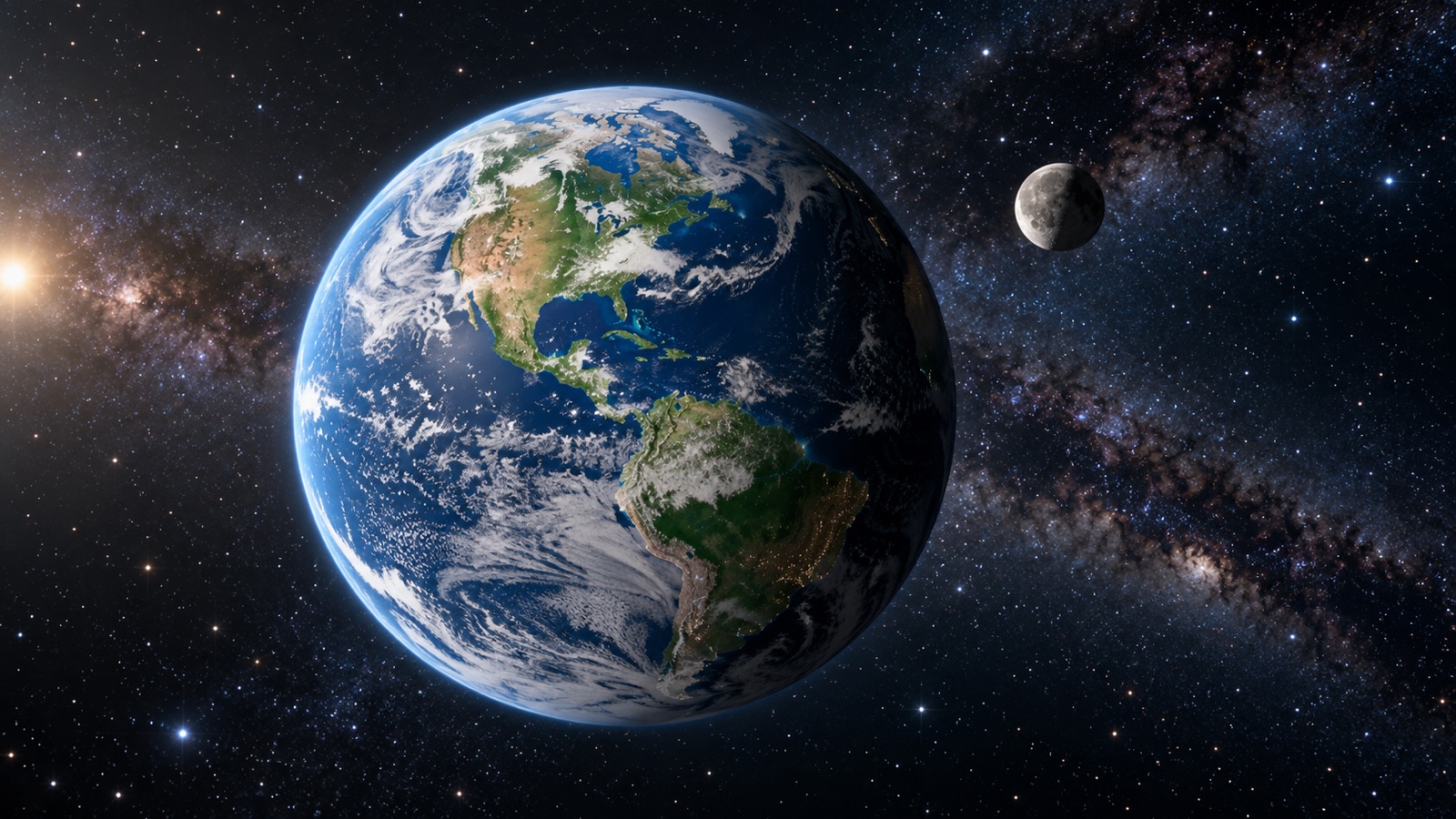
Mass and weight are not the same thing
- Mass measures an object's resistance to acceleration and amount of matter-energy in ordinary usage.
- Weight is the force associated with gravity acting on that mass.
- Your mass stays nearly the same on Earth and the Moon.
- Your weight changes because lunar surface gravity is weaker.
- The Moon's surface gravity is about one sixth of Earth's.
- A 180-pound person on Earth would weigh about 30 pounds on the Moon.
- The person's mass would not become one sixth as large.
- Bathroom scales are calibrated to report weight or an equivalent mass estimate under Earth's gravity.
- Weight can vary slightly across Earth's surface.
- Earth's rotation reduces apparent weight slightly near the equator.
- Earth is also slightly wider at the equator than at the poles.
- Greater distance from Earth's center weakens gravity slightly.
- Altitude therefore reduces weight by a tiny amount.
- Local geology can create very small gravitational variations.
- Scientists map these variations with sensitive instruments.
- Gravimeters measure local gravitational acceleration.
- Satellites can measure changes in Earth's gravity field.
- Those changes can reveal movement of water, ice, and mass inside Earth.
- Gravity is therefore used as a tool for studying the planet itself.
- If a scale reading changes between Earth, the Moon, and a mountaintop, your body did not randomly lose matter. The local gravitational conditions changed.
Falling objects accelerate together in a vacuum
- Near Earth's surface, freely falling objects accelerate at about 32 feet per second squared.
- The standard value is about 9.81 meters per second squared.
- Local gravitational acceleration varies slightly by location.
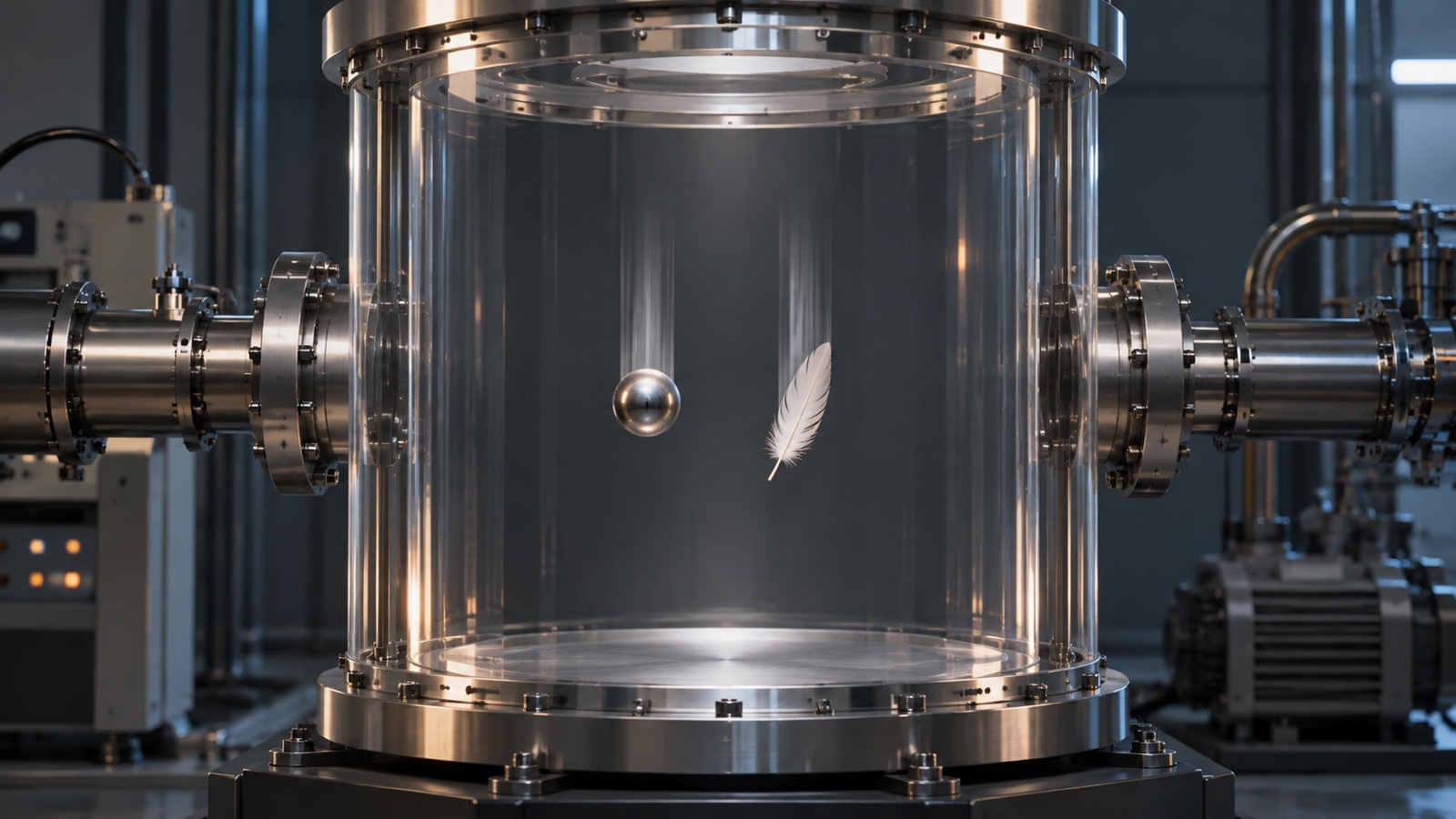
- In a vacuum, heavy and light objects fall with the same gravitational acceleration.
- Air resistance makes feathers fall more slowly than hammers in ordinary air.
- Remove the air and that difference disappears.
- Apollo 15 astronaut David Scott demonstrated this on the Moon.
- He dropped a hammer and a feather together.
- They reached the lunar ground at essentially the same time.
- Terminal velocity occurs when drag balances weight during a fall through a fluid.
- Terminal velocity depends on shape, area, mass, and fluid density.
- A skydiver changes terminal speed by changing body position.
- A parachute greatly increases drag area.
- That reduces terminal speed enough for a survivable landing.
- Free fall means gravity is the dominant force acting on an object.
- An orbiting spacecraft is in continuous free fall.
- Its sideways speed keeps it from hitting the ground.
- Astronauts feel weightless because they and their spacecraft fall together.
- Gravity is still strong at the altitude of the International Space Station.
- Orbital weightlessness is not the absence of gravity. It is the experience of falling around Earth without a supporting floor pushing back.
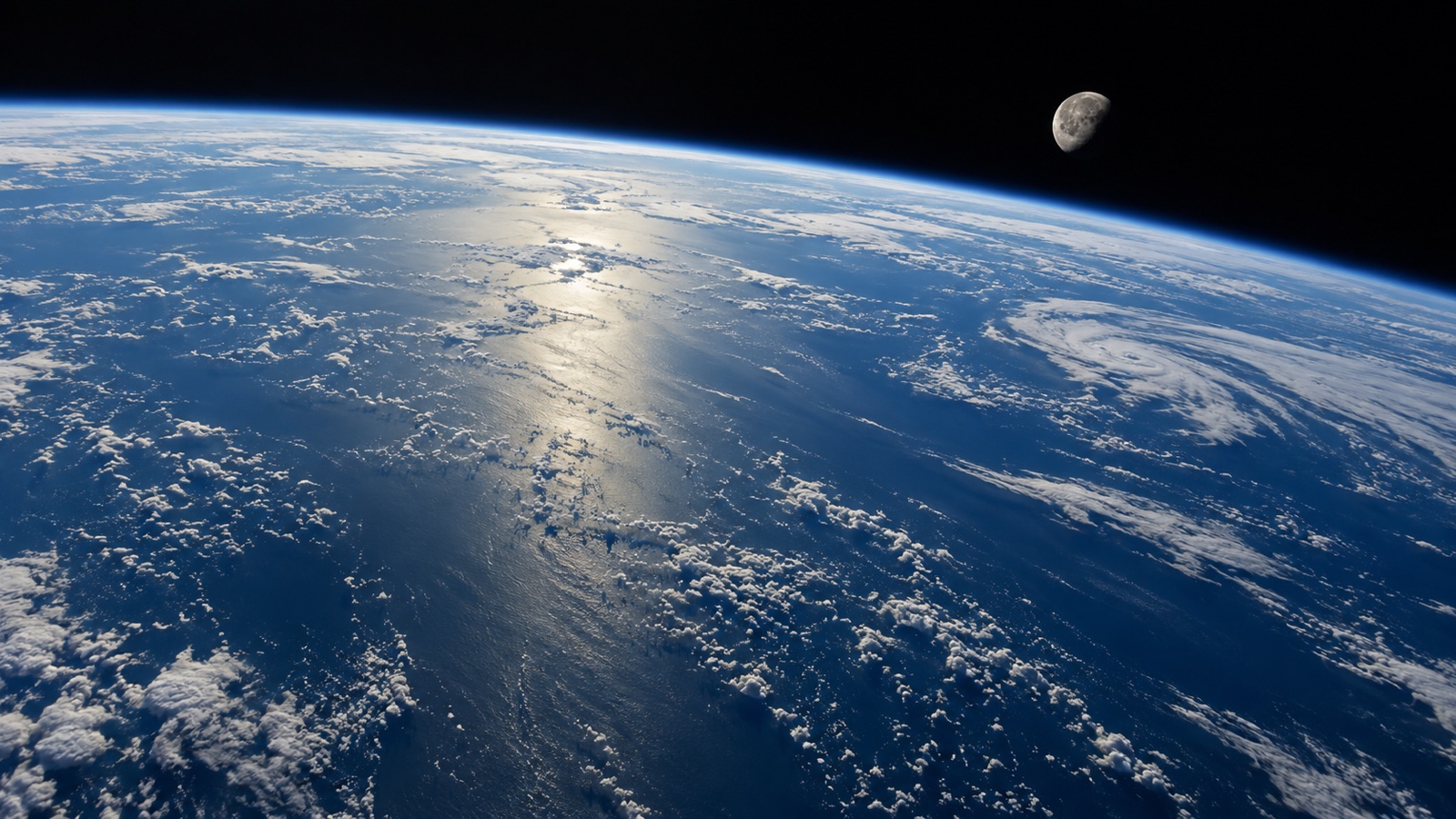
Orbits are controlled by gravity and sideways motion
- An orbit is a curved free-fall path around another object.
- Earth orbits the Sun because of solar gravity.
- The Moon orbits Earth because of Earth's gravity.
- Artificial satellites use the same basic physics.
- Orbital speed depends on altitude and the mass of the central body.
- Low Earth orbit requires speeds of roughly 17,000 miles per hour.
- Higher circular orbits generally have lower orbital speeds.
- Higher orbits generally take longer to complete.
- Kepler's laws describe planetary orbits accurately.
- Planetary orbits are ellipses rather than perfect circles.
- The Sun lies at one focus of each planetary ellipse.
- Planets move faster when closer to the Sun.
- They move more slowly when farther away.
- Escape velocity is the minimum speed needed to escape without further propulsion in an idealized case.
- Earth's surface escape velocity is about 25,000 miles per hour.
- Escape velocity does not depend on the mass of the escaping object.
- It does depend on the central body's mass and radius.
- Rockets usually do not instantly jump to escape velocity because propulsion continues over time.
- Spacecraft use gravity assists to exchange momentum with planets and change trajectory.
- Orbiting is not hovering. It is falling so fast sideways that the surface keeps curving away beneath you.
Gravity creates tides and shapes worlds
- Tides arise mainly from differences in gravitational pull across Earth.
- The Moon is the strongest contributor to ocean tides on Earth.
- The Sun also contributes significantly.
- When Sun, Moon, and Earth align, spring tides occur.
- Spring tides have larger tidal ranges.
- When Sun and Moon pull at right angles, neap tides occur.
- Neap tides have smaller tidal ranges.
- Tidal forces stretch objects because gravity differs across their size.
- Earth's gravity keeps the Moon tidally locked.
- Tidal locking means the Moon rotates once per orbit.
- That is why nearly the same lunar hemisphere faces Earth.
- Tides also slowly transfer angular momentum between Earth and Moon.
- Earth's rotation is gradually slowing over geological time.
- The Moon is slowly receding from Earth.
- Gravity pulls large planets toward round shapes.
- Self-gravity overwhelms material strength when worlds become large enough.
- Small asteroids can remain irregular because their gravity is weak.
- Stars form when gravity collapses clouds of gas and dust.
- Galaxies are also held together largely by gravity.
- Gravity shapes everything from a water droplet's fall to the spherical form of planets and the architecture of galaxies.
Einstein showed that gravity affects light and time
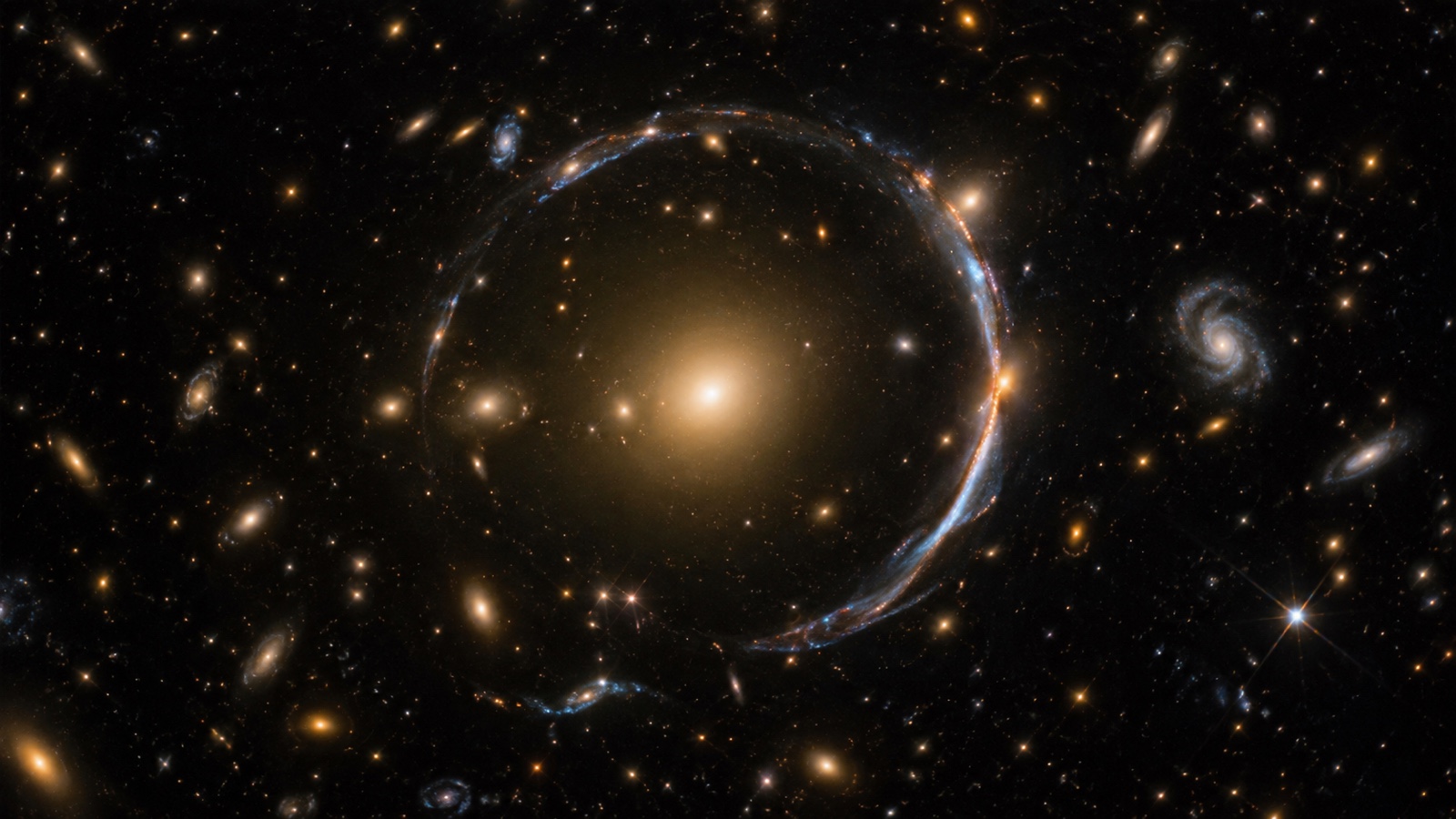
- General relativity predicts that gravity bends light.
- This bending is called gravitational lensing.
- Massive galaxies can magnify background objects.
- Galaxy clusters can produce spectacular lensing arcs.
- Gravity also changes the rate at which clocks tick.
- Clocks deeper in a gravitational field run slightly slower.
- This effect is called gravitational time dilation.
- It has been measured with extremely precise clocks.
- Even small altitude differences can produce measurable clock-rate differences.
- GPS satellites must account for relativistic time effects.
- Both special and general relativity affect satellite clocks.
- Ignoring these effects would cause navigation errors to accumulate.
- Black holes are regions where spacetime curvature becomes extreme.
- The event horizon marks a boundary beyond which escape is impossible.
- Black holes do not suck everything in the universe like vacuum cleaners.
- At a safe distance, their gravity behaves like the gravity of any object with the same mass.
- Replacing the Sun with a black hole of equal mass would leave Earth's orbit approximately unchanged.
- Earth would freeze without sunlight, but it would not instantly fall into the black hole.
- Gravitational waves are ripples in spacetime produced by accelerating masses.
- Gravity is so deeply tied to spacetime that moving masses can literally send measurable waves through the geometry of the universe.
Gravity can be measured across the universe
- Scientists first directly detected gravitational waves in 2015.
- The detected signal came from merging black holes.
- LIGO uses laser interferometers to measure incredibly tiny distance changes.
- Later detections have included neutron-star mergers.
- Neutron-star mergers also produce light and heavy elements.
- Gravity helps astronomers estimate masses of planets and stars.
- A planet's gravitational effect on its star can reveal an exoplanet.
- Binary-star orbits allow stellar masses to be measured.
- Galaxy rotation provides evidence for unseen mass.
- Much of that unseen mass is attributed to dark matter.
- Dark matter has not been directly identified as a particle as of 2026.
- Its gravitational effects are observed on galaxies and galaxy clusters.
- Gravitational lensing maps mass even when the matter emits little light.
- Cosmologists use gravity to model formation of large-scale structure.
- Gravity slows cosmic expansion locally by drawing matter together.
- At the largest scales, cosmic expansion is accelerating.
- Dark energy is the name given to the unknown cause or component associated with that acceleration.
- A complete quantum theory of gravity remains an unsolved problem in physics.
- General relativity and quantum mechanics are each extraordinarily successful but difficult to combine fully.
- Gravity is familiar enough to make an apple fall and mysterious enough that physicists still do not have its final quantum description.
Everyday gravity and 5 final facts
- You pull gravitationally on Earth at the same time Earth pulls gravitationally on you, with equal force in the Newtonian description.
- Earth accelerates toward you too, but its enormous mass makes that acceleration immeasurably tiny in ordinary life.
- The feeling of weight while standing comes largely from the floor pushing upward on your body while gravity pulls you downward.
- During true free fall, that support force disappears, which is why falling astronauts feel weightless even though gravity remains.
- After 145 facts, gravity looks less like “the thing that makes stuff fall” and more like the architecture behind weight, orbits, tides, stars, black holes, lensing, clocks, galaxies, and the shape of spacetime itself.
Quick FAQ
Q: Is there gravity in space?
A: Yes. Gravity extends through space. Astronauts in orbit feel weightless because they are continuously falling around Earth.
Q: Do heavier objects fall faster?
A: In a vacuum, objects fall with the same gravitational acceleration. Air resistance creates many everyday differences.
Q: Is gravity a force or curved spacetime?
A: Newtonian physics treats it as a force; general relativity describes it more fundamentally as spacetime curvature.
Q: Why do astronauts float?
A: Their spacecraft and bodies are falling together around Earth, so there is almost no supporting force pushing on them.
Q: Can gravity bend light?
A: Yes. Massive objects curve spacetime and bend light paths, producing gravitational lensing.

Ellie is the owner and sole author of Fun Facts, combining her mechanical engineering background with years of research-driven writing to deliver facts you can trust. Every article is thoroughly fact-checked and routinely updated as new science and sources emerge to keep information accurate and current. Her mission is to make learning delightful while upholding high standards of reliability and transparency.