
Walruses look like mustached Arctic philosophers until several tons of them start climbing onto the same patch of ice. Their tusks are giant canine teeth, whiskers can find buried clams, mouths create powerful suction, blubber handles icy water, and social herds can become so dense that simply finding enough safe resting space becomes a conservation issue.
Walruses are the only living members of their family
- The walrus's scientific name is Odobenus rosmarus.
- Walruses are pinnipeds.
- They belong to the family Odobenidae.
- The walrus is the only living species in that family.
- Seals and sea lions belong to different pinniped families.
- Walruses live in Arctic and subarctic waters.
- Two main subspecies are widely recognized.
- Atlantic walruses live around the North Atlantic Arctic.
- Pacific walruses live around the Bering and Chukchi seas.
- Some classifications also discuss the Laptev Sea population separately.
- Adult males are much larger than females.
- Large Pacific males can weigh more than 3,000 pounds.
- The body is bulky and wrapped in thick skin and blubber.
- Walrus skin can appear pink, brown, gray, or reddish depending on temperature and blood flow.
- The neck and shoulders of adult males become especially thick.
- Males develop prominent skin bumps called bosses around the neck and shoulders.
- The muzzle is broad and covered in stiff whiskers.
- Both sexes have tusks.
- Walruses can rotate their hind flippers forward enough to help move on land.
- The face looks like a grandfatherly mustache attached to a body that can weigh more than a compact car.
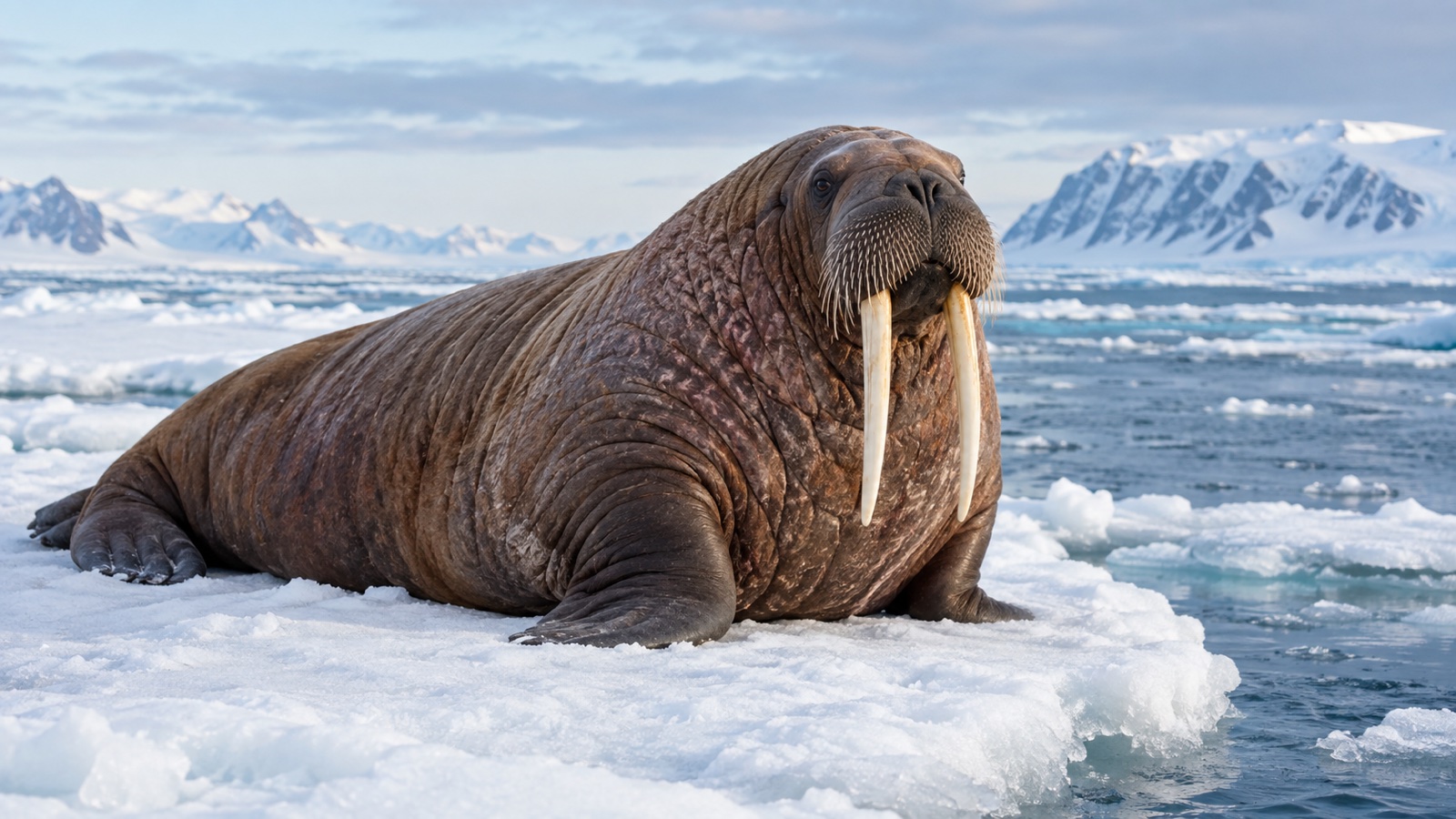
Tusks are enormous canine teeth
- Walrus tusks are elongated upper canine teeth.
- Both males and females grow tusks.
- Male tusks are usually longer and thicker.
- Large tusks can reach roughly 3 feet in length.
- Tusks grow continuously through much of life.
- The visible tusk is only part of the entire tooth.
- Roots extend deep into the skull.
- Walruses use tusks during social displays.
- Males use them in competition with rivals.
- Tusks can help establish rank without every encounter becoming a full fight.
- Walruses also use tusks to assist with hauling onto ice.
- They may hook tusks over an edge for leverage.
- The genus name Odobenus refers to tooth-assisted walking.
- Tusks can help maintain breathing holes or break thin ice.
- They are not primarily shovels for digging clams from the seafloor.
- The sensitive muzzle and flippers do most prey detection and disturbance.
- Tusks become worn and scratched through use.
- Broken tusks can occur in the wild.
- Walrus ivory has been carved for centuries.
- A tooth that functions as display weapon, ice hook, age clue, and cultural art material is doing considerably more work than my molars.
Hundreds of whiskers search the seafloor for food
- Walrus whiskers are called vibrissae.
- The muzzle can carry hundreds of stiff vibrissae.
- Each whisker is packed with sensory nerves.
- Whiskers help detect objects on the seafloor.
- Walruses feed heavily on bottom-dwelling invertebrates.
- Clams are especially important prey in many areas.
- They also eat worms, snails, crabs, sea cucumbers, and other benthic animals.
- The front flippers can fan sediment away.
- A jet of water from the mouth can disturb seafloor mud.
- Whiskers then locate exposed prey.
- Walruses can identify surprisingly small objects by touch.
- They usually do not crush every clam shell with their tusks.
- Instead, they use powerful suction to extract soft tissue from shells.
- The tongue and mouth create strong negative pressure.
- Empty shells can remain behind on the seafloor.
- A large walrus may consume thousands of small prey items in a day.
- Feeding disturbs sediment and affects benthic ecosystems.
- Walrus foraging can redistribute nutrients.
- Some individuals occasionally prey on seals or scavenge carcasses.
- A walrus searching for clams is basically operating a whiskered vacuum cleaner with flippers.
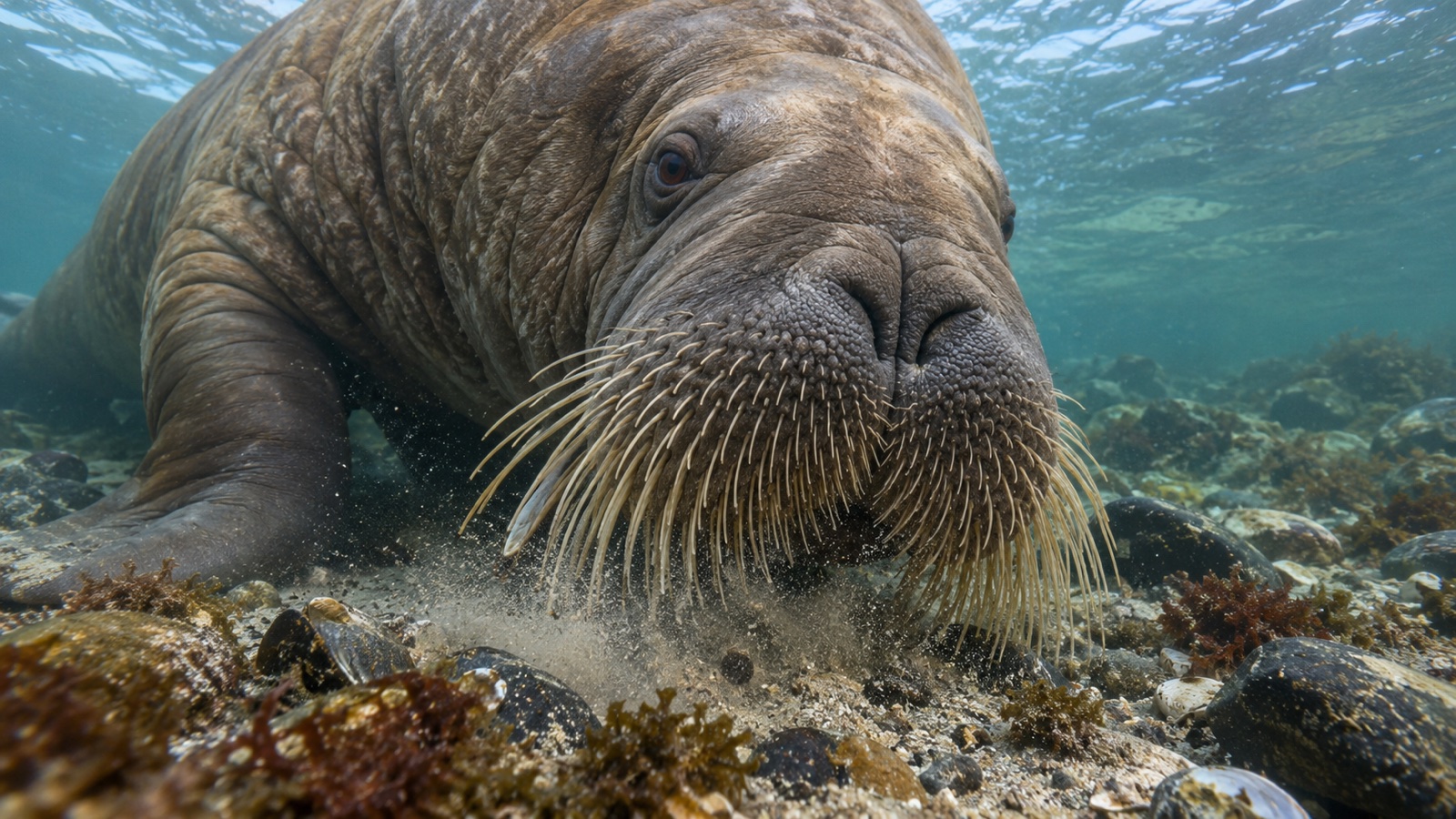
Blubber and blood flow manage extreme Arctic temperatures
Walruses alternate between freezing seawater and crowded haul-outs where thousands of warm bodies can create the opposite problem. Thick blubber conserves heat, while adjustable blood flow near the skin lets a resting walrus dump excess warmth and temporarily turn much pinker.
- Walrus blubber can be several inches thick.
- Blubber reduces heat loss in icy water.
- It also stores energy.
- Large body size lowers the surface-area-to-volume ratio.
- That helps conserve body heat.
- Blood vessels near the skin constrict in cold conditions.
- Reduced surface blood flow helps retain core warmth.
- On warm haul-outs, blood vessels can dilate.
- Increased blood flow makes skin appear pink or red.
- Walruses may enter water to cool down.
- They can tolerate water near the freezing point of seawater.
- Flippers have specialized circulation that limits heat loss.
- Walruses can sleep on ice, land, or in water.
- They sometimes rest vertically in water with the head near the surface.
- Inflatable throat pouches in males can help maintain buoyancy while resting.
- Those pouches also play roles in sound production.
- Walrus heart rate slows during dives.
- Blood and muscle store oxygen.
- Most feeding dives are relatively shallow compared with record-diving seals.
- A walrus can spend the morning in near-freezing water and the afternoon overheating in a crowd, which is a very Arctic thermostat problem.
Walrus herds can cover entire beaches
- Walruses are highly social.
- They gather at haul-outs to rest between feeding trips.
- Haul-outs can occur on sea ice or land.
- Animals often lie in direct body contact.
- Groups can contain hundreds or thousands of walruses.
- Pacific walrus land haul-outs can become enormous.
- Sea-ice conditions strongly influence where animals rest.
- Floating ice lets walruses rest close to offshore feeding grounds.
- When summer sea ice retreats far north, females and young may haul out on land.
- Land-based herds can be far from productive feeding areas.
- Large crowded haul-outs are vulnerable to disturbance.
- A sudden panic can trigger a stampede toward the water.
- Calves and smaller animals can be crushed.
- Aircraft, predators, people, or other disturbances may trigger movement.
- Management agencies establish buffer distances around major haul-outs.
- Walruses communicate with grunts, knocks, bell-like sounds, and other vocalizations.
- Breeding males produce elaborate underwater songs.
- Sounds include pulses, whistles, knocks, and bell-like notes.
- Male songs can continue for long periods during breeding season.
- A beach full of walruses is simultaneously a nursery, rest stop, social club, and crowd-control problem measured in thousands of tons.
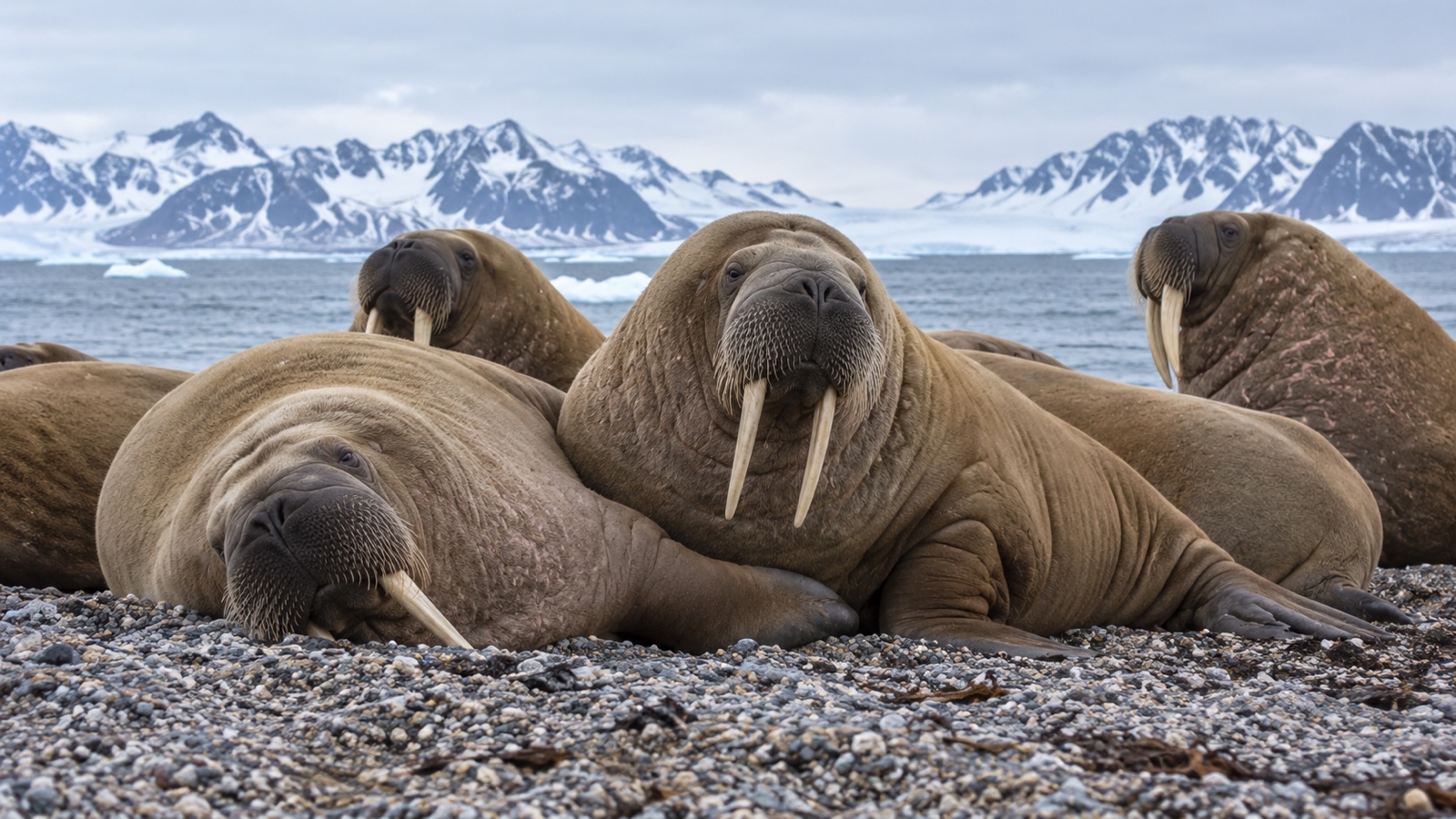
Calves stay close to their mothers for years
Walruses reproduce slowly, which makes adult female survival especially important. Mothers invest heavily in one calf at a time, nursing for well over a year and teaching young where to rest, feed, travel, and navigate a constantly changing Arctic seascape.
- Female walruses usually give birth to one calf.
- Twin births are rare.
- Walrus reproduction includes delayed implantation.
- The embryo pauses development before attaching fully to the uterus.
- Total time from mating to birth is more than a year.
- Calves are born on ice or sometimes land depending on population and conditions.
- A newborn weighs roughly 100 to 150 pounds.
- Calves can swim soon after birth.
- They nurse on extremely rich milk.
- Walrus calves may nurse for two years or longer.
- They begin eating solid prey while still nursing.
- Mothers are strongly protective.
- A calf may ride on the mother's back in water.
- Mothers and calves recognize each other's calls.
- Close physical contact is common.
- Females do not produce a calf every year.
- Long parental care creates a slow population growth rate.
- Young females need years to reach sexual maturity.
- Walruses can live for several decades.
- A walrus calf gets a longer nursing contract than many mammals get an entire childhood.
Indigenous cultures, climate change and 25 final walrus facts
- Walruses have supported Arctic Indigenous communities for thousands of years.
- Subsistence harvests provide food in several northern communities.
- Hide, ivory, bone, and other materials have traditional uses.
- Indigenous ecological knowledge contributes to modern walrus research and management.
- Harvest rules differ among Alaska, Canada, Greenland, Russia, and other jurisdictions.
- Commercial overhunting severely reduced several walrus populations historically.
- Atlantic walruses disappeared from parts of their former range.
- Some populations recovered after hunting restrictions.
- Pacific walrus abundance remains difficult to estimate precisely across a huge remote range.
- Sea-ice loss is a major long-term concern.
- Female Pacific walruses traditionally use drifting ice above continental-shelf feeding areas in summer.
- Retreating ice can force more animals onto coastal land haul-outs.
- Longer travel between haul-outs and feeding grounds increases energy costs.
- Ocean warming can alter clam and benthic communities.
- Shipping and industrial activity are expanding in parts of the Arctic.
- Noise can disturb marine mammals and change habitat use.
- Oil spills would be difficult to clean in icy remote waters.
- Polar bears occasionally prey on walrus calves.
- Killer whales also prey on walruses.
- Adult walruses can defend themselves with size and tusks.
- Large herds can create safety in numbers but also stampede risk.
- Walruses use sea ice as habitat rather than merely floating scenery.
- Climate projections therefore affect rest, reproduction, movement, and access to prey simultaneously.
- The walrus became globally recognizable through literature and popular culture, including Lewis Carroll's “The Walrus and the Carpenter.”
- After 145 facts, walruses look less like comic mustaches on ice and more like social Arctic bottom-feeders whose tusks, whiskers, blubber, songs, calves, and cultures all depend on access to a rapidly changing seascape.
Quick FAQ
Q: What are walrus tusks?
A: They are elongated upper canine teeth that grow in both sexes and serve in display, defense, social competition, and ice-hauling behavior.
Q: Do walruses use tusks to dig up clams?
A: Not usually. They find prey with sensitive whiskers, disturb sediment with flippers or water jets, and often suck the soft animal from its shell.
Q: Are walruses seals?
A: They are pinnipeds like seals and sea lions, but belong to their own family, Odobenidae.
Q: Why do walruses turn pink?
A: Blood vessels near the skin dilate when walruses need to release heat, making the skin look much pinker or redder.
Q: How does climate change affect walruses?
A: Loss of summer sea ice can force animals onto crowded land haul-outs farther from offshore feeding grounds, increasing travel costs and stampede risk.

Ellie is the owner and sole author of Fun Facts, combining her mechanical engineering background with years of research-driven writing to deliver facts you can trust. Every article is thoroughly fact-checked and routinely updated as new science and sources emerge to keep information accurate and current. Her mission is to make learning delightful while upholding high standards of reliability and transparency.