
Llamas have a reputation for spitting, which is a little unfair to an animal that carried Andean trade goods for centuries, communicates by humming, uses communal bathrooms, guards sheep, has padded feet instead of hooves, and can read another llama's mood from ear position faster than I can read a group chat.
Llamas are domesticated South American camelids
- The llama's scientific name is Lama glama.
- Llamas belong to the camel family Camelidae.
- Camels, alpacas, guanacos, and vicuñas are their relatives.
- Llamas are native as a domesticated species to South America.
- They were domesticated thousands of years ago in the Andes.
- Genetic evidence indicates llamas descend mainly from wild guanacos.
- Domestic breeding and historical hybridization make camelid ancestry more complicated than one perfectly clean family tree.
- Llamas are larger than alpacas.
- Adult llamas commonly weigh around 250 to 450 pounds.
- They can stand roughly 5 to 6 feet tall at the top of the head.
- Llamas have long curved ears often compared with bananas.
- Alpaca ears are usually shorter and more spear shaped.
- Llama faces tend to be longer than alpaca faces.
- The neck is long and flexible.
- The body is covered with insulating fiber.
- Llama fiber varies from fine to quite coarse depending on breeding and body area.
- Llamas do not have camel-style humps.
- Their ancestors evolved in North America before camelids spread to South America and Asia millions of years ago.
- Modern llamas therefore live on a continent their camelid ancestors reached after a very long prehistoric migration.
- The llama family tree starts in North America, ends in the Andes, and still somehow gets summarized as “the animal that spits.”

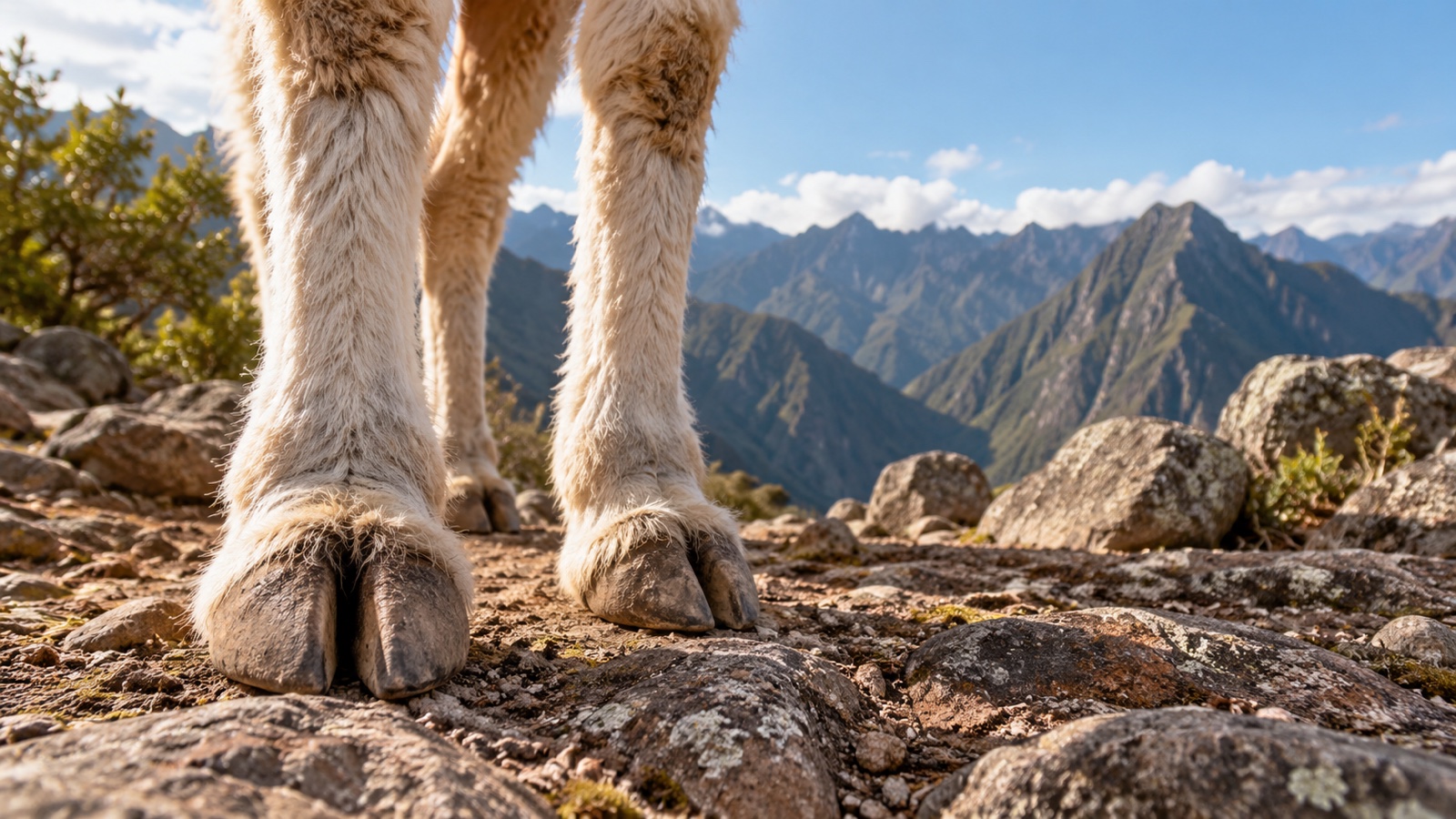
Their feet are made for mountain trails
- Llamas have two toes on each foot.
- Each toe ends in a hard nail rather than a true hoof.
- A broad soft pad cushions the underside of the foot.
- Padded feet provide good traction on rocky ground.
- They also cause less soil damage than hard hooves under many conditions.
- Toenails continue growing and may need trimming in domestic animals.
- Wild rocky terrain can wear nails naturally.
- Llamas are sure-footed on steep trails.
- Their long legs help them step over rocks and uneven ground.
- They can carry pack loads but should not be overloaded.
- A healthy adult llama often carries roughly 20 to 25 percent of its body weight depending on conditioning, terrain, weather, and animal welfare.
- Young llamas should not carry heavy packs while the skeleton is still developing.
- Pack saddles distribute weight across the back.
- Balanced loads reduce strain.
- Llamas can hike long distances when properly conditioned.
- They are generally calmer and quieter on trails than many pack animals.
- They browse and graze vegetation along the way.
- Responsible handlers carry appropriate feed and do not rely on fragile public-land vegetation.
- Llama trekking has become a recreational activity far beyond South America.
- Two padded toes sound less impressive than a hoof until the trail turns into loose rock on a mountainside.
Llamas hum, posture and use their ears like mood indicators
- Llamas communicate with sound, posture, scent, and facial expression.
- Humming is one of their most recognizable vocalizations.
- Mothers and young may hum to maintain contact.
- Adults can hum when curious, uneasy, separated, or interacting socially.
- The exact meaning depends on context.
- Llamas also make alarm calls.
- An alarm call can alert the herd to a perceived predator.
- Males use a distinctive breeding vocalization called orgling.
- Orgling is a deep rhythmic sound made during mating.
- Ear position gives obvious social clues.
- Forward ears often indicate attention or interest.
- Ears pinned backward can indicate irritation, fear, or a warning.
- A raised head and tense neck can signal concern.
- Body posture helps establish personal space.
- Llamas are herd animals and generally need companionship.
- Keeping a llama completely isolated can cause stress.
- They learn routines and recognize familiar animals and people.
- Llamas can be trained with calm reward-based methods.
- Forceful handling can increase fear and defensive behavior.
- A llama has enough visible ear drama that pretending you “had no warning” before an argument is often optimistic.
Spitting is real, but humans are usually not the intended audience
Llama spitting is mainly social communication between camelids. Most well-socialized llamas do not walk around firing at people for entertainment, but an animal that feels threatened, poorly handled, food-competitive, or overly human-imprinted may absolutely make a person regret standing in the splash zone.
- Llamas spit primarily at other llamas.
- Spitting helps settle disputes over food, rank, breeding, and personal space.
- A warning spit can consist mostly of saliva.
- More intense spits may bring up partially digested stomach contents.
- That material smells unpleasant.
- A llama often gives body-language warnings before spitting.
- Pinned ears are one common warning.
- A raised chin or tense posture can also precede escalation.
- Food competition can trigger spitting between herd mates.
- Providing enough feeding space can reduce conflict.
- Pregnant females may spit at males to reject breeding attempts.
- This behavior is sometimes used informally by breeders as one clue that a female may be pregnant.
- It is not a foolproof pregnancy test.
- Veterinary reproductive exams are more reliable.
- Some llamas spit at people when they feel cornered or mistreated.
- Hand-raised males that are poorly socialized can become dangerously overfamiliar with humans.
- That behavioral problem is sometimes called berserk male syndrome, though camelid professionals increasingly prefer more descriptive terms related to aberrant behavior.
- Proper boundaries and llama companionship during rearing reduce risk.
- Spitting should be interpreted as communication rather than revenge.
- Unfortunately, “communication” does not make fermented grass landing on your shirt smell any better.
Their digestive system has three compartments, not four
- Llamas are herbivores.
- They eat grasses, hay, leaves, shrubs, and other plant material.
- They are efficient at extracting nutrients from relatively coarse forage.
- Llamas chew cud.
- They regurgitate partially digested food and chew it again.
- They are foregut fermenters.
- Llama stomach anatomy has three main compartments.
- The compartments are commonly called C1, C2, and C3.
- True ruminants such as cattle have four stomach compartments.
- Llamas are therefore often described as pseudoruminants rather than true ruminants.
- Microbes in the foregut help break down plant fiber.
- Fermentation produces nutrients the llama can absorb and use.
- Llamas have a split upper lip that helps select vegetation.
- They do not have upper front incisors like humans.
- A tough dental pad opposes the lower incisors.
- Male llamas can develop sharp fighting teeth.
- Those teeth may need veterinary management in domestic males.
- Clean water and balanced minerals are important to domestic llama health.
- Obesity can occur when llamas receive overly rich feed with too little activity.
- A llama can turn rough forage into hiking fuel with three stomach compartments and still find time to judge your trail snacks.

Crias arrive after a very long pregnancy
A baby llama is called a cria, and pregnancy lasts around a year. Females generally give birth to one cria in daylight, which may help a wet newborn dry and stand before cold Andean nighttime temperatures arrive.
- Female llamas are called females or dams in breeding contexts.
- Adult intact males are often called studs or herd sires.
- Castrated males are commonly called geldings.
- A baby llama is called a cria.
- Llama gestation usually lasts roughly 11 to 12 months.
- Most pregnancies produce one cria.
- Twin births are uncommon and carry greater risk.
- Llamas are induced ovulators.
- Ovulation is triggered by mating rather than occurring on a fixed monthly cycle like in humans.
- Females can breed during much of the year under suitable conditions.
- Birth commonly occurs during daylight hours.
- A healthy cria often begins trying to stand within an hour.
- Early nursing provides colostrum rich in antibodies.
- Newborn camelids depend heavily on that maternal antibody transfer.
- A cria that fails to nurse promptly can become critically vulnerable to infection.
- Veterinary assessment is important when a newborn is weak or cannot nurse.
- Mothers recognize their offspring through smell, sound, and close contact.
- Crias begin nibbling vegetation while still nursing.
- They gradually develop a functional fermenting digestive system.
- A newborn llama getting upright on those legs within an hour is a stronger first-day performance than I have ever delivered.
Andean history, guard duty and 25 final llama facts
- Llamas were crucial pack animals in the Andes long before European colonization.
- They carried food, textiles, salt, metal goods, and other cargo across mountain routes.
- The Inca Empire relied heavily on llama caravans.
- Llamas cannot carry adult riders the way horses can.
- Their load capacity is much lower than their total body weight.
- Llama dung served as fertilizer.
- Dried dung also served as fuel in high-elevation regions with little firewood.
- Llamas provided meat and fiber as well as transport.
- They had ceremonial importance in several Andean societies.
- Archaeologists have found naturally and intentionally preserved llama remains at ritual sites.
- Spanish colonization introduced horses, donkeys, sheep, and cattle, changing Andean transport and agriculture.
- Llamas nevertheless remained important in many highland communities.
- Today llamas are raised across North America, Europe, Australia, and other regions.
- Some farmers use llamas as livestock guardians.
- A guard llama may bond with sheep, goats, or other livestock.
- It can confront or chase canids such as coyotes under some conditions.
- Guard llamas are not appropriate against every predator or in every herd situation.
- Using more than one guardian llama can sometimes cause the llamas to bond with each other instead of livestock.
- Llamas often use communal dung piles.
- Shared latrines can help keep grazing areas relatively clean.
- Llama red blood cells are small and oval rather than round like typical human red blood cells.
- Their blood physiology helps support life at high altitude.
- They tolerate low oxygen better than many lowland domestic animals.
- Llamas can live around 15 to 25 years with good care, though individual lifespan varies.
- After 145 facts, llamas look less like novelty farm animals and more like high-altitude pack specialists with excellent feet, complicated social etiquette, efficient digestion, and one famously unpleasant way of saying “back off.”

Quick FAQ
Q: Do llamas really spit at people?
A: They can, but spitting is mainly llama-to-llama communication. Well-socialized llamas usually reserve it for other camelids unless they feel threatened or have learned poor boundaries.
Q: What is the difference between a llama and an alpaca?
A: Llamas are generally much larger, have longer curved ears, and were developed strongly for packing. Alpacas are smaller and were bred especially for fine fiber.
Q: Can you ride a llama?
A: Adult llamas are pack animals, not riding animals for ordinary adults. Their backs are not designed to carry human-sized riding loads.
Q: What is a baby llama called?
A: A baby llama is called a cria.
Q: Are llamas ruminants?
A: They chew cud and ferment plants in the foregut, but their stomach has three compartments rather than the four found in true ruminants such as cattle.

Ellie is the owner and sole author of Fun Facts, combining her mechanical engineering background with years of research-driven writing to deliver facts you can trust. Every article is thoroughly fact-checked and routinely updated as new science and sources emerge to keep information accurate and current. Her mission is to make learning delightful while upholding high standards of reliability and transparency.