
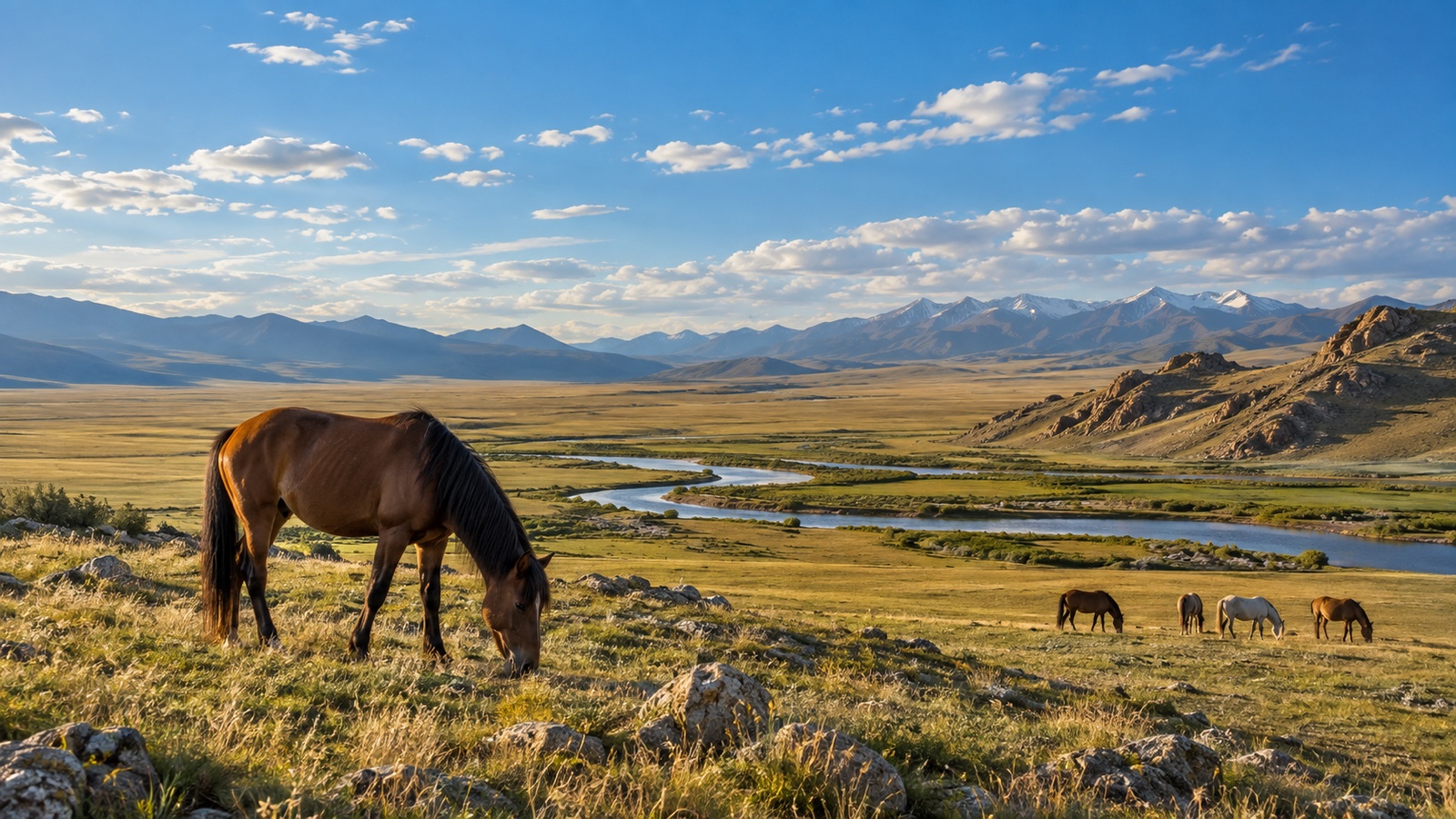
Mongolia has more livestock than people, a capital famous for brutal winters, dinosaur fossil sites in the Gobi, horse culture woven into childhood, mobile felt homes, throat singing, eagle hunters, and the legacy of the largest contiguous land empire in history. “Empty” is not the same thing as uneventful.
Mongolia is enormous, landlocked and sparsely populated
- Mongolia is a landlocked country in East and Central Asia.
- It lies between Russia and China.
- Those are Mongolia's only two neighboring countries.
- Ulaanbaatar is the national capital and largest city.
- Mongolia is larger than Alaska.
- It has one of the world's lowest population densities.
- A large share of the country's people live in Ulaanbaatar.
- The national currency is the tögrög, also spelled tugrik.
- Mongolian is the official language.
- Modern Mongolian in Mongolia is usually written in Cyrillic script.
- A traditional vertical Mongolian script is also being revived and promoted.
- Mongolia's flag has red, blue, and red vertical bands.
- A yellow Soyombo symbol appears on the left band.
- The Soyombo combines symbolic forms representing fire, sun, moon, earth, water, and other concepts.
- Mongolia uses two main time zones.
- Ulaanbaatar uses a time zone eight hours ahead of Coordinated Universal Time.
- The country does not use Daylight Saving Time.
- Most of Mongolia lies on high plateaus.
- The average elevation is more than 5,000 feet.
- Mongolia makes “wide open space” look like an understatement someone typed while standing in a parking lot.
The Gobi is a cold desert, not an endless sea of sand
- The Gobi Desert covers much of southern Mongolia and northern China.
- Large parts of the Gobi are rocky or gravel-covered rather than sandy.
- Sand dunes occur in some areas but do not define the whole desert.
- Khongoryn Els is one of Mongolia's famous dune systems.
- Some dunes there rise hundreds of feet.
- Wind can make certain dunes produce deep booming or humming sounds.
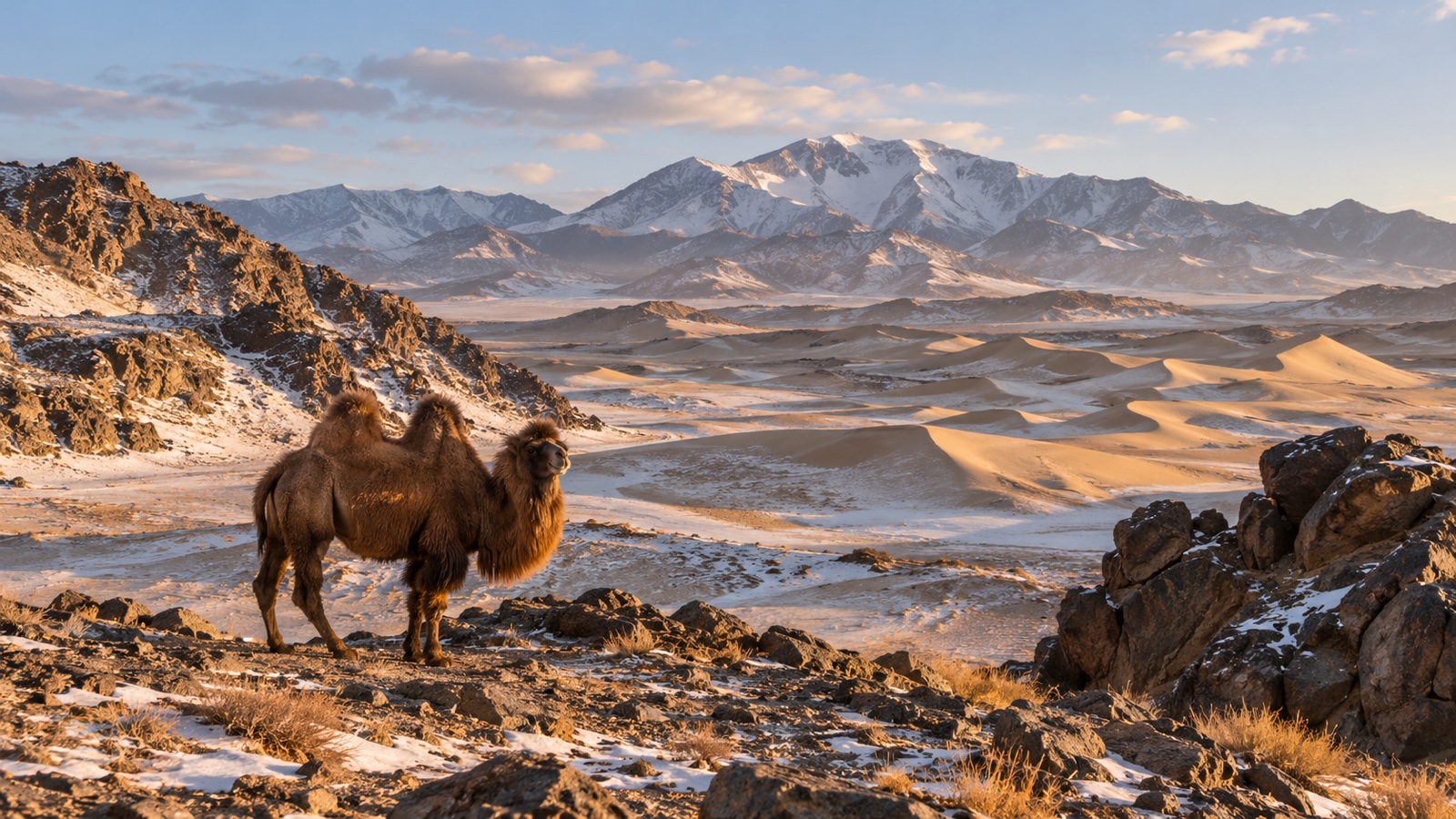
- The Gobi has extremely cold winters.
- Winter temperatures can plunge far below 0°F.
- Summer days can be hot.
- Large daily and seasonal temperature swings are common.
- Rainfall is scarce and unpredictable.
- Bactrian camels are adapted to the Gobi's harsh climate.
- Wild Bactrian camels survive in small populations in Mongolia and China.
- They are critically endangered.
- Gobi bears are a rare brown-bear population found in southwestern Mongolia.
- Only a very small number of Gobi bears survive.
- Snow leopards inhabit mountainous regions around the Gobi and western Mongolia.
- Saiga antelope survive in western Mongolian landscapes.
- Mongolian gazelles can form huge herds on eastern steppes.
- A desert that requires both camel sunscreen logic and serious winter gear is already refusing to cooperate with stereotypes.
Dinosaurs made the Gobi famous to paleontologists
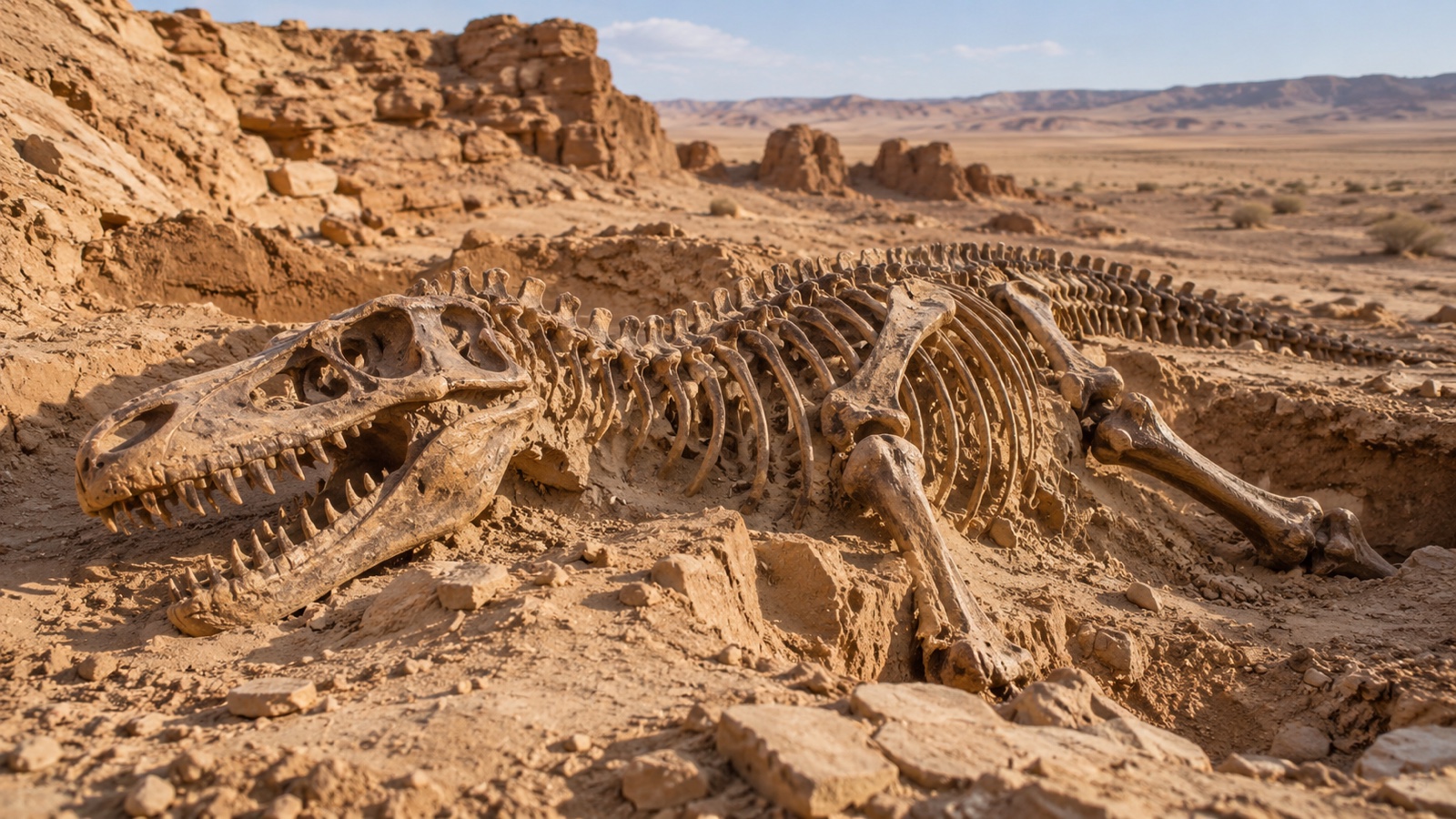
- Mongolia contains some of the world's most important dinosaur fossil sites.
- American Museum of Natural History expeditions explored the Gobi during the 1920s.
- Roy Chapman Andrews led several famous expeditions.
- The Flaming Cliffs are known in Mongolian as Bayanzag.
- The cliffs glow reddish orange in low-angle sunlight.
- Fossil dinosaur eggs were famously discovered there in the 1920s.
- Those discoveries helped prove that dinosaurs laid eggs.
- The eggs were initially attributed to Protoceratops.
- Later evidence showed some famous nests belonged to oviraptorid dinosaurs.
- Oviraptor's name means roughly “egg thief.”
- The dinosaur received that unfair reputation because a fossil was found near eggs once thought to belong to another species.
- Later discoveries showed oviraptorids were likely brooding their own nests.
- Velociraptor fossils come from Mongolia and nearby regions.
- Real Velociraptors were much smaller than the oversized movie versions in “Jurassic Park.”
- They were feathered theropod dinosaurs.
- Protoceratops was a sheep-sized horned-dinosaur relative common in the region.
- A famous fossil preserves a Velociraptor and Protoceratops locked in combat.
- Tarbosaurus was a large tyrannosaur relative from Mongolia.
- Fossil poaching and illegal export have threatened Mongolia's paleontological heritage.
- Mongolia gave science dinosaur eggs, feathered predators, and one of paleontology's most embarrassing naming corrections.
Pastoral nomadism still shapes life across the steppe
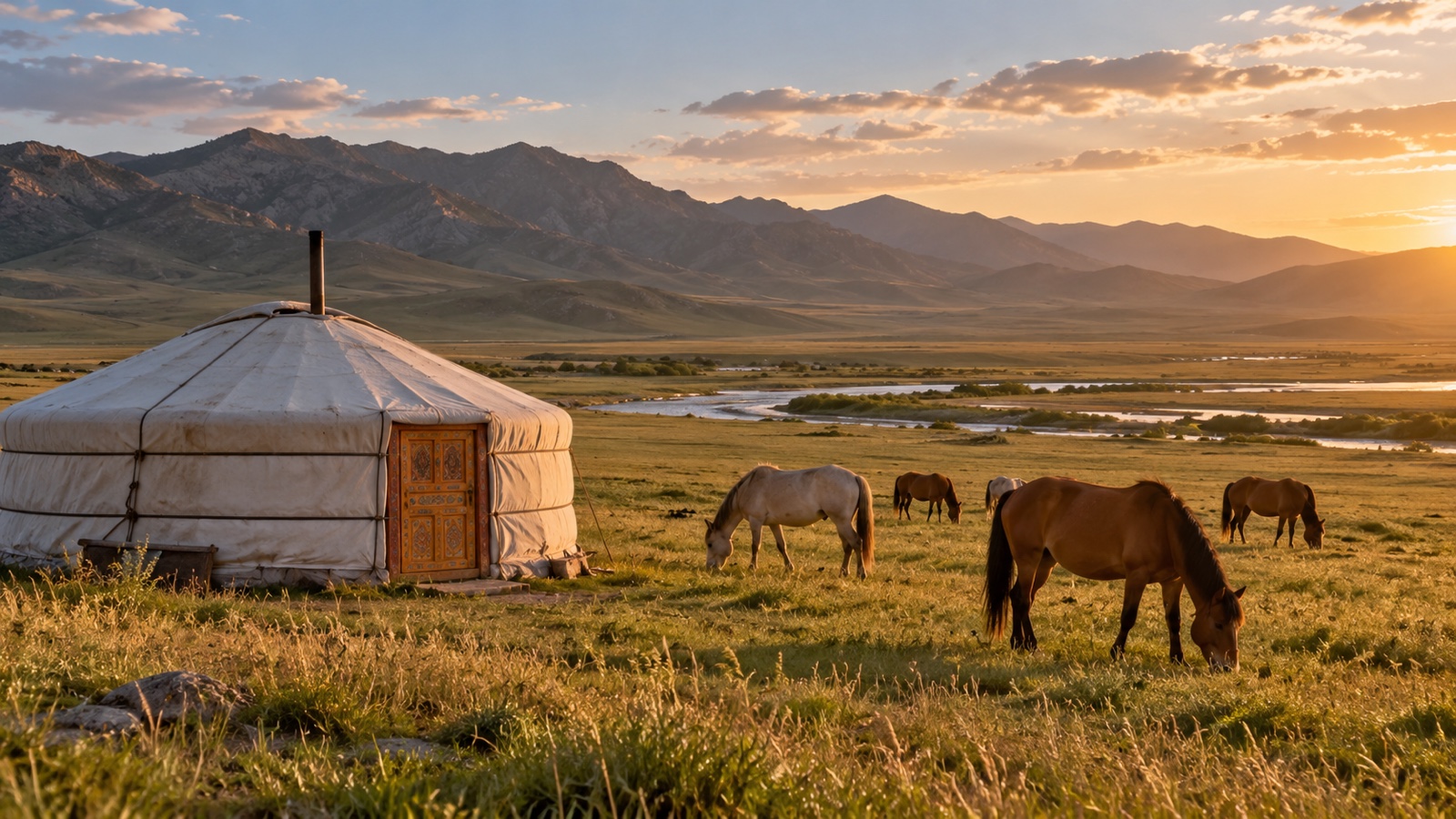
Calling Mongolian herders “nomads” can sound like they wander randomly, which is not accurate. Families move strategically among seasonal pastures based on grass, water, snow, livestock needs, weather, customary use, markets, roads, family ties, and increasingly difficult climate conditions.
- Livestock herding remains central to rural Mongolian life.
- Major livestock include sheep, goats, cattle, yaks, horses, and camels.
- Mongolia has many more livestock animals than human residents.
- Herders often move seasonally rather than remaining in one permanent pasture.
- A ger is the traditional round portable dwelling used by many Mongolian families.
- The dwelling is called a yurt in some other languages and regions.
- “Ger” is the ordinary Mongolian term.
- A wooden lattice wall creates the circular frame.
- Roof poles radiate from a central crown.
- Felt layers provide insulation.
- A stove in the center provides heat and cooking.
- The chimney passes through the roof opening.
- Gers can be dismantled, transported, and rebuilt.
- Modern gers may include solar panels, televisions, satellite dishes, and mobile-phone charging.
- Motorcycles and trucks increasingly supplement horses for herding and transportation.
- Cashmere goats are economically important.
- Mongolia is one of the world's largest raw cashmere producers.
- Rapid growth in goat numbers can increase grazing pressure because goats browse plants differently from some other livestock.
- Pasture degradation is a significant environmental concern.
- A satellite dish on a felt ger is not a cultural contradiction; it is what living tradition looks like when people have electricity.
Genghis Khan built an empire larger than any modern Mongolian border
- Temüjin was born in Mongolia during the 12th century.
- He eventually united many Mongol tribes.
- In 1206, he was proclaimed Chinggis Khaan.
- The name is commonly rendered Genghis Khan in English.
- His armies expanded across enormous areas of Eurasia.
- Mongol forces became famous for mounted archery, mobility, intelligence gathering, and disciplined organization.
- Riders could travel long distances by rotating among multiple horses.
- The Mongol Empire expanded further under Genghis Khan's descendants.
- It became the largest contiguous land empire in recorded history.
- The empire connected trade routes across Eurasia.
- The term Pax Mongolica describes a period when Mongol rule facilitated long-distance movement and commerce across large territories.
- Mongol conquests also caused enormous destruction and loss of life.
- Cities that resisted could face catastrophic reprisals.
- Genghis Khan died in 1227.
- The location of his burial remains unknown.
- Karakorum became an imperial capital under Ögedei Khan.
- Its archaeological ruins lie in central Mongolia.
- Kublai Khan founded the Yuan dynasty in China.
- Marco Polo's famous account describes the wider Mongol imperial world, though historians debate details of his travels.
- Modern Mongolia celebrates Genghis Khan as a state-builder while the wider world also remembers the extraordinary violence of imperial conquest.
Communism, Buddhism and democracy reshaped modern Mongolia
Mongolia's 20th century changed religion, politics, cities, alphabets, borders, and daily life at extraordinary speed. The country moved from a Qing-ruled frontier through revolution and Soviet-backed socialism into a multiparty democracy, while Tibetan Buddhism survived devastating communist persecution.
- Mongolia declared independence from Qing China in 1911.
- The Bogd Khan became ruler of the new Mongolian state.
- Political control remained contested during the following decade.
- A Soviet-backed revolution took place in 1921.
- The Mongolian People's Republic was proclaimed in 1924.
- Mongolia became closely aligned with the Soviet Union.
- Collectivization transformed livestock ownership and rural economics.
- Communist authorities launched severe anti-religious repression during the 1930s.
- Hundreds of Buddhist monasteries were destroyed or closed.
- Thousands of monks were killed, imprisoned, or forced into secular life.
- The Cyrillic alphabet became standard for Mongolian during the 20th century.
- Ulaanbaatar expanded as an industrial and administrative capital.
- Peaceful democratic protests grew in 1989 and 1990.
- Mongolia transitioned away from one-party communist rule.
- A new constitution took effect in 1992.
- Mongolia became a multiparty parliamentary democracy.
- Buddhist monasteries reopened after the democratic transition.
- Gandantegchinlen Monastery in Ulaanbaatar became a major center of revived Buddhism.
- Mining expanded rapidly in the post-socialist economy.
- Modern Mongolia balances democracy, mineral wealth, Russian and Chinese neighbors, herding traditions, and a very fast-growing capital.
Horses, eagle hunters, throat singing and 25 final Mongolia facts
- Horses are central to Mongolian history and culture.
- Mongolian horses are relatively small, hardy, and well adapted to steppe conditions.
- Many rural children learn to ride at a young age.
- Horse racing is a major part of the Naadam festival.
- Naadam also features Mongolian wrestling and archery.
- Those three competitions are traditionally called the Three Manly Games, although girls and women now participate in some events.
- Naadam is held nationally around July 11.
- Mongolian wrestling has no fixed weight classes.
- Wrestlers perform an eagle-like dance called devekh.
- Western Mongolian Kazakh communities preserve a tradition of hunting with trained golden eagles.
- Eagle hunters traditionally pursue foxes and other quarry during winter.
- The practice belongs particularly to ethnic Kazakh culture rather than every Mongolian community.
- Khöömii is a Mongolian throat-singing tradition.
- Singers manipulate resonances so listeners can hear a low fundamental and higher whistle-like overtone together.
- The morin khuur is a two-stringed horsehead fiddle.
- Its carved horse-head scroll reflects the cultural importance of horses.
- Airag is fermented mare's milk.
- Buuz are steamed meat dumplings.
- Khuushuur are fried meat-filled pastries.
- Tsuivan is a noodle dish commonly cooked with meat and vegetables.
- Ulaanbaatar is one of the world's coldest national capitals by average winter temperature.
- Coal burning in ger districts contributes to severe winter air pollution.
- Oyu Tolgoi is one of the world's largest known copper-gold mining projects.
- Mining provides major export revenue but also creates debates over foreign investment, water, and economic dependence.
- After 145 facts, Mongolia still feels like a place where a dinosaur fossil, smartphone, racing horse, gold mine, Buddhist monastery, and portable home can all fit comfortably under the same enormous sky.
Quick FAQ
Q: What is Mongolia famous for?
A: Genghis Khan, vast grasslands, the Gobi Desert, horses, pastoral herding, gers, eagle hunters, dinosaur fossils, throat singing, Naadam, cashmere, and an extremely cold capital.
Q: What is the capital of Mongolia?
A: Ulaanbaatar is both the capital and largest city.
Q: Is the Gobi Desert all sand dunes?
A: No. Large areas are rocky, gravelly, or covered in sparse steppe vegetation, with major sand dunes only in certain regions.
Q: Do Mongolians still live in yurts?
A: Many rural and urban families live in portable round homes called gers. Modern gers often include electricity, solar panels, phones, televisions, and other current technology.
Q: Was Genghis Khan from Mongolia?
A: Yes. Temüjin, later known as Chinggis or Genghis Khan, was born in the Mongolian steppe and united Mongol tribes before launching a vast Eurasian empire.

Ellie is the owner and sole author of Fun Facts, combining her mechanical engineering background with years of research-driven writing to deliver facts you can trust. Every article is thoroughly fact-checked and routinely updated as new science and sources emerge to keep information accurate and current. Her mission is to make learning delightful while upholding high standards of reliability and transparency.