
Swimming turns the human body into a moving physics problem involving buoyancy, drag, propulsion, breathing, rotation, timing, and waves. Elite swimmers shave fractions of a second with underwater dolphin kicks, streamlined turns, high-tech suits, and carefully chosen stroke rhythms, while beginners use the same basic forces just to stay afloat. These 145 facts explore strokes, pools, Olympic history, starts, turns, water safety, records, equipment, training, open water, and the science beneath every splash.
Swimming basics
- Swimming is movement through water using coordinated body and limb actions.
- Humans swim recreationally, competitively, occupationally, and for survival.
- Competitive pool swimming uses four main strokes.
- They are freestyle, backstroke, breaststroke, and butterfly.
- Freestyle events technically permit several stroke choices under the rules.
- Front crawl is overwhelmingly used because it is usually the fastest practical stroke.
- Individual medley combines all four strokes in one race.
- Medley relays also use all four strokes.
- The stroke order differs between individual medley and medley relay.
- Pool racing is measured by distance rather than laps in official event names.
- Elite swimmers minimize unnecessary drag.
- They also maximize useful propulsion.
- Breathing must be coordinated without destroying body position.
- Water is hundreds of times denser than air.
- World Aquatics governs international competitive swimming rules.
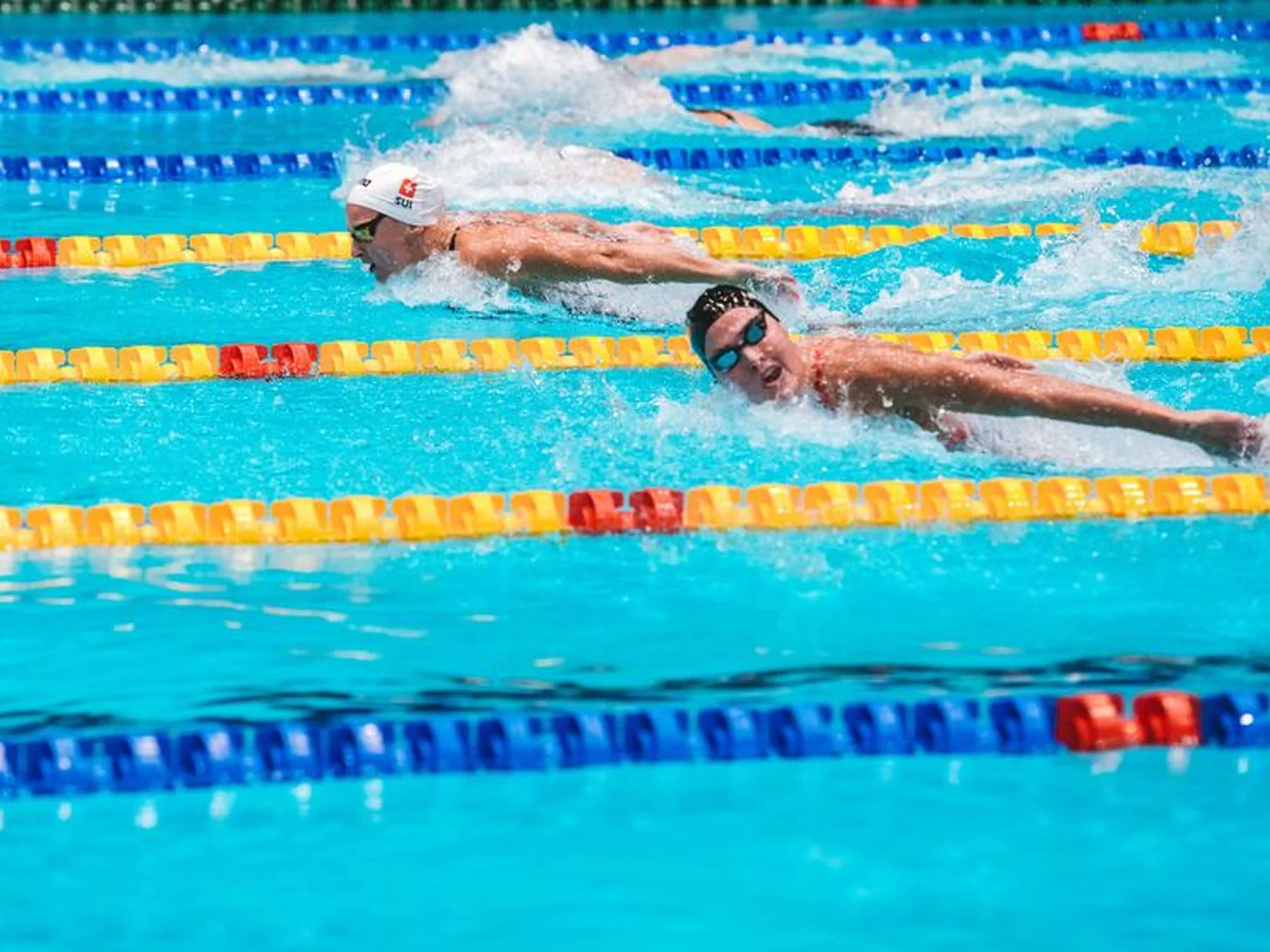
Why humans float
- Buoyancy is the upward force water exerts on an immersed body.
- Archimedes’ principle relates buoyant force to displaced fluid.
- Human bodies contain tissues with different densities.
- Body fat is less dense than water.
- Bone and muscle are generally denser than body fat.
- Air held in the lungs increases overall buoyancy.
- Inhaling deeply can make floating easier.
- Exhaling decreases lung volume and buoyancy.
- Body composition changes how easily people float.
- Salt water is denser than fresh water.
- People therefore tend to float more easily in seawater.
- Floating still requires body-position control.
- Relaxation can help keep the face and airway positioned safely.
- Panic and unnecessary movement can waste energy.
- Water-safety skills include learning to float, breathe, and move calmly rather than only swimming quickly.
The freestyle is really front crawl
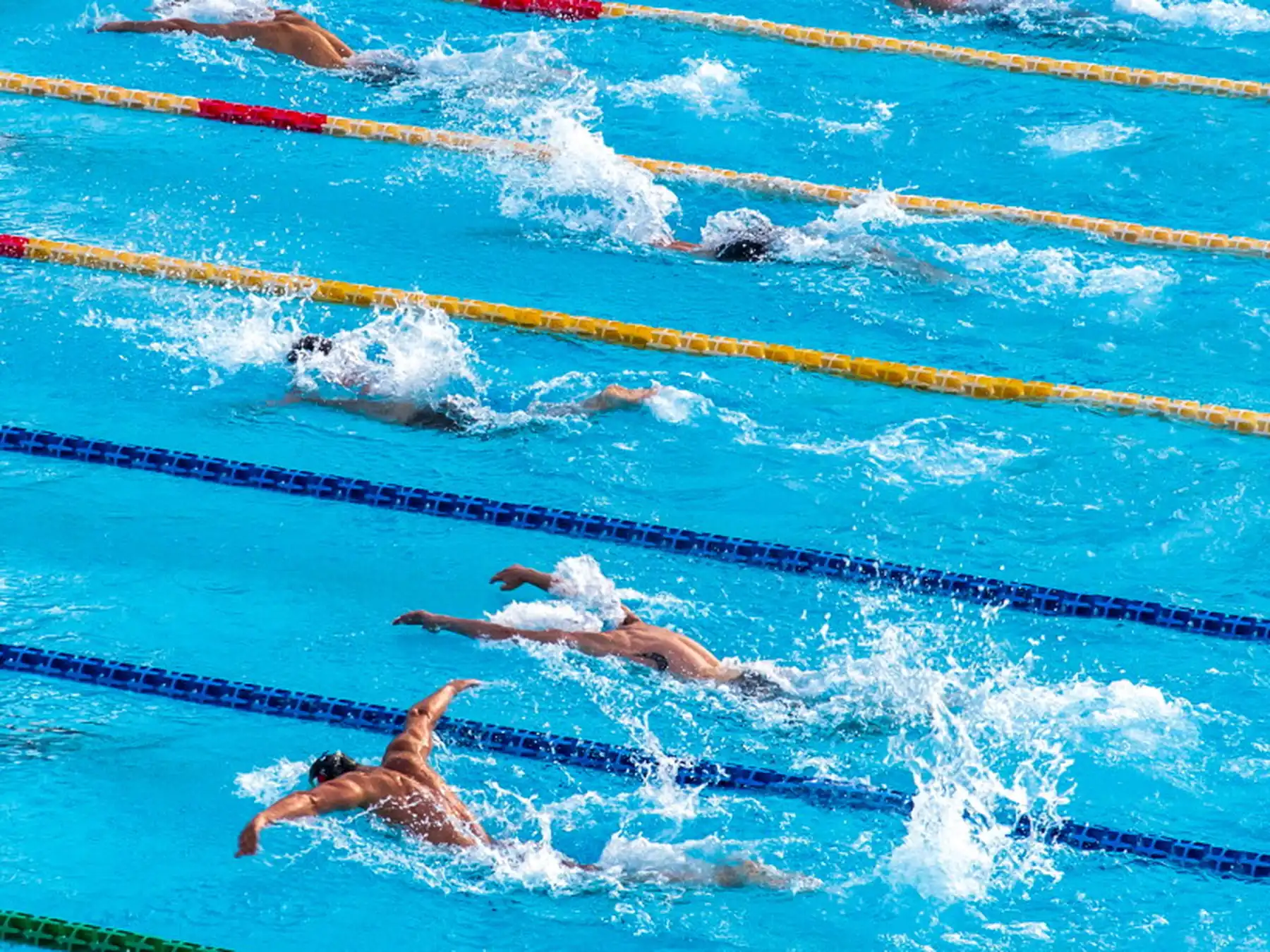
- Front crawl alternates the arms continuously.
- The legs usually perform a flutter kick.
- The swimmer rotates slightly around the body’s long axis.
- Body roll lets the shoulders move efficiently.
- Breathing usually occurs by rotating the head sideways.
- Good swimmers avoid lifting the head high because that drops the hips and increases drag.
- The hand enters ahead of the shoulder.
- The underwater pull pushes water backward.
- Newton’s laws help explain why pushing water backward propels the swimmer forward.
- The forearm can act as a major propulsive surface during the pull.
- Elbow position affects how effectively the swimmer holds water.
- The kick contributes propulsion and body stability.
- Sprint swimmers often kick faster than distance swimmers.
- Freestyle stroke rate rises dramatically during short races.
- Distance swimmers balance speed with energy conservation.
Backstroke starts in the water
- Backstroke is the only major Olympic pool stroke that starts in the water.
- Swimmers grip handles on the starting block.
- Feet press against the wall.
- At the signal, swimmers launch backward and upward.
- Modern backstroke start ledges provide improved foot contact.
- The stroke uses alternating arm movements.
- A flutter kick supports speed and body position.
- Swimmers cannot see the wall directly while facing upward.
- Backstroke flags hang above the pool near each end.
- Swimmers count strokes from the flags to time turns and finishes.
- Ceilings and lane lines also provide visual orientation indoors.
- Backstrokers roll the shoulders and torso through each arm cycle.
- The face stays above water during ordinary surface swimming.
- Water can still splash into the nose and mouth.
- Learning breath rhythm remains important even without face-down inhalation.
Breaststroke is technically strict
- Breaststroke uses simultaneous arm movements.
- The legs perform a frog-like whip kick.
- Both legs must move symmetrically under competition rules.
- The swimmer pulls, breathes, kicks, and glides in a coordinated cycle.
- Timing is crucial because arms and legs can create drag if poorly synchronized.
- The head must break the surface during each complete stroke cycle under normal rules.
- Starts and turns allow special underwater actions.
- Modern breaststroke permits one butterfly-style dolphin kick during the underwater pullout.
- The arms can pull down beyond the hips during the first underwater stroke after starts and turns.
- At turns and finishes, both hands must touch the wall simultaneously.
- Breaststroke is usually slower than front crawl.
- It can be efficient for recreational swimmers when performed gently.
- The kick places unusual rotational demands on knees and hips.
- Poor technique can contribute to breaststroker’s knee.
- Elite breaststroke looks smooth because years of practice hide complex timing rules.
Butterfly grew out of breaststroke
- Butterfly developed from experiments within breaststroke racing.
- Swimmers discovered that recovering arms over the water could be faster.
- The dolphin kick later replaced the older breaststroke-style leg action.
- Butterfly eventually became a separate stroke.
- Both arms move simultaneously.
- The legs move together in a dolphin kick.
- The body undulates through a wave-like motion.
- Power travels through chest, hips, legs, and feet.
- Most swimmers use two dolphin kicks per arm cycle.
- Breathing usually occurs by lifting the head forward.
- Some swimmers breathe to the side.
- A low breath keeps the body more streamlined.
- Butterfly demands high power and precise timing.
- It can feel much harder when the stroke rhythm breaks down.
- What began as a breaststroke innovation became one of swimming’s most spectacular events.
Olympic swimming history
- Swimming appeared at the first modern Olympics in 1896.
- The earliest Olympic swimming races were held in open water.
- Women first competed in Olympic swimming in 1912.
- Early Olympic programs included events no longer contested.
- Stroke rules evolved significantly over time.
- Freestyle distances became standardized.
- Backstroke entered the Olympic program early in the 20th century.
- Breaststroke has been an Olympic discipline for more than a century.
- Butterfly became a separate Olympic event in 1956.
- Individual medley events combine all four strokes.
- Relays add team strategy to swimming.
- Open-water marathon swimming joined the Olympic program in 2008.
- The Olympic 10-kilometer swim takes place outside a pool.
- Modern Olympic pool events use electronic timing systems.
- Swimming remains one of the Summer Games’ largest medal sports.
Olympic pools are precisely measured
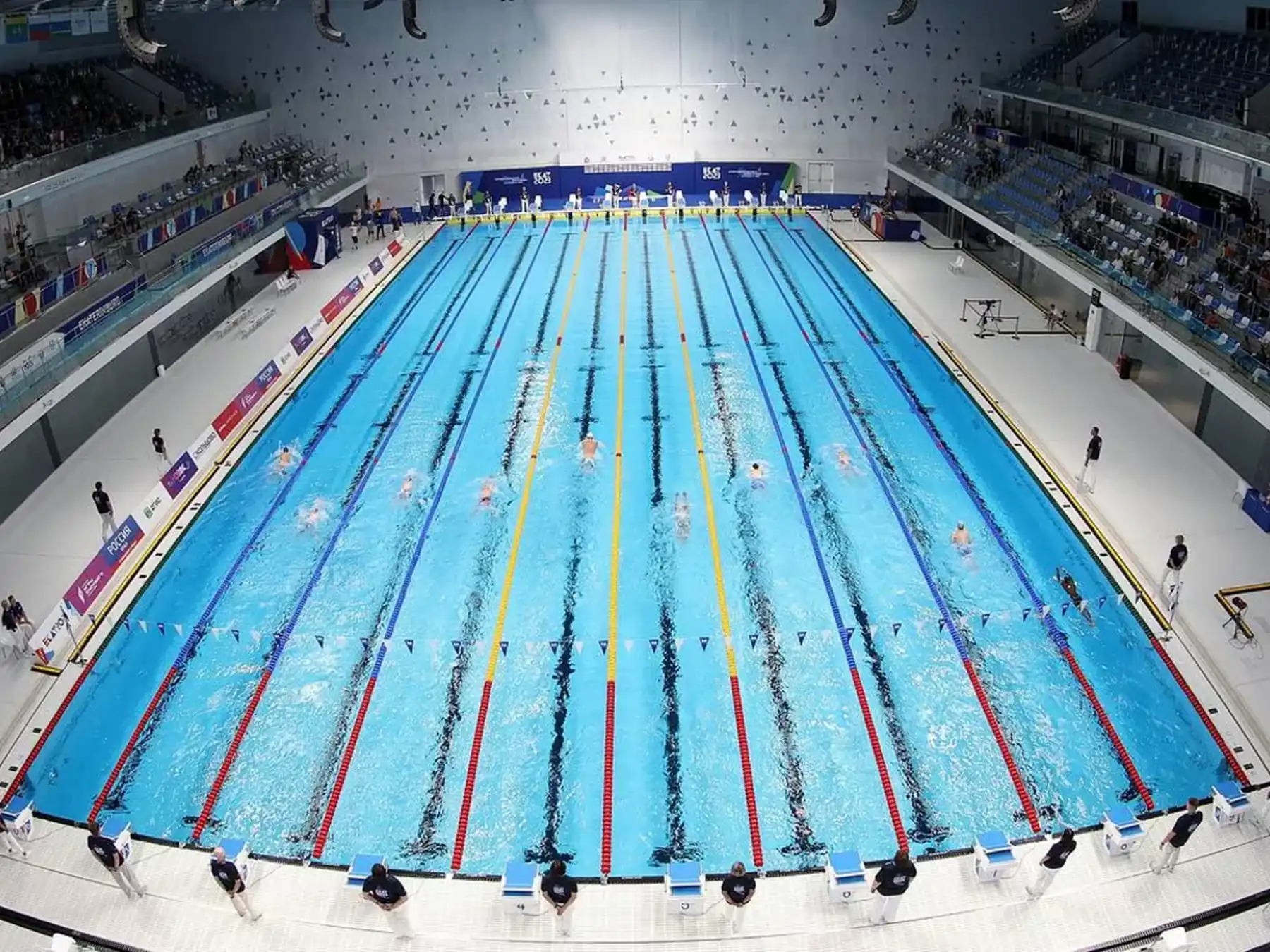
- An Olympic long-course swimming pool is 50 meters long.
- Short-course competition commonly uses 25-meter or 25-yard pools.
- Long-course and short-course records are separate.
- More turns in short-course racing can make times much faster.
- Competition lane lines reduce waves crossing between lanes.
- The outer lanes can experience different wave environments than center lanes.
- Deep water can reduce wave reflection from the pool floor.
- Modern elite pools are designed to be “fast” by managing turbulence.
- Overflow gutters absorb surface waves.
- Starting blocks provide rigid elevated platforms.
- Foot wedges help swimmers produce powerful track starts.
- Touchpads record finishes electronically.
- Swimmers must contact the wall correctly according to stroke rules.
- A hundredth of a second can separate medal positions.
- Pool engineering therefore matters at the same tiny time scale as elite technique.
Starts, turns, and underwater speed
- Swimmers are fastest immediately after a powerful start or wall push.
- Streamlining reduces drag during this high-speed phase.
- Arms squeeze tightly around the head.
- Hands overlap to create a narrow leading shape.
- Underwater dolphin kicks can maintain high speed.
- Competition rules limit how far swimmers can remain underwater in several strokes.
- In freestyle, backstroke, and butterfly, swimmers generally must surface by 15 meters after starts and turns.
- The rule prevents races from becoming almost entirely underwater dolphin-kick events.
- Freestyle flip turns use a forward somersault near the wall.
- The swimmer plants the feet and pushes off without grabbing the wall.
- Backstroke uses a specialized turning sequence.
- Breaststroke and butterfly require simultaneous two-hand touches.
- Elite swimmers rehearse turns thousands of times because every wall is a chance to gain or lose tenths of a second.
- Underwater sections reward both technique and breath control.
- A short race can be won partly by what happens where spectators see the least splashing.
Ten surprising swimming facts
- Freestyle does not literally require front crawl, although almost every elite swimmer uses it.
- Backstroke is the only major pool stroke with an in-water start.
- Butterfly originally emerged from breaststroke experimentation.
- Short-course swimmers can post faster times largely because they get more wall push-offs.
- Olympic swimmers generally cannot stay underwater beyond 15 meters in freestyle, backstroke, and butterfly.
- Pool depth and gutters can influence elite race speed by changing wave behavior.
- Salt water makes floating easier because it is denser than fresh water.
- A swimmer’s lungs function as adjustable buoyancy chambers.
- A hundredth of a second is enough to decide major swimming medals.
- For more Olympic trivia, explore our Olympics facts and sports facts.
Quick swimming FAQ
How long is an Olympic swimming pool?
50 meters from wall to wall.
What are the four competitive swimming strokes?
Freestyle, backstroke, breaststroke, and butterfly.
Why do swimmers wear caps?
Caps help control hair, reduce some drag, improve visibility, and keep goggles and hair more organized during training and racing.
Why are swimmers faster underwater after a turn?
A hard wall push gives them high speed, and a tight streamline plus dolphin kicks can reduce drag compared with surface swimming.
Is freestyle the same as front crawl?
Not technically. Freestyle means swimmers may use almost any stroke under event rules, but front crawl is normally fastest and therefore dominates competition.

Ellie is the owner and sole author of Fun Facts, combining her mechanical engineering background with years of research-driven writing to deliver facts you can trust. Every article is thoroughly fact-checked and routinely updated as new science and sources emerge to keep information accurate and current. Her mission is to make learning delightful while upholding high standards of reliability and transparency.