
Kangaroos can hop faster than many people can sprint, balance on enormous feet, lean back on a muscular tail, pause an embryo’s development, and raise two joeys at completely different stages at once. They are marsupials found naturally in Australia and nearby regions, but “kangaroo” covers more diversity than the postcard stereotype suggests. These 145 facts explore species, hopping, pouches, babies, diet, social life, anatomy, survival, conservation, and Australian culture.
Kangaroo basics
- Kangaroos are marsupial mammals.
- They belong to the family Macropodidae.
- The family name means roughly large-footed.
- Macropodidae also includes wallabies, wallaroos, tree-kangaroos, and related animals.
- The word kangaroo usually refers especially to several large macropod species.
- Red kangaroos are the largest living marsupials.
- Eastern grey kangaroos are common in eastern Australia.
- Western grey kangaroos occur across southern and western parts of Australia.
- Antilopine kangaroos inhabit tropical northern Australia.
- Kangaroos are herbivores.
- They eat grasses, leaves, shrubs, and other plant material depending on species and habitat.
- Kangaroos are native to Australia.
- Closely related macropods also live naturally in New Guinea and nearby islands.
- Wild kangaroos occupy habitats from arid grasslands to open forests.
- The Australian Museum describes red kangaroos as iconic mammals of the continent’s arid zone.
Those enormous feet
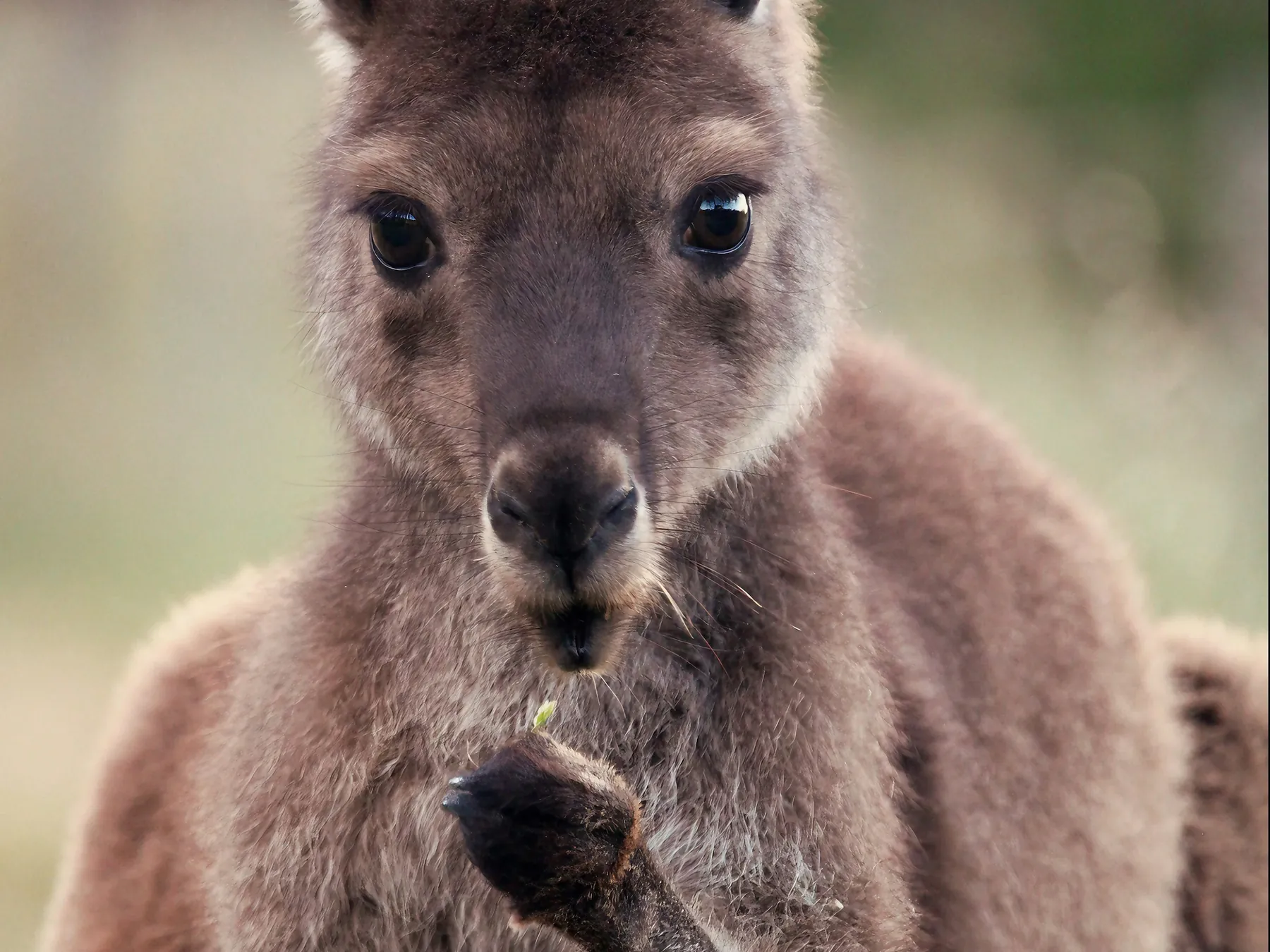
- Kangaroos have extremely long hind feet compared with their front limbs.
- The powerful hind legs are specialized for hopping.
- The fourth toe is especially large and strong.
- A long claw on that toe helps with traction and defense.
- Some smaller toes are reduced or fused together.
- Kangaroos cannot move each hind leg independently in the same way when hopping on land.
- Both hind limbs usually push together during their characteristic fast movement.
- The forelimbs are much smaller and more dexterous.
- Kangaroos use their forepaws while feeding and grooming.
- Males also use forelimbs to grapple during fights.
- At slow speeds, kangaroos often use all four limbs plus the tail.
- This five-point movement is called pentapedal locomotion.
- The tail supports body weight like a powerful fifth limb during slow walking.
- The contrast between slow walking and fast hopping makes kangaroo locomotion unusually specialized.
- A kangaroo’s famous feet are part of an integrated system involving tendons, muscles, hips, spine, and tail.
Hopping is surprisingly efficient
- Kangaroos can cover large distances by hopping.
- Elastic tendons in the hind legs store energy when the animal lands.
- That stored energy is released during the next takeoff.
- The mechanism functions partly like a spring.
- At higher speeds, kangaroo hopping becomes remarkably energy-efficient.
- Energy cost does not rise as steeply with speed as it does in many running mammals.
- This helps large kangaroos travel across sparse Australian landscapes.
- Large red kangaroos can make long bounding leaps.
- They can also reach high speeds during short bursts.
- Exact speed depends on species, terrain, motivation, and measurement method.
- The long tail acts as a counterbalance during rapid hopping.
- A kangaroo changes body angle while airborne to prepare for landing.
- Hopping is less practical for moving slowly in tight spaces.
- That is why pentapedal movement is used when grazing or creeping forward.
- Kangaroo locomotion is a classic example of evolution matching movement to environment.
The tail is more than a balance pole
- A kangaroo tail is thick, muscular, and powerful.
- It helps balance the body during fast hopping.
- It also supports weight during slow movement.
- Researchers have measured substantial propulsive force from the tail during pentapedal walking.
- The tail can contribute more mechanical work than the forelimbs during that gait.
- Male kangaroos use the tail as a brace while fighting.
- A fighting male can lean back on his tail and kick with both hind feet.
- The tail is therefore important for locomotion, balance, and combat.
- Kangaroos cannot simply use the tail as a free-swinging decoration.
- Injury to the tail can seriously affect mobility.
- The tail contains vertebrae, muscles, blood vessels, nerves, and connective tissues.
- It tapers toward the tip but remains substantial through much of its length.
- At rest, a large kangaroo may use the tail as one point of a stable tripod.
- A kangaroo sitting upright often looks almost chair-supported by its own anatomy.
- The animal’s silhouette would be mechanically incomplete without the tail.
Kangaroo babies begin unbelievably tiny
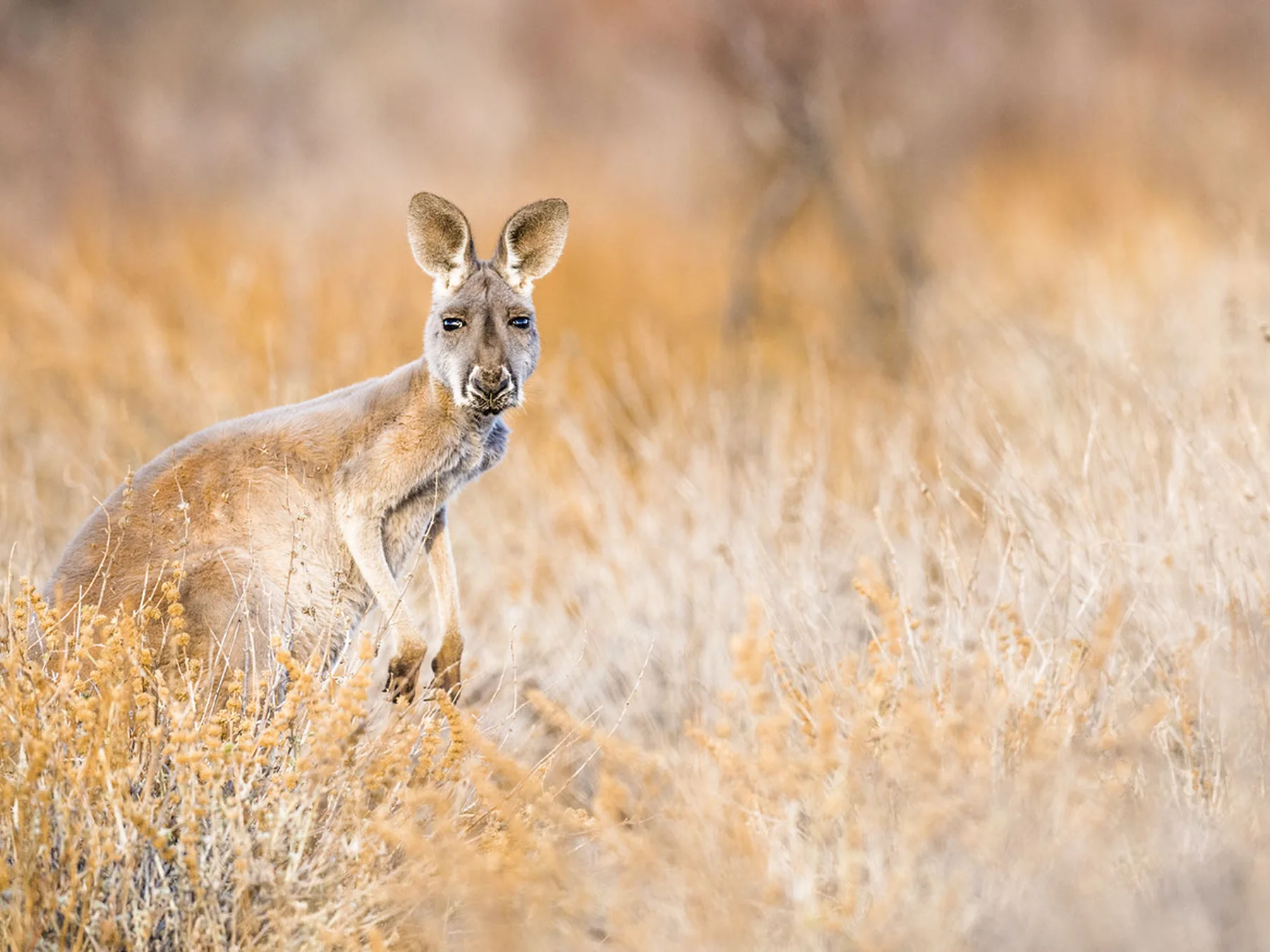
- A baby kangaroo is called a joey.
- Kangaroo pregnancies are short compared with those of similarly sized placental mammals.
- A newborn joey is extremely underdeveloped.
- It is tiny, pink, nearly hairless, and has poorly developed hind limbs.
- The forelimbs are relatively well developed at birth.
- The newborn uses those forelimbs to crawl from the birth opening toward the pouch.
- The mother does not pick up the newborn and place it inside.
- The joey makes the journey largely under its own power.
- Once inside the pouch, it attaches to a nipple.
- The nipple enlarges in the joey’s mouth and helps keep it attached.
- The joey continues developing inside the pouch for months.
- Eyes, ears, fur, limbs, and nervous-system capabilities mature gradually.
- Older joeys begin poking their heads from the pouch.
- They later leave for short exploratory trips.
- An eastern grey joey may continue returning to the pouch and nursing after it begins spending time outside.
Kangaroo reproduction gets even stranger
- Female kangaroos can support offspring at different developmental stages simultaneously.
- A mother can have an older joey outside the pouch while a younger joey remains inside.
- She may also carry an embryo whose development is temporarily paused.
- This pause is called embryonic diapause.
- Environmental conditions and the presence of another nursing joey can influence the timing.
- Embryonic diapause lets birth be delayed until conditions are more favorable.
- Red kangaroo reproduction is especially responsive to drought and rainfall.
- A female can produce milk of different composition for joeys at different ages.
- Separate mammary glands can support different milk needs simultaneously.
- This is one of mammalian biology’s most impressive multitasking systems.
- Females can become fertile again soon after giving birth.
- The paused embryo can resume development when the pouch becomes available.
- Reproductive flexibility helps kangaroo populations respond quickly after good rainfall.
- Severe drought can suppress reproduction and reduce juvenile survival.
- The Australian Museum specifically notes the red kangaroo’s ability to delay birth until an older joey leaves the pouch.
Kangaroo digestion
- Kangaroos are foregut fermenters.
- Microorganisms help break down tough plant fiber before food reaches later digestive stages.
- This digestive strategy resembles ruminant fermentation in some ways.
- Kangaroos do not have the same four-chambered stomach arrangement as cattle.
- They can regurgitate and rechew plant material.
- This process helps reduce particle size and improve digestion.
- Microbes convert plant material into compounds the kangaroo can absorb and use.
- Grass quality changes dramatically with rainfall and season.
- Kangaroos can move long distances while searching for productive feeding areas.
- Red kangaroos are especially adapted to dry environments where food availability fluctuates.
- They can survive without drinking every day when moisture-rich plants are available.
- They still drink water when conditions require it.
- Kangaroos often graze during cooler parts of the day.
- Resting in shade reduces heat load and water loss.
- Digestive and behavioral adaptations work together to survive Australia’s variable climate.
Mobs, males, and kangaroo boxing
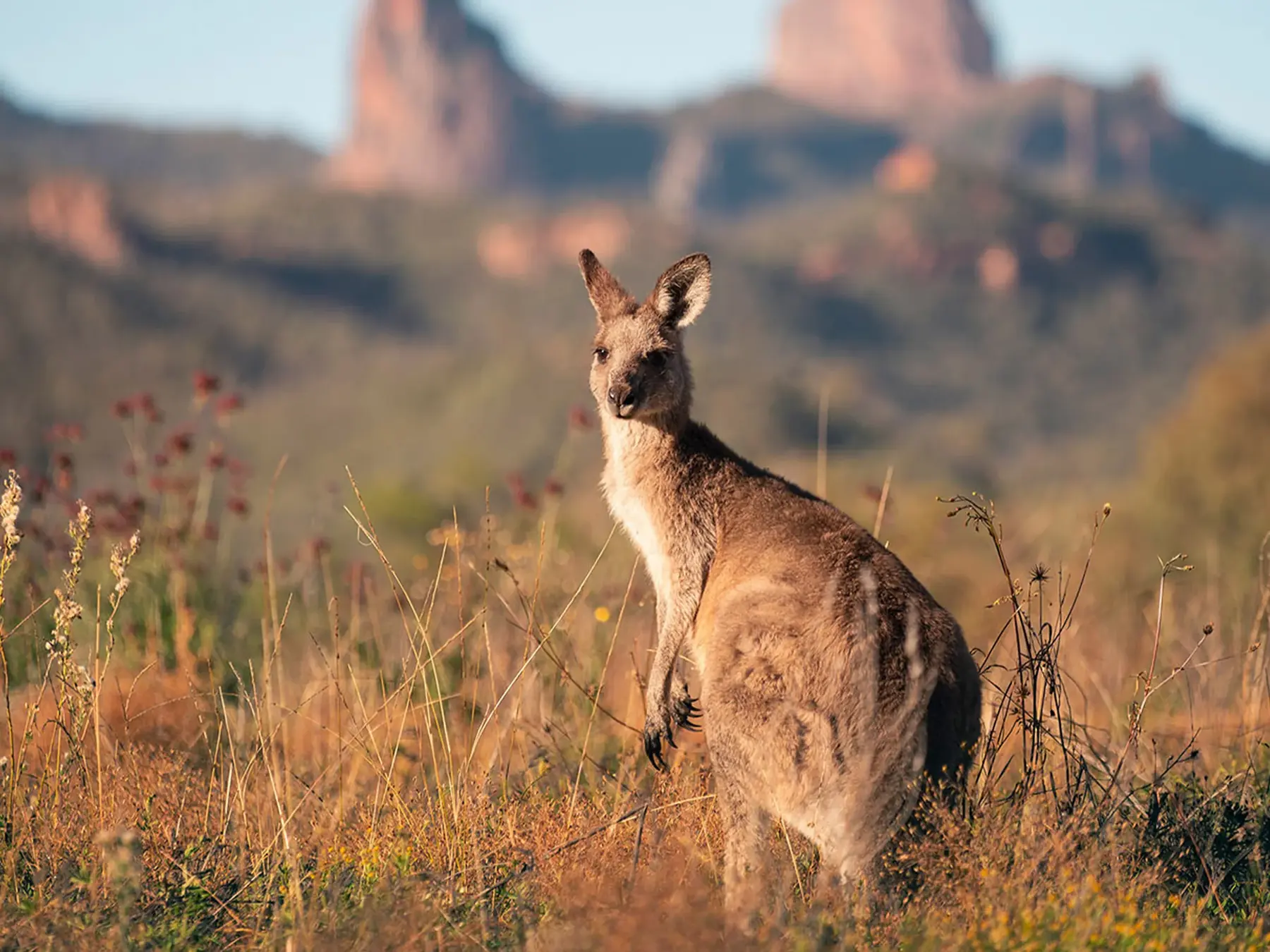
- A group of kangaroos is commonly called a mob.
- Mobs can change membership rather than functioning as perfectly fixed herds.
- Group living helps individuals detect predators.
- Kangaroos communicate with posture, movement, touch, scent, and sound.
- Large males compete for access to females.
- Male fighting is often described as boxing.
- Opponents grapple with their forearms.
- They can push, wrestle, and strike.
- A male may balance on his tail while delivering powerful hind-leg kicks.
- Those kicks can cause serious injuries.
- Dominant males can gain more mating opportunities.
- Male red kangaroos may become much larger than females.
- Large males are sometimes called boomers.
- Adult females are sometimes called flyers.
- Young animals are more vulnerable to dingoes, eagles, and other predators than healthy giant males are.
Kangaroos and Australia
- Kangaroos are among the most recognizable symbols of Australia.
- A kangaroo appears on the Australian coat of arms.
- An emu appears beside it.
- Both animals are native to Australia.
- Kangaroo imagery appears on coins, logos, sports teams, tourism advertising, and aircraft.
- Wild kangaroos can be common near towns and farmland in some regions.
- Road collisions are a serious risk where kangaroos cross at dawn, dusk, or night.
- Drivers in kangaroo habitat are often warned to reduce speed during peak activity times.
- Some kangaroo species remain abundant.
- Other macropod species are threatened by habitat loss, introduced predators, climate change, and altered fire regimes.
- Australia manages commercial harvests of certain abundant kangaroo species under regulated systems.
- Kangaroo population estimates can fluctuate enormously with rainfall.
- Drought can sharply reduce numbers in arid regions.
- Good seasons can support rapid recovery because of flexible reproduction.
- Conservation discussions must distinguish abundant large kangaroos from threatened wallabies and other macropods.
Ten surprising kangaroo facts
- A kangaroo tail can function as a weight-bearing fifth limb during slow walking.
- Newborn joeys crawl to the pouch without being placed there by their mother.
- A female can pause an embryo’s development through embryonic diapause.
- She can produce different milk for joeys of different ages at the same time.
- Fast hopping becomes more energy-efficient because elastic tendons recycle mechanical energy.
- Red kangaroos are the largest living marsupials.
- Kangaroos can move each hind leg separately while swimming even though they hop with them together on land.
- Fighting males can support themselves on the tail and kick with both feet.
- A kangaroo mob is a flexible social group rather than a single permanent family.
- For more Australian wildlife trivia, browse our koala facts and animal guides.
Quick kangaroo FAQ
What is a baby kangaroo called?
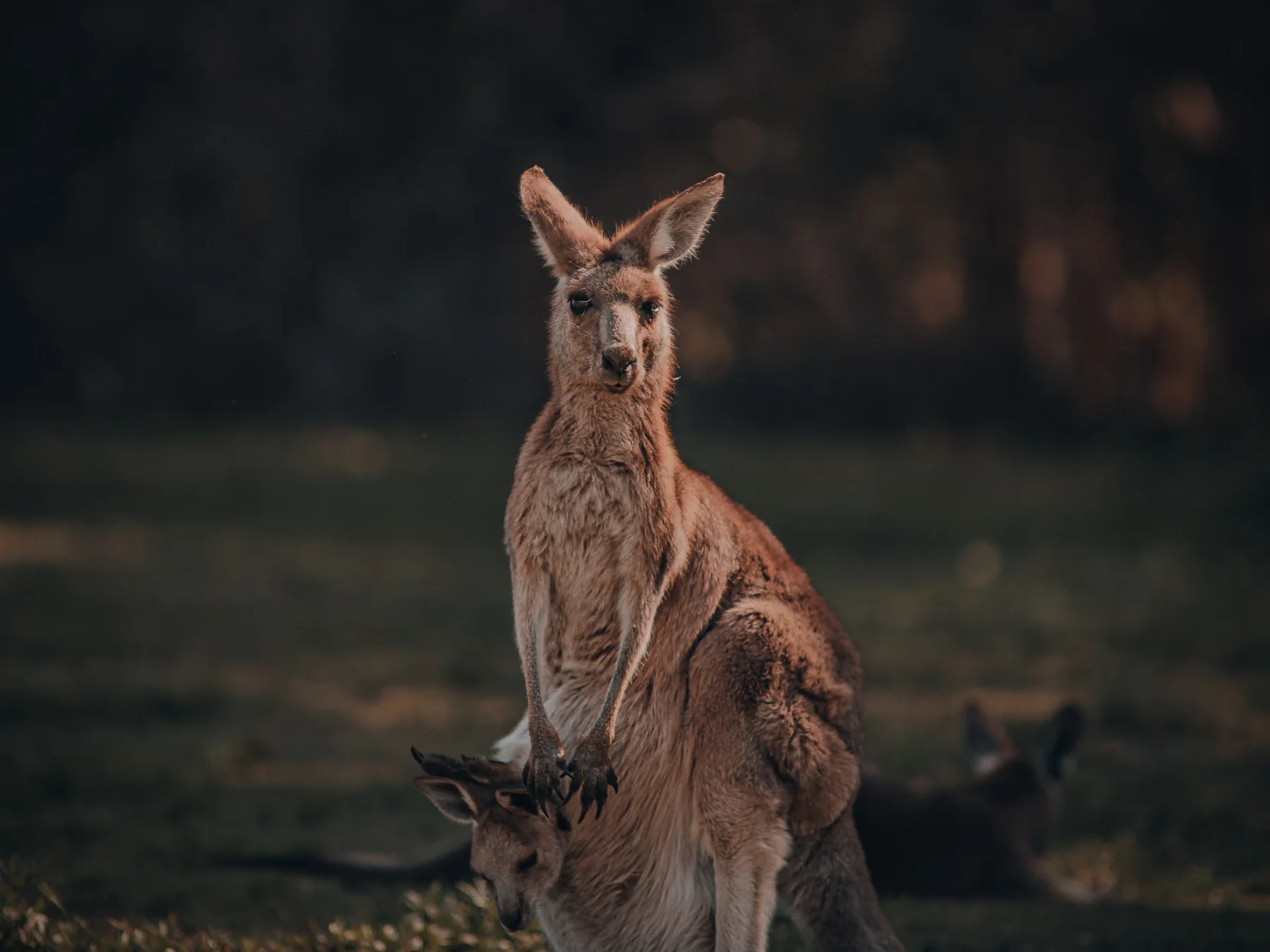
A joey. It is born extremely underdeveloped and crawls into the pouch, where it attaches to a nipple and continues growing.
Why do kangaroos hop?
Their long hind legs and elastic tendons make hopping an efficient way to travel quickly across open landscapes while recycling energy between jumps.
Do kangaroos use their tails as a fifth leg?
Yes, during slow pentapedal movement. The tail supports weight and produces propulsive force while the forelimbs and hind feet reposition.
Can kangaroos pause pregnancy?
Some species can pause early embryo development through embryonic diapause until an older joey leaves the pouch or environmental conditions improve.
Are kangaroos dangerous?
Wild kangaroos usually avoid people, but large animals can kick, scratch, and grapple powerfully if threatened, habituated, cornered, or involved in conflict.

Ellie is the owner and sole author of Fun Facts, combining her mechanical engineering background with years of research-driven writing to deliver facts you can trust. Every article is thoroughly fact-checked and routinely updated as new science and sources emerge to keep information accurate and current. Her mission is to make learning delightful while upholding high standards of reliability and transparency.