
Cleopatra VII has been turned into a beauty icon, movie queen, tragic lover, political villain, and snake-bite legend, but the real ruler was far more interesting. She spoke multiple languages, governed a wealthy Mediterranean kingdom, navigated Roman civil wars, minted her own image on coins, and fought to keep Egypt independent. These 145 facts separate documented history from two thousand years of mythmaking.
Cleopatra basics
- Cleopatra VII Philopator was the last active ruler of Ptolemaic Egypt.
- She was born around 69 BCE.
- Cleopatra died in 30 BCE.
- She ruled Egypt for about two decades, though not always alone.
- Her capital was Alexandria on Egypt’s Mediterranean coast.
- Cleopatra belonged to the Ptolemaic dynasty.
- The dynasty descended from Ptolemy I Soter, a Macedonian general of Alexander the Great.
- That means Cleopatra’s ruling family was Macedonian Greek rather than ethnically ancient Egyptian in origin.
- The Ptolemies had ruled Egypt for nearly three centuries before Cleopatra.
- Cleopatra’s father was Ptolemy XII Auletes.
- Her mother’s identity is not known with certainty.
- Cleopatra became queen after her father died in 51 BCE.
- She initially ruled with her younger brother Ptolemy XIII.
- Ptolemaic royal siblings frequently married one another to preserve dynastic legitimacy.
- Cleopatra’s reign ended when Egypt became a Roman province.
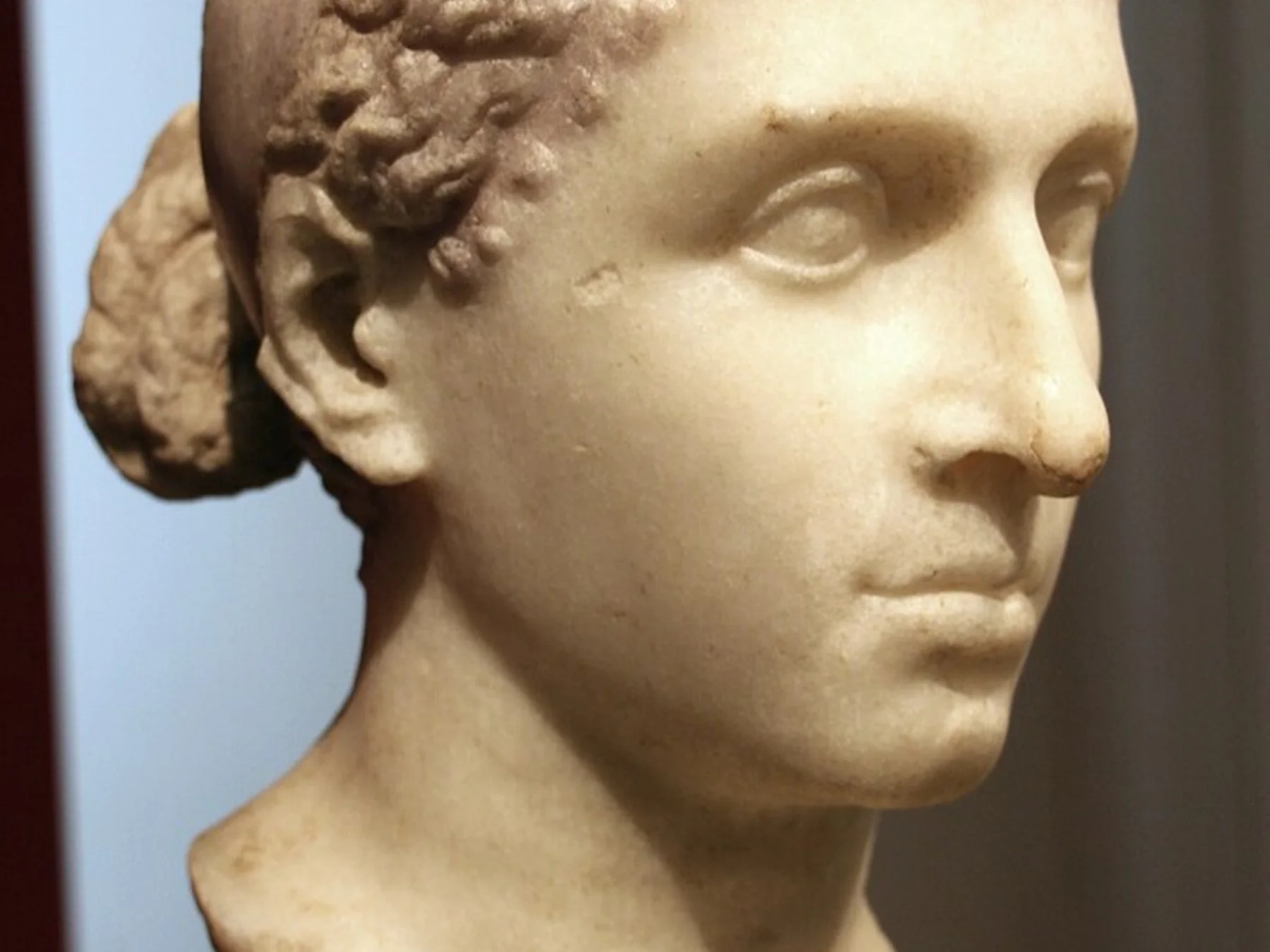
Cleopatra was highly educated
- Cleopatra was educated in the sophisticated intellectual environment of Alexandria.
- Ancient writers credited her with unusual linguistic ability.
- Plutarch wrote that she could speak with many foreign peoples without an interpreter.
- Greek was the language of the Ptolemaic royal court.
- Cleopatra is often described as the first Ptolemaic ruler known to have learned Egyptian.
- Learning Egyptian would have strengthened her relationship with native religious and political traditions.
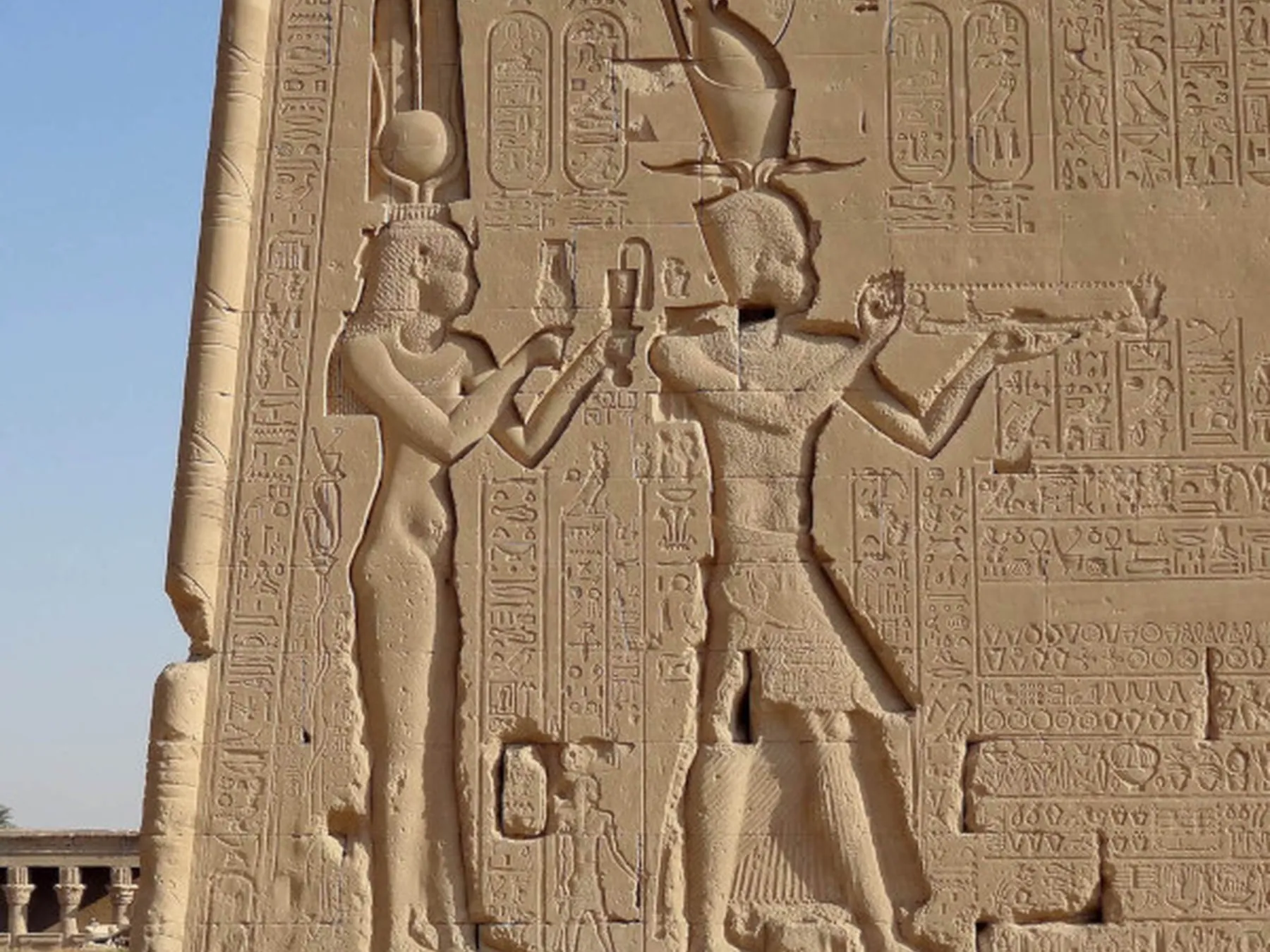
- She also represented herself through traditional Egyptian royal imagery.
- Temple reliefs show Cleopatra in the visual language of pharaohs.
- She was associated with the Egyptian goddess Isis.
- Her royal titles had meaning in both Greek and Egyptian political worlds.
- Cleopatra’s reputation for intelligence appears repeatedly in surviving ancient accounts.
- Ancient authors emphasized her conversation and presence more consistently than perfect physical beauty.
- Her education would have included rhetoric, politics, literature, and administration appropriate to royalty.
- Alexandria housed major scholarly institutions including the famous Mouseion and library traditions.
- Cleopatra ruled from one of the ancient Mediterranean’s most cosmopolitan cities.
The Ptolemaic family was complicated
- Ptolemaic royal names repeat constantly, making the dynasty notoriously confusing.
- Many male rulers were named Ptolemy.
- Royal women frequently carried names such as Cleopatra, Berenice, and Arsinoe.
- Cleopatra VII had several royal siblings.
- Her sister Berenice IV ruled Egypt while their father was in exile.
- Ptolemy XII returned with Roman-backed military support in 55 BCE.
- Berenice IV was executed after his restoration.
- Cleopatra later became co-ruler with Ptolemy XIII.
- The siblings soon fell into open political conflict.
- Ptolemy XIII’s advisers pushed Cleopatra out of Alexandria.
- Cleopatra gathered support and forces outside the capital.
- The Egyptian civil war became entangled with Rome’s own civil war.
- Her younger sister Arsinoe IV later emerged as a rival claimant.
- Another younger brother, Ptolemy XIV, eventually became Cleopatra’s co-ruler.
- Dynastic survival in the Ptolemaic court could be deadly even among close relatives.
Julius Caesar arrives in Egypt
- Roman general Pompey fled to Egypt after losing to Julius Caesar in 48 BCE.
- Advisers of Ptolemy XIII had Pompey killed after he landed.
- Caesar arrived in Alexandria soon afterward.
- Ancient sources say Caesar was horrified or displeased by Pompey’s murder.
- Caesar became involved in the dispute between Cleopatra and Ptolemy XIII.
- Cleopatra needed to reach Caesar despite her rivals controlling Alexandria.
- Plutarch tells the famous story that she was secretly carried into Caesar’s quarters in bedding.
- The object was probably a bed sack or bundle rather than the luxurious rolled carpet of movie legend.
- Cleopatra persuaded Caesar to support her political position.
- Fighting erupted in Alexandria between Caesar’s forces and Cleopatra’s opponents.
- The conflict is commonly called the Alexandrian War.
- Ptolemy XIII died during the fighting in 47 BCE.
- Cleopatra was restored as ruler.
- She then ruled with her younger brother Ptolemy XIV.
- Caesar’s intervention changed the course of both Cleopatra’s reign and Egyptian politics.
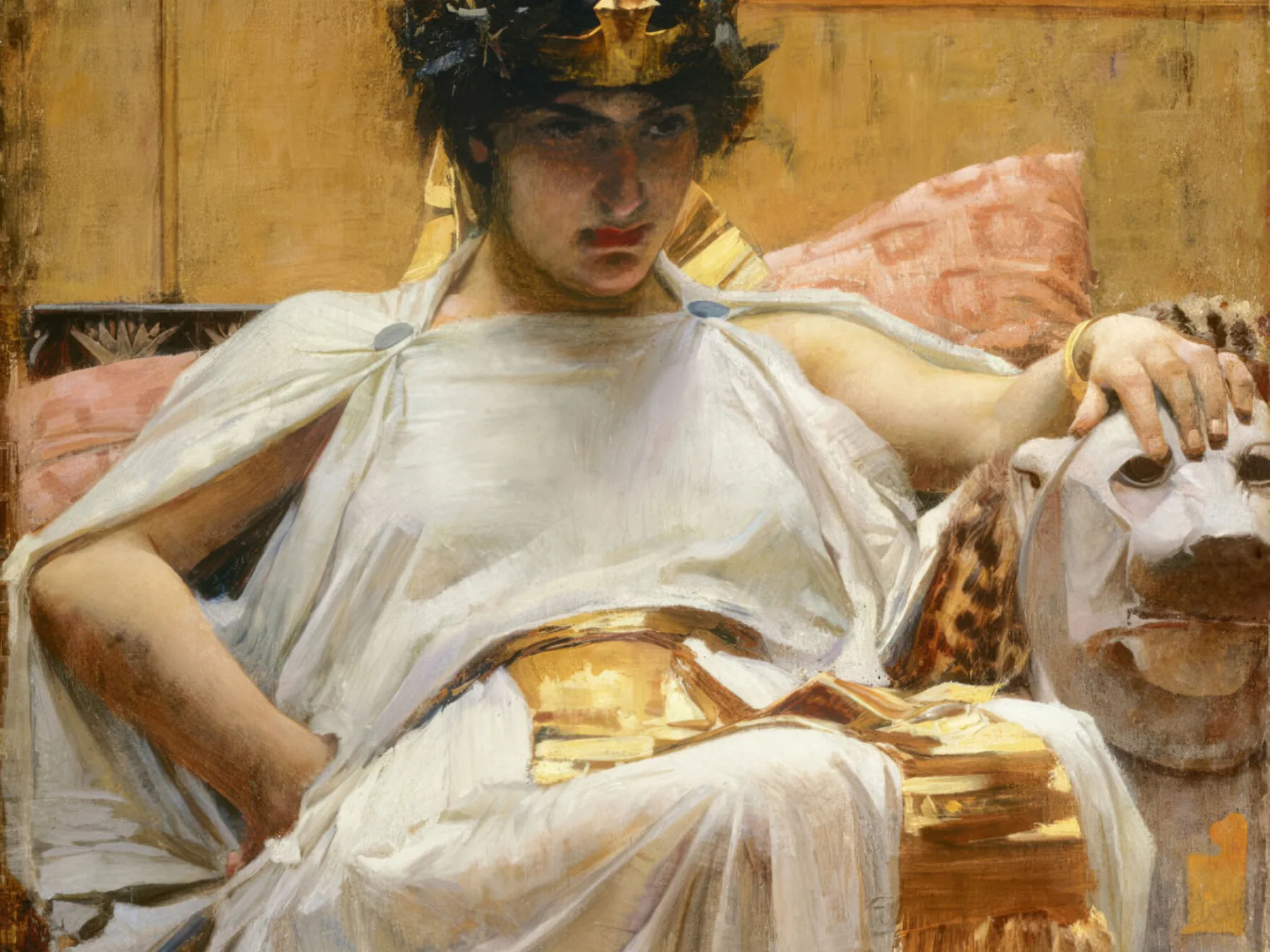
Cleopatra and Caesarion
- Cleopatra had a son named Ptolemy XV Caesar.
- He became widely known by the nickname Caesarion, meaning “little Caesar.”
- Cleopatra identified Julius Caesar as Caesarion’s father.
- Caesar never formally made Caesarion his Roman heir.
- Caesar’s legal heir in Rome was his great-nephew Octavian.
- Cleopatra visited Rome during Caesar’s dictatorship.
- She stayed in one of Caesar’s properties outside the sacred city boundary.
- A gilded statue of Cleopatra was placed in the Temple of Venus Genetrix.
- Caesar was assassinated in Rome on March 15, 44 BCE.
- Cleopatra returned to Egypt after his death.
- Ptolemy XIV died soon afterward.
- Cleopatra elevated young Caesarion as her co-ruler.
- Caesarion became Ptolemy XV.
- Cleopatra increasingly presented her son as part of a powerful dynastic future.
- Octavian later viewed Caesarion’s claimed connection to Caesar as a political threat.
Cleopatra meets Mark Antony
- After Caesar’s death, Roman politics fractured into another series of civil wars.
- Mark Antony became one of Rome’s most powerful leaders.
- Antony summoned Cleopatra to meet him at Tarsus in 41 BCE.
- Ancient sources describe Cleopatra’s arrival as deliberately theatrical and luxurious.
- Plutarch says she sailed in a magnificent vessel associated with imagery of Aphrodite.
- The spectacle communicated wealth, divine symbolism, and political confidence.
- Cleopatra and Antony became political allies and lovers.
- Antony spent time with Cleopatra in Alexandria.
- They had twins, Alexander Helios and Cleopatra Selene II.
- They later had another son, Ptolemy Philadelphus.
- Antony needed Egyptian wealth and resources for his eastern campaigns.
- Cleopatra wanted territory, security, and recognition for her dynasty.
- Their relationship was therefore political as well as personal.
- Roman propaganda later reduced this alliance to a story of Antony being seduced by a foreign queen.
- That portrayal served Octavian’s campaign against his Roman rival.
The Donations of Alexandria
- In 34 BCE, Antony and Cleopatra staged a grand political ceremony in Alexandria.
- The event became known as the Donations of Alexandria.
- Antony distributed royal titles and territories among Cleopatra and her children.
- Some of the promised territories were not actually under his direct control.
- Caesarion was proclaimed Caesar’s legitimate son in the ceremony’s political messaging.
- Cleopatra received the title Queen of Kings.
- Caesarion was styled King of Kings.
- The ceremony projected a new eastern dynastic order centered on Cleopatra’s family.
- Octavian used the event as evidence that Antony had betrayed Roman interests.
- Roman political rhetoric portrayed Cleopatra as a dangerous foreign monarch.
- Octavian carefully directed public hostility toward Cleopatra.
- Rome formally declared war on Cleopatra rather than framing the conflict simply as civil war against Antony.
- This allowed Octavian to present himself as defending Rome from an external queen.
- Propaganda from the conflict strongly influenced later historical descriptions of Cleopatra.
- Modern historians therefore read hostile Roman sources with particular caution.
Actium and the fall of Cleopatra
- The decisive Battle of Actium occurred on September 2, 31 BCE.
- It was a naval battle off the western coast of Greece.
- Octavian’s forces were commanded at sea by Marcus Agrippa.
- Antony and Cleopatra commanded the opposing alliance.
- Cleopatra contributed a major Egyptian fleet.
- During the battle, Cleopatra’s squadron broke through and sailed away.
- Antony followed her.
- The exact tactical reasons for their departure remain debated.
- Actium was a devastating strategic defeat.
- Antony and Cleopatra withdrew to Egypt.
- Octavian invaded Egypt in 30 BCE.
- Antony’s remaining military position collapsed.
- Antony died by suicide after mistakenly believing Cleopatra was dead.
- Cleopatra was then captured by Octavian.
- She died shortly afterward in Alexandria.
How did Cleopatra die?
- Cleopatra died in August 30 BCE.
- Ancient sources agree that her death was probably suicide.
- The exact method is uncertain.
- The most famous story says she used the bite of an asp.
- “Asp” in ancient writing could refer to a venomous snake such as an Egyptian cobra.
- Plutarch reported several possible explanations rather than one proven method.
- He mentions a snake hidden in a basket of figs as one story.
- He also mentions the possibility of poison applied with a sharp implement.
- No eyewitness medical report survives to settle the question.
- The cobra version became irresistible to later artists and dramatists.
- Cleopatra may have wanted to avoid being displayed as a captive in Octavian’s Roman triumph.
- Two attendants were reportedly found dying with her.
- Cleopatra was about 39 years old.
- Caesarion was killed soon afterward on Octavian’s orders.
- Egypt was annexed into the Roman imperial system.
Ten surprising Cleopatra facts
- Cleopatra was closer in time to the Moon landing than to the building of the Great Pyramid.
- She was Macedonian Greek by dynasty, though she ruled as an Egyptian pharaoh.
- Ancient writers praised her voice and intelligence more than an impossibly perfect face.
- The famous carpet entrance was probably a bundle of bedding rather than a modern carpet.
- Cleopatra had relationships with two of Rome’s most powerful men during separate civil wars.
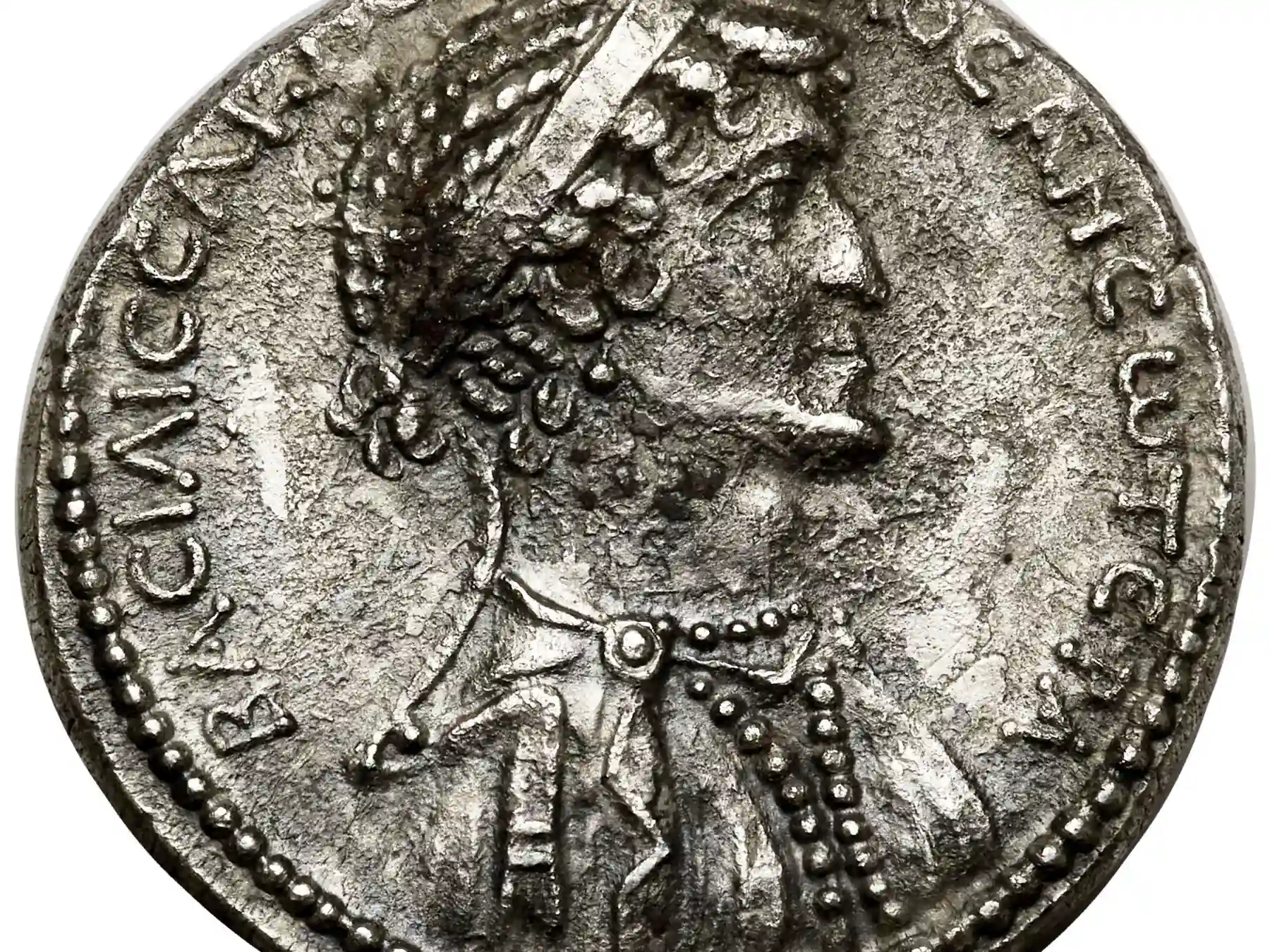
- Her coins deliberately showed a strong royal profile instead of modern Hollywood beauty ideals.
- She did not personally burn down the Library of Alexandria.
- The snake-bite death is famous but cannot be proven.
- Cleopatra’s daughter Cleopatra Selene II survived and later became queen of Mauretania.
- For more ancient history, explore our Egypt facts and History facts.
Quick Cleopatra FAQ
Was Cleopatra Egyptian?
She ruled Egypt as pharaoh and embraced Egyptian royal traditions, but her dynasty descended from Macedonian Greeks who had taken power after Alexander the Great.
Was Cleopatra really beautiful?
Ancient descriptions emphasize her intelligence, voice, charm, and ability to command attention. Surviving coins show a strong royal portrait, but beauty standards and political imagery make modern judgments unreliable.
Did Cleopatra marry Julius Caesar?
No. They were political allies and lovers, and Cleopatra said Caesar fathered Caesarion, but they did not enter a recognized Roman marriage.
Did Cleopatra die from a snake bite?
Possibly, but nobody can prove it. Ancient writers offered multiple possibilities, including a venomous snake and other methods of poisoning.
Was Cleopatra the last pharaoh?
She was the last active ruler of Ptolemaic Egypt. Her son Caesarion briefly held royal status after her death before Octavian had him killed and annexed Egypt.

Ellie is the owner and sole author of Fun Facts, combining her mechanical engineering background with years of research-driven writing to deliver facts you can trust. Every article is thoroughly fact-checked and routinely updated as new science and sources emerge to keep information accurate and current. Her mission is to make learning delightful while upholding high standards of reliability and transparency.