
Eagles are not one single bird. They are a diverse group of powerful raptors found across much of the world, from fish-hunting sea eagles to mountain-soaring golden eagles and rainforest giants strong enough to hunt monkeys. These 145 eagle facts explore their eyesight, talons, nests, flight, hunting, famous species, conservation stories, and the myths people often mistake for facts.
Eagle basics
- Eagles are birds of prey, also called raptors.
- Most birds commonly called eagles belong to the hawk family Accipitridae.
- That family also contains many hawks, kites, harriers, and Old World vultures.
- “Eagle” is a common-name category rather than one single branch containing every eagle and no other raptor.
- There are dozens of living eagle species.
- Eagles live on every continent except Antarctica.
- They occupy habitats including coasts, wetlands, deserts, mountains, forests, grasslands, and tundra.
- Eagles are carnivores.
- Different species specialize on fish, birds, mammals, reptiles, carrion, or combinations of prey.
- Eagles have hooked bills designed to tear food.
- Their feet end in strong curved talons.
- Like other birds, eagles have lightweight skeletons adapted for flight.
- Large wings help many eagle species soar efficiently.
- Female eagles are often larger than males of the same species.
- This female-larger size pattern is common among many birds of prey.
Eagle eyesight is extraordinary
- Vision is one of an eagle’s most important hunting senses.
- Eagle eyes are large relative to the size of the skull.
- Many eagles can resolve fine details from much farther away than humans can.
- The retina of a raptor contains densely packed light-sensitive cells.
- Many raptors possess two foveae in each eye, specialized retinal regions for sharp vision.
- Eagles can detect ultraviolet wavelengths that human eyes cannot see.
- Their forward-facing eyes create overlapping fields of view for depth perception.
- Good depth perception helps an eagle judge distance during a strike.
- Eagles can scan enormous areas while soaring high above the ground or water.
- They can rapidly shift attention from broad landscapes to a particular moving target.
- An eagle’s eye is supported by a ring of small bones called the sclerotic ring.
- Eagles have a transparent third eyelid called a nictitating membrane.
- The nictitating membrane helps protect and moisten the eye.
- Eagles can see in color.
- The Smithsonian describes keen full-color vision as a bald eagle’s most developed sense.
Talons, beaks, and hunting tools
- Eagle talons are claws made of keratin, the same broad material found in human fingernails.
- Powerful leg muscles help drive the talons into prey.
- The hooked beak tears food into pieces after prey has been captured.
- The beak itself is covered by a hard keratin sheath.
- Fish-eating eagles often have roughened or specialized foot surfaces that help grip slippery prey.
- Sea eagles can snatch fish near the surface with their feet while remaining mostly airborne.
- Bald eagles usually do not plunge deeply underwater like ospreys.
- Some eagles hunt by watching from a perch before launching toward prey.
- Others search while soaring over open terrain.
- Forest eagles may use short, powerful bursts of flight through trees.
- Golden eagles commonly hunt mammals such as rabbits, hares, ground squirrels, and prairie dogs.
- Harpy eagles hunt arboreal mammals including sloths and monkeys in tropical forests.
- Some eagles readily eat carrion instead of killing every meal themselves.
- Eagles may steal prey from other birds, a behavior called kleptoparasitism.
- Bald eagles are notorious for harassing ospreys until the smaller birds drop fish.
How eagles fly and soar
- Eagles save energy by soaring whenever atmospheric conditions allow it.
- Thermals are columns of rising warm air that can lift soaring birds.
- An eagle can circle within a thermal to gain altitude without constantly flapping.
- After gaining height, it can glide toward another rising-air source.
- Mountain winds create updrafts that golden eagles can use for lift.
- The U.S. Fish and Wildlife Service notes that golden eagles use both thermal and orographic lift during movement and migration.
- Long broad wings are efficient for soaring at relatively low speeds.
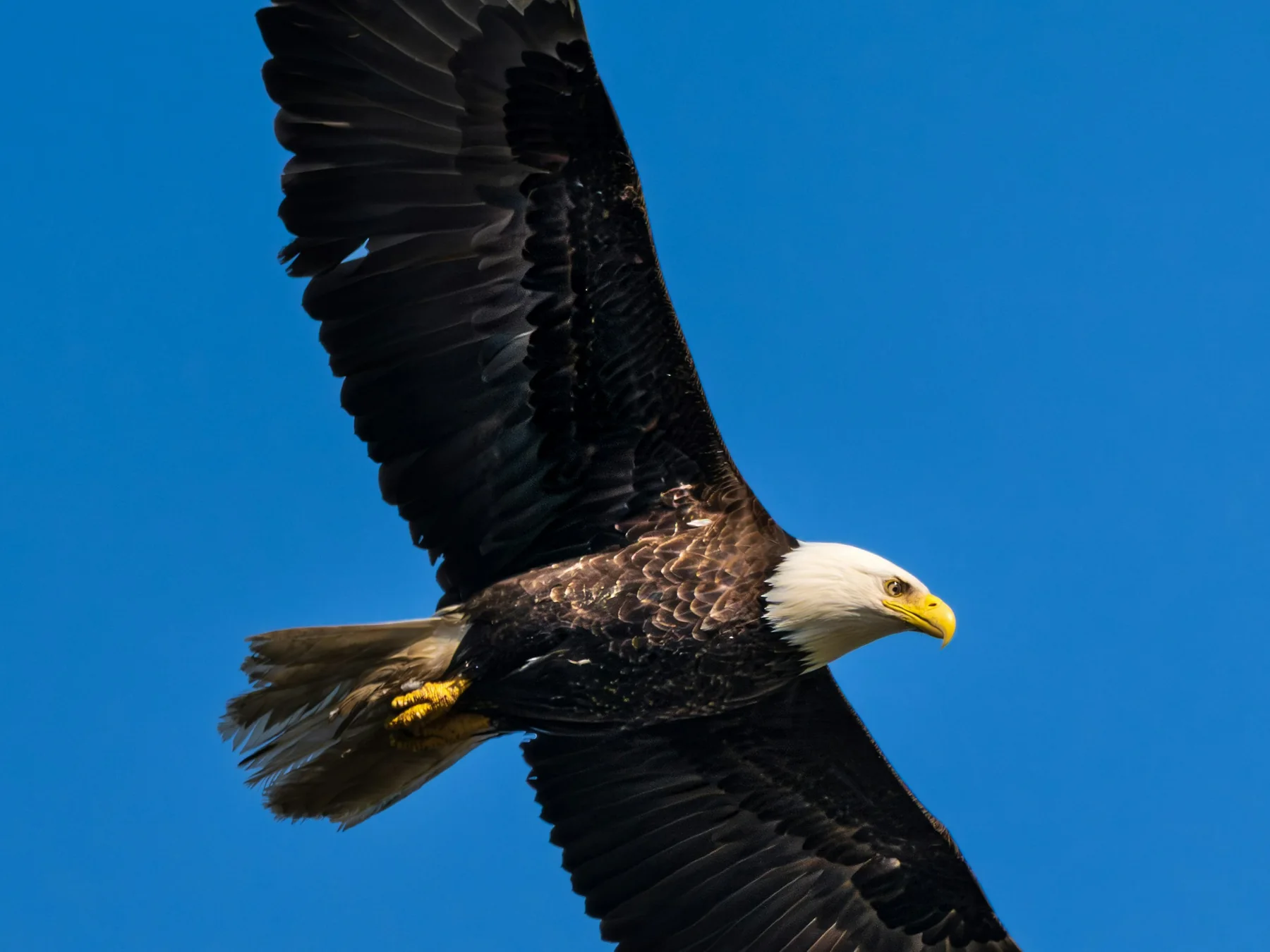
- Separated primary feathers at the wingtips look like fingers during flight.
- Those slotted wingtip feathers help manage airflow and reduce drag.
- Eagles use their tails for steering, braking, and balance.
- Flight style varies by species, habitat, wind, and purpose.
- A hunting dive can convert height into tremendous speed.
- Eagles are powerful fliers, but peregrine falcons hold the famous speed records for diving flight.
- Large eagles cannot simply lift prey of any size they choose.
- Carrying capacity depends on the bird’s size, speed, altitude, wind, prey shape, and flight conditions.
Bald eagles
- The bald eagle’s scientific name is Haliaeetus leucocephalus.
- Bald eagles are native to North America.
- The word “bald” in the common name refers historically to the bird’s white head, not a lack of feathers.
- Adult bald eagles have white heads and tails with dark brown bodies.
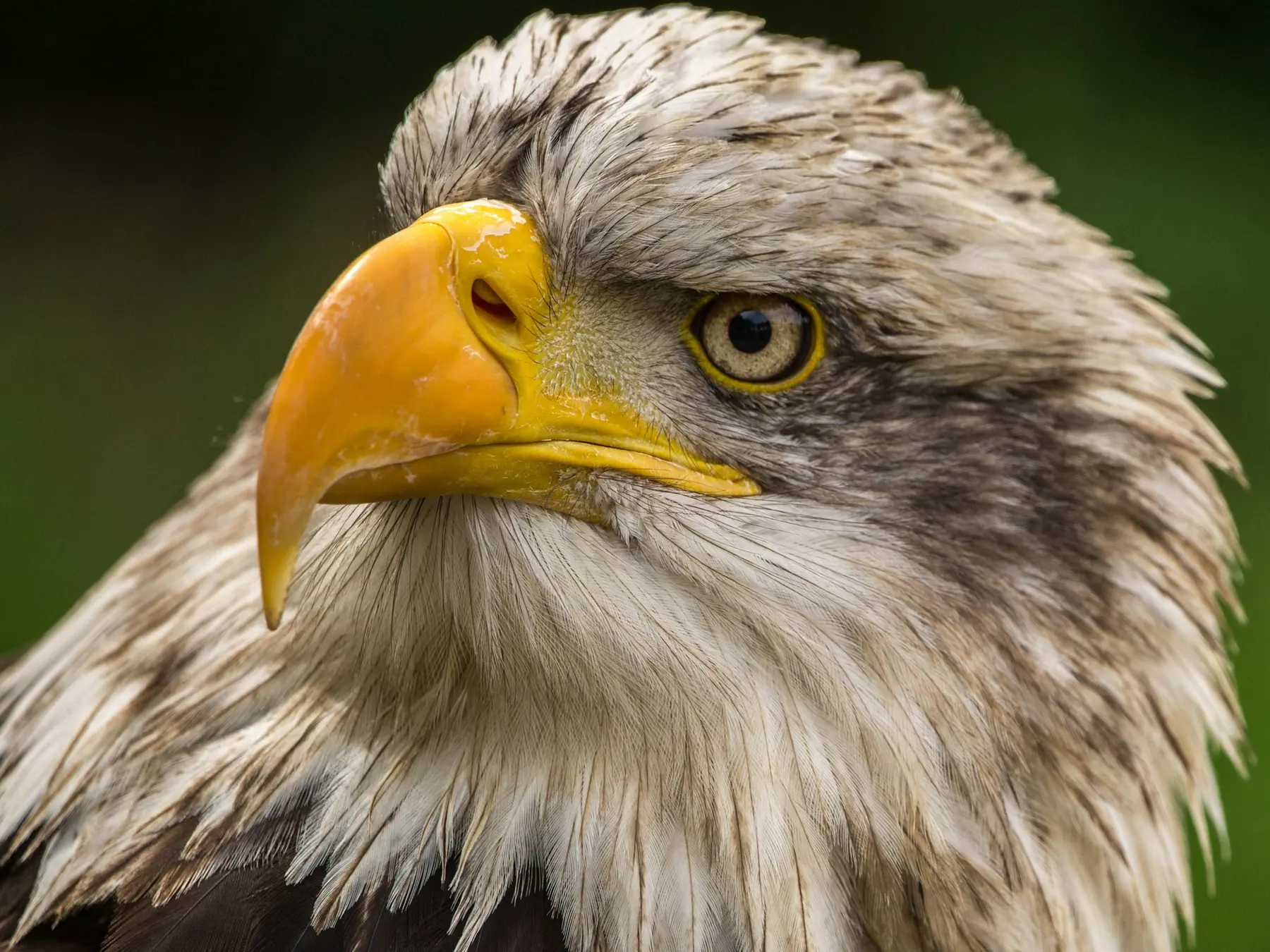
- Young bald eagles are mostly mottled brown and white.
- They generally develop the familiar adult white head and tail at around four to five years old.
- Females are usually larger than males.
- The Smithsonian gives adult bald eagle weights of roughly 6.5 to 14 pounds, or 3 to 6.5 kilograms.
- Large individuals can have wingspans exceeding 8 feet, or about 2.4 meters.
- Bald eagles are strongly associated with lakes, rivers, coasts, and other fish-rich waters.
- Fish are a major part of their diet.
- They also eat birds, mammals, and carrion.
- The famous dramatic “eagle scream” used in many movies is often actually a red-tailed hawk recording.
- Real bald eagle calls are relatively high, thin, chirping, or squeaking sounds.
- The Smithsonian’s current bald eagle profile specifically calls out this Hollywood sound swap.
Bald eagle nests and family life
- Bald eagles build some of the largest bird nests in the world.
- Pairs often reuse and add material to the same nest over multiple breeding seasons.
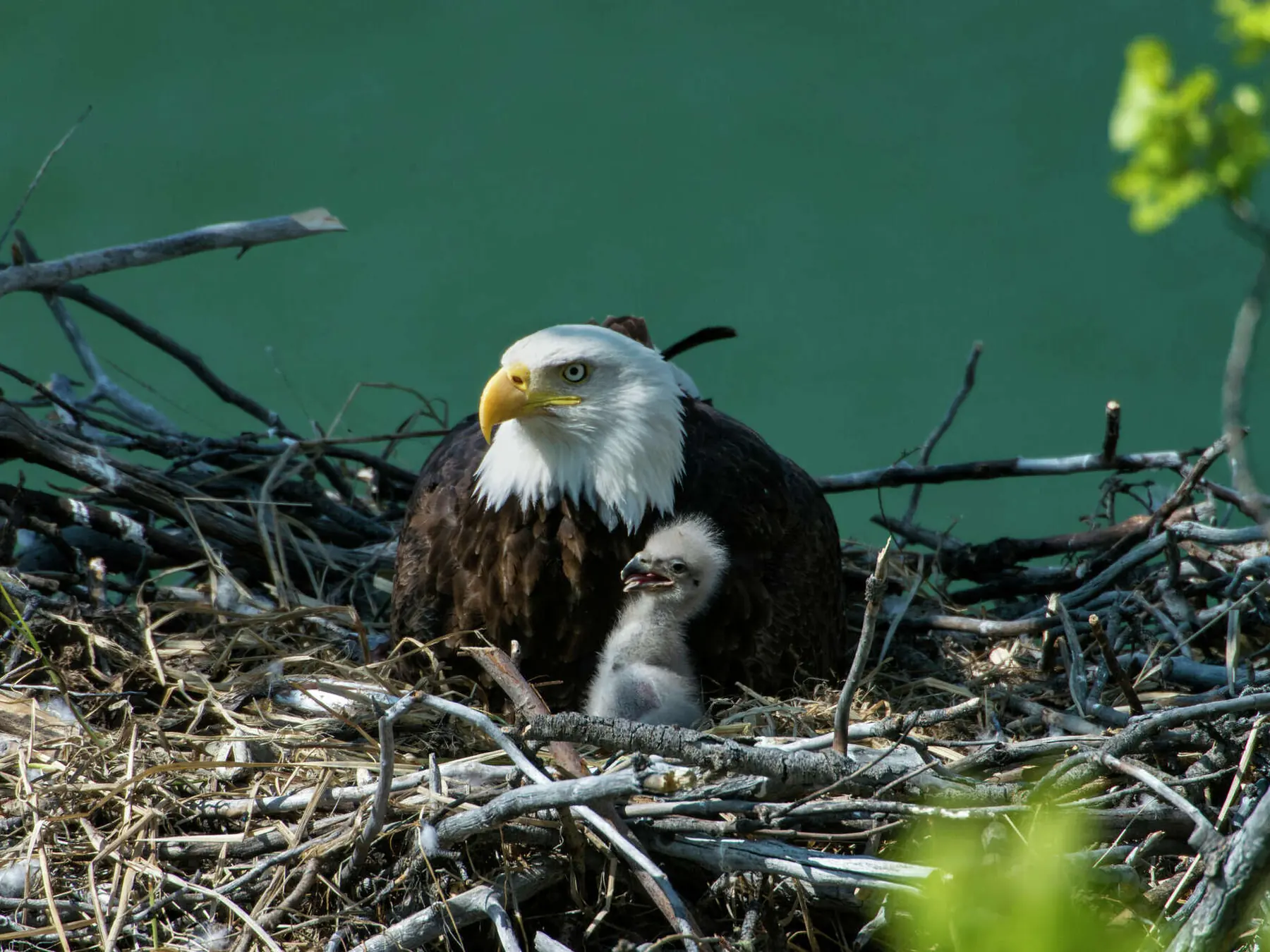
- A typical nest is built from large sticks and lined with softer material.
- The U.S. Fish and Wildlife Service says bald eagle nests can reach about 10 feet across.
- The largest recorded bald eagle nest near St. Petersburg, Florida, measured about 9.5 feet wide and 20 feet deep.
- That record nest was estimated to weigh nearly 6,000 pounds.
- Nests are often placed in tall sturdy trees with clear access to nearby foraging areas.
- Bald eagles may also nest on cliffs or human-made structures where suitable.
- Pairs may maintain alternate nests within the same breeding territory.
- Bald eagles usually lay one to three eggs.
- Two eggs are common.
- Both parents participate in incubation and chick care.
- Incubation lasts about 34 to 36 days according to the Smithsonian.
- Young bald eagles remain in the nest for roughly 10 to 12 weeks before fledging.
- Young eagles continue developing hunting skills long after their first flight.
The bald eagle’s conservation comeback
- The bald eagle became the national emblem of the United States in 1782.
- By the mid-20th century, bald eagle populations had collapsed across much of the lower 48 states.
- Habitat destruction, shooting, and chemical contamination all contributed to the decline.
- The pesticide DDT became one of the most important causes of reproductive failure.
- DDT and its breakdown products accumulated through aquatic food webs.
- Exposure caused eggshell thinning that made eggs more likely to break during incubation.
- Only 417 known nesting pairs remained in the contiguous United States in 1963.
- The United States banned most uses of DDT in 1972.
- Legal protection, habitat conservation, cleaner ecosystems, and active management helped bald eagles recover.
- The species was moved from endangered to threatened status in much of the United States in 1995.
- Bald eagles were removed from the federal endangered and threatened species list in 2007.
- Delisting did not remove every legal protection for bald eagles.
- The Bald and Golden Eagle Protection Act continues to protect both species.
- The U.S. Fish and Wildlife Service calls the bald eagle recovery an Endangered Species Act success story.
- Lead poisoning, collisions, habitat disturbance, illegal shooting, and other threats still affect eagles today.
Golden eagles and other remarkable species
- The golden eagle’s scientific name is Aquila chrysaetos.
- Golden eagles live across parts of North America, Europe, Asia, and North Africa.
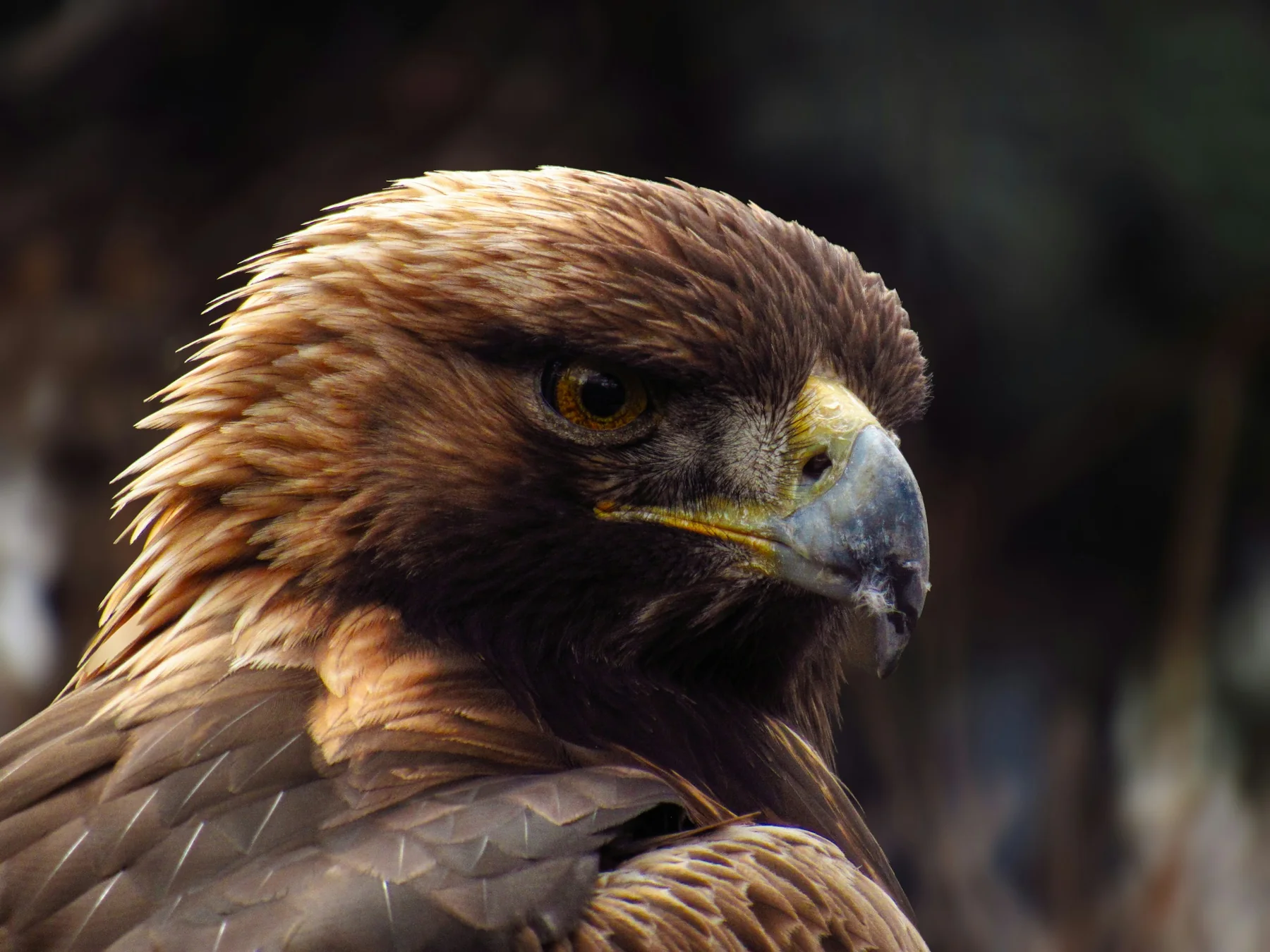
- They are named for the golden-brown feathers on the back of the head and neck.
- Golden eagles favor open country, cliffs, mountains, grasslands, and other landscapes that support hunting.
- They often prey on medium-sized mammals.
- The U.S. Fish and Wildlife Service protects golden eagles under the same federal eagle law that protects bald eagles.
- Golden eagles are important national symbols in several countries.
- Cornell notes that the golden eagle appears as an official national emblem or animal for countries including Albania, Germany, Austria, Mexico, and Kazakhstan.
- The harpy eagle is one of the largest and most powerful forest eagles.
- Harpy eagles live in tropical forests of Central and South America.
- Their short broad wings help them maneuver through dense forests.
- Philippine eagles are enormous forest raptors found only in the Philippines.
- Steller’s sea eagle is a massive fish-eating eagle of northeastern Asia.
- African fish eagles are famous for their striking white head and loud ringing calls.
- Different eagle species show how the same basic raptor body plan can adapt to coastlines, forests, mountains, deserts, and wetlands.
Eagles in culture and symbolism
- Eagles have symbolized power, courage, victory, kingship, and divine authority in many cultures.
- The Roman military used eagle standards called aquilae.
- Losing a legion’s eagle standard was considered a major disgrace in ancient Rome.
- The double-headed eagle became an important symbol in Byzantine and later European heraldry.
- Eagles appear on modern flags, coats of arms, seals, coins, and government buildings.
- The Great Seal of the United States features a bald eagle.
- The bald eagle on the Great Seal holds an olive branch and arrows.
- The bird faces toward the olive branch in the familiar modern design.
- Eagle feathers hold deep religious and cultural significance in many Indigenous North American traditions.
- U.S. law strictly regulates possession of bald and golden eagle feathers.
- Federal programs provide legally obtained eagle feathers to enrolled members of federally recognized tribes for religious purposes.
- The eagle appears in myths and legends from Europe, Asia, Africa, and the Americas.
- Sports teams frequently use eagle names and imagery to suggest speed and strength.
- “Eagle-eyed” became an English expression for exceptionally sharp observation.
- Cultural symbolism can make eagles seem almost mythical, but their real biology is just as impressive.
Ten surprising eagle facts
- The majestic bald eagle scream in movies is often a red-tailed hawk voice-over.
- A juvenile bald eagle can look so different from an adult that beginners sometimes mistake it for another species.
- Bald eagle nests can eventually weigh thousands of pounds because pairs keep adding material.
- Eagles do not have a magical ability to carry animals equal to their own body size over long distances.
- Bald eagles are skilled hunters but also enthusiastic scavengers and food thieves.
- The harpy eagle’s compact forest-adapted wings look very different from the soaring wings of many open-country eagles.
- Some golden eagles migrate thousands of kilometers while others remain in the same general region year-round.
- Bald and golden eagles are the two species specifically protected by the U.S. Bald and Golden Eagle Protection Act.
- One of America’s most famous conservation recoveries belongs to a bird that remains protected even after leaving the endangered species list.
- For more feathered trivia, explore the site’s Science facts and our animal guides.
Quick eagle FAQ
How many kinds of eagles are there?
There are dozens of living species called eagles. They are spread among several groups within the hawk family Accipitridae rather than forming one simple biological category.
What do eagles eat?
It depends on the species. Eagles may specialize on fish, mammals, birds, reptiles, or other prey, and many also eat carrion when the opportunity arises.
Why are female eagles bigger than males?
Reverse size dimorphism, where females are larger, occurs in many raptors. Scientists have proposed several evolutionary explanations involving reproduction, competition, prey use, and division of parental roles.
Are bald eagles still endangered?
No. They were removed from the U.S. federal endangered and threatened species list in 2007 after a remarkable recovery, but they remain protected by other federal laws.
Do bald eagles really make the movie “screech”?
Usually not. The dramatic cry commonly dubbed over bald eagle footage is often the call of a red-tailed hawk. Actual bald eagle calls are higher and more chirping.

Ellie is the owner and sole author of Fun Facts, combining her mechanical engineering background with years of research-driven writing to deliver facts you can trust. Every article is thoroughly fact-checked and routinely updated as new science and sources emerge to keep information accurate and current. Her mission is to make learning delightful while upholding high standards of reliability and transparency.