
Robots weld cars, explore Mars, crawl through disaster zones, help surgeons, vacuum floors, and float around space stations. Some look almost human, while others are little more than a clever arm, vehicle, or machine on wheels. These 145 robot facts unpack how robots sense, move, learn, work with people, and evolved from mechanical curiosities into everyday technology.
Robot basics
- Robotics is the field concerned with designing, building, controlling, and using robots.
- There is no single body shape that makes a machine a robot.
- A robot generally combines physical machinery with sensing, control, and programmed behavior.
- Some robots are remotely controlled by people.
- Other robots can perform parts of a task autonomously.
- Autonomy means a robot can make at least some operational decisions without a person directing every movement.
- A robot does not need artificial intelligence to perform useful work.
- Many industrial robots repeat carefully programmed motions without using modern generative AI.
- A robot’s controller acts like the system that coordinates instructions and movement.
- Actuators turn electrical, hydraulic, or pneumatic energy into physical movement.
- Sensors give robots information about themselves or their surroundings.
- Software determines how a robot interprets information and responds.
- Robots can be fixed in one location or mobile.
- Robot designs range from microscopic experimental systems to enormous industrial machines.
- NASA describes robotics as essential for exploring places that are difficult or risky for people.
Where the word robot came from
- The word “robot” entered popular use through Karel Čapek’s 1920 play R.U.R., short for Rossum’s Universal Robots.
- The term was suggested to Karel Čapek by his brother Josef Čapek.
- The Czech word robota is connected with forced labor or drudgery.
- The “robots” in Čapek’s play were manufactured artificial workers rather than metal machines like many modern robots.
- Mechanical automata existed centuries before anyone used the word robot.
- Ancient engineers built mechanisms that could imitate movements of animals or people.
- Medieval and early modern clockmakers created elaborate moving figures.
- Automata could play music, write, draw, or perform repeating theatrical motions.
- These machines relied on gears, cams, springs, hydraulics, or other mechanical systems rather than electronic computers.
- The word “robotics” was popularized by science-fiction writer Isaac Asimov in the 1940s.
- Asimov’s fictional Three Laws of Robotics were storytelling ideas, not real engineering laws.
- Real robot safety depends on engineering standards, risk assessment, sensing, controls, training, and workplace procedures.
- Science fiction helped shape public expectations about humanoid robots long before such machines were practical.
- Real-world robots often look nothing like their fictional counterparts because engineers optimize form for the task.
- The Computer History Museum traces robotics alongside the history of computing and technology.
The first industrial robots
- George Devol developed a programmable manipulator concept that became the foundation for Unimate.
- Devol partnered with Joseph Engelberger, who became a major champion of industrial robotics.
- Unimation became the first major industrial robot company.
- Unimate became the first mass-produced industrial robot.
- A Unimate began work at a General Motors plant in 1961.
- Early industrial robots were especially useful for repetitive, hot, dirty, or hazardous factory tasks.
- One early Unimate application involved handling hot die-cast metal parts.
- Industrial robot arms later became common in automotive welding and assembly.
- Victor Scheinman developed the Stanford Arm in the late 1960s.
- The Stanford Arm was an important electrically powered, computer-controlled robot arm.
- Scheinman later designed the PUMA family of industrial robots.
- PUMA stands for Programmable Universal Machine for Assembly.
- Modern industrial robots may weld, paint, assemble, inspect, cut, package, palletize, or move materials.
- According to the International Federation of Robotics, 542,000 industrial robots were installed worldwide in 2024.
- The IFR reported in 2025 that annual factory robot installations had more than doubled over the preceding decade.
How robot arms move
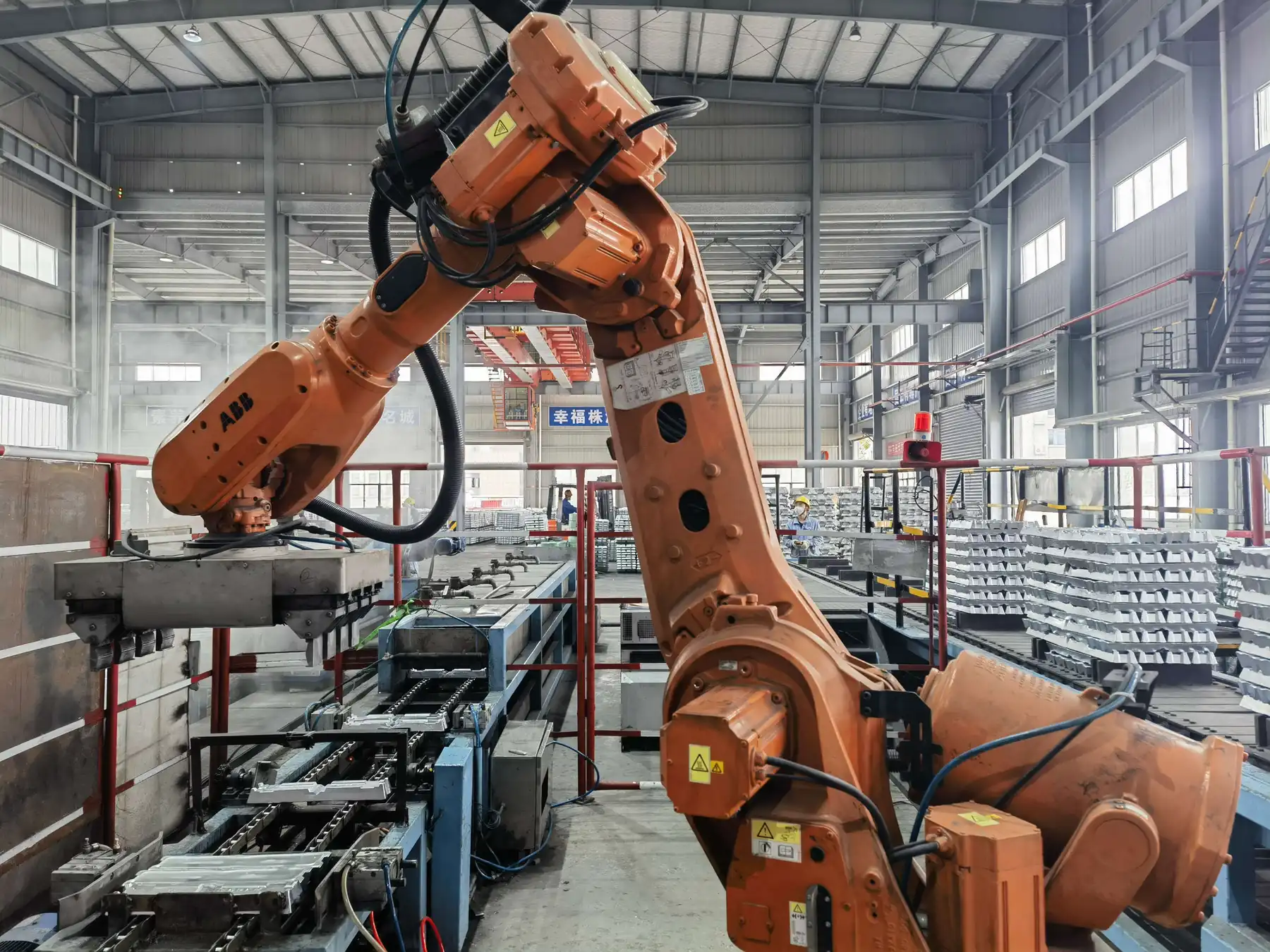
- A robot arm is built from connected links and joints.
- Each independently controlled joint contributes a degree of freedom.
- More degrees of freedom can allow a robot to reach more orientations and positions.
- Many general-purpose industrial arms have six controlled axes.
- Six-axis arms can position and orient an end effector in three-dimensional space.
- The tool attached to the working end of a robot arm is called an end effector.
- An end effector can be a gripper, welding torch, suction cup, screwdriver, camera, cutter, or specialized tool.
- Robot grippers can use fingers, vacuum, magnets, soft materials, or other mechanisms.
- Forward kinematics calculates where a robot’s tool will be given known joint positions.
- Inverse kinematics works backward from a desired tool position to possible joint configurations.
- A single target position may have several valid joint solutions.
- Some positions are unreachable because of joint limits or the physical geometry of the robot.
- The region a robot can physically reach is called its workspace.
- Repeatability describes how consistently a robot can return to the same commanded position.
- Accuracy and repeatability are related but are not exactly the same measurement.
How robots sense the world
- Cameras can give robots visual information about objects, people, and environments.
- Machine vision can help a robot identify parts, inspect products, read codes, and guide movement.
- Depth cameras estimate the distance from the sensor to visible surfaces.
- Lidar measures distance using pulses of laser light.
- Radar uses radio waves and can work in conditions where ordinary cameras struggle.
- Ultrasonic sensors estimate distance using sound waves above typical human hearing.
- Force and torque sensors measure pushes, pulls, and twisting forces.
- Tactile sensors can help robots detect contact and pressure.
- Encoders measure the position or movement of motors and joints.
- Inertial measurement units can measure acceleration and rotation.
- GPS can help outdoor robots estimate their global position when satellite signals are available.
- Sensor fusion combines information from multiple sensors to improve a robot’s estimate of the world.
- A robot may map an unknown environment while simultaneously estimating its own position.
- This challenge is commonly called simultaneous localization and mapping, or SLAM.
- NIST develops test methods to measure robot perception, mobility, manipulation, and safety performance.
Robots that move
- Wheeled robots are efficient on relatively smooth terrain.
- Tracked robots can cross loose or uneven ground that challenges ordinary wheels.
- Legged robots can step over obstacles rather than rolling around them.
- Two-legged robots face difficult balance and control problems.
- Four-legged robots can use animal-inspired gaits for stability and mobility.
- Some robots crawl like snakes to move through pipes, rubble, or confined spaces.
- Underwater robots can use thrusters, fins, or buoyancy control to move through water.
- Remotely operated vehicles, or ROVs, stay connected to an operator through a tether.
- Autonomous underwater vehicles, or AUVs, can execute missions without a continuous tether.
- Drones are flying robots when they combine aircraft hardware with robotic control systems.
- Some aerial robots can hover, while others need forward motion to stay aloft.
- Self-driving vehicles combine robotics, sensing, mapping, planning, and control.
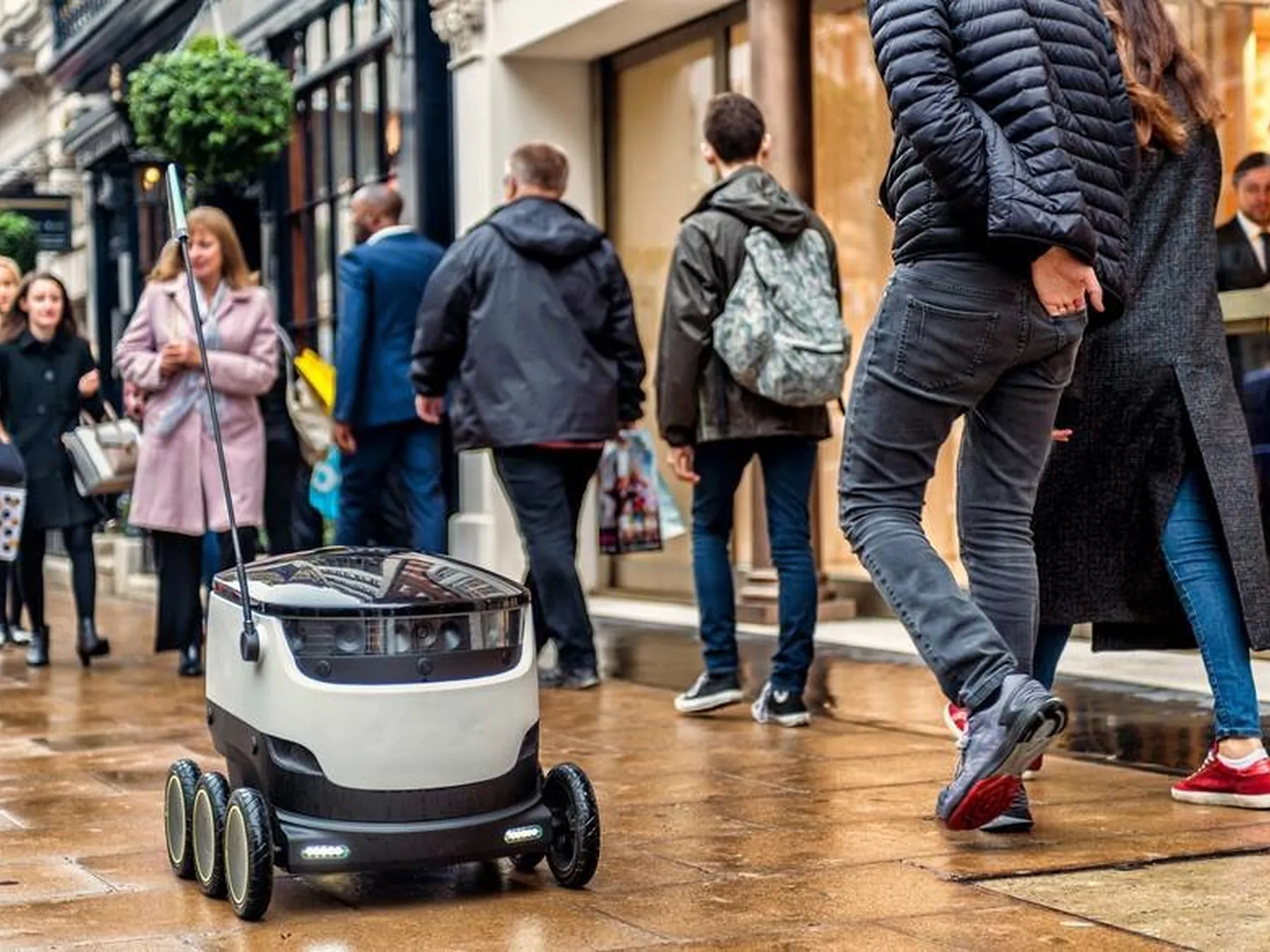
- Warehouse mobile robots can carry shelves, carts, bins, or pallets.
- Robot mobility is always a tradeoff involving speed, stability, energy, terrain, payload, and complexity.
- A robot designed for a factory floor may be nearly useless on stairs, mud, sand, or ice.
Robots in space
- Space agencies use robots to explore destinations before sending people there.
- Robots can survive missions where human life-support systems would be impractical.
- NASA’s Mars rovers are mobile robots operating millions of kilometers from Earth.
- Sojourner became the first rover to operate on Mars in 1997.
- Spirit and Opportunity landed on Mars in 2004.
- Curiosity has explored Gale Crater since 2012.
- Perseverance has explored Jezero Crater since 2021.
- Ingenuity was a small robotic helicopter that demonstrated powered flight on Mars.
- NASA’s space shuttle robotic arm, Canadarm, first flew in 1981.
- Canadarm2 on the International Space Station can move equipment and assist with spacecraft operations.
- Dextre is a two-armed robotic system on the space station used for precise maintenance tasks.
- Astrobee robots are free-flying cube-shaped robots that operate inside the International Space Station.
- Astrobee robots use electric fans to maneuver in the station’s microgravity environment.
- NASA says robots can reduce human risk while extending what astronauts and scientists can accomplish.
- NASA’s current robotics program supports planetary exploration, human spaceflight, and scientific missions.
Robots in factories, hospitals, and daily life
- Industrial robots can repeat precisely defined tasks thousands of times without fatigue.
- Robots are especially useful where tasks are dangerous, dirty, dull, repetitive, or physically demanding.
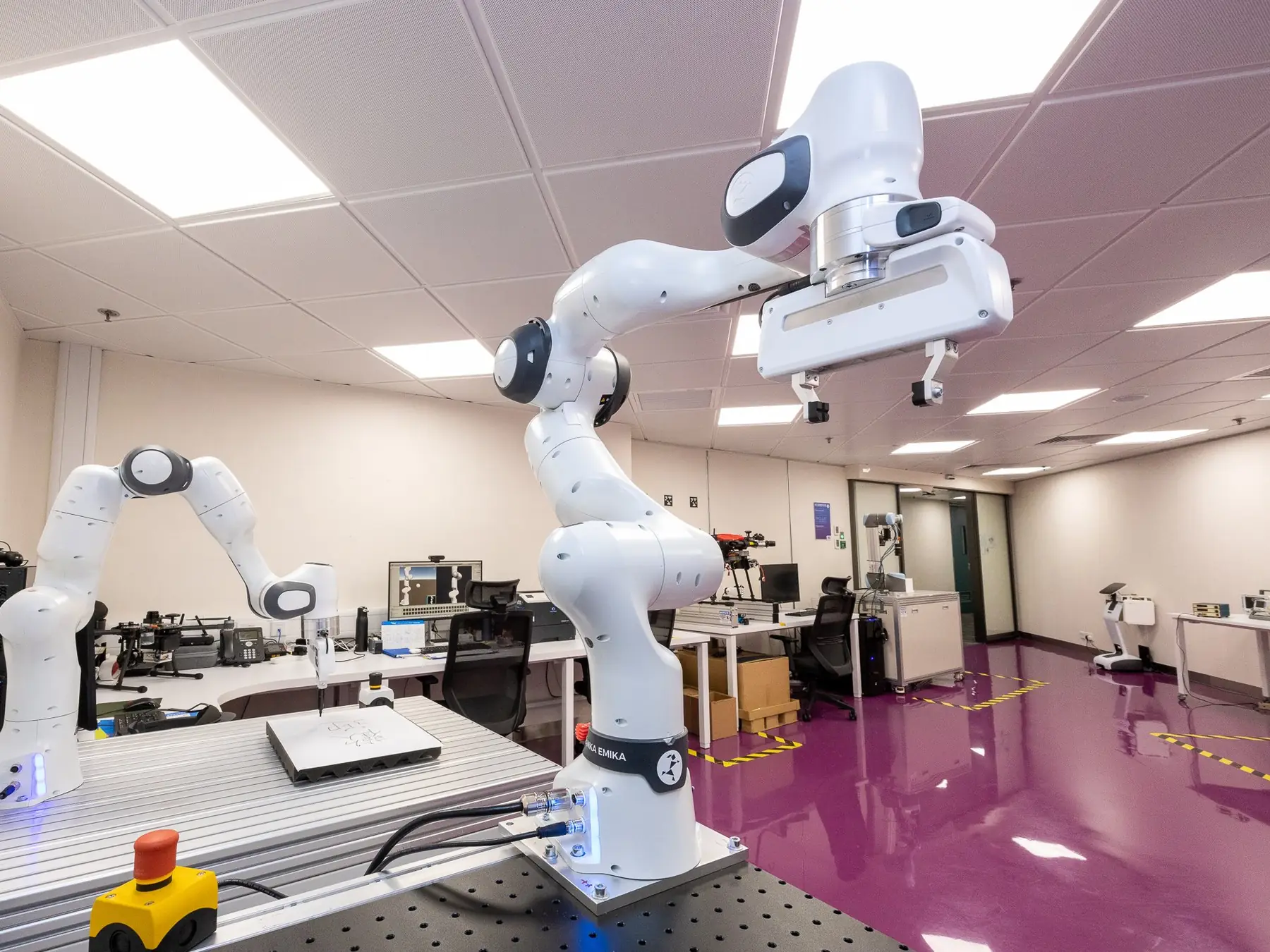
- Collaborative robots, often called cobots, are designed for closer interaction with people than traditional fenced industrial systems.
- A cobot is not automatically safe in every situation simply because it is marketed as collaborative.
- Safety depends on the robot, tool, task, speed, payload, workspace, controls, and risk assessment.
- Surgical robotic systems allow clinicians to control specialized instruments during certain procedures.
- Most surgical robots do not independently decide how to perform an operation.
- Rehabilitation robots can help patients practice repeated movements.
- Robotic prosthetics can use sensors and powered joints to restore or assist movement.
- Robot vacuum cleaners use sensors and navigation software to move through homes.
- Robotic lawn mowers automate another repetitive household task.
- Agricultural robots can assist with milking, weeding, spraying, harvesting, or crop monitoring.
- Inspection robots can enter pipes, tanks, power facilities, mines, and hazardous industrial spaces.
- Search-and-rescue robots can help responders inspect unstable or dangerous environments.
- NIST studies response-robot test methods so teams can compare capabilities under repeatable conditions.
Humanoid robots and robot intelligence
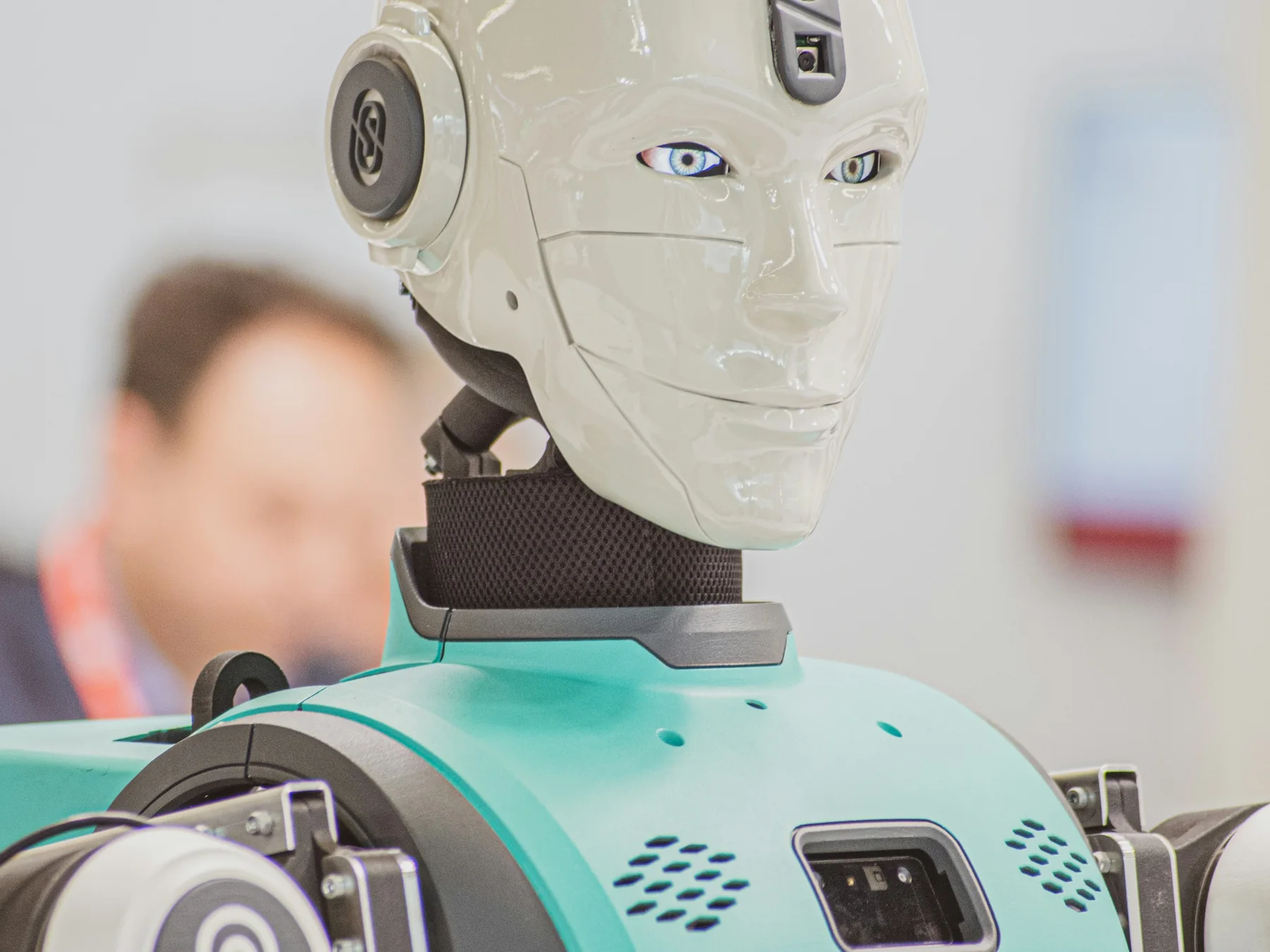
- A humanoid robot has a body layout inspired by the human form.
- Humanoid designs may have a torso, head, two arms, and two legs, but there is no single required shape.
- A human-like body can be useful in environments built for human hands, doors, stairs, tools, and furniture.
- Human-like locomotion is mechanically difficult because walking requires constant balance corrections.
- Robonaut is a NASA humanoid robot project designed around dexterous human-like manipulation.
- Some modern robots use machine learning to improve perception or decision making.
- Computer vision can let robots detect objects and estimate their positions.
- Language models can be connected to robotic systems, but language fluency does not guarantee reliable physical control.
- Robots must handle real-world physics, uncertainty, friction, breakable objects, people, and changing surroundings.
- A mistake in a software chatbot may be annoying, while the same planning error in a heavy robot can create a physical hazard.
- Robotic learning often requires simulations, demonstrations, real-world trials, or combinations of all three.
- Simulators can let robots practice many scenarios without damaging real hardware.
- Reality never matches a simulation perfectly, creating what roboticists call the sim-to-real gap.
- Human-robot interaction research studies how people understand, trust, control, and work alongside machines.
- NIST’s robotics research includes measurement science for safe and effective human-robot collaboration.
Ten surprising robot facts
- The first mass-produced industrial robot started factory work more than six decades ago.
- A robot can be highly autonomous without looking remotely human.
- A human-shaped robot can be far less capable at a specific job than a simple machine designed only for that task.
- Spacecraft that autonomously sense and control their behavior can be considered robotic systems even when they have no arms or wheels.
- Some robots move by rolling, walking, flying, swimming, climbing, crawling, hopping, or floating.
- Robot hands remain difficult to engineer because human hands combine extraordinary sensing, dexterity, compliance, and control.
- Soft robots replace some rigid links with flexible materials that can bend around objects.
- Swarm robotics studies how many relatively simple robots can coordinate as a group.
- Robots are increasingly measured not only by speed and precision, but also by adaptability, safety, reliability, and ease of working with people.
- The most successful robot is often the one people barely notice because it quietly performs one useful job exceptionally well.
Quick robot FAQ
What is a robot?
A robot is a physical machine that uses programmed control, and usually sensors and actuators, to perform tasks. Robots can be remotely controlled, autonomous, or somewhere in between.
Who invented the first industrial robot?
George Devol developed the programmable manipulator concept behind Unimate and worked with Joseph Engelberger to commercialize it. A Unimate began factory work at General Motors in 1961.
Do all robots use AI?
No. Many useful robots rely on conventional programming and control systems. AI can add capabilities such as perception, learning, prediction, or flexible decision making.
Are robots safer than people?
Not automatically. Robots can remove people from dangerous tasks, but the machines themselves require careful design, guarding, sensing, testing, and risk management.
Why does NASA use robots?
Robots can travel to dangerous or distant environments without human life support, scout future destinations, perform science, and help astronauts with operations in space.

Ellie is the owner and sole author of Fun Facts, combining her mechanical engineering background with years of research-driven writing to deliver facts you can trust. Every article is thoroughly fact-checked and routinely updated as new science and sources emerge to keep information accurate and current. Her mission is to make learning delightful while upholding high standards of reliability and transparency.