
Jupiter is so enormous that more than 1,300 Earth-sized worlds could fit inside its volume, yet its day lasts less than 10 hours. It has faint rings, dozens of known moons, crushing pressures, gigantic auroras, and a storm bigger than Earth. These 145 Jupiter facts explore the solar system’s largest planet from its striped clouds to its icy moons.
Jupiter basics
- Jupiter is the fifth planet from the Sun.
- It is the largest planet in our solar system.
- Jupiter is a gas giant.
- Hydrogen and helium make up most of Jupiter’s bulk composition.
- Jupiter’s equatorial diameter is about 142,984 kilometers, or 88,846 miles.
- Jupiter is roughly 11 times wider than Earth.
- Its mass is about 318 times Earth’s mass.
- Jupiter contains more than twice as much mass as all the other planets combined.
- More than 1,300 Earths could fit inside Jupiter by volume.
- Jupiter is named after the king of the gods in Roman mythology.
- People have observed Jupiter with the naked eye since ancient times.
- It is usually one of the brightest planet-like objects in Earth’s night sky.
- Jupiter does not have a solid surface like Earth.
- A spacecraft descending into Jupiter would encounter increasingly dense gas and fluid rather than a rocky ground surface.
- NASA summarizes current measurements on its official Jupiter facts page.
A very short day and a very long year
- Jupiter rotates once in only about 9.9 hours.
- That gives Jupiter the shortest day of any planet in the solar system.
- Jupiter’s rapid rotation makes the planet bulge noticeably around its equator.
- The planet is flatter at its poles than a slowly rotating sphere would be.
- Jupiter takes about 11.86 Earth years to orbit the Sun.
- One Jovian year lasts about 4,333 Earth days.
- Jupiter orbits the Sun at an average distance of about 778 million kilometers, or 484 million miles.
- Sunlight takes roughly 43 minutes to reach Jupiter at its average distance.
- Jupiter’s orbit is slightly elliptical.
- Its axial tilt is only about 3 degrees.
- That small tilt means Jupiter does not experience Earth-like seasonal changes.
- Because Jupiter is mostly fluid, different latitudes rotate at slightly different speeds.
- This phenomenon is called differential rotation.
- Radio emissions tied to Jupiter’s magnetic field provide a precise way to define its internal rotation period.
- A person could experience more than two Jupiter sunrises during one Earth day if standing on an imaginary cloud-level platform.
Jupiter’s striped atmosphere
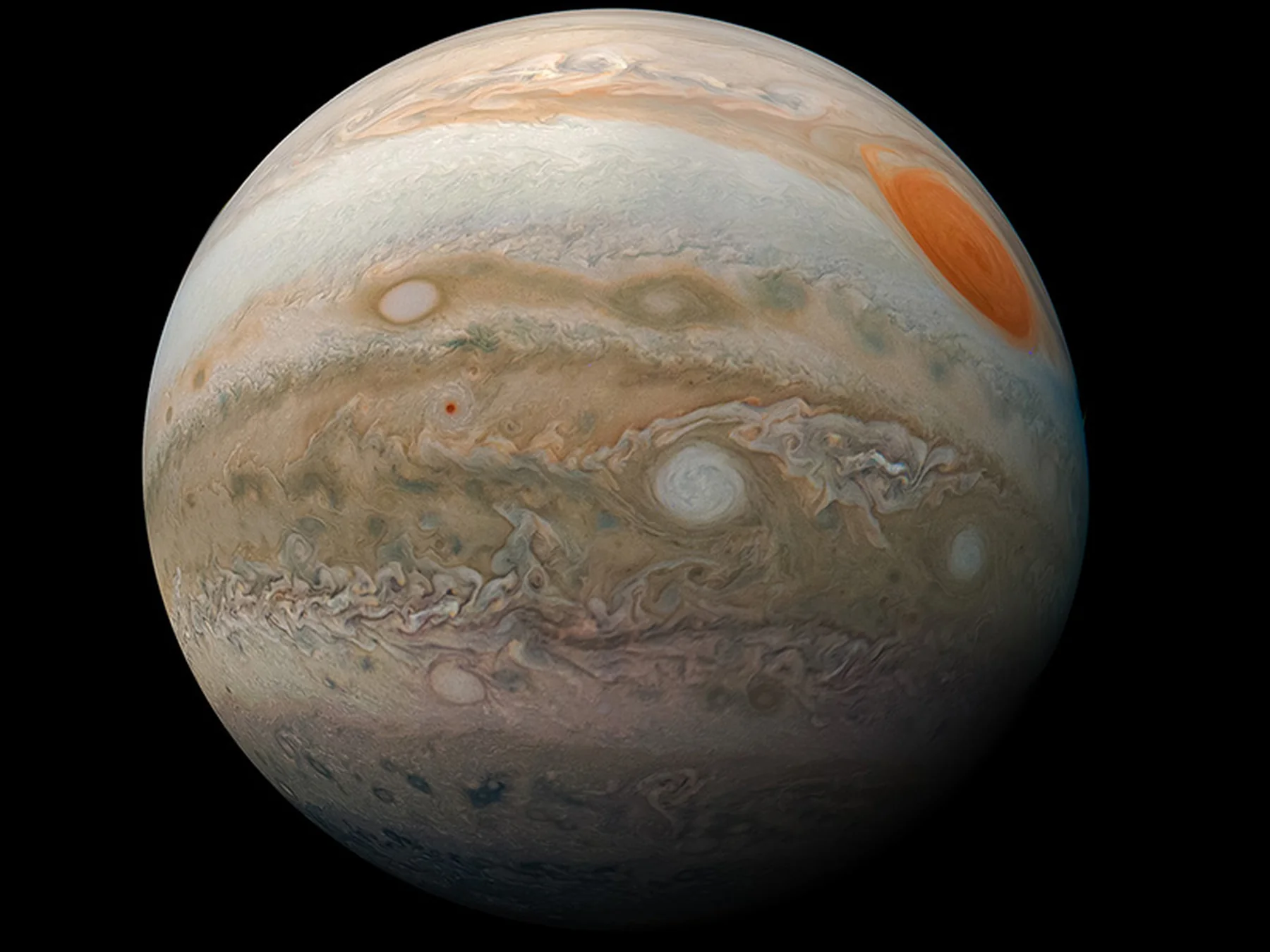
- Jupiter’s visible atmosphere is organized into alternating light zones and darker belts.
- Powerful east-west jet streams help maintain the striped appearance.
- Jupiter’s upper clouds contain compounds including ammonia.
- Deeper cloud layers are thought to involve water and other compounds.
- The exact chemistry producing Jupiter’s brown, orange, white, and red colors is still studied.
- Jupiter’s atmosphere contains enormous storms, vortices, waves, and turbulent structures.
- Cloud-top winds can reach hundreds of kilometers per hour.
- Some jet streams blow eastward while neighboring bands move westward.
- Bright white spots can be storms with high, reflective clouds.
- Brown or darker regions can expose deeper atmospheric layers.
- Lightning occurs in Jupiter’s atmosphere.
- NASA’s Juno spacecraft has detected lightning in regions unlike the main lightning zones familiar on Earth.
- Water plays an important role in at least some Jovian thunderstorms.
- Jupiter emits more heat than it receives from the Sun.
- Much of that extra heat is leftover energy released as the giant planet slowly contracts and cools.
The Great Red Spot
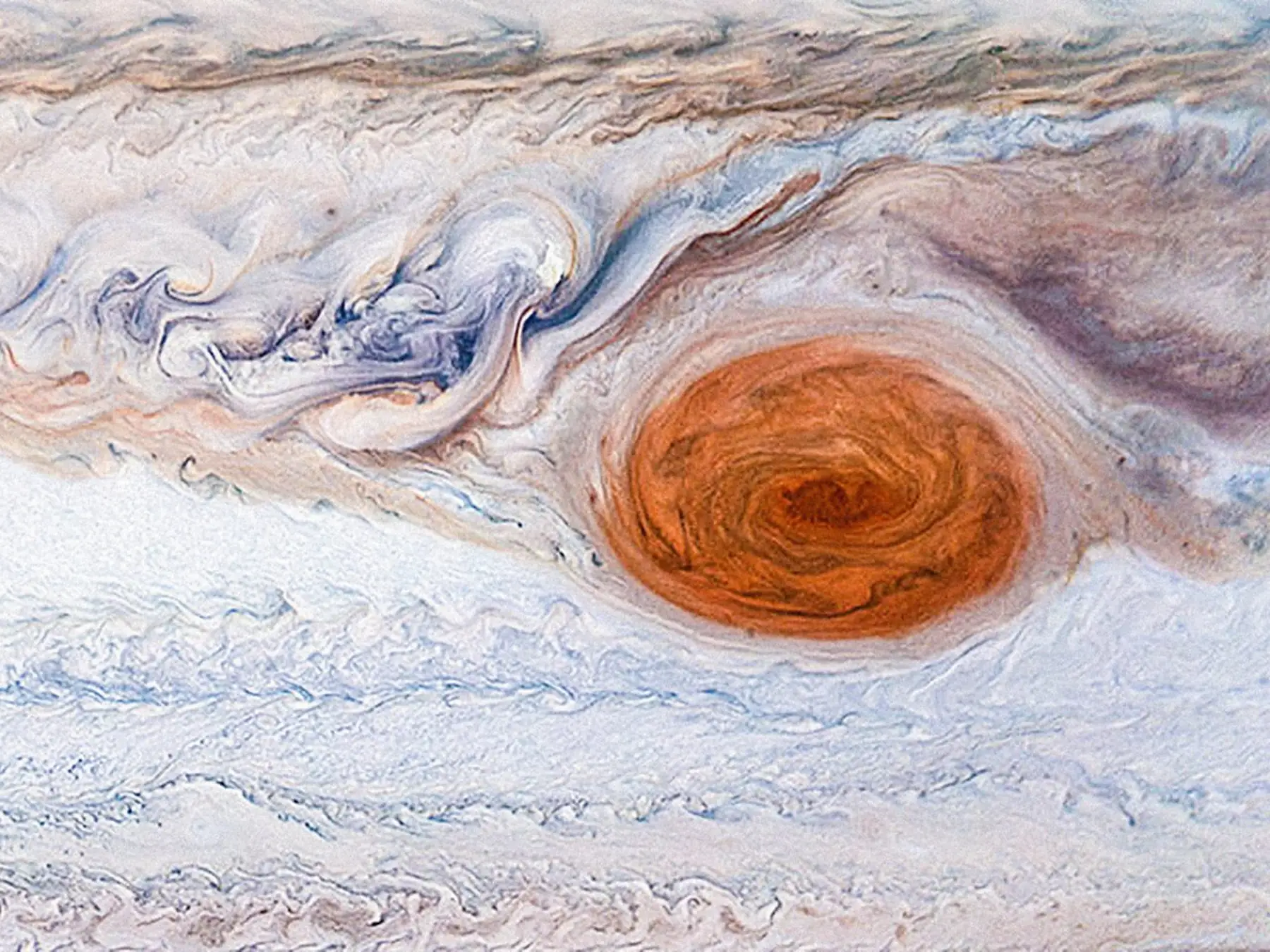
- The Great Red Spot is Jupiter’s most famous storm.
- It is a gigantic anticyclonic vortex in Jupiter’s southern hemisphere.
- The storm is wider than Earth.
- The Great Red Spot has persisted for at least centuries.
- Astronomers observed large Jovian spots in the 1600s, although historians debate whether every early observation was the same continuous storm.
- The modern Great Red Spot has been followed continuously since the 19th century.
- The storm rotates counterclockwise.
- Its winds can exceed 400 kilometers per hour, or roughly 250 miles per hour.
- The Great Red Spot has been shrinking over long-term observations.
- In the 19th century, it was measured much wider than it is today.
- Its color and intensity vary over time.
- Scientists still investigate exactly what makes the storm red.
- Juno spacecraft measurements reveal that the Great Red Spot extends far below the visible cloud tops.
- The Great Red Spot is not Jupiter’s only long-lived vortex.
- White ovals and other storms can merge, change color, or persist for years.
What is inside Jupiter?
- Pressure rises enormously as you travel deeper into Jupiter.
- Hydrogen changes behavior under the planet’s intense pressure.
- Deep inside Jupiter, hydrogen is expected to become electrically conducting metallic hydrogen.
- Metallic hydrogen is thought to play a major role in creating Jupiter’s magnetic field.
- Jupiter probably contains a concentration of heavier elements near its center.
- Juno data suggest the central region may be diffuse rather than a neat, sharply bounded solid core.
- Temperatures deep inside Jupiter reach many thousands of degrees.
- Pressure near the center is millions of times Earth’s atmospheric pressure at sea level.
- Ordinary definitions such as “gas” and “liquid” become less simple under these extreme conditions.
- There is no solid cloud deck where a human could stand.
- A probe descending deep enough would eventually be crushed, heated, or destroyed by the environment.
- The Galileo atmospheric probe survived for less than an hour after entering Jupiter in 1995.
- It transmitted direct measurements of temperature, pressure, winds, and atmospheric chemistry.
- Jupiter’s immense gravity helped compress the planet into a very dense interior for a world made mostly of light elements.
- Studying Jupiter’s interior helps scientists understand how giant planets form elsewhere in the galaxy.
Jupiter’s powerful magnetic field
- Jupiter has the strongest planetary magnetic field in the solar system.
- Its magnetic field is far stronger than Earth’s at comparable cloud-level measurements.
- Jupiter’s magnetosphere is enormous.
- On the Sun-facing side, the solar wind compresses the magnetosphere.
- On the night side, Jupiter’s magnetic tail stretches far into space.
- Charged particles trapped around Jupiter create intense radiation belts.
- Those radiation belts are dangerous to spacecraft electronics.
- NASA’s Juno spacecraft follows a highly elongated polar orbit that reduces time spent in the harshest radiation zones.
- Jupiter produces powerful radio emissions detectable from Earth.
- Its volcanic moon Io strongly influences some of those radio emissions.
- Jupiter has spectacular auroras near its poles.
- Jovian auroras are powered by both solar particles and particles from the planet’s own moon system.
- Io supplies large quantities of sulfur and oxygen ions to Jupiter’s magnetic environment.
- Jupiter’s auroras can be much more energetic than auroras on Earth.
- Juno carries instruments specifically designed to investigate the planet’s magnetic and auroral environments.
Jupiter has rings too
- Jupiter has a ring system, although its rings are much fainter than Saturn’s.
- The rings were discovered by NASA’s Voyager 1 spacecraft in 1979.
- Jupiter’s rings are made largely of tiny dark dust particles.
- Impacts on small inner moons help supply dust to the rings.
- The main ring is relatively narrow.
- A faint halo extends inward toward Jupiter.
- Gossamer rings extend outward and are linked with small moons.
- Metis and Adrastea orbit near the main ring.
- Amalthea and Thebe contribute material to separate gossamer ring components.
- Because the particles are small and dark, Jupiter’s rings are difficult to see from Earth.
- Spacecraft viewing geometry can make the rings much easier to detect.
- Jupiter is one of four giant planets in our solar system with rings.
- Saturn, Uranus, and Neptune also possess ring systems.
- Planetary rings can evolve as particles collide, orbit, and interact with moons.
- The rings show that even Jupiter’s smallest moons can shape the environment around the giant planet.
The Galilean moons
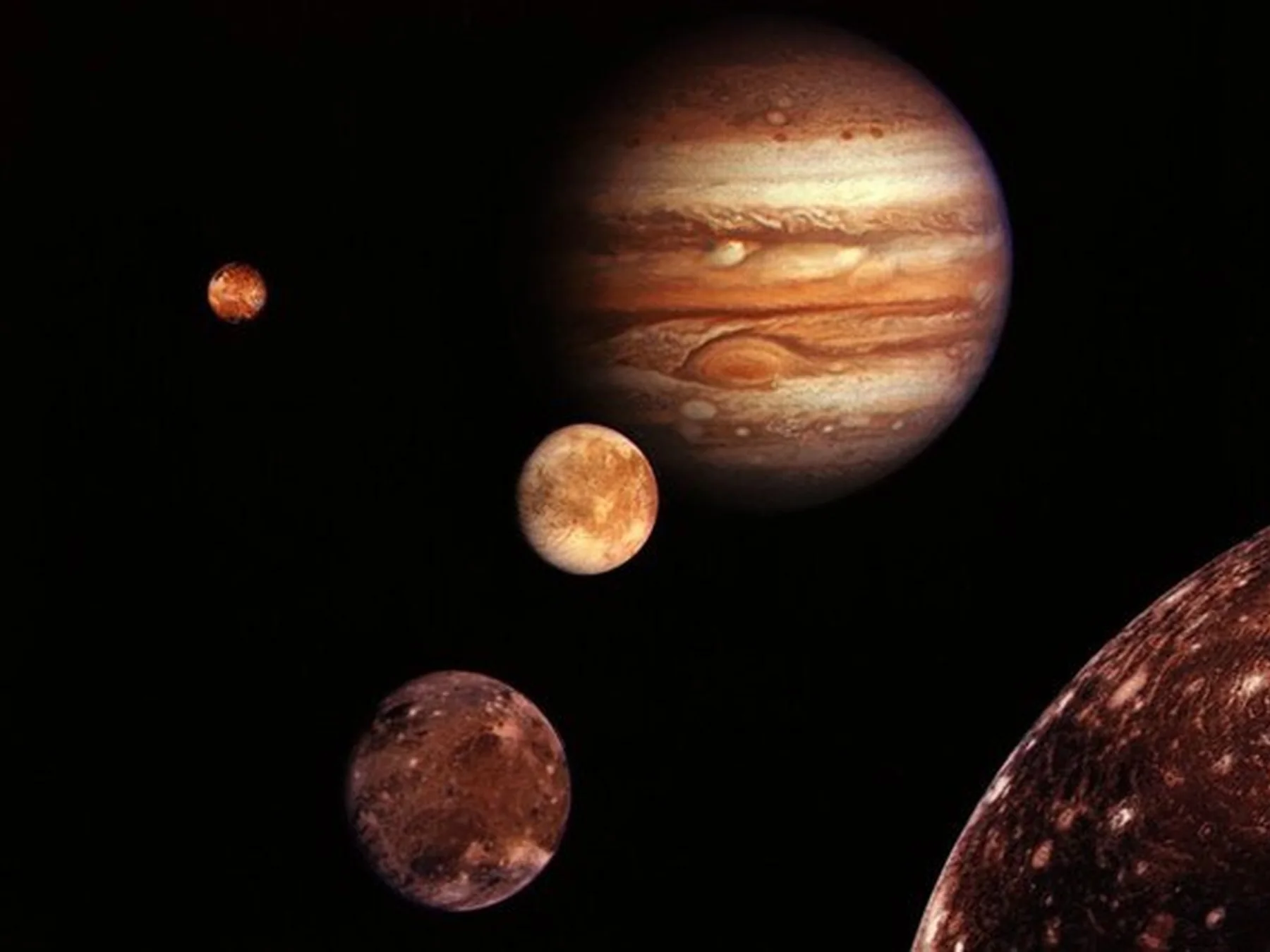
- Galileo Galilei observed four large moons orbiting Jupiter in January 1610.
- Those moons are Io, Europa, Ganymede, and Callisto.
- They are collectively called the Galilean moons.
- Their discovery provided powerful evidence that not everything in the heavens orbits Earth.
- Io is the most volcanically active world known in the solar system.
- Jupiter’s gravity and orbital interactions with neighboring moons flex Io’s interior and generate tremendous heat.
- Europa has an icy surface covering a global salty ocean that scientists think exists beneath the crust.
- Europa’s hidden ocean makes it a major target in the search for potentially habitable environments beyond Earth.
- Ganymede is the largest moon in the solar system.
- Ganymede is wider than the planet Mercury.
- Ganymede is the only moon known to generate its own intrinsic magnetic field.
- Callisto is heavily cratered and preserves a very ancient surface.
- Callisto also appears to contain a deep subsurface ocean.
- The four Galilean moons can be seen with a small telescope or good binocular setup under suitable conditions.
- Watching them change positions from night to night recreates one of astronomy’s most famous observations.
Exploring Jupiter
- Pioneer 10 became the first spacecraft to fly past Jupiter in 1973.
- Pioneer 11 followed in 1974.
- Voyager 1 and Voyager 2 both visited Jupiter in 1979.
- The Voyager missions revealed active volcanoes on Io.
- NASA’s Galileo spacecraft entered orbit around Jupiter in 1995.
- Galileo spent nearly eight years studying Jupiter and its moons.
- The Galileo mission deliberately ended by entering Jupiter’s atmosphere in 2003.
- That disposal strategy avoided an accidental future impact on potentially habitable Europa.
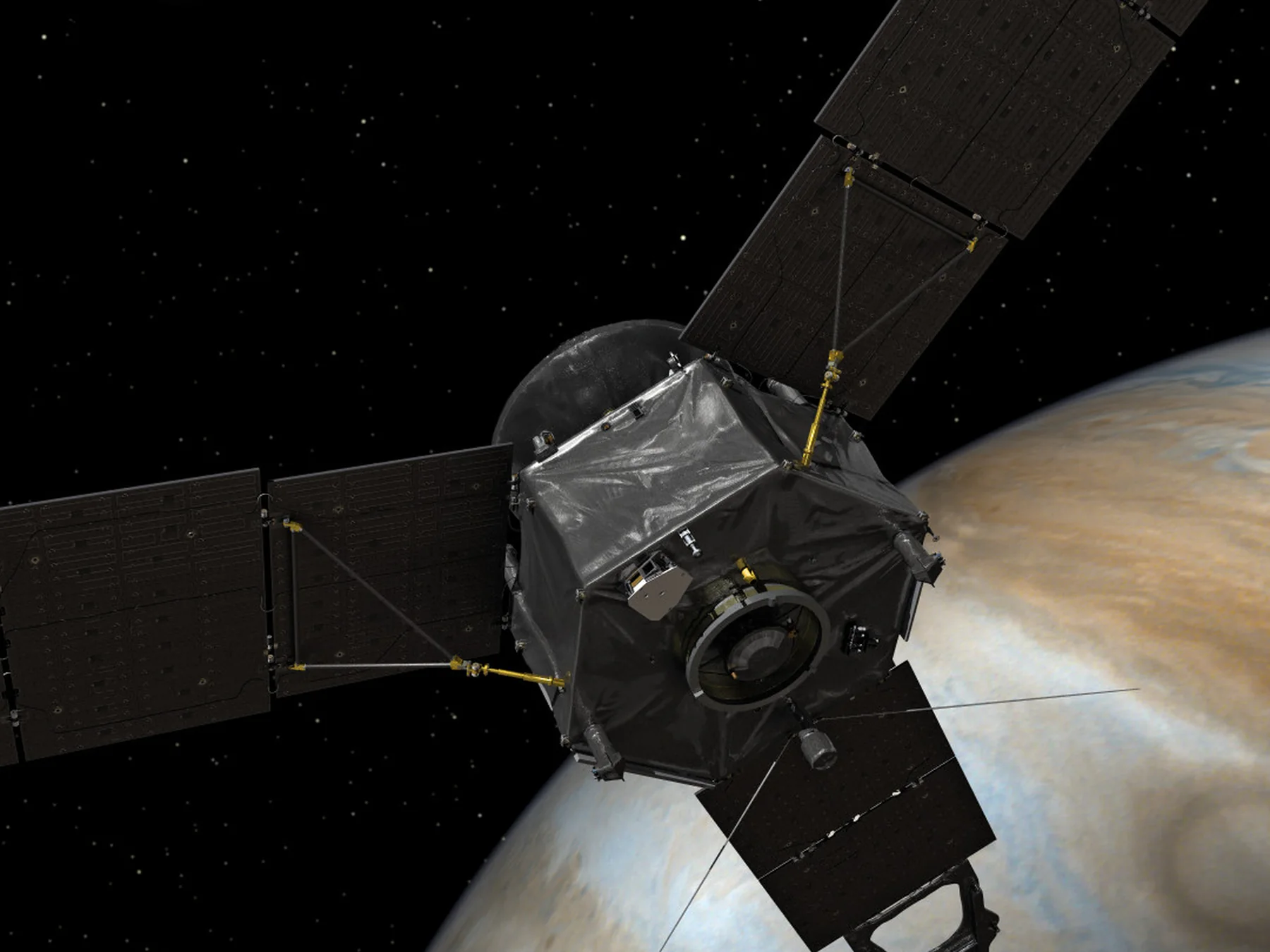
- NASA’s Juno spacecraft arrived at Jupiter in July 2016.
- Juno studies Jupiter’s gravity, magnetic field, atmosphere, auroras, and interior structure.
- Juno is the first spacecraft to orbit Jupiter over its poles.
- Juno images revealed giant cyclone patterns around both poles.
- NASA’s Europa Clipper launched in 2024 to study Europa and its habitability when it reaches the Jupiter system.
- Jupiter’s immense gravity has also been used for gravity assists that change spacecraft speed and direction.
- Studying Jupiter helps scientists interpret the many giant exoplanets discovered around other stars.
Ten surprising Jupiter facts
- A day on Jupiter ends before 10 Earth hours have passed.
- Jupiter is so massive that the center of mass of the Sun-Jupiter system can sometimes lie just outside the Sun’s surface.
- Jupiter’s Great Red Spot is a storm larger than our entire planet.
- The largest moon in the solar system belongs to Jupiter, not to Saturn.
- Jupiter has rings, but they are too faint to compete visually with Saturn’s.
- There is no solid surface hidden just beneath Jupiter’s colorful clouds.
- Deep inside Jupiter, ordinary hydrogen is squeezed into a strange metallic state.
- Jupiter’s gravity protects and endangers the inner solar system in different ways by redirecting comets and asteroids.
- The exact number of known Jovian moons changes as astronomers discover, confirm, and classify small distant satellites.
- For a very different outer-solar-system world, explore our 145 facts about Pluto.
Quick Jupiter FAQ
How big is Jupiter?
Jupiter is about 11 times wider than Earth and roughly 318 times as massive. More than 1,300 Earth-sized planets could fit inside its volume.
Can you stand on Jupiter?
No. Jupiter has no solid surface like Earth. Its gases become progressively denser and hotter with depth until they behave as compressed fluids.
How long is a day on Jupiter?
About 9.9 hours, making Jupiter the fastest-rotating planet in the solar system.
What is the Great Red Spot?
It is a gigantic long-lived storm in Jupiter’s southern hemisphere. The vortex is wider than Earth and has been observed for centuries.
What are Jupiter’s four biggest famous moons?
Io, Europa, Ganymede, and Callisto are the Galilean moons discovered by Galileo in 1610.

Ellie is the owner and sole author of Fun Facts, combining her mechanical engineering background with years of research-driven writing to deliver facts you can trust. Every article is thoroughly fact-checked and routinely updated as new science and sources emerge to keep information accurate and current. Her mission is to make learning delightful while upholding high standards of reliability and transparency.