
I love the autumn equinox because it sounds like a grand cosmic event, yet most of us experience it by wondering why dinner suddenly happens after sunset. The science is much better than the name suggests, and a few familiar “equal day” claims are not quite true.
What the autumn equinox actually is
- The autumn equinox is the instant when the Sun crosses Earth’s celestial equator heading southward.
- In the Northern Hemisphere, that September event marks the start of astronomical fall.
- At the same instant, the Southern Hemisphere begins astronomical spring.
- An equinox happens twice each year, once in March and once in September.
- The word “equinox” comes from Latin words meaning “equal” and “night.”
- The September equinox usually occurs on September 22 or September 23.
- The exact local calendar date can vary because an equinox is one worldwide instant.
- People in different time zones can experience that instant on different local dates.
- The equinox is not a full day-long event in astronomical terms.
- It is a precise moment defined by the geometry of Earth and the Sun.
- At the equinox, Earth’s axis is tilted sideways relative to the incoming sunlight.
- Neither hemisphere is tilted strongly toward the Sun at that moment.
- Earth’s axial tilt is about 23.4 degrees.
- That tilt is the main reason Earth has seasons.
- Earth’s changing distance from the Sun is not what causes fall.
- Earth is actually closer to the Sun during Northern Hemisphere winter than during summer.
- Meteorological fall starts September 1, several weeks before the astronomical equinox.
- Weather scientists often use three complete months for each meteorological season.
- Astronomical seasons are based on equinoxes and solstices instead of calendar months.
- So there are two perfectly legitimate answers to “When does fall begin?”
The truth about “equal day and night”
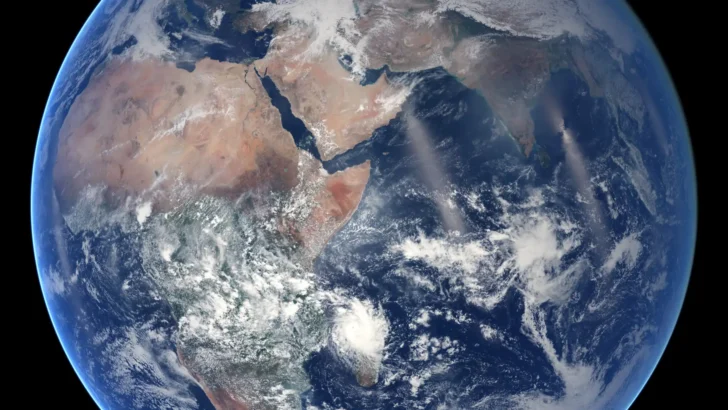
This is my favorite equinox technicality because the name practically dares us to get it wrong. Day and night are close to equal, but the stopwatch refuses to cooperate perfectly.
- Day and night are not exactly 12 hours long everywhere on the equinox.
- Most places receive slightly more than 12 hours of daylight on the equinox.
- One reason is that sunrise is timed from the Sun’s upper edge, not its center.
- Sunset is also timed using the Sun’s upper edge.
- The Sun has an apparent disk rather than appearing as a mathematical point.
- Earth’s atmosphere bends sunlight near the horizon through atmospheric refraction.
- Refraction lets us see the Sun shortly before it geometrically rises.
- Refraction also keeps the Sun visible shortly after it geometrically sets.
- Those effects add several minutes to the measured daylight period.
- The date with nearly equal daylight and darkness is sometimes called the equilux.
- The equilux does not necessarily occur on the equinox itself.
- Its date depends partly on latitude.
- Local terrain can also change the visible time of sunrise and sunset.
- A mountain can hide the Sun even while official sunrise has technically occurred.
- An unobstructed horizon gives a different visual experience than a city skyline.
- Near the equator, day length changes relatively little throughout the year.
- At higher latitudes, seasonal changes in day length become much more dramatic.
- The equinox is a transition point in that changing daylight pattern.
- After the September equinox, Northern Hemisphere nights continue getting longer.
- They keep lengthening until the December solstice reverses the trend.
Sunrise, sunset & the sky on equinox day
- Around an equinox, the Sun rises approximately due east for observers worldwide.
- It also sets approximately due west.
- The exact observed direction can still be affected by the local horizon.
- The Sun’s path across the sky changes gradually from one day to the next.
- There is no sudden visual jump in the Sun’s route on equinox morning.
- The subsolar point sits on the equator at the instant of equinox.
- The subsolar point is where the Sun appears directly overhead at local noon.
- After the September equinox, that overhead-Sun point moves into the Southern Hemisphere.
- It keeps moving south until the December solstice.
- The Sun is never directly overhead from locations outside the tropics.
- Even on the equinox, a person in Minnesota does not see the noon Sun at the zenith.
- At the equator, the noon Sun can pass very high in the sky around equinox time.
- The September equinox happens during every phase of the Moon over different years.
- The Moon does not cause the equinox.
- The Harvest Moon is the full moon closest to the September equinox.
- That full moon can fall before or after the equinox.
- Harvest Moon timing once provided useful evening light during busy harvest periods.
- Near that time, successive moonrises can occur unusually close together in clock time.
- The equinox does not make the Moon look larger.
- Any especially huge-looking moon near the horizon is mostly a perception effect.
Why the date moves around
If the equinox feels like it refuses to stay on one square of the calendar, that is because our calendar and Earth’s orbit are not neat roommates. Leap years are basically the chore chart keeping them from drifting too far apart.
- Earth does not orbit the Sun in exactly 365 days.
- A tropical year is roughly 365.2422 days long.
- That extra fraction is why leap days are needed.
- Most leap years add February 29 every four years.
- Century years are not leap years unless divisible by 400.
- Those Gregorian calendar rules keep seasons from slowly wandering through the calendar.
- The time of the September equinox therefore shifts from year to year.
- Leap years push the calendar relationship back toward alignment.
- The equinox is calculated from Earth’s position in its orbit, not chosen by law.
- No committee decides when the astronomical equinox happens.
- The September equinox can occur at any hour of the day.
- It may happen while it is nighttime where you live.
- It can also happen while another continent is already on the next calendar date.
- The equinox instant is commonly reported in Coordinated Universal Time for consistency.
- Local time zones convert that same instant into local clock time.
- Earth’s orbit is slightly elliptical rather than perfectly circular.
- Earth moves at different orbital speeds at different points in the year.
- That means the four astronomical seasons are not exactly equal in length.
- Northern Hemisphere fall is shorter than Northern Hemisphere summer.
- Orbital mechanics, not the calendar, determine those season lengths.
What changes in nature after the equinox
- The equinox does not instantly make leaves change color.
- Many plants respond strongly to shortening day length, a cue called photoperiod.
- Temperature and moisture also influence the timing and quality of fall foliage.
- Chlorophyll production declines in many deciduous leaves as the growing season ends.
- Yellow and orange carotenoid pigments then become easier to see.
- Some trees also produce red anthocyanin pigments during fall.
- A hard freeze can shorten a colorful foliage display.
- Drought can cause leaves to brown or drop earlier than expected.
- Animals also use changing daylight as a seasonal cue.
- Many migratory birds begin or continue southbound journeys during early fall.
- Monarch butterflies migrate south across North America in late summer and fall.
- Deer breeding behavior increases later in fall across much of North America.
- Some mammals intensify feeding as winter approaches.
- Squirrels cache nuts and seeds during the fall season.
- Many insects seek protected overwintering sites as temperatures drop.
- The ocean and large lakes release summer heat slowly.
- That stored heat can make coastal fall weather milder than inland weather.
- Seasonal temperature changes often lag behind changes in sunlight.
- This lag is one reason the equinox is not usually the coldest point of fall.
- In fact, many places remain comfortably warm for weeks after the September equinox.
Equinox traditions, calendars & culture
Humans have been paying attention to seasonal turning points for a very long time. The details vary by place and tradition, which is much more interesting than pretending every culture celebrated the same way.
- Japan observes Autumnal Equinox Day as a national public holiday.
- The Japanese holiday is connected with honoring ancestors and appreciating seasonal change.
- Its official date is determined around the astronomical September equinox.
- Modern Pagan traditions may observe the fall equinox as Mabon.
- Mabon is a modern name and should not be treated as a universal ancient Celtic holiday.
- Many contemporary equinox celebrations focus on harvest, balance, or seasonal transition.
- Harvest festivals exist in cultures around the world, but not all are tied to the equinox.
- Oktoberfest usually begins before the autumn equinox despite its October-themed name.
- The Jewish High Holidays often occur during the Northern Hemisphere fall season.
- Their dates follow the Hebrew calendar rather than the September equinox.
- The Mid-Autumn Festival follows a lunisolar calendar and is not set by the equinox.
- Its date generally falls in September or October.
- Thanksgiving in the United States happens well after the September equinox.
- Many schools use the equinox as an easy entry point for teaching Earth science.
- Planetariums often highlight equinoxes because they demonstrate Earth’s axial tilt clearly.
- Some people visit ancient monuments around equinox time to watch sunrise or sunset.
- Not every famous ancient monument was built specifically for equinox alignment.
- Stonehenge is especially famous for solstice alignments rather than a simple equinox marker.
- Seasonal architecture and calendars often reflect local farming needs and solar observations.
- The equinox remains useful today as a precise astronomical marker even without a harvest calendar.
Equinox myths I would happily retire
- You can balance an egg on its end any day of the year with enough patience.
- The equinox does not create a special egg-balancing gravitational effect.
- You can also try balancing a broom on other days, despite recurring social media claims.
- Gravity does not suddenly weaken, strengthen, or become perfectly balanced at equinox time.
- The Sun does not pause in the sky during an equinox.
- Earth does not stop tilting on the equinox.
- The axis keeps pointing roughly toward the same direction in space as Earth orbits.
- The equinox does not guarantee mild weather.
- Heat waves, frost, thunderstorms, hurricanes, and even snow can occur during astronomical fall.
- The equinox does not make every place on Earth exactly 12 hours bright and 12 hours dark.
- The poles have especially unusual lighting around equinox time.
- Near the North Pole, the September equinox marks the transition toward months of darkness.
- Near the South Pole, it marks the transition toward months of daylight.
- Polar sunrise and sunset are gradual because atmospheric refraction and the Sun’s disk matter.
- The equinox does not happen at noon everywhere.
- It is one global instant, so local clock times differ dramatically.
- Fall does not begin because Earth suddenly becomes farther from the Sun.
- Earth’s closest approach to the Sun comes around early January.
- Earth’s farthest point from the Sun comes around early July.
- Seasonal temperature differences are driven primarily by sunlight angle and day length.
- The equinox does not instantly shorten the day by an hour.
- The abrupt one-hour clock change comes from Daylight Saving Time rules where they are used.
- Day length itself changes smoothly from one day to the next.
- The equinox is less a weather event than a geometry event, which is somehow nerdier and more impressive.
- And yes, I still use it as permission to bring out the sweaters.
Quick FAQ
Q: When is the autumn equinox?
A: In the Northern Hemisphere, it usually occurs on September 22 or 23, although the exact date and local time vary by year and time zone.
Q: Does the equinox really have exactly 12 hours of day and night?
A: Not quite. Atmospheric refraction and the way sunrise and sunset are defined usually make daylight a little longer than 12 hours.
Q: Why does fall begin at the equinox?
A: Astronomical seasons use Earth’s position in its orbit. The September equinox marks the point when the Sun crosses the celestial equator southward.
Q: Can you really balance an egg only on the equinox?
A: No. Egg balancing works on other days too and has nothing to do with special equinox gravity.
Q: Is the autumn equinox the same date everywhere?
A: It is the same instant worldwide, but time zones mean the local calendar date can differ from place to place.

Ellie is the owner and sole author of Fun Facts, combining her mechanical engineering background with years of research-driven writing to deliver facts you can trust. Every article is thoroughly fact-checked and routinely updated as new science and sources emerge to keep information accurate and current. Her mission is to make learning delightful while upholding high standards of reliability and transparency.