
Maple syrup is tree sap after a truly unreasonable amount of water gets boiled away. A maple spends months storing sugar, a short stretch of freezing nights and warmer days gets the sap moving, and humans collect gallons of nearly clear liquid to make one bottle of amber syrup.
Maple syrup starts as watery tree sap
- Maple syrup is made from sap collected from maple trees.
- Sugar maple is the most important commercial species.
- Its scientific name is Acer saccharum.
- Red maples can also be tapped.
- Black maples can also produce syrup.
- Other maple species yield usable sap too.
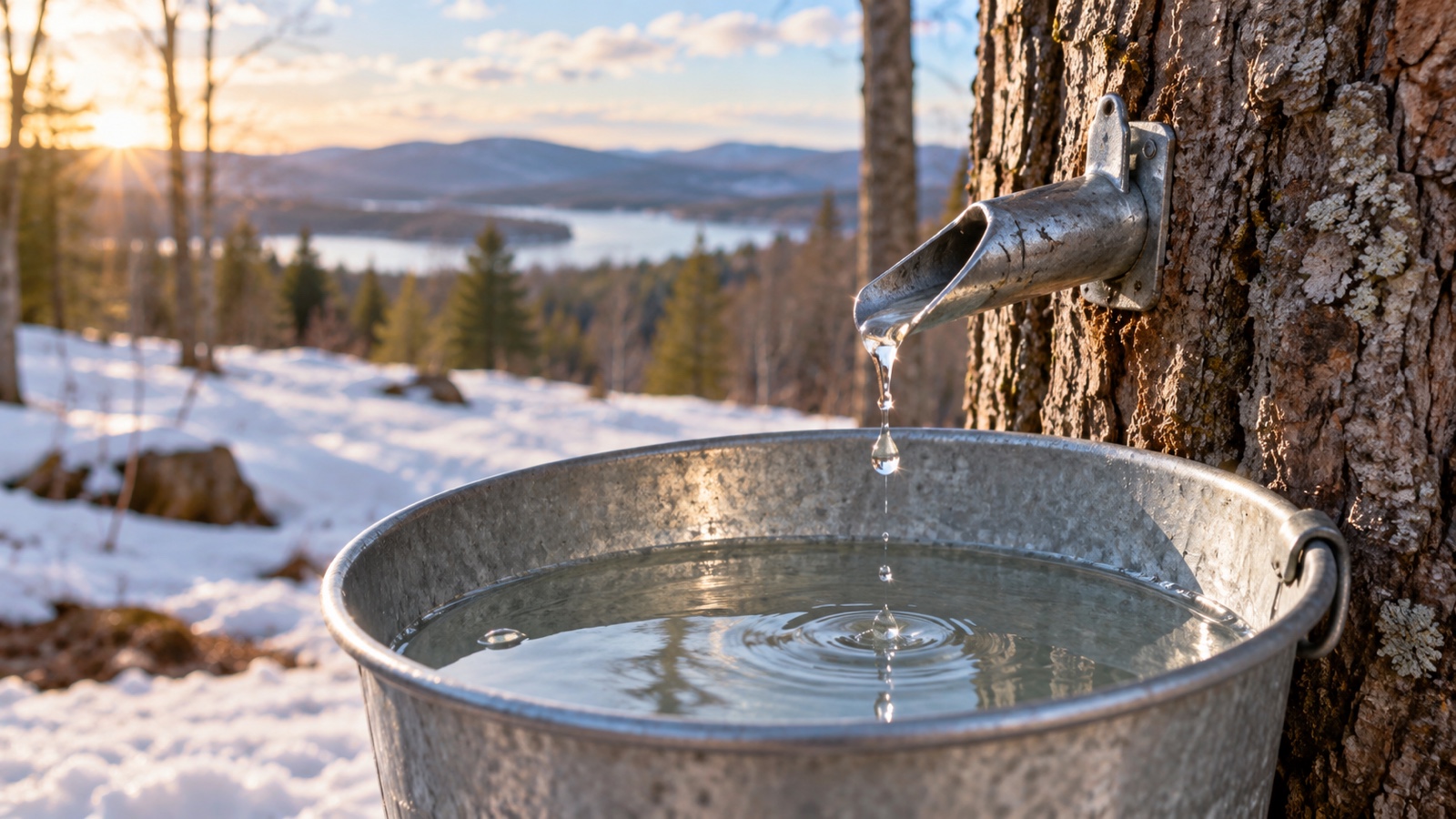
- Maple sap looks mostly clear when it leaves the tree.
- It is mostly water.
- Typical sugar-maple sap contains only a few percent sugar.
- Sucrose is the main sugar in fresh maple sap.
- Trees store carbohydrates in roots and wood.
- Those reserves help support spring growth.
- Sap flow is strongest during specific late-winter and early-spring weather.
- Freezing nights followed by above-freezing days are ideal.
- Pressure changes inside the tree help move sap.
- Sap flow is not simply the same thing as ordinary summer water transport.
- The sugaring season ends as trees begin active spring growth.
- Buds opening can change sap flavor.
- Late-season syrup can develop stronger flavors.
- The finished syrup starts as a liquid so watery that drinking the raw sap barely hints at what it will become.
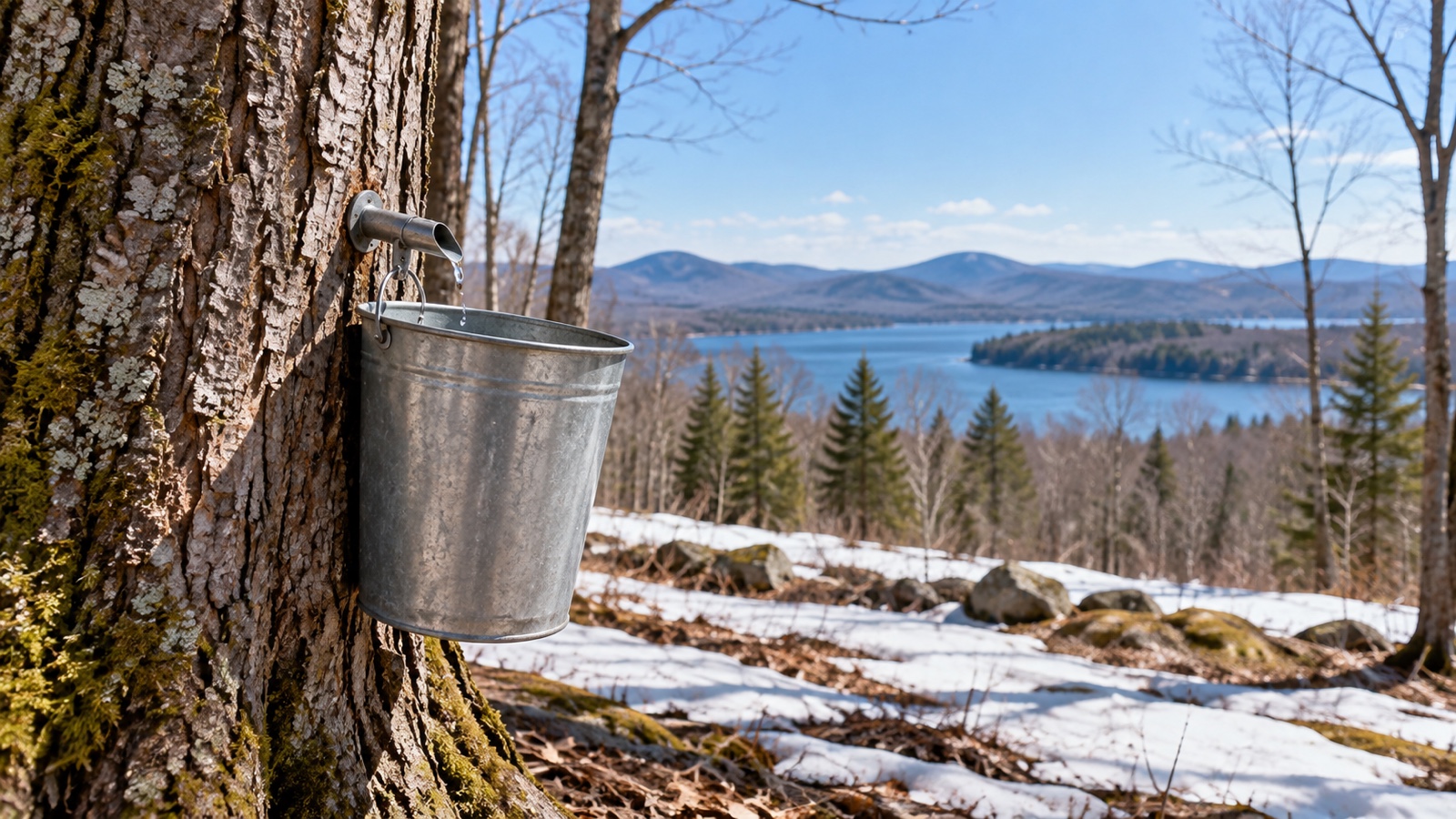
Tapping a maple removes only a small amount of sap
- A tap hole is drilled into the trunk.
- A small spout called a spile is inserted.
- Traditional systems collect sap in buckets.
- Modern commercial operations often use plastic tubing.
- Tubing carries sap downhill or toward collection tanks.
- Vacuum systems can increase sap collection.
- Proper tapping does not drain all sap from a tree.
- Healthy trees produce far more sap than one tap removes.
- Tap holes are intentionally small.
- The tree seals old tap wounds naturally over time.
- Producers drill new holes in later seasons.
- They avoid drilling directly into old stained wood.
- Tree diameter determines how many taps are appropriate.
- Small trees should not be tapped.
- Conservative tapping protects long-term tree health.
- Maple trees can be tapped for decades.
- Some sugar bushes include trees older than the people working them.
- Weather determines daily flow far more than a calendar date.
- Warm nights can stop a good sap run.
- Maple tapping is less “open a faucet in a tree” and more “borrow a tiny portion during a brief pressure-driven seasonal window.”
It takes roughly 40 gallons of sap to make one gallon of syrup
- The classic rule of thumb is about 40 gallons of sap for one gallon of syrup.
- The true ratio depends on sap sugar concentration.
- Sweeter sap needs less evaporation.
- Very dilute sap needs much more.
- Producers measure sugar concentration with instruments such as refractometers.
- Reverse osmosis removes water before boiling.
- This saves fuel and time.
- Reverse osmosis does not replace boiling completely.
- Boiling finishes concentration and develops flavor.
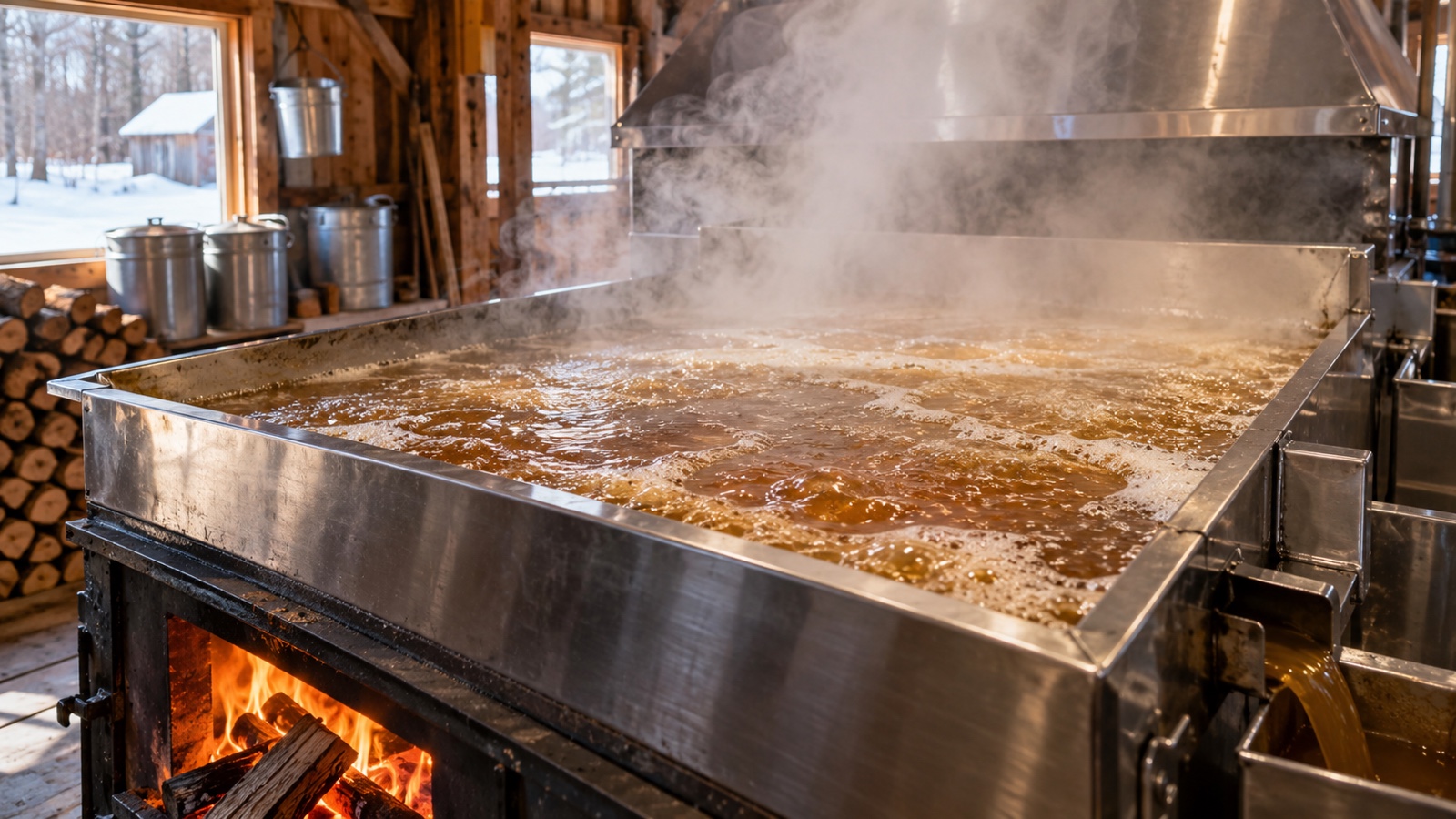
- Traditional evaporators use broad shallow pans.
- Large surface area speeds evaporation.
- Wood was historically a common fuel.
- Oil and other energy sources are also used.
- Modern evaporators recover heat more efficiently.
- Syrup is finished at about 66 to 67 percent sugar solids.
- Density is carefully controlled.
- Under-concentrated syrup can spoil more easily.
- Over-concentrated syrup can crystallize.
- Boiling temperature rises as sugar concentration increases.
- Making maple syrup is basically paying an enormous energy bill to remove water from tree juice.
Color and flavor change through the season
- Maple syrup can range from pale gold to very dark brown.
- Color often becomes darker as the sugaring season progresses.
- Microbial activity in sap can influence color and flavor.
- Longer storage before boiling can darken syrup.
- Heat creates additional flavor compounds.
- Maillard reactions contribute some cooked aromas.
- Caramel-like notes can develop without ordinary caramelization dominating the process.
- Maple syrup contains dozens of aroma compounds.
- Vanilla-like notes occur in some syrups.
- Woody aromas can occur.
- Nutty and toasted notes can occur.
- Dark syrup usually has a stronger flavor.
- Light syrup often tastes more delicate.
- U.S. Grade A now includes several color-and-taste classes.
- Golden has delicate taste.
- Amber has rich taste.
- Dark has robust taste.
- Very Dark has strong taste.
- All four can be high-quality table syrup.
- Dark maple syrup is not lower-grade punishment. It is simply louder maple.
Canada produces most of the world's maple syrup
- Canada is the world's leading maple-syrup producer.
- Quebec produces the majority of Canadian maple syrup.
- Quebec also produces most of the world's supply in many years.
- Ontario, New Brunswick, and Nova Scotia also produce syrup.
- Vermont is the leading U.S. maple-syrup state.
- New York is another major U.S. producer.
- Maine produces substantial maple syrup.
- Wisconsin, Michigan, Ohio, Pennsylvania, and New Hampshire also have maple industries.
- Commercial production is concentrated where sugar maples thrive.
- Cold winters are important.
- Freeze-thaw cycles drive sap runs.
- Climate change can shift the timing of sugaring season.
- Earlier warm springs can shorten favorable tapping windows.
- Tree species ranges may also shift over decades.
- Producers adapt with vacuum tubing and efficient processing.
- Quebec maintains a strategic syrup reserve.
- The reserve helps stabilize supply across variable harvest years.
- A famous theft from Quebec's maple reserve was discovered in 2012.
- Millions of dollars' worth of syrup had been stolen.
- Maple syrup may be the only pancake topping important enough to justify a strategic reserve and a major heist.
Indigenous peoples made maple sugar long before European settlement
- Indigenous peoples in northeastern North America developed maple-sap traditions before European colonization.
- Knowledge and practices varied among nations.
- Maple sugar was easier to transport than liquid syrup.
- Concentrated sap could be boiled further into solid sugar.
- Hot stones were used in some early boiling methods.
- Wooden containers could hold sap while heated stones supplied energy.
- European metal kettles later changed production methods.
- Maple sugar became an important trade product.
- Colonial households also produced maple sweeteners.
- Maple sugar could substitute for imported cane sugar.
- Sugaring season became a major seasonal activity.
- Families moved into sugar camps.
- Modern sugarhouses continue that seasonal tradition.
- Maple festivals celebrate spring production.
- Visitors can tour sugarhouses during sap season.
- Fresh syrup tastes different from shelf-stable pancake syrups flavored to imitate maple.
- Pure maple syrup contains no corn syrup.
- “Pancake syrup” can be mostly corn syrup with flavoring.
- Ingredient labels reveal the difference.
- The maple tradition is older than the countries now most associated with selling it.
Candy, storage and 25 final maple-syrup facts
- Pure maple syrup is mostly sucrose and water.
- It contains small amounts of minerals.
- Manganese is especially notable.
- Maple syrup is still an added sugar despite those minerals.
- One tablespoon contains roughly 50 calories.
- It is sweeter and more concentrated than raw maple sap.
- Opened pure maple syrup should be refrigerated.
- Mold can grow on improperly stored syrup.
- Freezing maple syrup is possible.
- It may not freeze solid because of its high sugar concentration.
- Maple syrup can crystallize.
- Crystals often form if syrup is over-concentrated.
- Maple cream is a spread made by controlled crystallization.
- Maple candy is made by concentrating syrup further.
- Maple sugar is granulated or solidified maple syrup.
- Maple taffy is made by pouring hot syrup onto clean snow or crushed ice.
- This tradition is especially associated with Quebec sugar shacks.
- Maple syrup works in savory glazes.
- It pairs well with mustard.
- It can sweeten baked beans.
- It can replace some sugar in baking.
- Liquid sweetener changes recipe moisture.
- Maple wood is also commercially valuable for furniture and flooring.
- The same sugar maple can provide shade, timber, fall color, and sap across a long lifetime.
- After 145 facts, maple syrup feels less like pancake topping and more like forest ecology, freeze-thaw physics, Indigenous knowledge, evaporation engineering, regional culture, and one remarkably concentrated tree harvest.

Ellie is the owner and sole author of Fun Facts, combining her mechanical engineering background with years of research-driven writing to deliver facts you can trust. Every article is thoroughly fact-checked and routinely updated as new science and sources emerge to keep information accurate and current. Her mission is to make learning delightful while upholding high standards of reliability and transparency.