
The International Space Station is a laboratory, construction project, spacecraft, home, gym, observatory, and international partnership circling Earth about every 90 minutes. Humans have lived there continuously since 2000, turning low Earth orbit into one of the strangest long-term workplaces ever built.
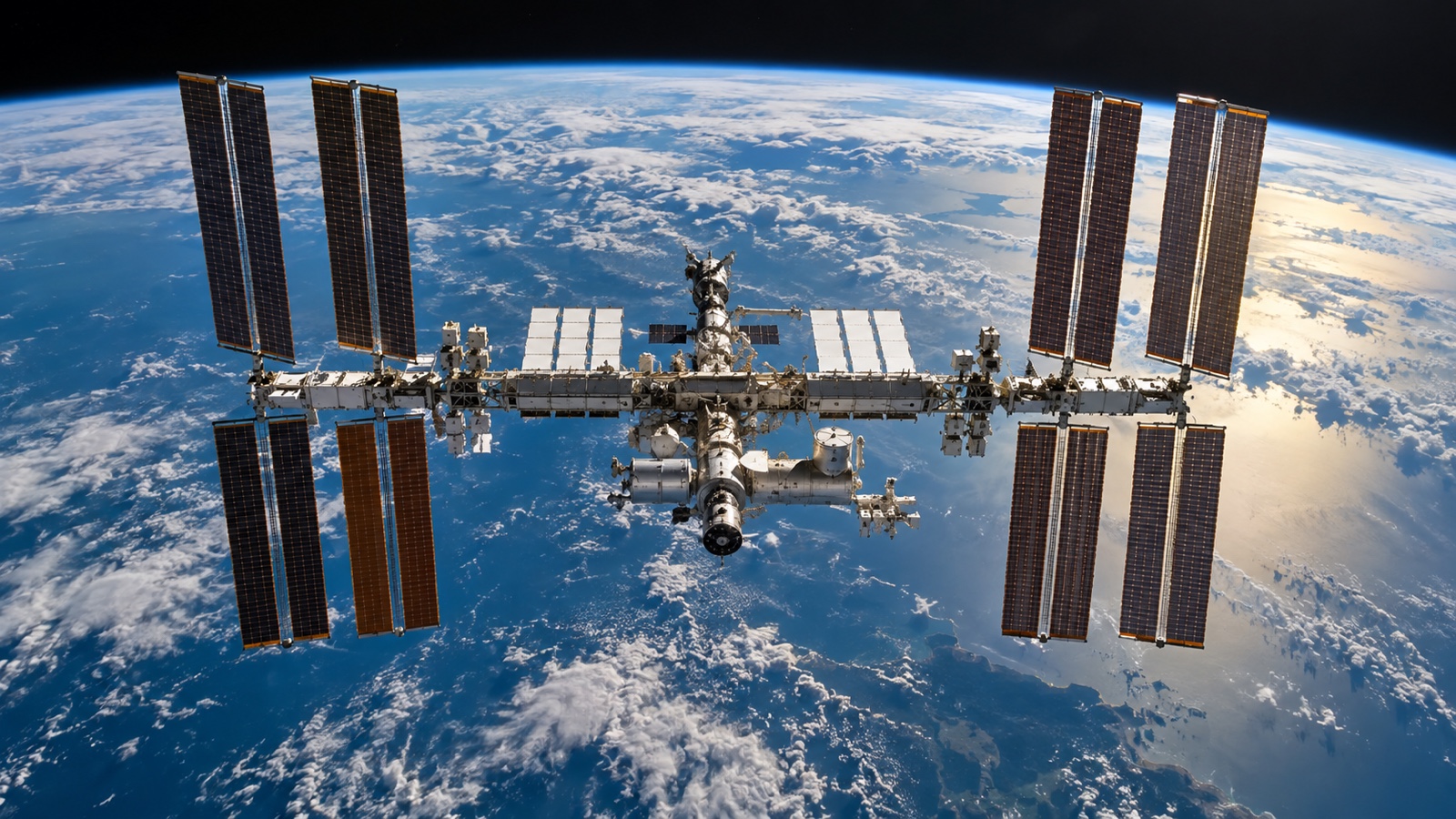
The ISS is one of the largest structures ever built in space
- The International Space Station is the largest human-made object ever assembled in Earth orbit.
- Its first element launched in 1998.
- The first module was the Russian-built Zarya functional cargo block.
- The U.S.-built Unity node launched later in 1998.
- Assembly continued through dozens of launches.
- Space Shuttle missions delivered many of the station's largest components.
- Russian Proton and Soyuz rockets also launched major elements.
- The station measures roughly the length of an American football field from end to end.
- Its truss stretches more than 300 feet.
- The station's mass exceeds 900,000 pounds.
- That mass changes as vehicles, cargo, and equipment come and go.
- The ISS contains multiple pressurized modules.
- It also carries large unpressurized trusses and external experiments.
- Solar arrays extend far beyond the pressurized modules.
- The station was assembled piece by piece in orbit rather than launched as one spacecraft.
- Robotic arms moved major components during assembly.
- Spacewalking astronauts connected cables, fluid lines, hardware, and experiments.
- The station's assembly required cooperation among countries using different engineering traditions.
- Its modules were built on Earth to fit together hundreds of miles above the planet.
- The ISS is basically a giant orbital Lego project where every piece had to survive a rocket launch before anyone could snap it into place.
Five major space agencies operate the station together
- NASA is one of the five major space agencies participating in the ISS partnership.
- Roscosmos represents Russia.
- ESA represents participating European nations.
- JAXA represents Japan.
- CSA represents Canada.
- More than a dozen countries contributed to station assembly.
- The partnership combines hardware, crew, research, transportation, and operations.
- Different partner modules use different engineering systems.
- The Russian orbital segment has its own major propulsion and life-support capabilities.
- The U.S. orbital segment includes American, European, Japanese, and Canadian contributions.
- Mission control responsibilities are distributed across several countries.
- NASA's major ISS control center is in Houston, Texas.
- Russian flight controllers work from near Moscow.
- European control centers support ESA modules and cargo operations.
- Japan operates its Kibo laboratory through Japanese mission-control facilities.
- Canada supports Canadarm2 and other robotic systems.
- English and Russian have historically been especially important operational languages aboard the station.
- Crews train extensively before launch to work across international systems.
- The ISS partnership has continued through major political tensions on Earth.
- The station may be the only workplace where international diplomacy includes orbital mechanics, oxygen systems, and deciding who gets which docking port.
Humans have lived aboard continuously since 2000
- Expedition 1 arrived at the ISS in November 2000.
- The station has been continuously occupied ever since.
- That makes it humanity's longest continuously inhabited outpost in space.
- Expedition crews live aboard for months at a time.
- Typical long-duration missions last roughly six months, although schedules vary.
- Some astronauts and cosmonauts have stayed much longer because of mission circumstances.
- More than 280 people have visited the ISS.
- Visitors have represented many countries.
- The station commonly hosts a permanent crew of around seven in modern operations.
- More people can be aboard temporarily during handovers or visiting missions.
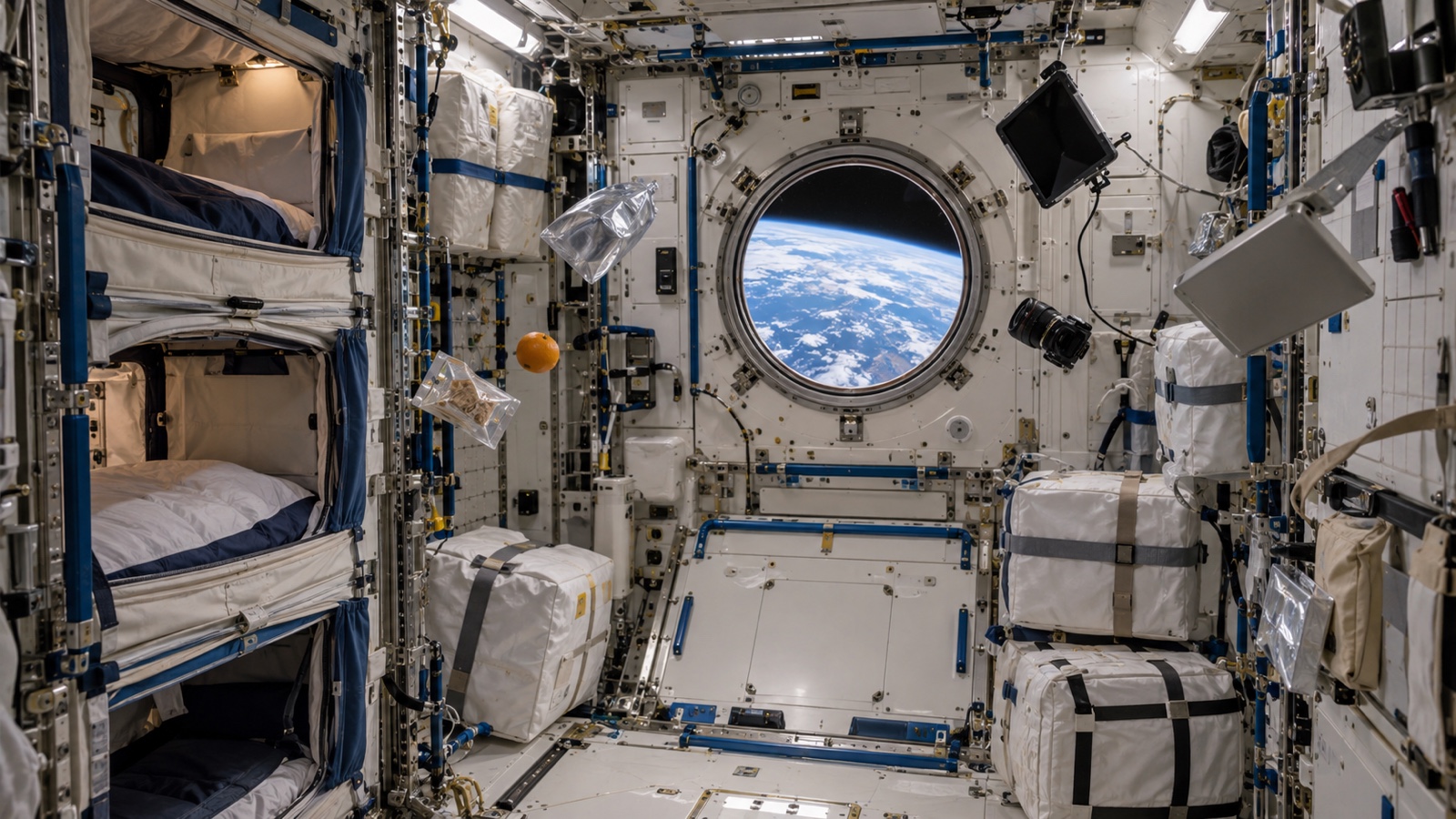
- Crew members sleep in small personal quarters.
- Sleeping bags are attached so astronauts do not drift around the module.
- There is no natural up or down inside a freely falling spacecraft.
- Astronauts can sleep on a wall, ceiling, or floor orientation without feeling the difference.
- Personal quarters include ventilation because exhaled carbon dioxide would otherwise collect near a sleeping face.
- Crews work long planned days filled with research, exercise, maintenance, and operations.
- Weekends still include chores and maintenance.
- Astronauts can communicate with family from orbit.
- Internet and digital communications are available but differ from ordinary home broadband.
- Living in orbit is less like floating on vacation and more like sharing a laboratory, machine room, apartment, and emergency shelter with coworkers for months.
The station circles Earth about 16 times a day
- The ISS travels in low Earth orbit.
- Its altitude is usually around 250 miles, though it changes.
- The station travels roughly 17,500 miles per hour.
- It completes an orbit in about 90 minutes.
- That means the crew experiences roughly 16 orbital sunrises and sunsets each day.
- The ISS orbital inclination is about 51.6 degrees.
- This inclination lets it pass over most of Earth's inhabited regions.
- The station does not fly directly over Earth's geographic poles.
- Atmospheric drag slowly lowers its orbit.
- The atmosphere is extremely thin at station altitude but not completely absent.
- Periodic reboost maneuvers raise the station's orbit.
- Visiting spacecraft can help perform reboost maneuvers.
- Orbital debris sometimes requires avoidance maneuvers.
- Flight controllers track objects that could pass dangerously close.
- The ISS itself is in continuous free fall around Earth.
- Gravity at station altitude is still most of the strength experienced at Earth's surface.
- Astronauts float because station and crew fall together.
- The correct term is microgravity rather than zero gravity.
- Small residual accelerations from airflow, equipment, motion, and orbital effects remain.
- The station stays up not because gravity disappears, but because it is moving sideways so fast that Earth curves away beneath it as it falls.
Solar arrays power the orbital laboratory
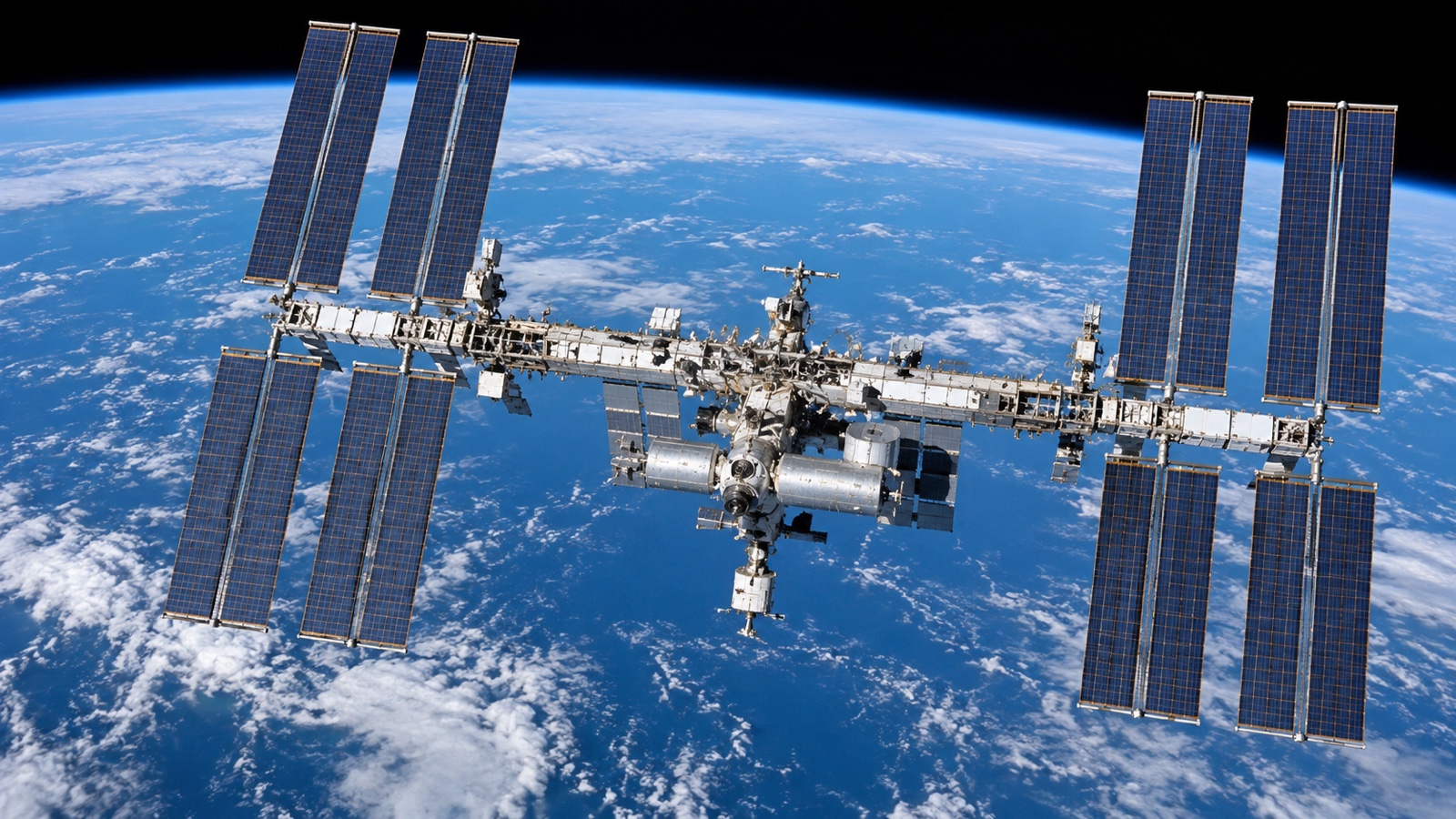
- The ISS generates electricity primarily from sunlight.
- Large photovoltaic arrays convert sunlight into electrical power.
- The original station power system includes eight main solar-array wings.
- Newer roll-out solar arrays augment the original arrays.
- The roll-out arrays are commonly called IROSAs.
- Solar arrays rotate to track the Sun efficiently.
- Batteries store energy for periods when the station passes through Earth's shadow.
- The ISS enters darkness during part of most orbits.
- Electrical systems distribute power throughout station modules.
- NASA says miles of electrical wiring connect ISS power systems.
- Heat produced by electronics and crew must be removed.
- Space does not provide cooling by ordinary air convection outside the spacecraft.
- Station cooling loops carry heat to radiators.
- External radiators release heat as infrared radiation.
- Thermal control is essential because both overheating and freezing can damage systems.
- Station orientation is managed partly for power, thermal, communication, and structural reasons.
- Power availability influences which experiments and systems can operate simultaneously.
- External payloads can draw electrical power from station interfaces.
- The solar arrays span a huge area compared with the inhabited modules.
- The ISS survives repeated 45-minute nights by charging batteries during daylight and running a giant orbital electrical grid around the clock.
Life support recycles water and manages the cabin atmosphere
- The ISS must provide breathable air without opening a window to the atmosphere.
- Oxygen can be generated by splitting water through electrolysis.
- Visiting spacecraft and stored supplies can also contribute oxygen.
- Carbon dioxide must be removed continuously from cabin air.
- Special scrubbers capture carbon dioxide.
- Trace contaminants are also filtered.
- The station recycles a large fraction of its water.
- Water recovery includes moisture from cabin air.
- It also includes water recovered from urine.
- Recovered water is extensively purified before reuse.
- Astronauts often joke that today's coffee becomes tomorrow's coffee.
- Recycling reduces the amount of water that must be launched from Earth.
- Humidity must be controlled to protect equipment and crew comfort.
- Fans circulate air throughout modules.
- Fans are essential because warm air does not naturally rise in microgravity the way it does on Earth.
- Without forced airflow, pockets of carbon dioxide could form around people.
- Cabin pressure is maintained near Earthlike conditions.
- Fire detection is challenging because smoke behaves differently in microgravity.
- Emergency equipment includes masks, extinguishers, and procedures for rapid response.
- Every glass of water aboard the ISS exists because an elaborate machine has filtered, recycled, disinfected, monitored, and moved fluids in an environment where even bubbles refuse to behave normally.
Microgravity turns the ISS into a unique research laboratory
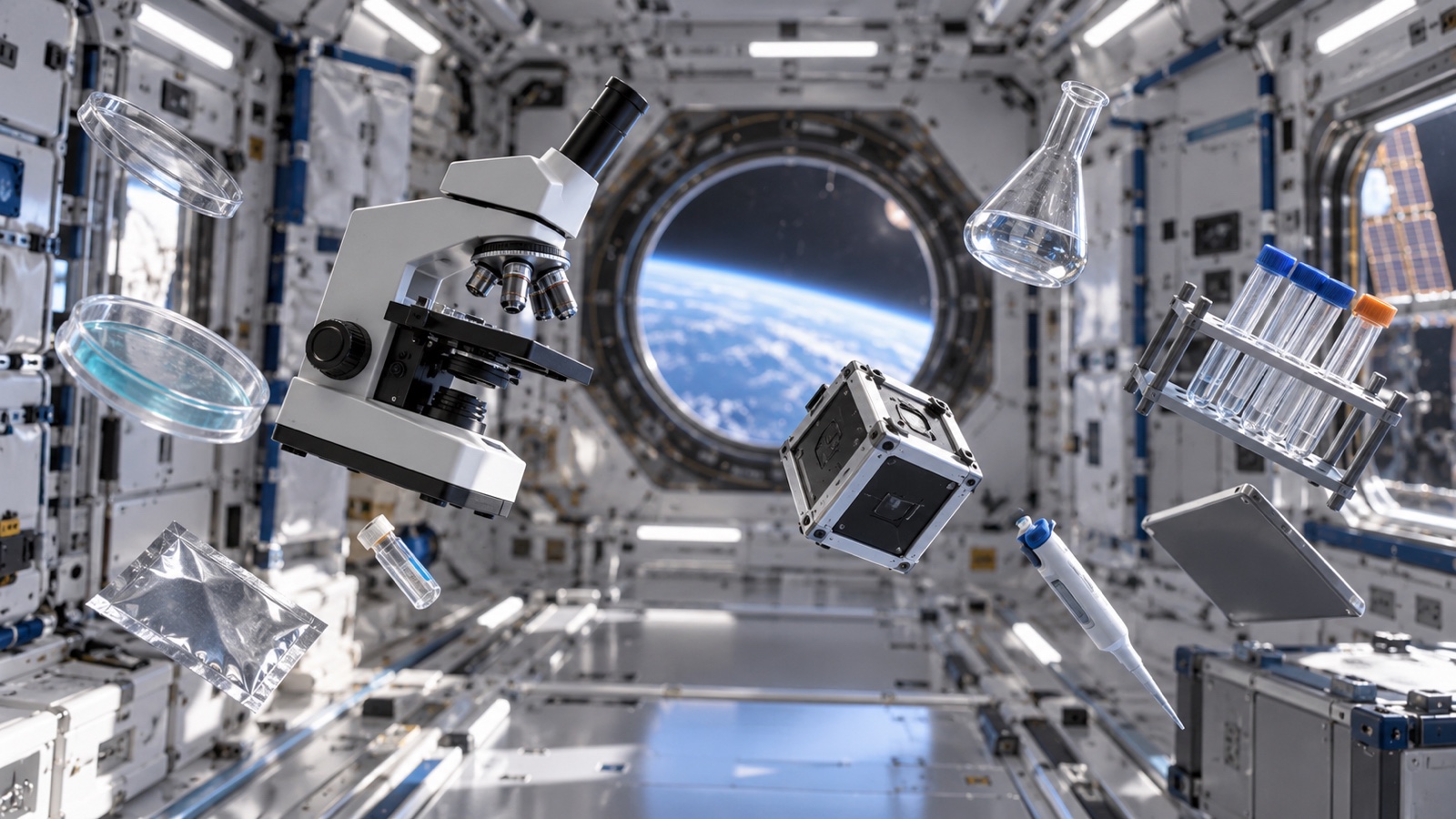
- Microgravity allows experiments that behave differently from those on Earth.
- Researchers study human physiology aboard the ISS.
- Long-duration spaceflight causes muscle loss without countermeasures.
- It also causes bone-density loss.
- Astronauts exercise for roughly two hours per day to reduce these effects.
- The station has treadmills, a cycling machine, and resistance equipment.
- Microgravity changes fluid distribution in the body.
- It can also affect vision in some astronauts.
- Researchers study immune changes during spaceflight.
- Plant experiments test growth without normal gravity cues.
- Protein crystals can form differently in microgravity.
- Combustion behaves differently because hot gases do not rise through buoyancy the same way.
- Flames can become more spherical in microgravity.
- Materials experiments expose samples to the space environment outside the station.
- The Alpha Magnetic Spectrometer studies cosmic particles from an external station location.
- Earth-observation instruments monitor climate, storms, cities, agriculture, and natural disasters.
- Technology demonstrations test systems for future Moon and Mars missions.
- Experiments can be operated by crew or remotely from Earth.
- Thousands of investigations from researchers around the world have used the station.
- The ISS is valuable scientifically precisely because ordinary physics still applies there while one familiar condition, continuous weight-bearing gravity, is dramatically reduced.
The end of the ISS era and 5 final facts
- As of September 2026, NASA and its international partners plan to continue ISS operations through 2030, with Russia also planning Russian-segment operations through 2030.
- NASA selected SpaceX to develop a U.S. Deorbit Vehicle for a controlled station reentry after the end of operations.
- The planned deorbit is intended to target an unpopulated ocean region and reduce risk to people on the ground.
- NASA is supporting commercial low-Earth-orbit stations so research and astronaut activity can continue after the ISS era.
- After 145 facts, the ISS looks less like one spacecraft and more like a 25-plus-year experiment in engineering, international cooperation, human biology, recycling, orbital construction, science, and learning how to live away from Earth.
Quick FAQ
Q: How fast does the ISS travel?
A: Roughly 17,500 miles per hour, fast enough to orbit Earth about every 90 minutes.
Q: Is there gravity on the ISS?
A: Yes. Gravity remains strong there. Astronauts float because station and crew are in continuous free fall together.
Q: How long has the ISS been continuously occupied?
A: Since November 2000.
Q: Does the ISS recycle urine?
A: Yes. Water-recovery systems purify water from urine and cabin humidity for reuse.
Q: When will the ISS retire?
A: Current partner plans call for operations through 2030, followed by a controlled deorbit using a dedicated U.S. Deorbit Vehicle.

Ellie is the owner and sole author of Fun Facts, combining her mechanical engineering background with years of research-driven writing to deliver facts you can trust. Every article is thoroughly fact-checked and routinely updated as new science and sources emerge to keep information accurate and current. Her mission is to make learning delightful while upholding high standards of reliability and transparency.