
Electricity powers nearly everything modern life depends on, but the physics begins with tiny charged particles. From static shocks and lightning to batteries, generators, power grids, and electronics, electricity is really the organized movement and interaction of electric charge.
Electricity begins with electric charge
- Electric charge is a fundamental property of matter.
- There are two familiar kinds of electric charge: positive and negative.
- Like charges repel each other.
- Opposite charges attract each other.
- Protons carry positive electric charge.
- Electrons carry negative electric charge.
- Neutrons have no net electric charge.
- An ordinary neutral atom contains equal numbers of protons and electrons.
- An ion forms when an atom or molecule gains or loses electrons.
- A positively charged ion is called a cation.
- A negatively charged ion is called an anion.
- Electric charge is conserved.
- That means charge is transferred rather than created from nothing in ordinary processes.
- The elementary charge is the magnitude of the charge carried by one proton or electron.
- Electric charge is measured in coulombs.
- One coulomb represents an enormous number of elementary charges.
- Electric forces can act across empty space.
- Coulomb's law describes the force between idealized point charges.
- The electric force falls with the square of distance between charges.
- The tiny static shock from a doorknob and the current powering a city both come from the same basic property: electric charge.
Voltage, current and resistance describe circuits
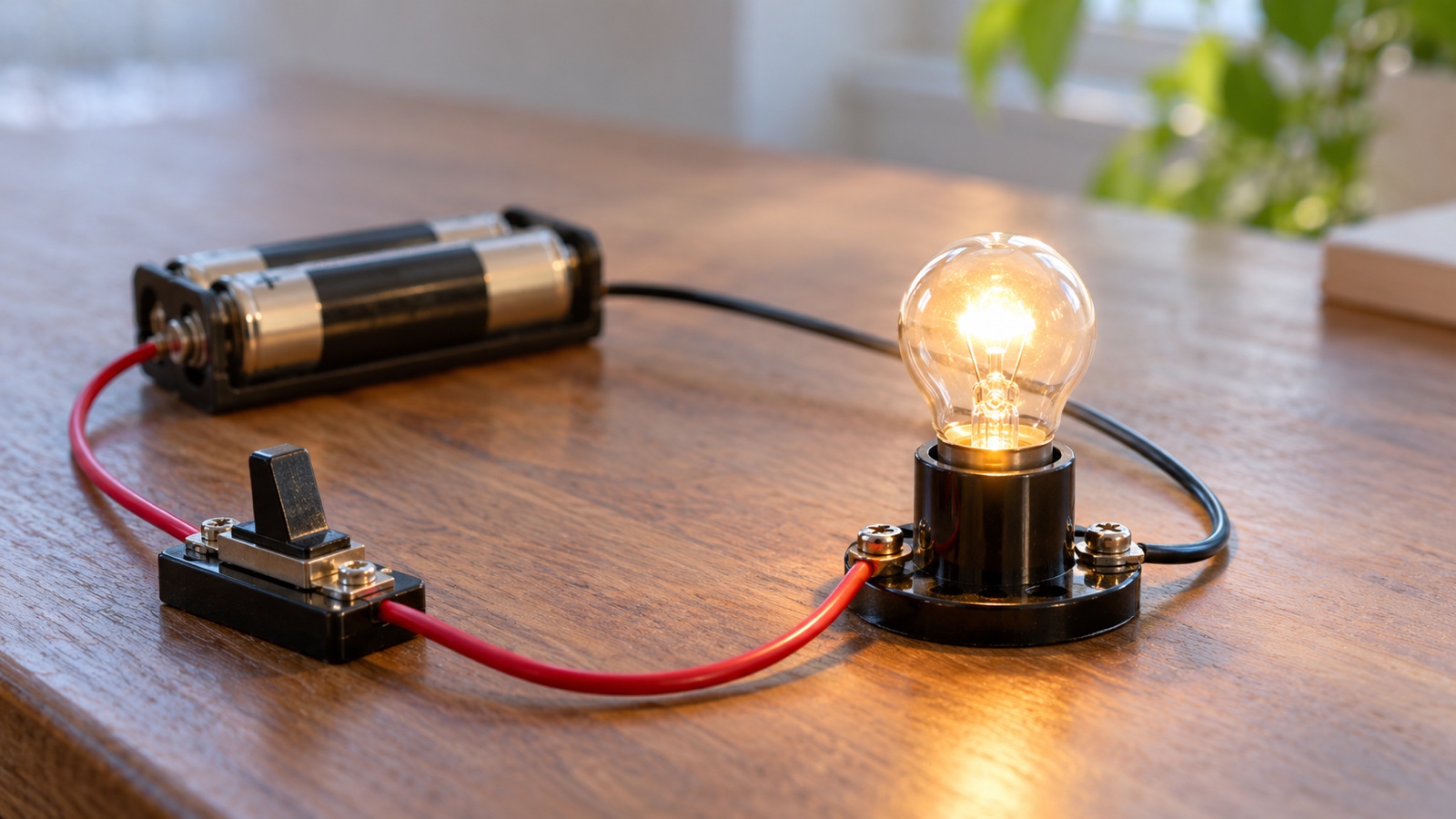
- Electric current is the rate at which charge flows.
- Current is measured in amperes.
- One ampere equals one coulomb of charge passing a point each second.
- Voltage is electric potential difference.
- Voltage is measured in volts.
- A voltage difference can drive electric current through a conductor.
- Resistance describes opposition to current flow.
- Resistance is measured in ohms.
- Ohm's law relates voltage, current, and resistance in many materials.
- Its common form is V equals I times R.
- Doubling voltage across the same resistance doubles current.
- Doubling resistance at the same voltage halves current.
- Electrical power is the rate of energy transfer.
- Power is measured in watts.
- One watt equals one joule per second.
- Power in a simple circuit can be calculated as voltage times current.
- Electrical energy usage is often billed in kilowatt-hours.
- A kilowatt-hour is a unit of energy, not power.
- One kilowatt-hour equals using 1,000 watts for one hour.
- Voltage is not “the amount of electricity,” just as water pressure is not the same thing as the amount of water flowing.
Electrons move slowly even when electrical effects appear fast
- Metal wires contain mobile electrons.
- Those electrons move randomly even before a circuit is energized.
- An electric field creates a small average drift motion.
- Electron drift speed in ordinary wires can be surprisingly slow.
- Electrical signals propagate through a circuit far faster than individual electrons drift.
- The electromagnetic field travels through and around the circuit at a substantial fraction of light speed.
- This is why a lamp responds almost immediately when a switch is closed.
- The electrons lighting the lamp did not race all the way from the power plant at light speed.
- Conventional current direction is defined as the direction positive charge would move.
- In metal wires, electron drift is opposite conventional current direction.
- The conventional-current convention was established before electrons were discovered.
- Electrical engineers still use it because the mathematics works consistently.
- Conductors allow charges to move relatively easily.
- Insulators strongly resist charge movement.
- Copper is an excellent electrical conductor.
- Aluminum is also widely used in power transmission.
- Rubber, glass, and many plastics are useful electrical insulators.
- Semiconductors have conductivity between that of conductors and insulators.
- Silicon is the most famous semiconductor material.
- When you flip a switch, the energy transfer begins quickly because the electric field reorganizes the entire circuit long before any single electron could travel very far.
Static electricity comes from charge imbalance
- Static electricity involves electric charge accumulating on surfaces.
- Friction can transfer electrons between materials.
- Rubbing a balloon on hair can move electrons.
- The balloon and hair then attract because they carry opposite net charges.
- Charged objects can also attract neutral objects through polarization.
- Polarization shifts positive and negative charge slightly within a material.
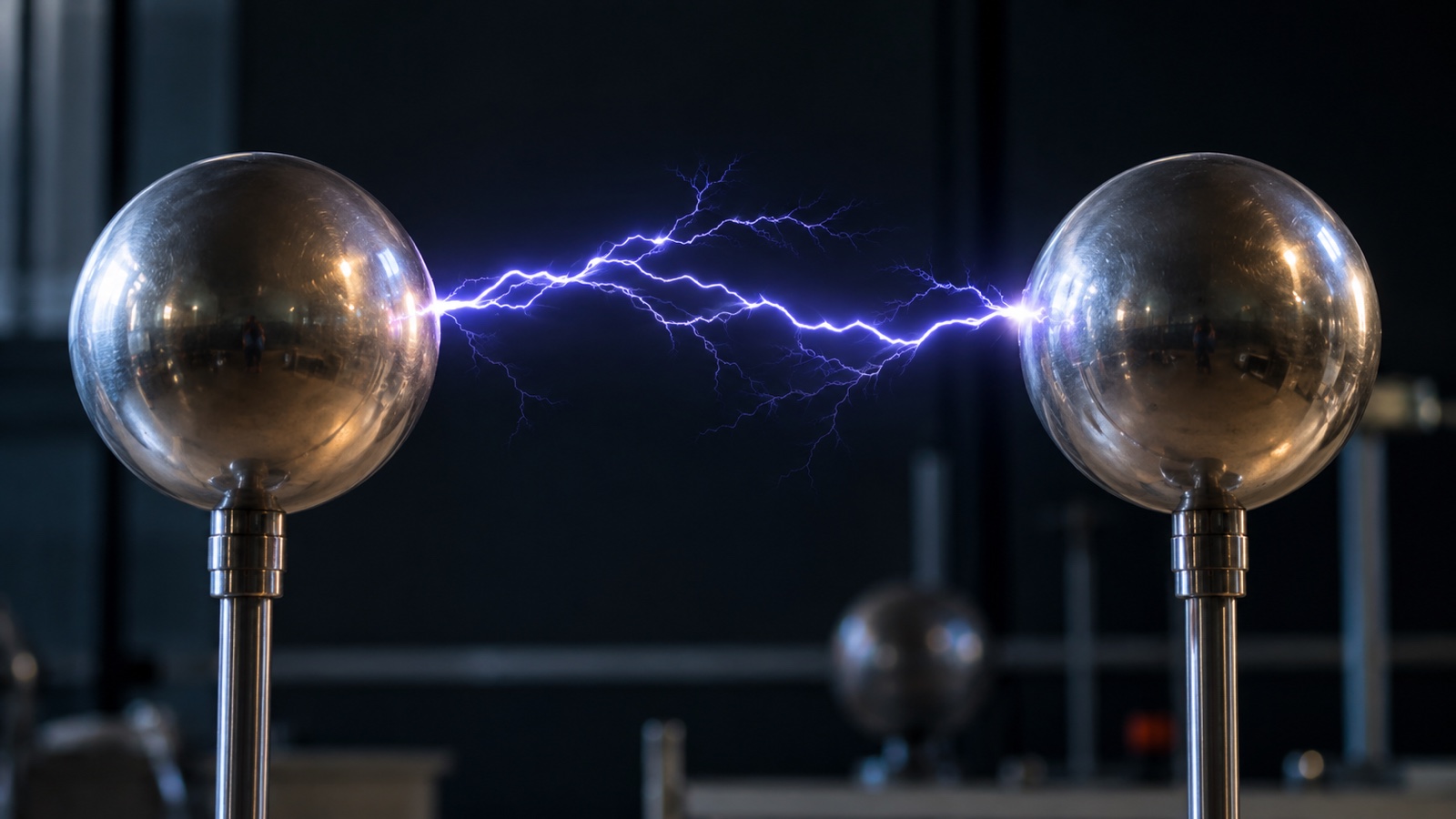
- A static spark occurs when the electric field becomes strong enough to ionize air.
- Dry air often makes static shocks more noticeable.
- Humid air allows charge to leak away more easily from many surfaces.
- Lightning is an enormous electrostatic discharge.
- Thunderstorms separate charge inside clouds.
- Strong electric fields can develop between cloud regions and the ground.
- A lightning channel forms through ionized air.
- Lightning can travel from cloud to ground, ground to cloud, or within clouds.
- The visible flash heats surrounding air extremely rapidly.
- Rapidly expanding hot air creates thunder.
- Light reaches you much faster than sound.
- This is why lightning is seen before thunder is heard.
- Lightning can carry tens of thousands of amperes or more.
- A doorknob spark and a lightning bolt differ wildly in scale, but both happen because separated charge eventually finds a conductive path.
Batteries convert chemical energy into electrical energy
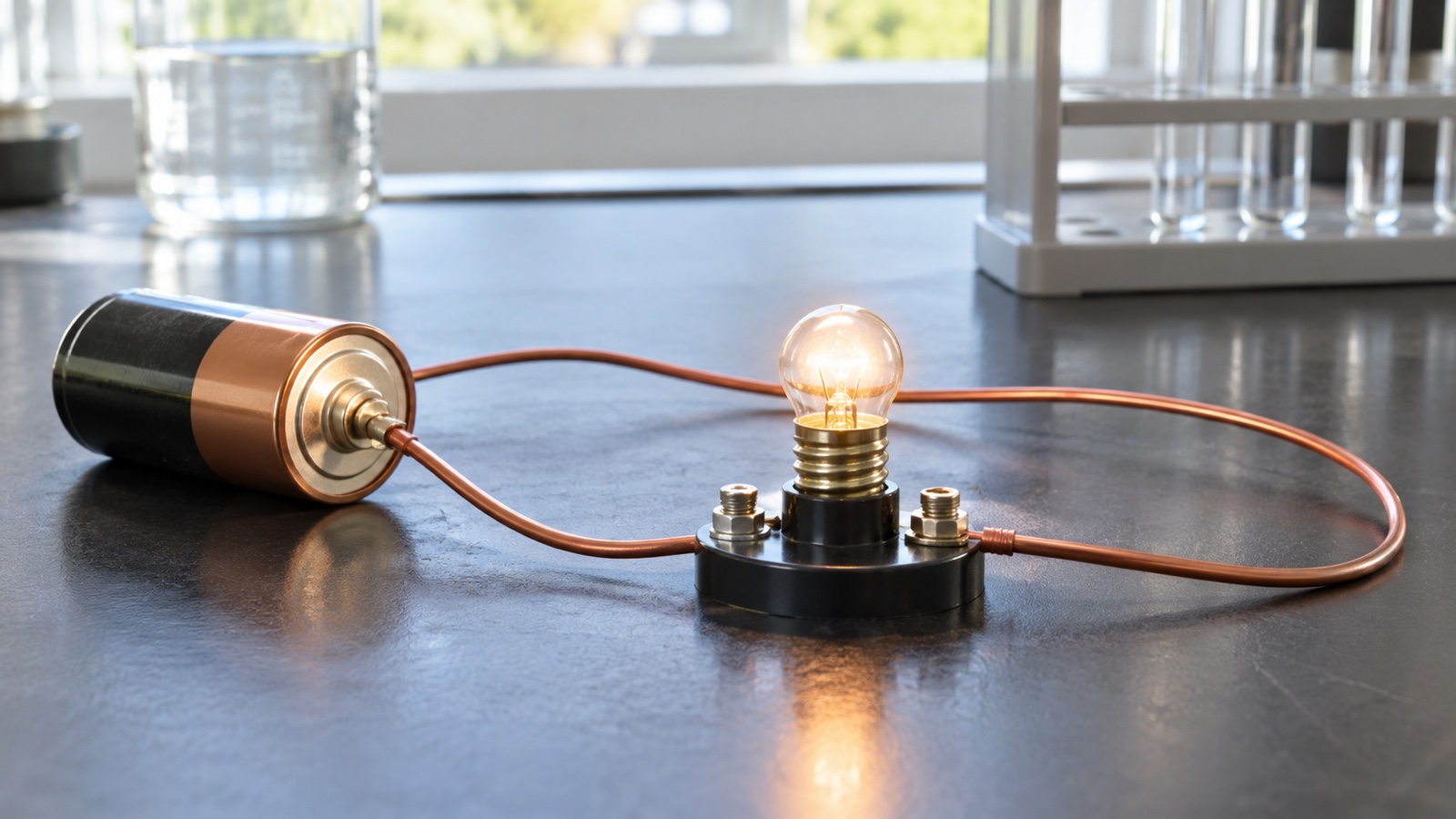
- A battery uses chemical reactions to create an electric potential difference.
- A battery cell contains two electrodes and an electrolyte.
- Oxidation occurs at the anode.
- Reduction occurs at the cathode.
- Electrons move through the external circuit between electrodes.
- Ions move through the electrolyte to maintain charge balance.
- A battery can contain one cell or many cells.
- Disposable alkaline batteries are primary cells.
- Rechargeable batteries use chemical reactions that can be driven backward to a useful extent.
- Lithium-ion batteries power many phones, laptops, vehicles, and tools.
- Lithium-ion cells move lithium ions between electrode materials during charging and discharging.
- Battery voltage depends on the chemistry used.
- Connecting cells in series increases total voltage.
- Connecting cells in parallel can increase current capability and capacity.
- Battery capacity is commonly rated in ampere-hours or watt-hours.
- Temperature affects battery performance.
- Very cold conditions can reduce available battery power.
- High temperatures can accelerate battery degradation.
- Damaged lithium-ion cells can enter dangerous thermal runaway.
- A battery does not store loose electricity like a bucket. It stores chemical energy that can be converted into electrical energy when a circuit is completed.
Generators turn motion into electricity
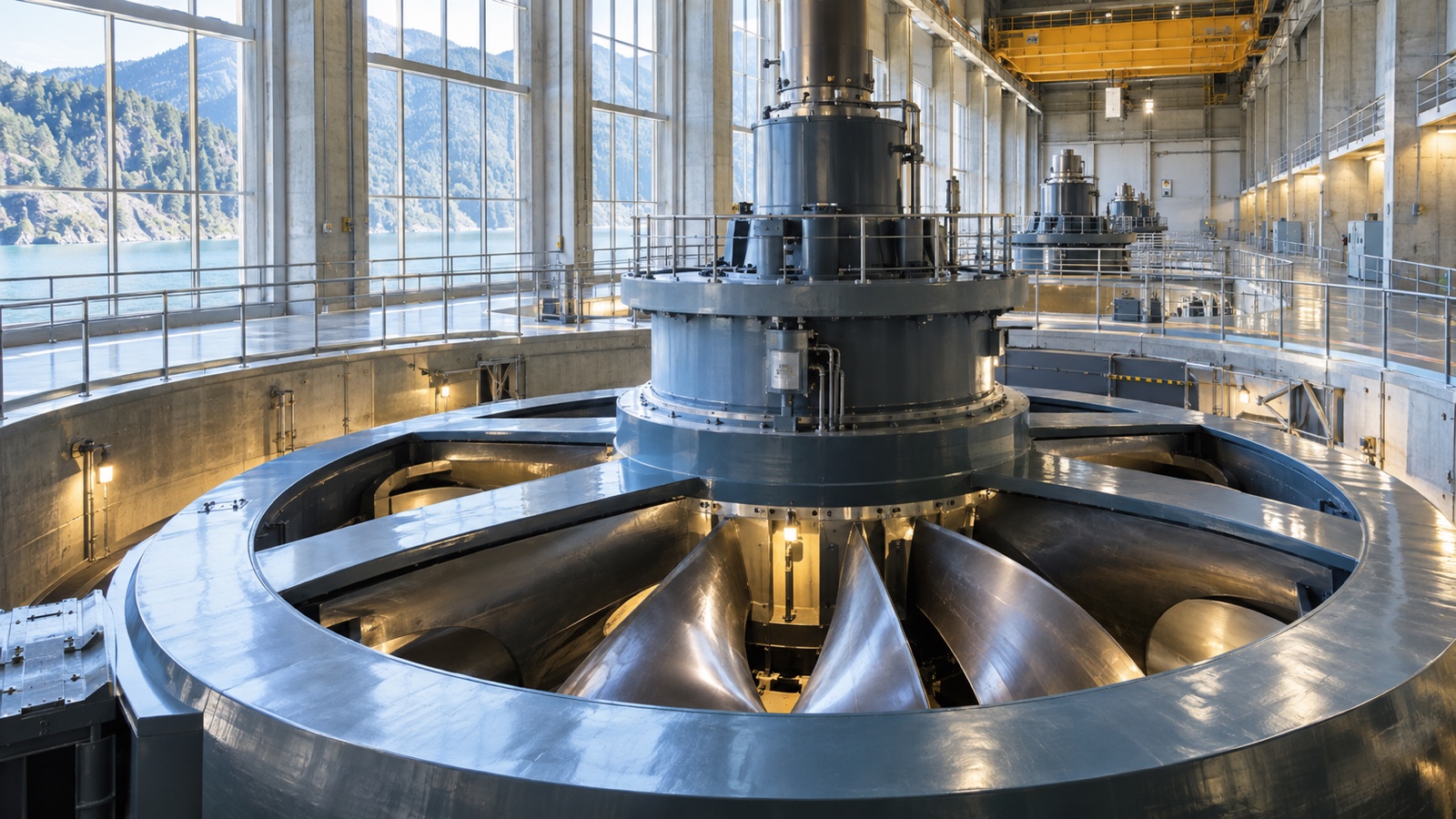
- Electric generators convert mechanical energy into electrical energy.
- Most large generators rely on electromagnetic induction.
- A changing magnetic field can induce voltage in a conductor.
- Michael Faraday demonstrated electromagnetic induction in the 19th century.
- Power plants rotate generators using turbines.
- Steam turbines are used in nuclear and many fossil-fuel power plants.
- Hydroelectric plants use falling or flowing water to spin turbines.
- Wind turbines use moving air.
- Solar photovoltaic panels generate electricity without rotating turbines.
- Photovoltaic cells convert light energy directly into electrical energy.
- Alternating current repeatedly changes direction.
- Direct current flows with one net direction.
- Household power grids commonly use alternating current.
- Batteries naturally supply direct current.
- Electronic devices often convert AC wall power into DC internally.
- Transformers change AC voltage efficiently.
- High-voltage transmission reduces current for a given amount of power.
- Lower current reduces resistive heating losses in wires.
- Utilities step voltage down before electricity reaches most homes.
- The power grid is basically a continent-scale balancing act that must match electrical generation and demand almost continuously.
Electricity and magnetism are two sides of one interaction
- Moving electric charges create magnetic fields.
- Changing magnetic fields can create electric fields.
- Electricity and magnetism are unified as electromagnetism.
- Maxwell's equations describe classical electromagnetic behavior.
- Electromagnetic waves can travel through empty space.
- Visible light is an electromagnetic wave.
- Radio waves are electromagnetic waves.
- Microwaves are electromagnetic waves.
- Infrared, ultraviolet, X-rays, and gamma rays are also electromagnetic radiation.
- All electromagnetic waves travel at the speed of light in vacuum.
- Electric motors use magnetic forces to convert electrical energy into motion.
- Speakers convert electrical signals into mechanical vibration.
- Microphones can perform the reverse conversion using several possible technologies.
- Induction cooktops use changing magnetic fields to generate currents in cookware.
- Wireless charging uses electromagnetic induction or related coupling methods.
- Electric currents can heat wires because moving electrons transfer energy to the material lattice.
- This resistive heating is useful in toasters and space heaters.
- The same heating can waste energy in transmission lines.
- Superconductors can carry current with zero DC electrical resistance below critical conditions.
- Electricity and magnetism looked like separate phenomena until physics revealed they are different expressions of one electromagnetic field.
Safety, biology and 5 final electricity facts
- Human nerves and muscles use electrical voltage differences across cell membranes to transmit signals and contract.
- The heart's rhythm depends on coordinated electrical activity, which is why abnormal conduction can produce dangerous arrhythmias.
- Electric shock danger depends on current path, magnitude, duration, frequency, skin condition, and many other factors rather than voltage alone.
- Ground-fault circuit interrupters can disconnect power rapidly when they detect current leaking along an unintended path.
- After 145 facts, electricity looks less like invisible stuff inside a wire and more like the controlled behavior of charge, fields, energy, chemistry, magnetism, materials, and circuits woven into modern civilization and biology.
Quick FAQ
Q: What is electricity?
A: Electricity broadly describes phenomena involving electric charge, electric fields, voltage, and current.
Q: Do electrons travel from the power plant to my lamp instantly?
A: No. Individual electrons drift slowly, while the electromagnetic signal and energy propagate through the circuit much faster.
Q: What is the difference between AC and DC?
A: Alternating current reverses direction periodically. Direct current has one net direction.
Q: Why is power transmitted at high voltage?
A: Higher voltage allows the same power to be transmitted with lower current, reducing resistive losses.
Q: Are electricity and magnetism connected?
A: Yes. They are unified parts of the electromagnetic interaction.

Ellie is the owner and sole author of Fun Facts, combining her mechanical engineering background with years of research-driven writing to deliver facts you can trust. Every article is thoroughly fact-checked and routinely updated as new science and sources emerge to keep information accurate and current. Her mission is to make learning delightful while upholding high standards of reliability and transparency.