
Día de los Muertos is colorful enough to photograph beautifully, but the real heart of it is quieter: remembering people you love and making space for their stories. I like the holiday most when the marigolds, skeleton art, food, humor, and family rituals stay connected to that purpose.
What Día de los Muertos is, and what it is not
- Día de los Muertos means “Day of the Dead” in Spanish.
- It is most strongly associated with Mexico and Mexican culture.
- The observance centers on remembering and honoring people who have died.
- It is not simply a Mexican version of Halloween.
- Halloween and Día de los Muertos happen near each other on the calendar but have different histories and purposes.
- Modern Día de los Muertos combines Indigenous Mesoamerican traditions with Catholic observances introduced after Spanish colonization.
- All Saints’ Day on November 1 helped shape the modern calendar placement.
- All Souls’ Day on November 2 also influenced the observance.
- November 1 and November 2 are the dates most closely associated with Día de los Muertos today.
- Some families and regions begin preparations or observances earlier.
- Traditions differ significantly across Mexican states, towns, Indigenous communities, and families.
- There is no single required Día de los Muertos celebration that every household follows.
- Some people celebrate primarily at home.
- Others spend substantial time at cemeteries.
- Public festivals and parades have become prominent in some cities.
- Private family remembrance remains just as central as large public events.
- The tone can mix grief, affection, humor, music, food, prayer, and storytelling.
- Skeleton imagery does not automatically make the holiday frightening or morbid.
- Many traditions treat death as a natural part of life rather than something that must be hidden.
- That combination of joy and remembrance is what makes the holiday feel so human to me.

Ofrendas & the meaning behind the altar
An ofrenda is not a spooky prop table. It is personal enough that two families can use many of the same traditional elements and still create altars that feel completely different because the photos, foods, jokes, and memories belong to specific people.
- An ofrenda is an offering altar created to honor the dead.
- Ofrendas can be built in homes, schools, cultural spaces, cemeteries, and public places.
- Photographs commonly identify the people being remembered.
- Favorite foods may be placed on the altar as offerings.
- Favorite drinks can appear too.
- Personal belongings may help represent the personality or interests of the deceased.
- Candles are commonly used on ofrendas.
- Light can symbolize welcome, guidance, remembrance, or prayer depending on family tradition.
- Water is often placed on an altar.
- It may be described as refreshment for visiting spirits in traditional explanations.
- Salt is another common altar element in some traditions.
- Its symbolism is often associated with purification or preservation.
- Incense may be burned near an ofrenda.
- Copal resin has deep ceremonial history in Mesoamerica.
- Flowers bring scent and color to the altar.
- Food offerings are usually chosen for meaning rather than because there is one mandatory menu.
- Toys or sweets may be included when remembering children.
- Religious images or crosses appear on many family altars.
- The number of levels on an ofrenda can vary.
- Claims that every altar must have one exact number of tiers oversimplify a very diverse tradition.
Marigolds, papel picado & the colors everyone recognizes
- Orange and yellow marigolds are among the most recognizable Día de los Muertos flowers.
- The Mexican marigold is commonly called cempasúchil.
- Its name comes through Nahuatl, an Indigenous language of central Mexico.
- Marigold petals may be scattered in paths leading toward an altar.
- The flowers’ strong color and scent are traditionally associated with guiding the dead.
- Whole marigold garlands can frame photographs and altar levels.
- White flowers may also appear, especially in remembrances of children.
- Papel picado is decorative tissue paper cut into intricate designs.
- The cut paper moves easily in the air because it is so thin.
- Papel picado is used for many Mexican celebrations, not only Día de los Muertos.
- Skulls, flowers, birds, lettering, and geometric designs can all appear in papel picado.
- Bright pink, purple, orange, yellow, blue, and white are common festival colors.
- Color meanings are not fixed identically in every community or family.
- Some ofrendas use cloth, banners, arches, candles, fruit, and handmade decorations together.
- The result can be visually elaborate without losing its personal purpose.
- Fresh fruit may be stacked decoratively on an altar.
- Oranges, bananas, sugar cane, and seasonal produce can appear depending on region and family.
- Clay pottery and traditional vessels may hold water, food, or incense.
- Family members often spend hours building and decorating an ofrenda.
- The beauty is not decoration for decoration’s sake; every object can carry a memory.
Sugar skulls, calaveras & La Catrina
The skeletons are often where outsiders stop looking, which is a shame because the humor matters. Día de los Muertos art can make death elegant, ridiculous, musical, fashionable, and familiar instead of pretending nobody wants to talk about it.
- Decorative skulls are commonly called calaveras.
- Sugar skulls are known as calaveras de azúcar.
- Traditional sugar skulls are molded from a sugar mixture and allowed to harden.
- They can be decorated with colorful icing, foil, beads, or other details.
- A person’s name may be written across a sugar skull’s forehead.
- The named person can be living or dead depending on context and playful tradition.
- Sugar skulls are often decorative offerings rather than candy meant to be eaten immediately.
- Calacas are playful skeleton figures shown doing ordinary human activities.
- Skeleton musicians, dancers, cooks, brides, and workers are common artistic subjects.
- The humor makes death part of everyday life rather than an unspeakable subject.
- José Guadalupe Posada created a famous skeletal woman originally known as La Calavera Garbancera.
- Posada used skeletal imagery in social and political satire.
- Diego Rivera later depicted the figure in an elaborate hat and helped popularize the name La Catrina.
- La Catrina became one of the most recognizable figures connected with Día de los Muertos imagery.
- Her elegant clothing satirizes status because death ultimately reaches rich and poor alike.
- Face painting inspired by calaveras has become popular during public celebrations.
- Traditional calavera imagery is more culturally specific than generic Halloween skull makeup.
- Literary calaveras are humorous poems written like mock epitaphs.
- Those poems often tease living people as if death had already come looking for them.
- I appreciate any literary tradition bold enough to turn an imaginary obituary into friendly roasting.
Pan de muerto & foods made for remembering
- Pan de muerto is one of the best-known foods associated with Día de los Muertos.
- The name literally means “bread of the dead.”
- Recipes vary by region and bakery.
- A common central-Mexican version is a soft enriched round loaf.
- Raised strips of dough on top are often shaped to resemble bones.
- A small round piece can sit at the center of the loaf.
- Orange blossom or orange zest is common in many recipes.
- Anise may flavor some regional versions.
- Sugar is often sprinkled over the baked bread.
- Pan de muerto can be eaten by the family and also placed on ofrendas.
- Tamales are another food families may prepare or offer.
- Mole can appear in family meals and offerings.
- Atole is a warm corn-based drink associated with many Mexican food traditions.
- Hot chocolate may be served with sweet bread.
- The deceased person’s favorite foods can matter more than a standardized holiday recipe.
- Adults may be remembered with a favorite alcoholic drink in families where that is appropriate.
- Children may be honored with fruit, sweets, toys, or favorite snacks.
- Food on the altar represents hospitality and memory, not just decoration.
- Families commonly share meals while telling stories about relatives who died.
- If a recipe brings back someone’s voice at the table, that may be the most meaningful ingredient.
Cemeteries, family visits & regional traditions
Día de los Muertos gets much more interesting when you stop asking what “Mexico does” and start asking what a particular town or family does. Cemetery visits, foods, music, timing, flowers, and altar styles can all change from one place to another.
- Families may clean and decorate graves before the holiday.
- Flowers, candles, food, and photographs can be brought to cemeteries.
- Some families spend long evening hours beside relatives’ graves.
- Music may be played or performed at gravesites.
- Stories and conversation help make remembrance active rather than silent.
- Some cemetery gatherings are solemn while others feel warm and social.
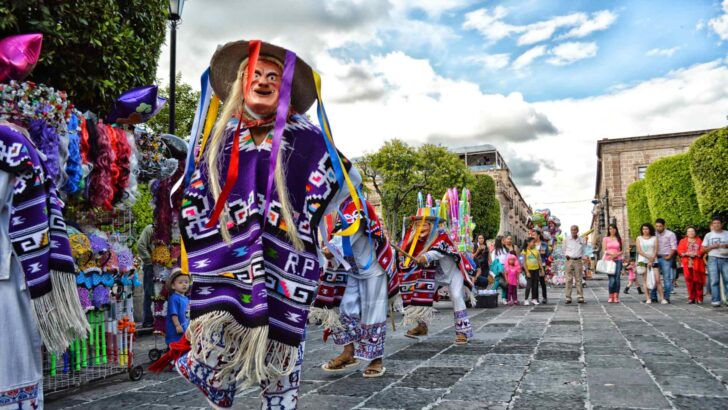
- Michoacán is famous for visually striking Día de los Muertos traditions.
- Lake Pátzcuaro communities receive many visitors during the holiday.
- Janitzio is especially well known internationally for nighttime observances.
- Purépecha communities in Michoacán have their own living traditions connected with remembrance of the dead.
- Those traditions should not be reduced to tourist spectacle.
- Oaxaca is another Mexican state known for elaborate Día de los Muertos observances.
- Mexico City hosts major public altars, events, performances, and parades.
- A large Mexico City Day of the Dead parade began in 2016.
- Its development was partly influenced by a fictional parade depicted in the James Bond movie “Spectre.”
- That is an unusual example of a movie image helping inspire a real modern public tradition.
- Public parades are therefore not proof that one identical parade existed nationwide for centuries.
- Regional Indigenous languages use their own names and concepts for local observances.
- Mexican communities outside Mexico also maintain and adapt Día de los Muertos traditions.
- Community celebrations in the United States can blend family heritage, public education, art, and remembrance.
History, modern culture & respectful participation
- Pre-Hispanic Mesoamerican cultures held many distinct beliefs and rituals concerning death and ancestors.
- There was not one single ancient “Day of the Dead” practiced identically across all of Mesoamerica.
- Spanish colonization brought Catholic feast days and religious practices into existing Indigenous traditions.
- Modern Día de los Muertos developed through centuries of cultural change and blending.
- That history is more complex than saying the holiday is simply “Aztec.”
- The celebration remains a living tradition rather than a frozen recreation of the distant past.
- Contemporary art, movies, tourism, schools, and social media continue influencing how it is represented.
- Animated movies have introduced many children worldwide to Día de los Muertos imagery.
- Pop-culture visibility can be useful when it encourages people to learn beyond the costumes and skulls.
- Buying Mexican-made crafts can support artists who work within these traditions.
- Mass-produced skull decorations do not automatically carry the same meaning as a family ofrenda.
- A respectful public altar should identify and honor real people rather than use death only as an aesthetic.
- Visitors should follow cemetery rules and local expectations.
- Graves are personal spaces, not photo props.
- Photographing people during private mourning may be intrusive even during a public holiday.
- Asking before photographing an altar or ceremony is a good habit.
- Learning the names of objects such as cempasúchil, ofrenda, pan de muerto, and calavera adds useful context.
- Pronouncing the holiday in Spanish is a small sign of attention rather than a requirement for appreciation.
- Día de los Muertos can coexist with Halloween in modern Mexican and Mexican American communities.
- Celebrating one does not erase the other.
- The holiday’s imagery is joyful, but grief remains part of the experience.
- An altar can honor someone with jokes because affection is not always solemn.
- Favorite music can be as meaningful as traditional holiday music.
- A humble family altar can carry just as much meaning as an enormous public installation.
- After 145 facts, the clearest one is still the simplest: Día de los Muertos is about keeping memory present.
Quick FAQ
Q: When is Día de los Muertos?
A: November 1 and November 2 are the main dates, though preparations and local observances can begin earlier.
Q: Is Día de los Muertos the same as Halloween?
A: No. They happen near each other, but Día de los Muertos centers on honoring and remembering the dead and has distinct Mexican cultural and religious roots.
Q: What is an ofrenda?
A: It is an altar created to honor deceased loved ones, commonly using photographs, candles, flowers, food, water, and personal objects.
Q: Why are marigolds used?
A: Their intense color and fragrance are traditionally associated with welcoming and guiding the spirits of loved ones.
Q: What is pan de muerto?
A: It is a sweet enriched bread made for the season, often decorated with dough shapes resembling bones and flavored with citrus or other regional ingredients.

Ellie is the owner and sole author of Fun Facts, combining her mechanical engineering background with years of research-driven writing to deliver facts you can trust. Every article is thoroughly fact-checked and routinely updated as new science and sources emerge to keep information accurate and current. Her mission is to make learning delightful while upholding high standards of reliability and transparency.