
Hippos look like oversized river pillows until one opens its mouth, charges, or launches itself along the bottom of a river. These massive African mammals spend daylight in water, graze mostly on land at night, communicate above and below the surface, secrete their own reddish skin protectant, and are far more athletic than their shape advertises.
Hippos are enormous semiaquatic mammals
- The common hippopotamus's scientific name is Hippopotamus amphibius.
- Common hippos are native to sub-Saharan Africa.
- They live near rivers, lakes, wetlands, and other permanent water.
- Adult males can weigh several thousand pounds.
- Large males may exceed 7,000 pounds.
- Females are generally smaller than males.
- Hippos are among the heaviest living land mammals.
- Only elephants and some rhinoceroses consistently exceed them in mass.
- The barrel-shaped body sits on relatively short legs.
- Each foot has four toes.
- Webbing between the toes helps spread weight and move through water.
- The skin can be more than an inch thick in places.
- Hippos have very little body hair.
- Hair is concentrated mainly around the muzzle and tail.
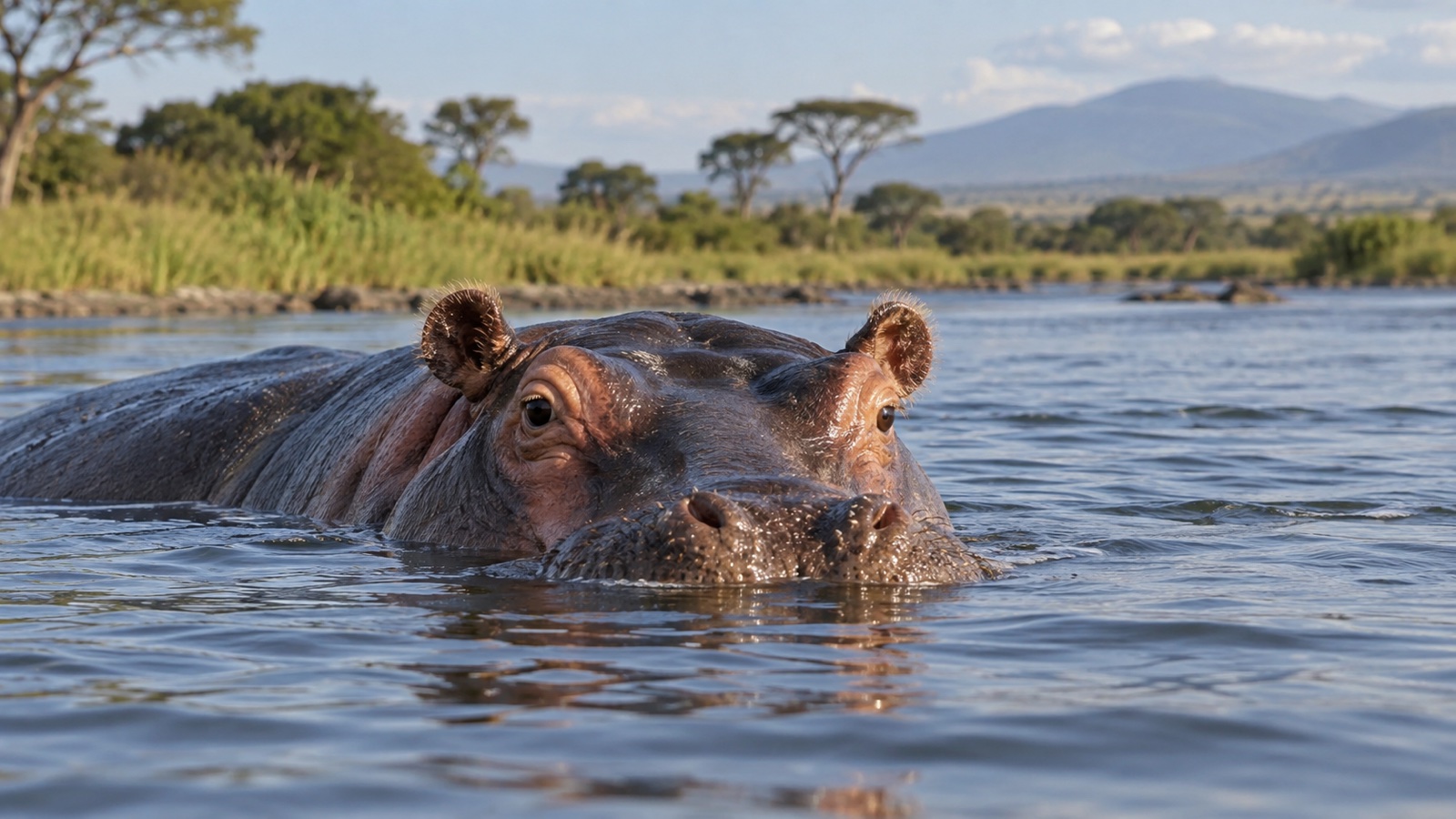
- The eyes, ears, and nostrils sit high on the skull.
- That arrangement lets a mostly submerged hippo see, hear, and breathe.
- The nostrils close when the animal submerges.
- The ears can fold or close tightly against water.
- Hippos are even-toed ungulates.
- The animal looks like a beanbag until you remember the beanbag weighs more than many pickup trucks.
Their closest living relatives are whales and dolphins
- Hippos are not especially close relatives of pigs despite superficial similarities.
- Genetic and fossil evidence places hippos closest to cetaceans.
- Cetaceans include whales, dolphins, and porpoises.
- Hippos and cetaceans share a common semiaquatic ancestor deep in mammalian history.
- The combined group is often called Whippomorpha in scientific classification.
- The hippo-cetacean split occurred tens of millions of years ago.
- Whales became fully aquatic.
- Hippo ancestors followed a different evolutionary path.
- Modern hippos retain limbs built for land movement.
- Their bones are unusually dense.
- Dense bones help reduce buoyancy.
- Reduced buoyancy makes it easier to stay submerged in shallow water.
- Hippos do not have the streamlined body of a whale.
- They do share several adaptations for aquatic life.
- Both groups can produce complex underwater sounds.
- Hippos give birth to well-developed young like other placental mammals.
- They nurse calves with milk.
- Hippo evolutionary history has been reshaped repeatedly as new fossils are discovered.
- Scientific family trees are hypotheses updated with evidence rather than permanent diagrams carved in stone.
- Finding out a hippo is closer to a whale than a pig is exactly the kind of family secret genetics was invented to reveal.
Hippos do not really swim the way many people imagine
- Hippos spend much of the day in water.
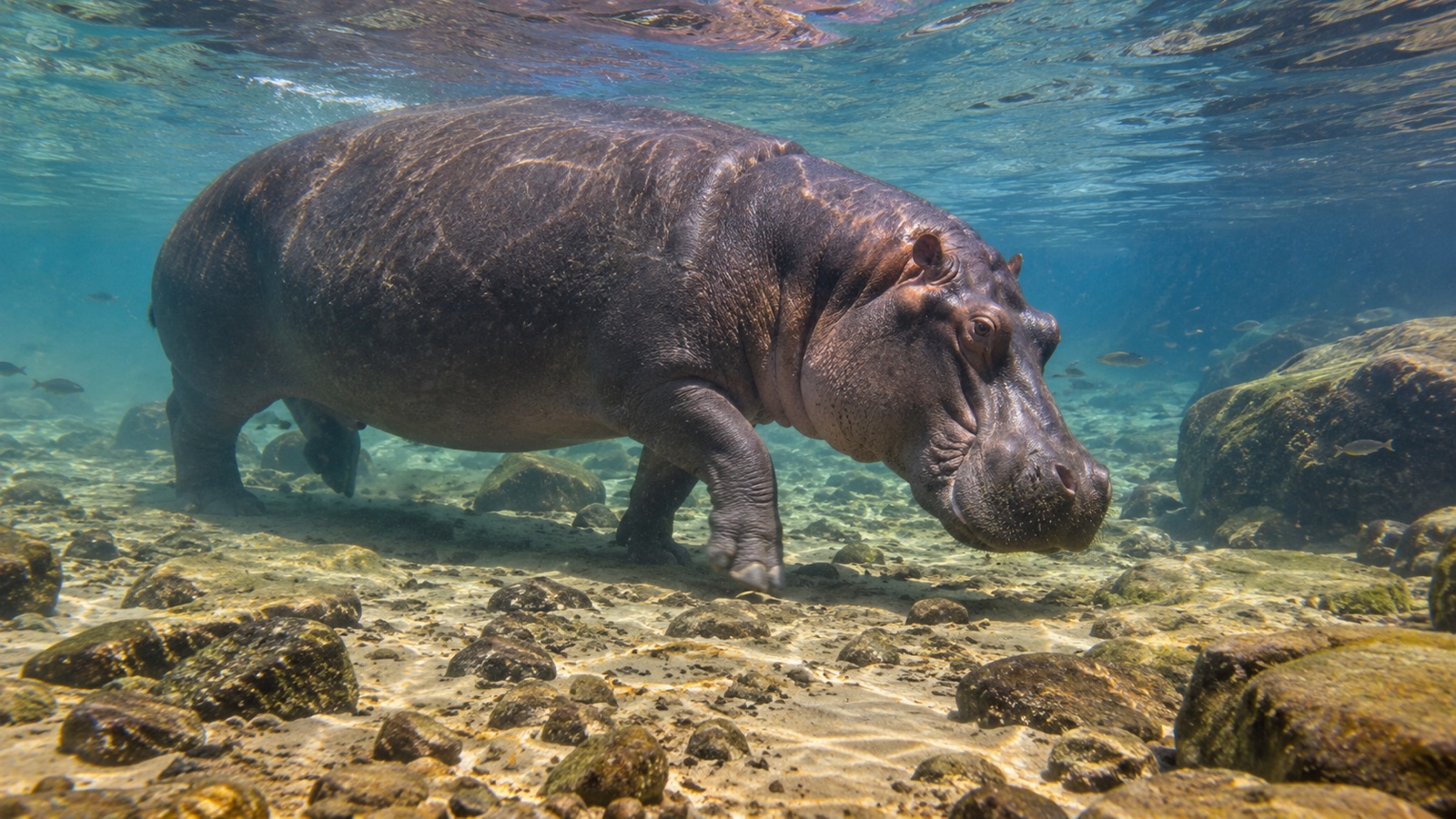
- They are excellent movers underwater.
- They often walk, trot, or push off the bottom instead of performing continuous swimming strokes.
- Dense bones help keep them from floating high at the surface.
- A hippo can launch itself upward to breathe.
- Adults can remain submerged for several minutes.
- Calves surface more frequently than adults.
- Hippos can sleep in water.
- A sleeping hippo can surface to breathe with minimal conscious effort.
- Buoyancy and bottom contact help support the body while resting.
- Hippos move surprisingly gracefully underwater.
- They can push through strong river currents.
- Deep water is not required for all hippo activity.
- Shallow pools can be important refuges during dry seasons.
- Overcrowding can occur when water sources shrink.
- Competition increases around limited pools.
- Hippos may leave water at night to graze several miles away.
- They often follow repeated trails between water and feeding grounds.
- Those trails can become deeply worn into banks.
- Watching a hippo bounce along a river bottom feels less like swimming and more like underwater moonwalking performed by a rhinoceros-sized athlete.
The famous “blood sweat” is neither blood nor sweat
Hippos can appear to sweat pink or red fluid, which sounds alarming until you learn they do not actually have ordinary sweat glands. Their skin secretes oily compounds that oxidize into reddish and orange pigments with antibacterial and ultraviolet-absorbing properties.
- Hippos do not sweat like humans do.
- Special skin glands produce a colorless oily secretion.
- The secretion develops orange and reddish colors after exposure to air.
- One pigment is called hipposudoric acid.
- Another is called norhipposudoric acid.
- These pigments can absorb ultraviolet light.
- The secretion may provide some natural protection from solar radiation.
- It also shows antibacterial activity in laboratory studies.
- The secretion helps keep exposed skin moist.
- Hippo skin can crack when animals stay out of water too long.
- Water and mud are still essential to skin health.
- The fluid is not blood.
- The fluid is not conventional sweat.
- The phrase “blood sweat” survives because the color looks dramatic.
- Hippo skin itself is grayish to brown with pinkish areas.
- Blood vessels near the skin can also influence coloration.
- Young hippos have relatively smooth skin.
- Older animals may carry scars from fights.
- Mud provides physical coating and cooling in addition to water.
- A hippo essentially has self-produced skin chemistry good enough to inspire researchers and confusing enough to alarm every first-time zoo visitor.
Those huge mouths are built for fighting as well as feeding
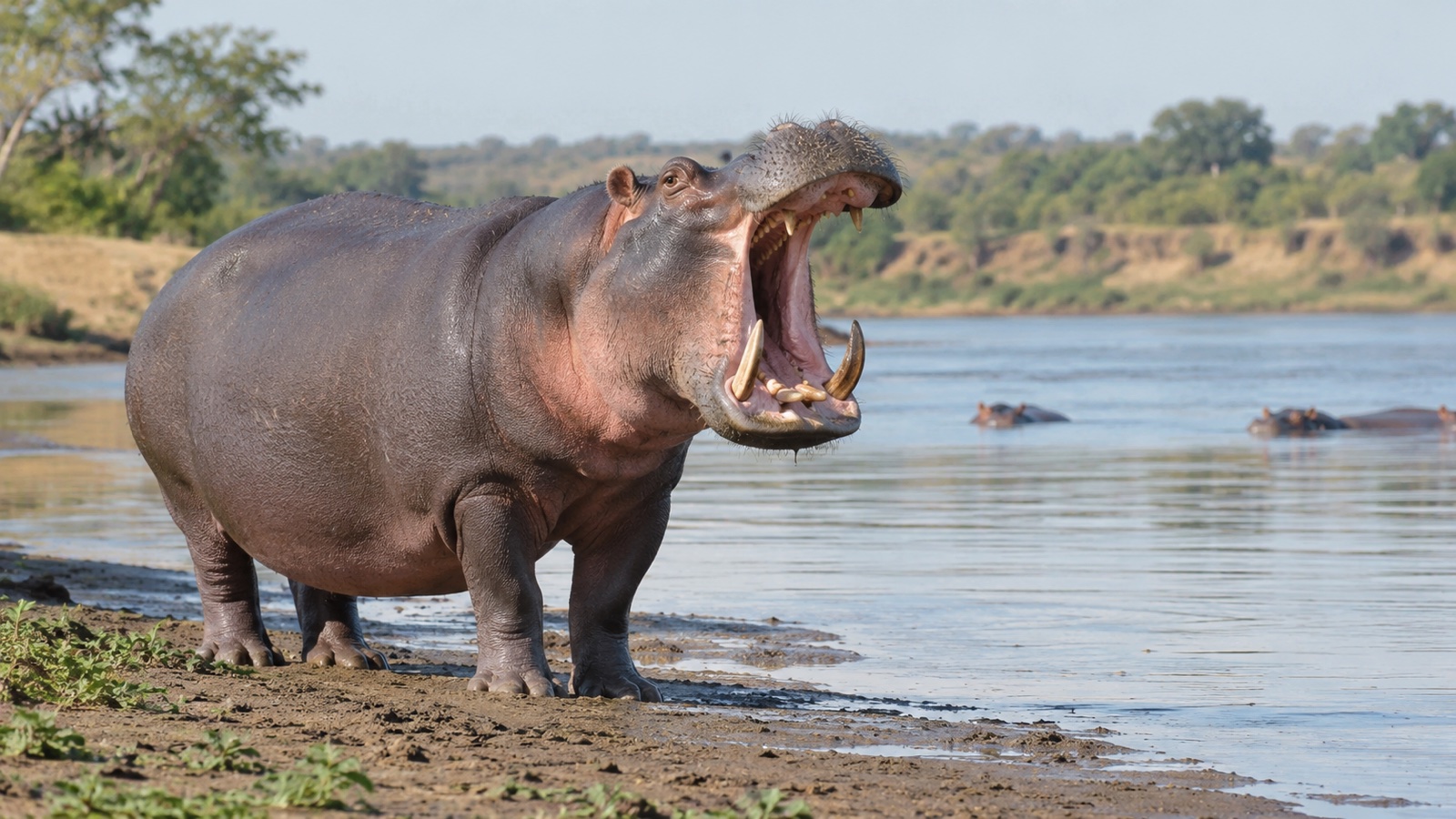
- A hippo can open its jaws extraordinarily wide.
- Large yawns are often threat displays rather than signs of sleepiness.
- Adult males use their mouths during territorial fights.
- The lower canine teeth can become more than a foot long.
- Hippo canines grow continuously.
- The incisors also continue growing.
- Opposing teeth sharpen one another through wear.
- Hippo teeth contain dense ivory-like dentin.
- Hippo ivory has been carved historically.
- International wildlife rules restrict trade in hippo parts.
- The lips are broad and muscular.
- Hippos usually graze by cropping grass with their lips.
- They do not typically use giant canine teeth to cut grass.
- Common hippos eat mostly grasses.
- They can consume dozens of pounds of vegetation in one night.
- Occasional meat eating or scavenging has been observed.
- Those observations do not make hippos regular carnivores.
- The digestive system is adapted primarily for plant food.
- Hippos are foregut fermenters with a complex multi-chambered stomach.
- A mouth capable of opening roughly 150 degrees is a useful reminder that “yawning” can be a very misleading social signal.
Hippo society is territorial in water and looser on land
Hippo groups can look peacefully crowded during the day, but the social rules depend heavily on sex, water access, and territory. Dominant males defend stretches of water, while nighttime grazing is less tightly territorial and animals often spread far apart.
- A group of hippos is sometimes called a pod, herd, bloat, or school.
- Common hippos may gather in groups containing many individuals.
- Adult territorial males defend valuable aquatic areas.
- Females and subordinate males may remain within a dominant male's territory.
- Territorial boundaries can follow sections of river or shoreline.
- Males advertise with yawns, grunts, dung spreading, and aggressive displays.
- The tail can spread feces during territorial marking.
- Rapid tail flicking scatters dung over vegetation and ground.
- Hippos make loud grunts and wheezing honks.
- Some calls are transmitted through both air and water.
- A hippo can hear a partly submerged neighbor across the air-water boundary.
- Researchers have found evidence that hippos distinguish familiar and unfamiliar group voices.
- Strangers can trigger stronger territorial reactions.
- Males fight with canine teeth and enormous jaw force.
- Serious fights can cause deep wounds.
- Many confrontations end with displays rather than fatal combat.
- Subordinate males may avoid challenging a dominant male directly.
- Grazing areas at night can overlap among individuals.
- Hippos often return to familiar water sites before daylight.
- A crowded hippo pool can look like a spa day until you realize everyone is keeping track of a very serious seating chart.
Calves, conservation and 25 final hippo facts
- Female hippos usually give birth to one calf.
- Gestation lasts about eight months.
- Birth can occur in water or on land.
- Newborn common hippos weigh roughly 50 to 100 pounds.
- Calves can nurse underwater.
- They close their nostrils and ears while submerged.
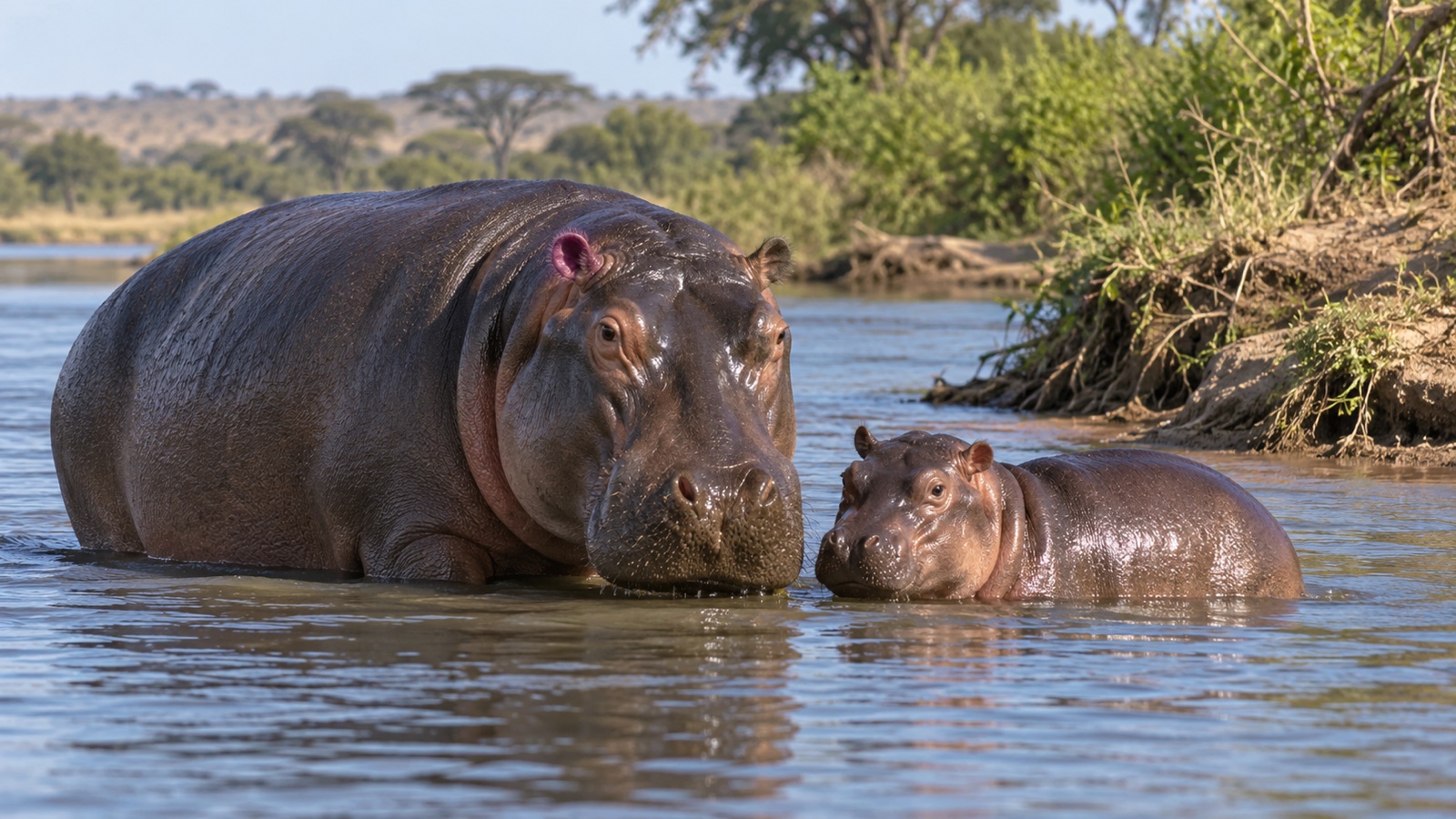
- Mothers are highly protective of young calves.
- Calves often rest on or near their mothers in water.
- Young begin nibbling vegetation before they are fully weaned.
- Common hippos are classified as vulnerable on the IUCN Red List.
- Habitat loss and illegal hunting threaten populations.
- Hippo teeth and meat can drive poaching.
- Water diversion and drought can reduce critical aquatic habitat.
- Conflict occurs when hippos and people share rivers, fields, or lakeshores.
- Hippos can be extremely dangerous when surprised, cornered, or defending water and calves.
- Reliable worldwide rankings of “the deadliest animal in Africa” are difficult, so dramatic fixed death-count claims should be treated cautiously.
- Giving wild hippos a large buffer is far safer than trying to judge whether one looks calm.
- Pygmy hippos are a separate species.
- Pygmy hippos live mainly in forests and swamps of West Africa.
- They are much smaller and more solitary than common hippos.
- Pygmy hippos are endangered.
- Common hippos transport nutrients from land into rivers through nighttime grazing and daytime defecation.
- Very dense hippo populations can strongly alter water chemistry and oxygen levels.
- Fossils show hippos once had a much wider distribution, including parts of Europe and North Africa.
- After 145 facts, hippos look less like oversized aquatic cows and more like semiaquatic ecosystem engineers with whale relatives, self-made sunscreen chemistry, territorial politics, and teeth nobody should ever mistake for a smile.
Quick FAQ
Q: Can hippos swim?
A: They move extremely well in water, but often walk, trot, or push off the bottom rather than swimming continuously with ordinary paddling strokes.
Q: Is hippo “blood sweat” really blood?
A: No. It is an oily skin secretion containing pigments that turn orange-red and can absorb ultraviolet light and inhibit some bacteria.
Q: Are hippos related to pigs?
A: Not especially closely. Their nearest living relatives are cetaceans, the group containing whales and dolphins.
Q: Are hippos herbivores?
A: Yes, primarily. They eat mostly grasses, although rare meat eating and scavenging have been documented.
Q: Are hippos dangerous?
A: Yes. They are powerful territorial wildlife and can attack people when threatened or surprised, especially around water. They should always be given substantial distance.

Ellie is the owner and sole author of Fun Facts, combining her mechanical engineering background with years of research-driven writing to deliver facts you can trust. Every article is thoroughly fact-checked and routinely updated as new science and sources emerge to keep information accurate and current. Her mission is to make learning delightful while upholding high standards of reliability and transparency.