
Cambodia has one monument so famous it sits on the national flag, but Angkor Wat is only the front door. Behind it are floating lake communities, Mekong dolphins, jungle temples, pepper farms, silk weaving, royal dance, extraordinary stone engineering, painful modern history, and a food culture that deserves far more attention than it gets.
Cambodia sits between the Mekong and the Gulf of Thailand
- Cambodia is located in mainland Southeast Asia.
- Phnom Penh is the national capital and largest city.
- Cambodia borders Thailand, Laos, and Vietnam.
- The Gulf of Thailand forms the country's southwestern coast.
- The national currency is the Cambodian riel.
- U.S. dollars are also widely used in many everyday transactions.
- Small change is commonly returned in riel.
- Khmer is the official language.
- Khmer has its own distinctive writing system.
- Khmer belongs to the Austroasiatic language family.
- The country's name in Khmer is Kampuchea.
- Cambodia is a constitutional monarchy.
- The king is head of state.
- The national flag is blue and red with Angkor Wat in the center.
- Cambodia is one of the few countries with a building prominently shown on its flag.
- The country is divided into provinces plus the municipality of Phnom Penh.
- Cambodia uses Indochina Time year-round.
- It is seven hours ahead of Coordinated Universal Time.
- The country does not use Daylight Saving Time.
- If your national flag contains a 12th-century temple complex, civic branding has become almost unfairly easy.
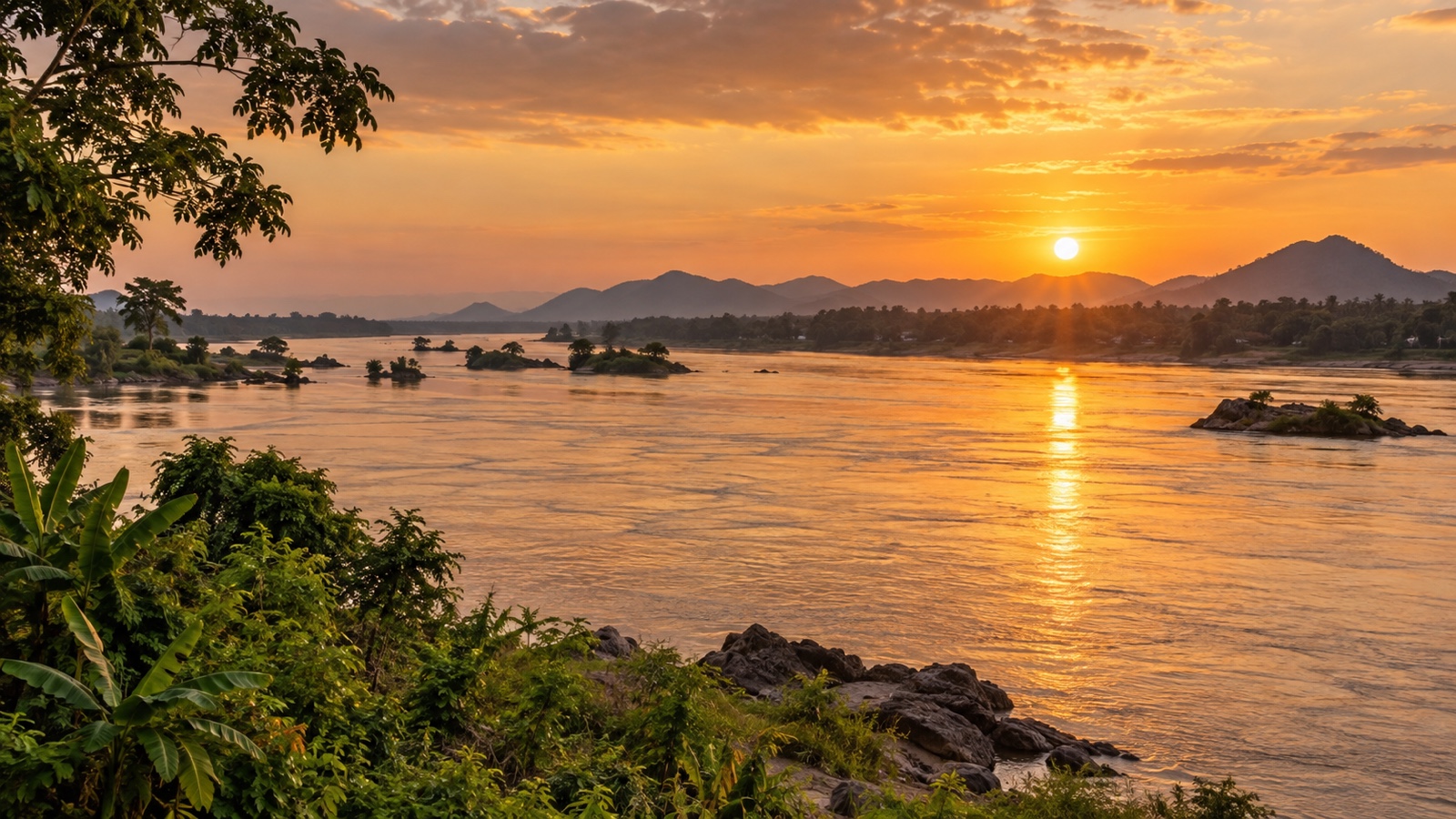
Tonle Sap reverses direction every year
- Tonle Sap is Southeast Asia's largest freshwater lake by seasonal area.
- The lake changes size dramatically between dry and wet seasons.
- The Tonle Sap River connects the lake with the Mekong River system.
- During the dry season, water generally flows out of Tonle Sap toward the Mekong.
- During the monsoon, high Mekong water pushes the Tonle Sap River backward.
- The reversed flow carries water into the lake.
- The lake can expand to several times its dry-season area.
- Flooded forests provide enormous fish-nursery habitat.
- Tonle Sap supports one of the world's most productive inland fisheries.
- Fish are central to Cambodian diets and livelihoods.
- Millions of people depend directly or indirectly on the lake system.
- Floating and stilt-house communities live around the lake.
- Some houses stand high above dry-season ground to handle annual flooding.
- The Mekong enters Cambodia from Laos.
- It flows past Phnom Penh before entering Vietnam.
- The Bassac River branches from the Mekong near Phnom Penh.
- Monsoon timing is crucial to farming and fisheries.
- Upstream dams, climate change, drought, overfishing, and habitat loss affect the river-lake system.
- Tonle Sap's annual pulse is basically a giant natural breathing cycle for Cambodian freshwater ecosystems.
- A river changing direction on schedule is the kind of fact that makes ordinary drainage feel lazy.
The Khmer Empire built Angkor on an enormous scale
- The Khmer Empire became one of Southeast Asia's great premodern states.
- Its political center was in the Angkor region for centuries.
- Angkor contains hundreds of temples and archaeological sites.
- The urban landscape once supported a very large population.
- Canals, reservoirs, embankments, and ponds managed water across the region.
- Angkor Wat was built during the early 12th century.
- King Suryavarman II commissioned the temple.
- Angkor Wat was originally dedicated primarily to the Hindu god Vishnu.
- It later became a Buddhist sacred site.
- The temple remains an active religious place as well as an archaeological monument.
- Its five central towers symbolize Mount Meru in Hindu cosmology.
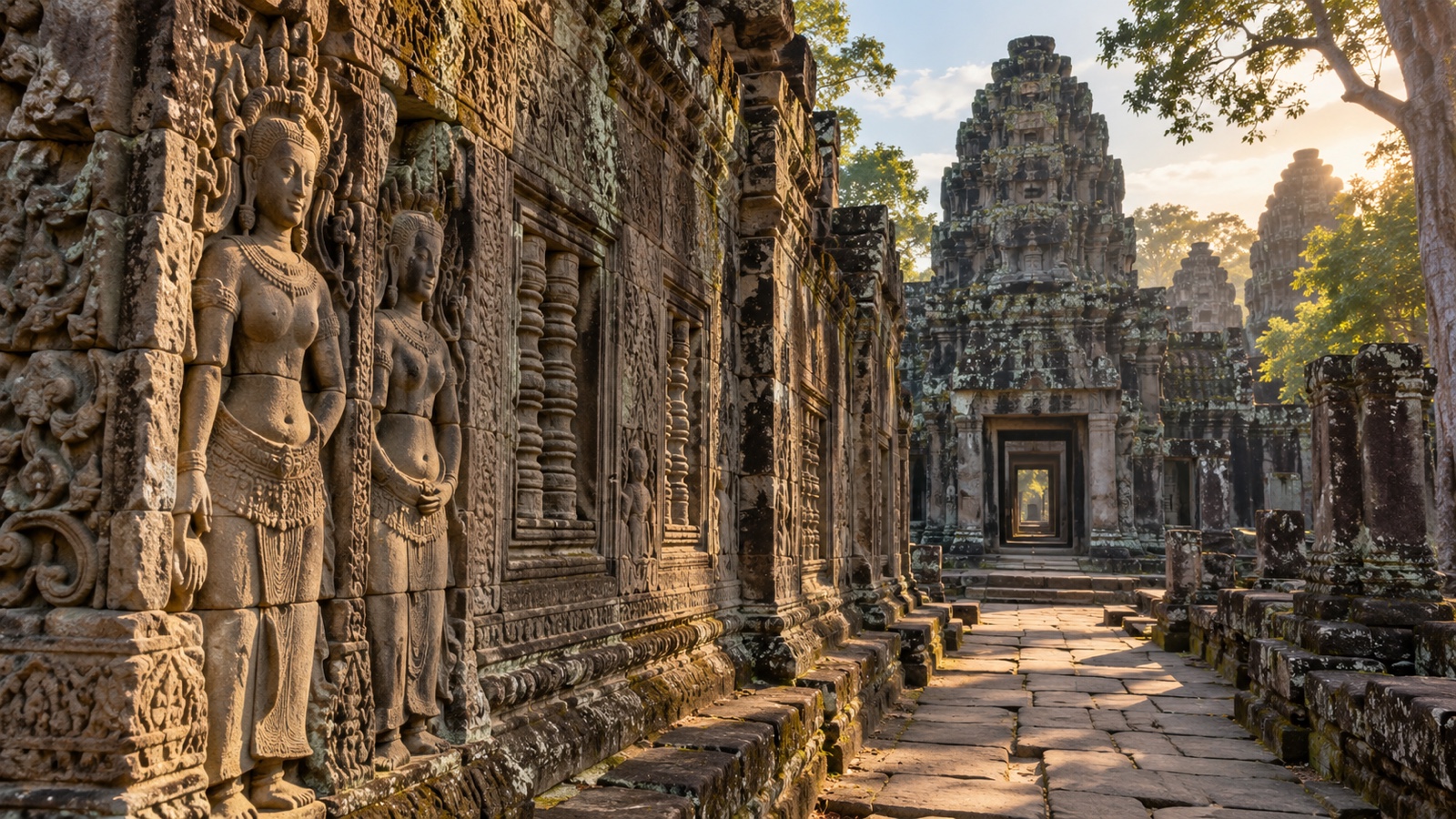
- Extensive bas-reliefs cover gallery walls.
- The carvings depict myths, battles, processions, and royal imagery.
- Angkor Wat is oriented toward the west, unlike many Khmer temples.
- Scholars have debated the symbolic and funerary meanings of that orientation.
- Angkor Thom was a later walled royal city.
- King Jayavarman VII built major monuments there.
- The Bayon is famous for giant serene faces carved on towers.
- Ta Prohm became famous for enormous tree roots growing over temple ruins.
- Angkor is less “one lost temple” and more an entire metropolitan archaeological landscape hiding behind one famous sunrise photo.
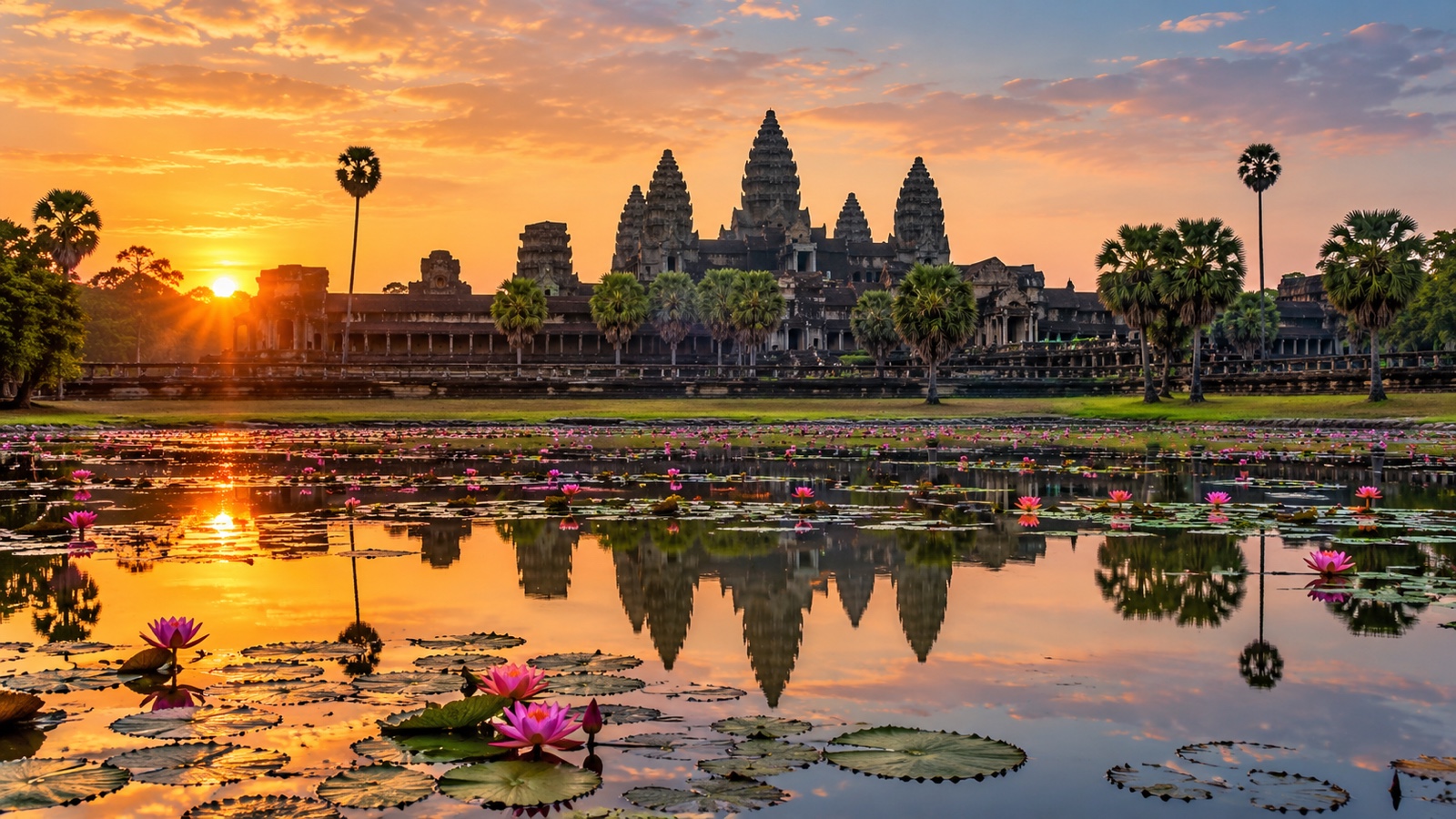
Khmer culture survived centuries of political upheaval
Cambodian culture did not freeze when Angkor's political importance declined. Khmer language, Buddhism, court dance, village traditions, crafts, food, music, and family life kept changing through later kingdoms, Thai and Vietnamese pressure, French colonialism, war, genocide, migration, and modern rebuilding.
- Theravada Buddhism is followed by most Cambodians.
- Buddhist monasteries are called wats.
- Monks traditionally wear saffron or orange robes.
- Many Cambodian men spend some period as monks or novices, although practices vary.
- Pchum Ben is an important festival honoring ancestors.
- Khmer New Year is celebrated in April.
- Water Festival celebrations are associated with the seasonal reversal of the Tonle Sap River and boat racing.
- Royal Ballet of Cambodia preserves a classical court-dance tradition.
- Apsara dancers are inspired partly by celestial figures shown in Angkorian art.
- Classical dancers use highly controlled hand and finger gestures.
- Pinpeat ensembles use instruments including xylophones, gongs, drums, and oboes.
- Shadow-puppet traditions survive in several forms.
- Silk weaving is practiced in Cambodian villages and workshops.
- Traditional krama scarves are woven in many colors and patterns.
- The krama is used as clothing, sun protection, a towel, carrying cloth, and more.
- Khmer houses in flood-prone regions may be raised on stilts.
- Rice farming remains central to rural life.
- Family and village networks play major social roles.
- Cambodian culture was deliberately targeted during the Khmer Rouge era but survived through people who preserved, remembered, and retaught it.
- A dance tradition surviving genocide is not quaint heritage; it is cultural resilience in motion.
French rule and war reshaped modern Cambodia
- Cambodia became a French protectorate in 1863.
- It was incorporated into French Indochina.
- French colonial rule lasted, with wartime interruptions, until the mid-20th century.
- King Norodom Sihanouk became a major figure in the independence movement.
- Cambodia achieved full independence from France in 1953.
- Sihanouk pursued a policy of neutrality during much of the early Vietnam War era.
- North Vietnamese and Viet Cong forces operated in Cambodian border regions.
- The United States secretly bombed Cambodian territory before expanding the campaign publicly.
- General Lon Nol overthrew Sihanouk in 1970.
- Civil war intensified between the Khmer Republic and communist Khmer Rouge forces.
- The Khmer Rouge captured Phnom Penh on April 17, 1975.
- They immediately forced most urban residents into the countryside.
- Money, markets, many schools, and many religious institutions were abolished or destroyed.
- People were forced into brutal agricultural labor systems.
- Intellectuals, officials, religious figures, minorities, and suspected enemies were targeted.
- Starvation, overwork, disease, torture, and execution killed enormous numbers of people.
- Historians commonly estimate that roughly 1.5 to 2 million people died under Khmer Rouge rule.
- Vietnamese forces invaded Cambodia in late 1978.
- Phnom Penh fell to Vietnamese-backed forces in January 1979.
- The Khmer Rouge period lasted less than four years and permanently changed millions of Cambodian families.
Recovery included peace agreements, demining and difficult accountability
War did not simply end in 1979. Cambodia endured continued fighting, international rivalry, refugee crises, land mines, competing governments, and years of negotiation before a 1991 peace agreement opened a new political phase.
- Fighting continued after the fall of the Khmer Rouge government.
- Khmer Rouge forces remained active in parts of Cambodia for years.
- The conflict became entangled in wider Cold War politics.
- The Paris Peace Agreements were signed in 1991.
- The United Nations Transitional Authority in Cambodia helped administer a transition.
- UN-supervised elections were held in 1993.
- The monarchy was restored.
- Norodom Sihanouk again became king.
- Land mines and unexploded ordnance remained scattered across rural areas.
- Cambodia became one of the world's most heavily mined countries.
- Mine-clearing organizations have removed large numbers of explosives.
- Land-mine deaths and injuries have fallen dramatically from past peaks.
- Some contaminated areas still require clearance.
- Mine-detection teams have used trained dogs and African giant pouched rats.
- A rat named Magawa became internationally famous for helping detect land mines.
- The Extraordinary Chambers in the Courts of Cambodia prosecuted senior Khmer Rouge figures.
- The tribunal was supported by Cambodia and the United Nations.
- Several senior Khmer Rouge leaders were convicted of serious international crimes.
- Debates continue over justice, political influence, historical memory, and survivor support.
- Cambodia's recovery is measured not only in new buildings but in whether people can safely walk across former battlefields.
Amok, pepper, dolphins and 25 final Cambodia facts
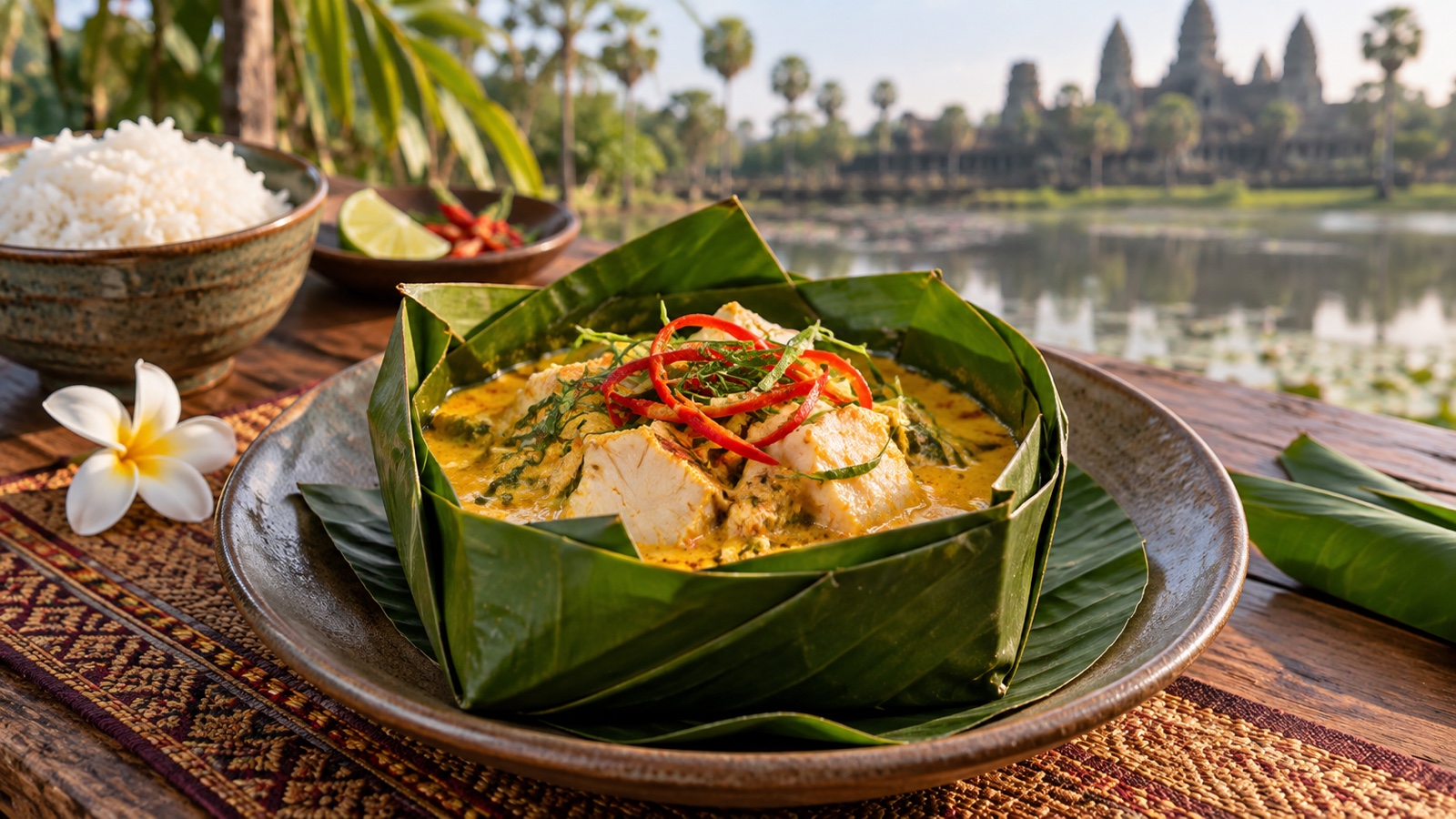
- Fish amok is one of Cambodia's best-known dishes.
- It commonly combines fish with coconut milk, herbs, spices, and a curry paste called kroeung.
- Prahok is a strongly flavored fermented fish paste.
- Prahok adds savory depth to many Khmer dishes.
- Nom banh chok is a rice-noodle dish commonly eaten for breakfast.
- Beef lok lak is another popular Cambodian dish.
- Kampot pepper is internationally famous for its flavor and protected geographic identity.
- Kampot Province also grows durian and other tropical fruit.
- Palm sugar is traditionally made from the sap of sugar palms.
- The sugar palm is an important Cambodian landscape and cultural symbol.
- Irrawaddy dolphins live in a stretch of the Mekong in northeastern Cambodia.
- The freshwater Mekong population is critically endangered.
- The giant ibis is Cambodia's national bird.
- It is critically endangered.
- Siamese crocodiles survive in small wild populations in Cambodia.
- Conservation programs have released captive-bred crocodiles into protected habitat.
- Asian elephants survive in some eastern forest landscapes.
- Cardamom Mountains forests support exceptional biodiversity.
- Cambodia has a short but important Gulf of Thailand coastline.
- Koh Rong and other islands have become major beach destinations.
- Phnom Penh sits where the Mekong, Tonle Sap, and Bassac river system converges.
- The Royal Palace remains an important Phnom Penh landmark.
- Angkor Wat is the largest religious monument complex in the world by commonly cited area measures.
- Football and traditional boat racing are popular sports and festival activities.
- After 145 facts, Cambodia still feels like a country where water, stone, rice, memory, and survival keep showing up in every chapter.
Quick FAQ
Q: What is Cambodia famous for?
A: Angkor Wat, Khmer civilization, Tonle Sap, the Mekong, apsara dance, tropical food, Kampot pepper, Buddhist temples, difficult Khmer Rouge history, and extraordinary archaeological sites.
Q: What is the capital of Cambodia?
A: Phnom Penh is both the capital and largest city.
Q: Why does Tonle Sap River reverse direction?
A: During monsoon season, high water in the Mekong pushes the Tonle Sap River backward, filling and greatly expanding Tonle Sap Lake.
Q: Is Angkor Wat Buddhist or Hindu?
A: It was originally built as a Hindu temple associated with Vishnu and later became a Buddhist sacred site, which it remains today.
Q: How many people died under the Khmer Rouge?
A: Estimates vary, but historians commonly place the death toll at roughly 1.5 to 2 million people from execution, starvation, disease, and forced labor.

Ellie is the owner and sole author of Fun Facts, combining her mechanical engineering background with years of research-driven writing to deliver facts you can trust. Every article is thoroughly fact-checked and routinely updated as new science and sources emerge to keep information accurate and current. Her mission is to make learning delightful while upholding high standards of reliability and transparency.