
North Dakota is the state people joke about forgetting, which is convenient for everyone who has not noticed the painted badlands, roaming bison, huge sunflower fields, Scandinavian heritage, missile history, oil boomtowns, Indigenous nations, and a roadside cow tall enough to have opinions about interstate traffic.
North Dakota basics from the Peace Garden State
- North Dakota became a state on November 2, 1889.
- South Dakota became a state on the same day.
- President Benjamin Harrison intentionally shuffled the statehood papers so the exact order of signing would not be known.
- North Dakota is therefore commonly listed as the 39th state alphabetically, not because anyone knows it was signed first.
- Bismarck is the state capital.
- Fargo is North Dakota’s largest city.
- North Dakota has 53 counties.
- The postal abbreviation is ND.
- The official nickname is the Peace Garden State.
- The nickname honors the International Peace Garden on the Canadian border.
- North Dakota borders Montana, South Dakota, and Minnesota.
- It also borders Saskatchewan and Manitoba in Canada.
- Most of the state uses Central Time.
- Several southwestern counties use Mountain Time.
- North Dakota is one of America’s least densely populated states.
- The state lies almost entirely within the Great Plains.
- Western North Dakota is drier and more rugged than the east.
- Eastern North Dakota is dominated by flat fertile farmland.
- The state motto is “Liberty and Union Now and Forever, One and Inseparable.”
- That is a very long motto for a state famous for wide-open space.
Badlands, grasslands & the Missouri River
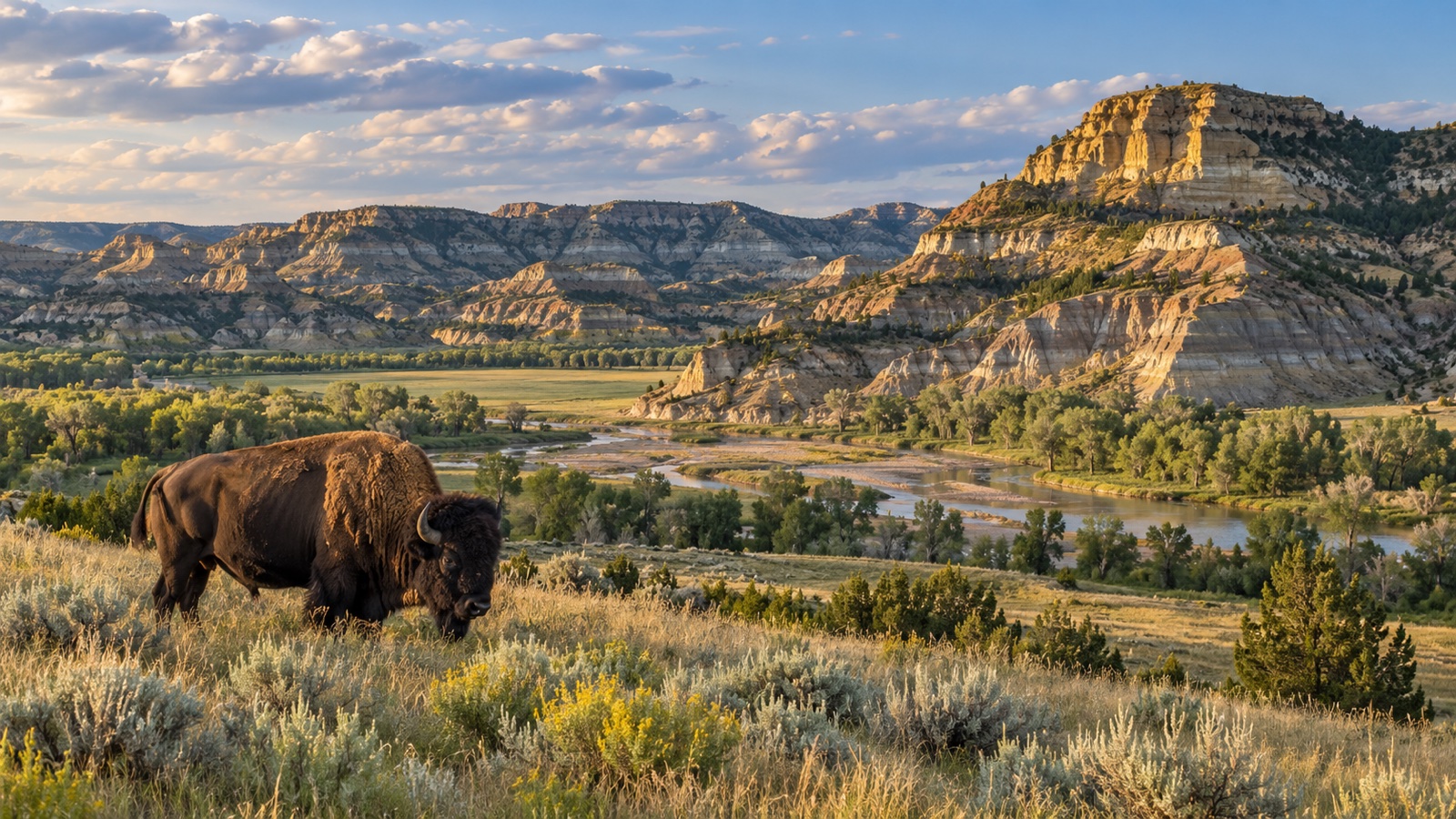
- North Dakota’s badlands lie mainly in the western part of the state.
- They were carved by erosion into colorful buttes, ridges, gullies, and valleys.
- The Little Missouri River winds through the badlands.
- Theodore Roosevelt National Park protects three separate units in western North Dakota.
- The park was established in 1978.
- It honors Theodore Roosevelt’s strong connection with the region.
- Roosevelt first came to the Dakota badlands to hunt bison in 1883.
- He later owned ranching interests there.
- Roosevelt said his experiences in the West influenced his conservation outlook.
- White Butte is North Dakota’s highest natural point.
- It reaches 3,506 feet above sea level.
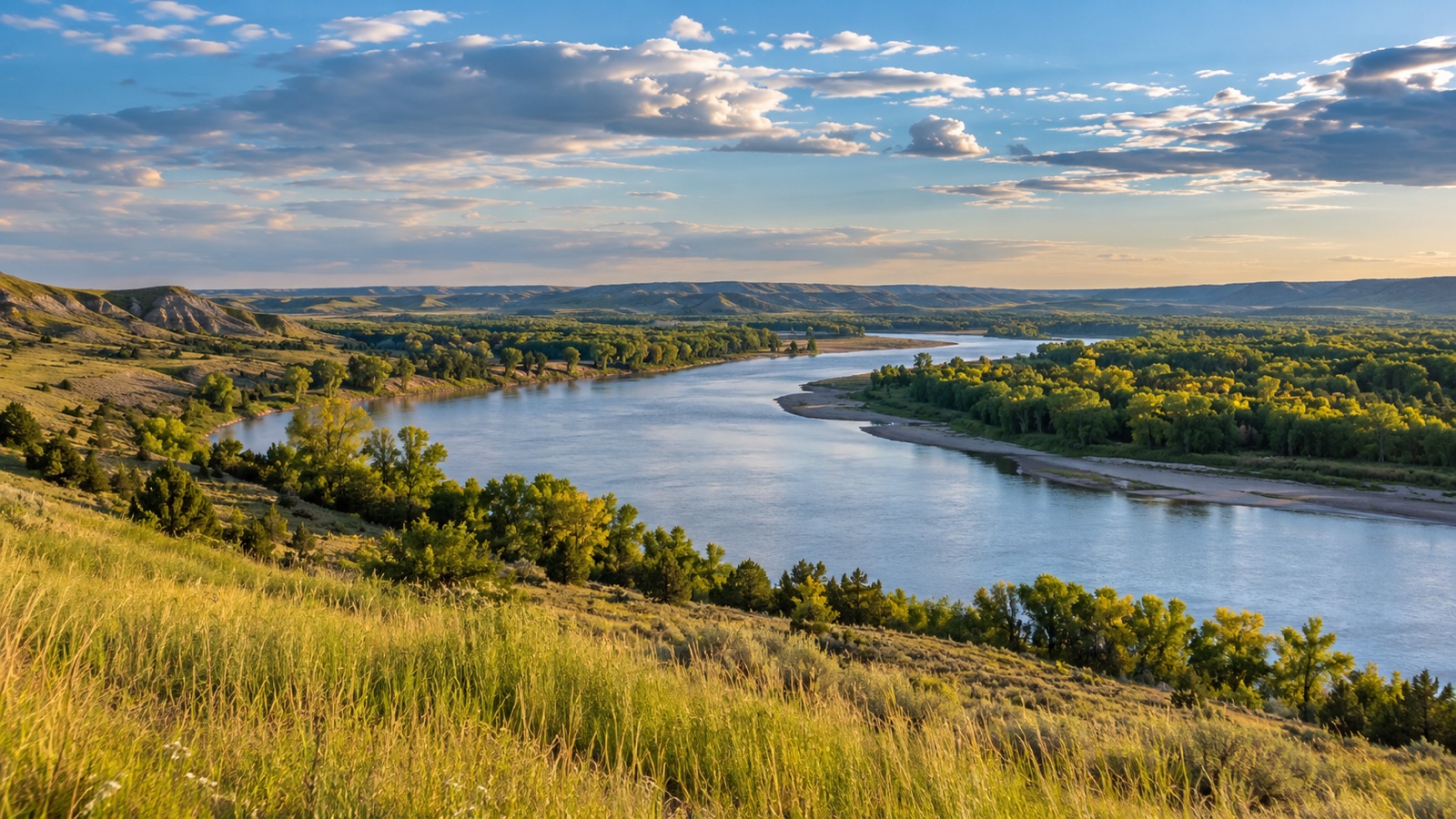
- The Missouri River enters North Dakota from Montana.
- It flows past Bismarck and Mandan before continuing into South Dakota.
- Garrison Dam creates Lake Sakakawea.
- Lake Sakakawea is one of the largest reservoirs in the United States.
- The reservoir stretches for well over 100 miles.
- The Red River of the North forms much of North Dakota’s eastern boundary with Minnesota.
- The Red River flows north toward Canada rather than south.
- Its flat valley is especially vulnerable to spring flooding.
- North Dakota’s rivers manage to run opposite directions while the western hills look like another planet.
Indigenous nations remain central to North Dakota
- Indigenous peoples lived across North Dakota for thousands of years before European colonization.
- The Mandan, Hidatsa, and Arikara Nation is headquartered on the Fort Berthold Reservation.
- Those three nations are often collectively called the Three Affiliated Tribes.
- The Standing Rock Sioux Tribe has lands in North Dakota and South Dakota.
- The Turtle Mountain Band of Chippewa Indians is based in north-central North Dakota.
- The Spirit Lake Nation is based near Devils Lake.
- The Sisseton-Wahpeton Oyate also has lands extending into southeastern North Dakota.
- Tribal nations maintain sovereign governments and distinct cultural traditions.
- The Mandan became famous for large earth-lodge villages along the Missouri River.
- Earth lodges provided substantial insulated living spaces.
- Mandan, Hidatsa, and Arikara agriculture traditionally included corn, beans, squash, and sunflowers.
- Plains bison were also enormously important for food, hides, tools, and trade.
- European diseases devastated Indigenous communities before large-scale U.S. settlement.
- The smallpox epidemic of 1837 was especially catastrophic along the upper Missouri.
- Sakakawea was a young Lemhi Shoshone woman who traveled with the Lewis and Clark Expedition.
- She joined the expedition while living among Hidatsa communities near present-day North Dakota.
- The spelling of her name varies across historical and tribal traditions.
- North Dakota commonly uses “Sakakawea” in state place names.
- Lake Sakakawea honors her.
- North Dakota history makes much more sense when tribal nations are treated as current neighbors instead of vanished characters.
Bison, prairie dogs & wildlife on the northern plains
North Dakota wildlife does not need mountains to be dramatic. Bison graze through badlands, prairie dogs build towns under grasslands, pronghorn sprint across western plains, and migrating waterfowl turn pothole wetlands into one of the continent’s most important bird nurseries.
- American bison live in Theodore Roosevelt National Park.
- The park manages separate bison herds in its South and North units.
- Bison can weigh more than a ton.
- Despite their size, bison can run much faster than a human.
- Visitors are required to keep a safe distance from them.
- Wild horses also live in Theodore Roosevelt National Park’s South Unit.
- Pronghorn inhabit open western North Dakota.
- Pronghorn are the fastest land mammals in North America.
- They are not true antelopes despite the common nickname “American antelope.”
- Black-tailed prairie dogs build colonies in western grasslands.
- Their burrows create habitat used by many other species.
- Sharp-tailed grouse are native prairie birds found in the state.
- North Dakota’s Prairie Pothole Region contains countless shallow glacial wetlands.
- Those wetlands provide breeding habitat for ducks and other waterfowl.
- The region has been called a duck factory because of its continental importance.
- Whooping cranes pass through North Dakota during migration.
- White-tailed deer are common across much of the state.
- Mule deer are more typical in western areas.
- Moose occur especially in northern and eastern North Dakota.
- A place can look empty from the highway and still function as an enormous wildlife nursery.
Farms, sunflowers & the Bakken oil boom
- Agriculture has long been one of North Dakota’s biggest industries.
- The Red River Valley contains exceptionally fertile agricultural soils.
- Spring wheat is a major North Dakota crop.
- Durum wheat used for pasta is also important.
- North Dakota is a leading U.S. producer of dry edible beans.
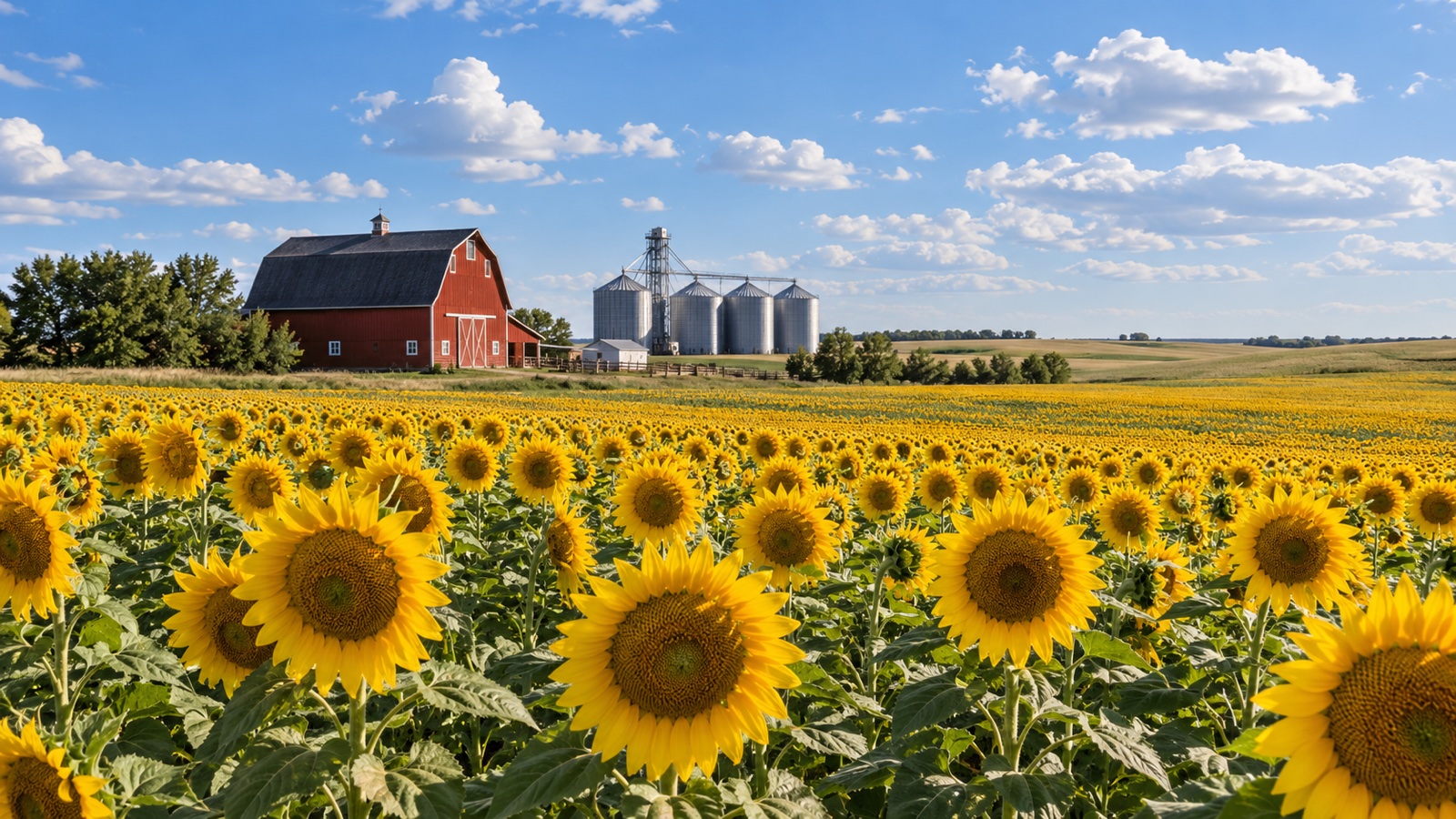
- It is also famous for sunflower production.
- Canola fields can turn large areas bright yellow in summer.
- Barley, corn, soybeans, lentils, and sugar beets are other important crops.
- Ranching is more prominent in the drier western part of the state.
- The Bakken Formation contains large oil and natural-gas resources.
- Horizontal drilling and hydraulic fracturing dramatically expanded Bakken oil production in the 2000s.
- Williston became one of the main centers of the oil boom.
- Rapid growth strained housing, roads, schools, and local services.
- Oil production also created jobs and major tax revenue.
- Drilling raised environmental concerns involving spills, flaring, water, and habitat.
- Natural gas produced alongside oil has sometimes been burned through flaring.
- Industry and regulators have worked to reduce routine flaring as infrastructure expanded.
- Coal-fired power generation remains important in parts of North Dakota.
- Lignite coal is mined in the state.
- North Dakota’s economy can shift from wheat field to oil rig without leaving the horizon.
Fargo, Scandinavian heritage & roadside giants
North Dakota’s cultural side is a glorious mix of Norwegian pastries, German-Russian farm traditions, college hockey, movie jokes, and roadside attractions that understand the correct response to a giant empty prairie is to build an enormous fiberglass animal on it.
- Fargo was named for Wells Fargo cofounder William Fargo.
- The city grew as a railroad center along the Red River.
- North Dakota State University is located in Fargo.
- The school’s athletic teams are called the Bison.
- The 1996 movie “Fargo” is named for the city even though much of the story takes place in Minnesota.
- Scandinavian immigrants settled North Dakota in large numbers during the late 19th and early 20th centuries.
- Norwegian heritage remains especially visible.
- Norsk Høstfest in Minot is one of North America’s largest Scandinavian festivals.
- Lefse is a familiar Norwegian flatbread in many North Dakota families.
- Krumkake is a thin rolled Norwegian cookie.
- German immigrants from Russia also shaped North Dakota food and farming culture.
- Knoephla is a creamy dumpling soup strongly associated with German-Russian communities.
- Fleischkuechle is a fried meat-filled pastry found in regional cooking.
- Jamestown is home to the World’s Largest Buffalo Monument.
- The enormous concrete bison is nicknamed Dakota Thunder.
- New Salem has a giant fiberglass Holstein cow named Salem Sue.
- Salem Sue stands on a hill above the town.
- Regent is the starting point of the Enchanted Highway.
- The route features enormous metal roadside sculptures.
- North Dakota understands that if the scenery is big, the roadside art should not be timid.
Peace gardens, missiles & 25 final North Dakota facts
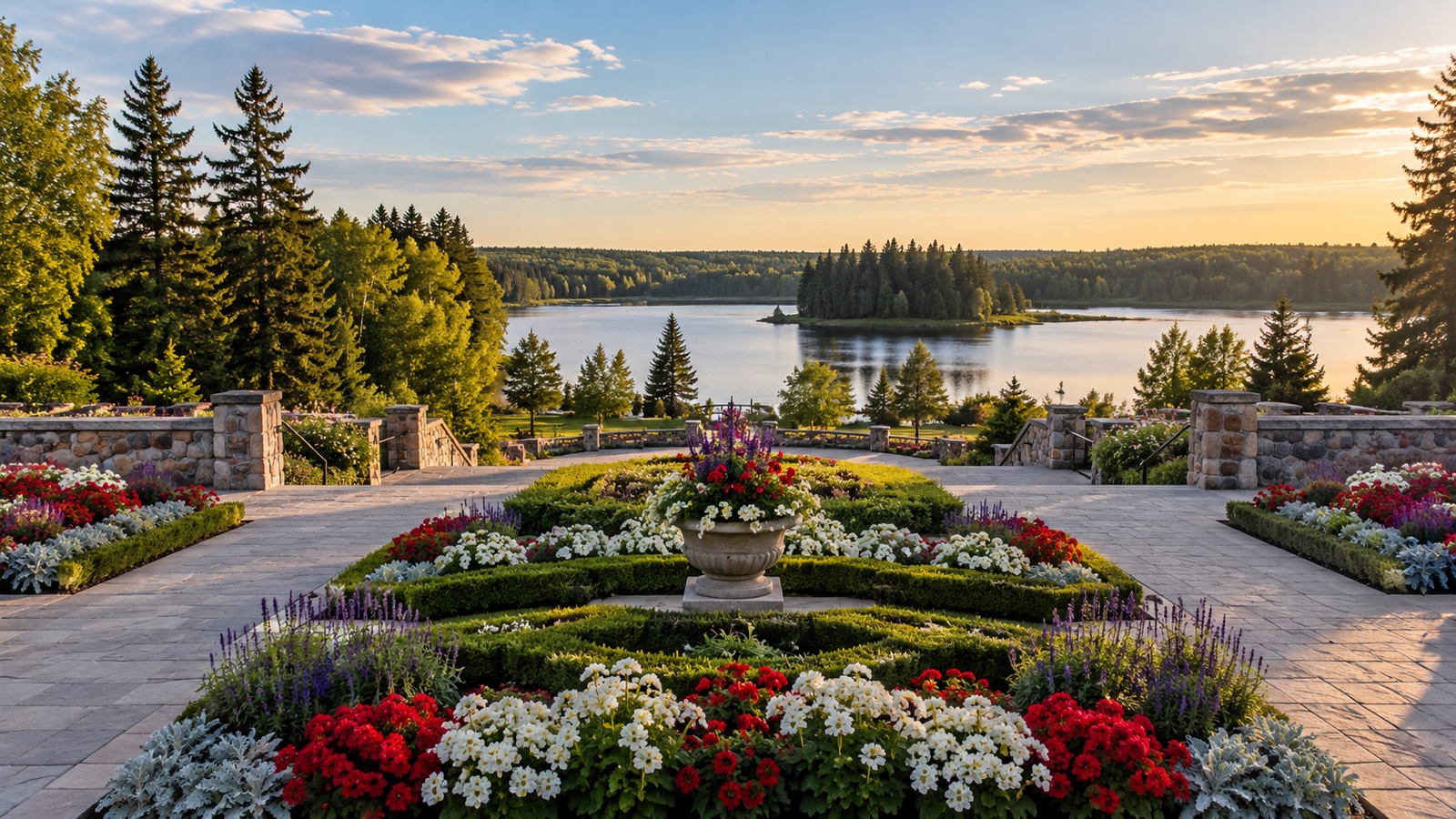
- The International Peace Garden straddles the North Dakota-Manitoba border.
- It was dedicated in 1932 as a symbol of peaceful U.S.-Canadian relations.
- The garden inspired North Dakota’s Peace Garden State nickname.
- The geographical center of North America is traditionally marked near Rugby, North Dakota.
- Different mathematical methods can produce different “center” points, so the title is partly conventional.
- Minot Air Force Base hosts important U.S. nuclear-deterrence missions.
- North Dakota contains Minuteman missile facilities across large rural areas.
- Cold War missile sites became a major part of the state’s military history.
- Some former missile facilities are preserved as historic sites.
- The Ronald Reagan Minuteman Missile State Historic Site preserves a former launch-control facility.
- Bismarck and Mandan sit on opposite sides of the Missouri River.
- The North Dakota Heritage Center in Bismarck includes state history, geology, fossils, and Indigenous exhibits.
- Devils Lake is the largest natural body of water entirely within North Dakota.
- Its water level has changed dramatically over time because the basin has no regular natural outlet at lower levels.
- The state flower is the wild prairie rose.
- The state bird is the western meadowlark.
- The state tree is the American elm.
- The Nokota horse is North Dakota’s honorary state equine.
- The state fruit is the chokecherry.
- North Dakota winters can be intensely cold because Arctic air can sweep across the open plains.
- Blizzards can create dangerous whiteout conditions even when snowfall itself is not extraordinary.
- Chinook-like warming is less common than farther west, but rapid temperature changes still occur.
- The University of North Dakota in Grand Forks is especially famous for hockey and aviation programs.
- Grand Forks suffered a devastating Red River flood in 1997 and rebuilt extensive flood-protection infrastructure afterward.
- After 145 facts, North Dakota feels much harder to forget, which is probably the state’s quietest revenge.
Quick FAQ
Q: What is North Dakota famous for?
A: Theodore Roosevelt National Park, badlands, bison, the Missouri River, grain and sunflower farming, Bakken oil, Scandinavian heritage, and the International Peace Garden.
Q: What is the capital of North Dakota?
A: Bismarck is the capital, while Fargo is the largest city.
Q: Was North Dakota the 39th or 40th state?
A: No one knows the signing order. North and South Dakota entered on the same day, and President Harrison shuffled the papers. North Dakota is conventionally listed 39th alphabetically.
Q: Why is North Dakota called the Peace Garden State?
A: The nickname honors the International Peace Garden on the U.S.-Canada border.
Q: Are there wild bison in North Dakota?
A: Yes. Managed free-ranging bison herds live in Theodore Roosevelt National Park and in tribal conservation programs.

Ellie is the owner and sole author of Fun Facts, combining her mechanical engineering background with years of research-driven writing to deliver facts you can trust. Every article is thoroughly fact-checked and routinely updated as new science and sources emerge to keep information accurate and current. Her mission is to make learning delightful while upholding high standards of reliability and transparency.