
Norway stretches from gentle southern farmland to Arctic islands where the sun can stay above the horizon for weeks. Its coastline is carved by enormous fjords, its mountains were shaped by ice, its history runs from Viking ships to modern offshore energy, and its culture gave the world skis, polar explorers, brown cheese, dramatic painters, and a sovereign wealth fund larger than most countries could imagine. These 145 Norway facts explore Oslo, fjords, Vikings, Sami culture, monarchy, polar nights, wildlife, oil, hydropower, skiing, food, Nobel traditions, and the landscapes that make Norway look almost unreal.
Norway basics
- Norway is a Nordic country in northern Europe.
- Its official name is the Kingdom of Norway.
- Oslo is the capital and largest city.
- Norway shares a long land border with Sweden.
- It also borders Finland and Russia in the far north.
- The mainland faces the North Atlantic and Norwegian Sea.
- Norway includes many islands.
- Svalbard is a Norwegian Arctic archipelago.
- Jan Mayen is another remote Norwegian island.
- The Norwegian krone is the national currency.
- Norway is a constitutional monarchy.
- It has an elected parliament called the Storting.
- Norway is not a member of the European Union.
- It participates in the European Economic Area.
- The country’s extraordinary length creates major differences in climate, daylight, landscape, and culture from south to north.
A coastline carved by ice
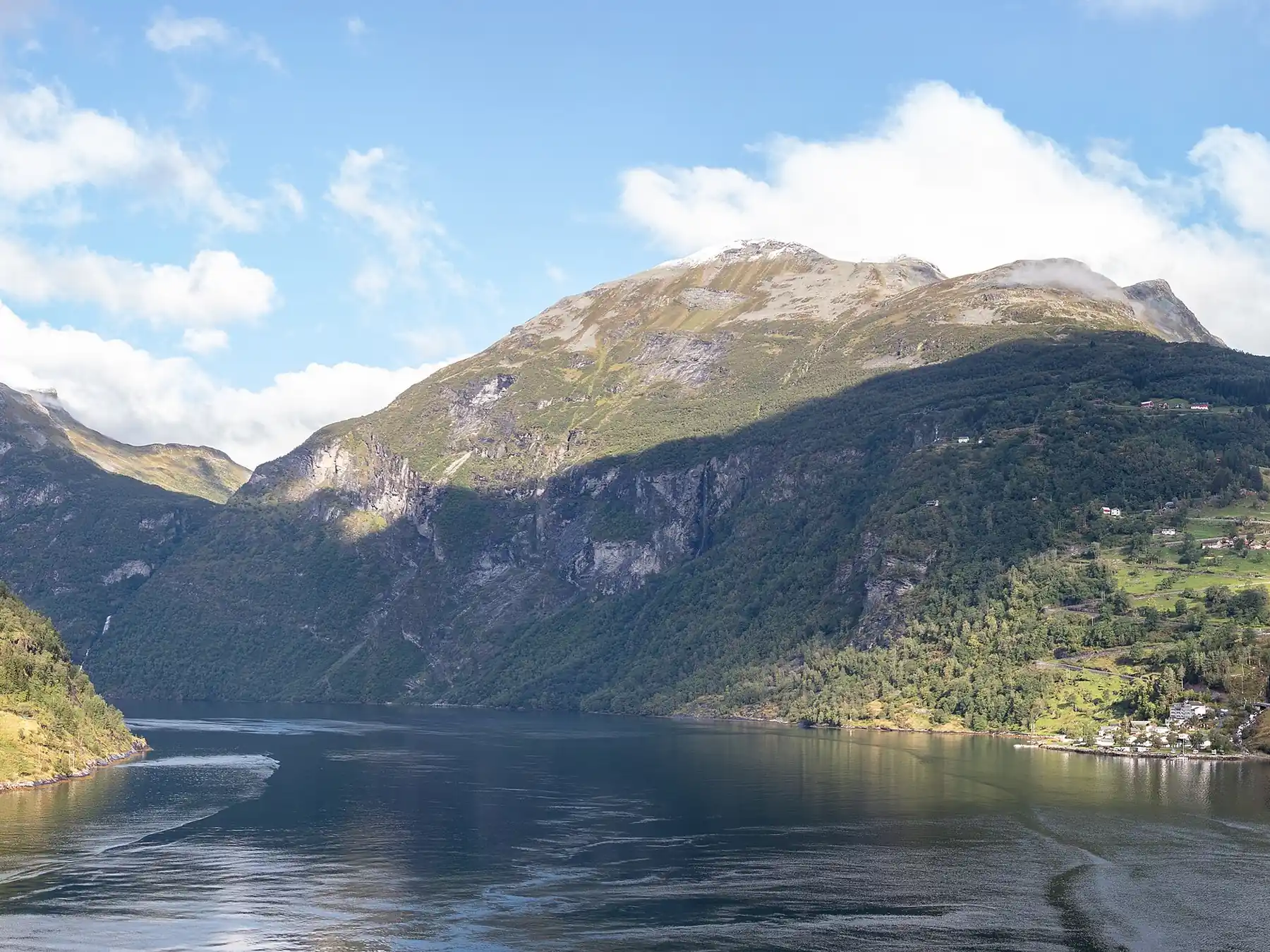
- Norway is famous for fjords.
- A fjord is a deep narrow marine inlet carved by glaciers.
- During ice ages, glaciers flowed through mountain valleys toward the sea.
- Moving ice eroded valleys into deep U-shaped troughs.
- Sea water flooded those valleys after glaciers retreated.
- Some Norwegian fjords are more than a kilometer deep.
- Sognefjord is Norway’s longest and deepest major fjord.
- It extends more than 200 kilometers inland.
- Geirangerfjord is famous for steep cliffs and waterfalls.
- Nærøyfjord is exceptionally narrow.
- Geirangerfjord and Nærøyfjord form part of a UNESCO World Heritage property.
- Farms were historically built on surprisingly steep fjord slopes.
- Boats provided essential transportation between isolated communities.
- Road tunnels and bridges now connect many places once reachable mainly by water.
- Norway’s famously complicated coastline becomes vastly longer when every fjord, island, and inlet is measured in detail.
Mountains and glaciers
- Much of Norway is mountainous.
- Galdhøpiggen is the highest mountain in mainland Norway.
- It rises to 2,469 meters.
- Jotunheimen contains many of the country’s highest peaks.
- The name Jotunheimen means home of the giants.
- Norway still contains substantial glaciers.
- Jostedalsbreen is the largest glacier in mainland continental Europe by area.
- Outlet glaciers descend from its main ice cap.
- Glaciers have retreated significantly during modern warming.
- Norwegian mountains create strong local weather differences.
- Western slopes receive heavy precipitation from Atlantic air.
- Interior valleys can be much drier.
- Snow can remain at high elevation into summer.
- Mountain cabins support a strong hiking culture.
- The Norwegian Trekking Association maintains a huge network of routes and cabins.
Midnight sun and polar night
- The Arctic Circle crosses Norway.
- North of the Arctic Circle, the sun can remain above the horizon for at least one full day in summer.
- This phenomenon is called the midnight sun.
- The farther north you travel, the longer the midnight-sun period lasts.
- Tromsø experiences weeks when the sun does not set.
- Svalbard experiences an even longer continuous-light season.
- Winter brings the opposite phenomenon.
- During polar night, the sun stays below the horizon.
- Polar night does not mean complete blackness for 24 hours.
- Twilight can provide hours of blue or pink light depending on latitude and date.
- Snow reflects available light strongly.
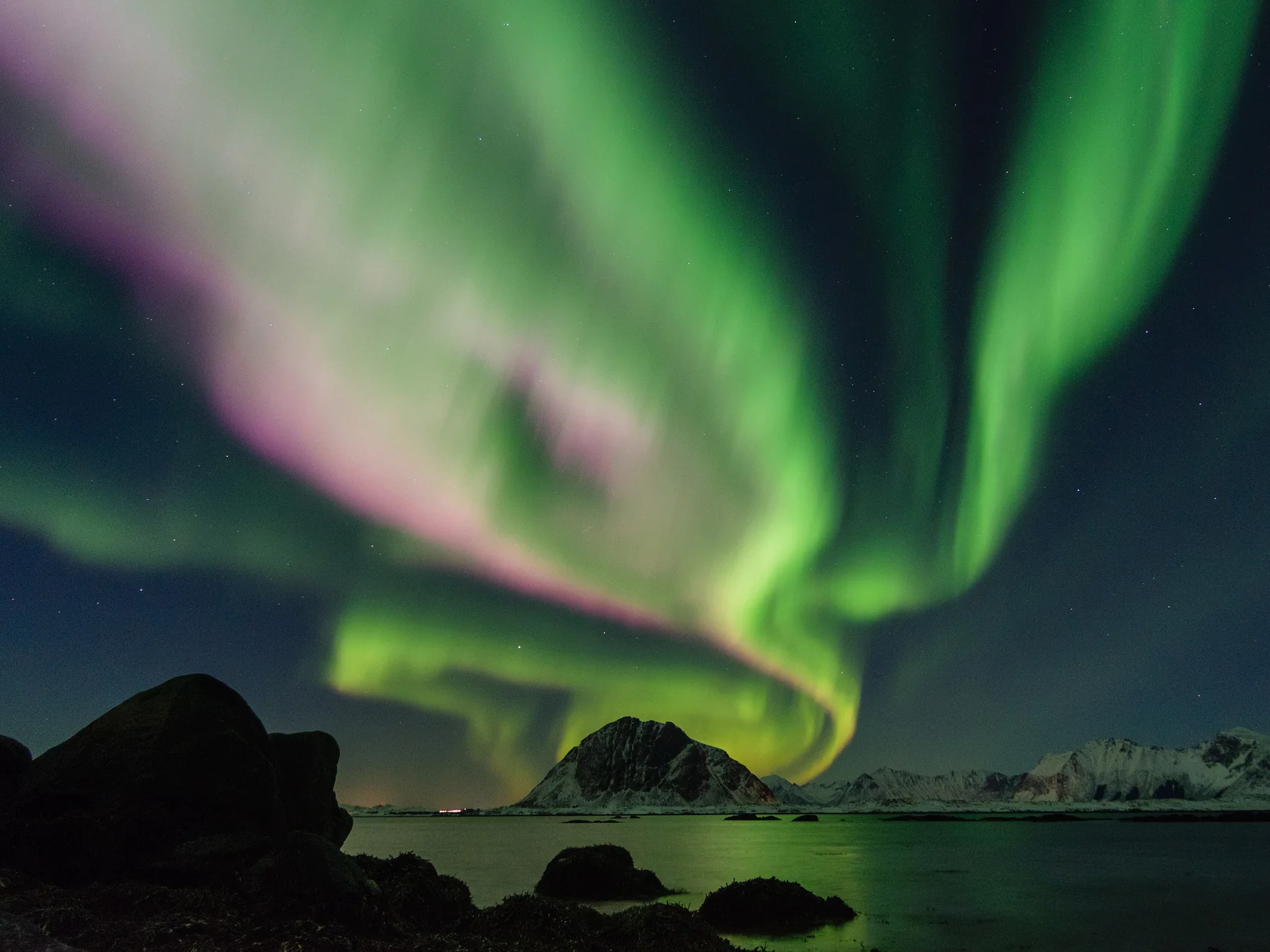
- The aurora borealis is frequently visible in northern Norway under dark clear conditions.
- Auroras occur when charged particles interact with Earth’s magnetic field and upper atmosphere.
- They are not caused by cold weather itself.
- Norway’s seasonal daylight cycle shapes sleep, work, tourism, festivals, and everyday life.
Viking Norway
- The Viking Age is commonly dated from the late eighth to 11th centuries.
- People from what is now Norway participated in Viking expansion.
- Viking was an activity or identity connected with seafaring expeditions, not the name of every Scandinavian person.
- Norwegian seafarers traveled west toward the British Isles.
- They settled parts of Ireland, Scotland, the Faroe Islands, and Iceland.
- Norse settlers later reached Greenland.
- Leif Erikson reached North America around the year 1000.
- His family had Norwegian and Icelandic connections.
- Viking ships used overlapping wooden planks in clinker construction.
- Longships combined speed, shallow draft, sails, and oars.
- They could cross open seas and travel up rivers.
- Viking helmets did not normally have horns.
- Horned helmets became a much later artistic stereotype.
- Beautifully preserved Viking ships were excavated from Norwegian burial mounds.
- The Oseberg and Gokstad ships reveal extraordinary woodworking and shipbuilding skill.
From unions to independence
- Norway spent centuries in political unions with neighboring kingdoms.
- It entered a long union with Denmark.
- After the Napoleonic Wars, Norway was transferred from Danish to Swedish rule in 1814.
- Norwegians drafted a constitution at Eidsvoll that same year.
- Norway celebrates Constitution Day on May 17.
- The constitution is one of the world’s oldest still in force, although it has been amended many times.
- Norway entered a union with Sweden while retaining its constitution and considerable internal autonomy.
- The union dissolved peacefully in 1905.
- Prince Carl of Denmark became Norway’s king.
- He took the Norwegian regnal name Haakon VII.
- Norway declared neutrality during World War I.
- Nazi Germany invaded Norway in April 1940.
- King Haakon VII and the government continued resistance from exile.
- German occupation lasted until 1945.
- Postwar Norway became a founding member of NATO.
Sami culture predates modern borders
- The Sami are an Indigenous people of northern Europe.
- Sápmi, the Sami homeland, spans parts of Norway, Sweden, Finland, and Russia.
- Sami communities have diverse languages and livelihoods.
- Reindeer herding is important to some Sami people but does not define every Sami life.
- Fishing, farming, hunting, crafts, and modern professions are also part of Sami culture.
- Traditional Sami singing includes joik.
- Duodji refers to traditional Sami handicraft and design traditions.
- Norwegian authorities historically pursued assimilation policies.
- Sami languages were suppressed in schools and public life.
- Land and cultural rights became major political issues.
- The Sami Parliament of Norway opened in 1989.
- It is called Sámediggi in Northern Sami.
- February 6 is Sámi National Day.
- Several Sami languages are spoken in Norway.
- Modern Norway’s identity includes both Scandinavian majority culture and Indigenous Sami history that long predates today’s national borders.
Oil, gas, and a giant national fund
- Major petroleum discoveries transformed Norway’s economy.
- Ekofisk was discovered in the North Sea in 1969.
- Production began in the early 1970s.
- Norway created a strong regulatory and taxation system around petroleum resources.
- The state retained substantial ownership and revenue.
- Oil and gas exports generated enormous national income.
- Norway established a sovereign wealth fund to invest petroleum revenue for future generations.
- It is officially called the Government Pension Fund Global.
- The fund invests primarily outside Norway.
- That reduces pressure on the domestic economy.
- The fund owns small stakes in thousands of companies worldwide.
- Ethical guidelines restrict certain investments.
- Norway remains a major fossil-fuel exporter while also pursuing domestic climate policies.
- This creates an ongoing political and environmental tension.
- The fund is one of the largest sovereign wealth funds in the world.
Skiing is practically a national language
- Norway has a very long skiing tradition.
- Ancient Scandinavian rock carvings show people using ski-like equipment.
- The English word ski comes from Norwegian.
- It traces to an Old Norse word connected with a split piece of wood.
- Sondre Norheim became an influential 19th-century Norwegian skier.
- He helped develop techniques and equipment associated with Telemark skiing.
- Telemark is a region of Norway.
- Norway has won an extraordinary number of Winter Olympic medals.
- Cross-country skiing is especially important.
- Ski jumping is another major tradition.
- Holmenkollen in Oslo is a famous ski-jump and winter-sports site.
- The area has hosted competitions for well over a century.
- Norwegians use the word friluftsliv for a cultural idea centered on outdoor life.
- Cabin trips, hiking, skiing, and time in nature are major leisure traditions.
- The saying that Norwegians are “born with skis on their feet” is a joke, but it reflects how deeply skiing is embedded in national culture.
Ten surprising Norway facts
- The English word ski comes from Norwegian.
- Viking helmets were not normally horned.
- Norway’s constitution dates to 1814.
- The modern independent union with Sweden ended peacefully in 1905.
- The Sami homeland crosses four modern countries.
- Norway’s giant sovereign wealth fund was built from petroleum revenue.
- Norway produces most of its domestic electricity from hydropower in a typical year.
- Svalbard has months of continuous summer daylight and months without sunrise.
- The Nobel Peace Prize is awarded in Oslo even though the other original Nobel Prizes are awarded in Stockholm.
- For more Nordic trivia, explore our Iceland facts and Culture facts.
Quick Norway FAQ
What is the capital of Norway?
Oslo, located at the head of the Oslofjord in southeastern Norway.
Is Norway in the European Union?
No. Norway is not an EU member, but it participates in the European Economic Area and cooperates closely with the EU.
What is a fjord?
A deep, narrow sea inlet occupying a valley carved by glaciers.
Can you see the midnight sun in Norway?
Yes. North of the Arctic Circle, summer periods occur when the sun remains above the horizon around the clock.
Why is the Nobel Peace Prize awarded in Norway?
Alfred Nobel’s will specified that a committee chosen by the Norwegian parliament would award the Peace Prize, while Swedish institutions award the other original Nobel categories.

Ellie is the owner and sole author of Fun Facts, combining her mechanical engineering background with years of research-driven writing to deliver facts you can trust. Every article is thoroughly fact-checked and routinely updated as new science and sources emerge to keep information accurate and current. Her mission is to make learning delightful while upholding high standards of reliability and transparency.