
Orcas are called killer whales, but they are actually the largest members of the dolphin family. Different populations have their own diets, hunting strategies, calls, social traditions, and even preferred prey, making orca culture surprisingly complicated. These 145 facts explore pods, echolocation, matriarchs, salmon specialists, seal hunters, calves, dorsal fins, intelligence, global habitats, conservation, menopause, and the sophisticated teamwork behind one of the ocean’s most powerful predators.
Orca basics
- Orcas are marine mammals.
- Their scientific name is Orcinus orca.
- They belong to the oceanic dolphin family Delphinidae.
- Orcas are the largest living members of the dolphin family.
- The name killer whale reflects historical observations of their ability to kill other large marine animals.
- Scientists and the public commonly use both killer whale and orca.
- Orcas live in every ocean.
- They occur from polar waters to the tropics.
- They are especially abundant in some productive high-latitude seas.
- Adult males are larger than adult females.
- Large males can exceed 8 meters, or about 26 feet, in length.
- Males can weigh several tons.
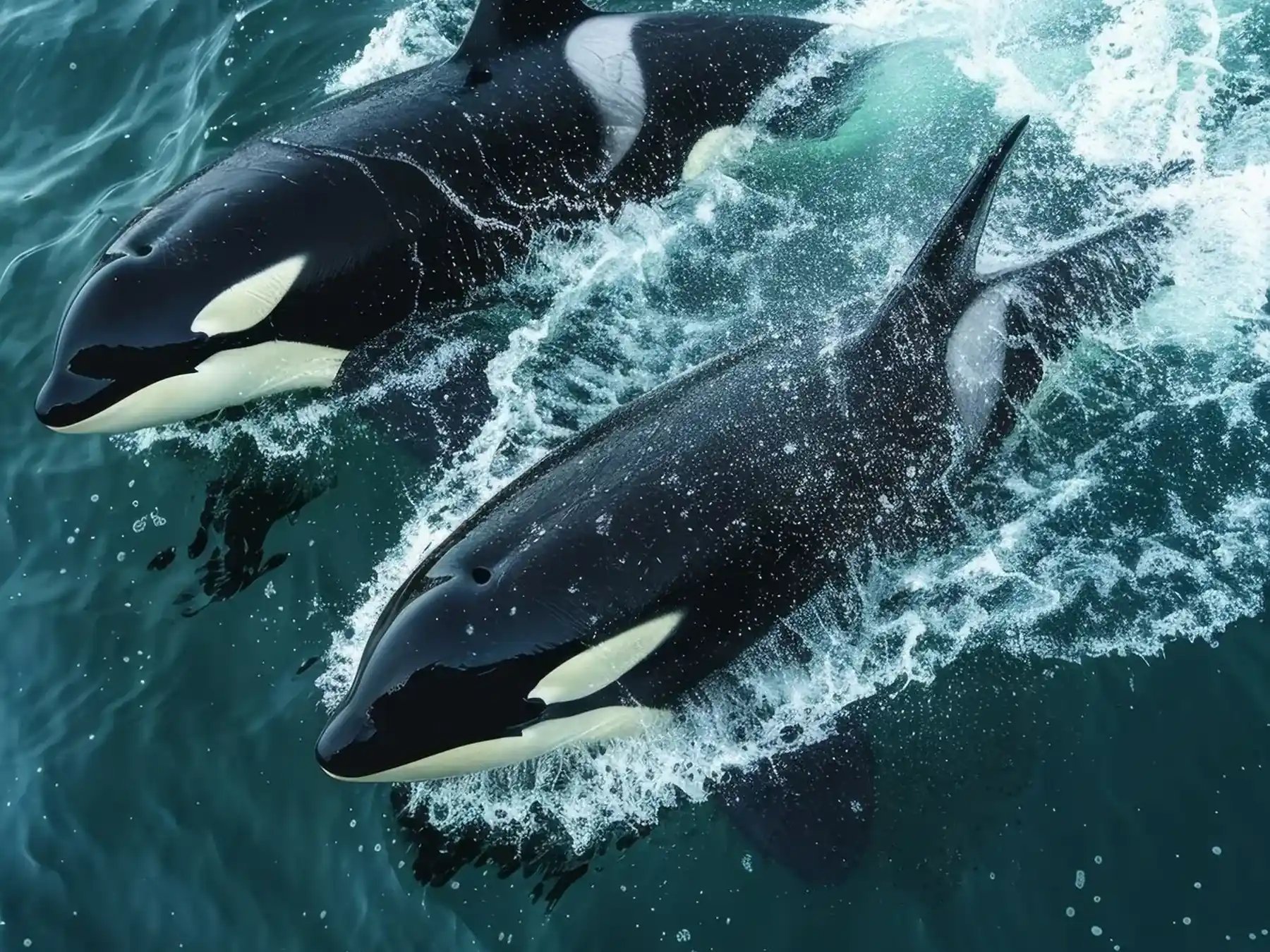
- Orcas have striking black-and-white coloration.
- A pale saddle patch lies behind the dorsal fin.
- NOAA Fisheries recognizes killer whales as highly social apex predators with complex population differences.
That black-and-white body is functional
- An orca’s dark back and pale underside create countershading.
- Countershading can make an animal harder to see from above or below.
- The white eye patch is not the actual eye.
- The real eye is much smaller and sits below and forward of the white patch.
- Orca markings vary subtly among populations and individuals.
- Researchers can identify individual orcas from natural markings.
- The saddle patch differs in shape, scars, and pigmentation.
- The dorsal fin also provides identification clues.
- Photo-identification catalogs track whales for decades.
- This lets scientists reconstruct family relationships and life histories.
- Scars can record interactions with prey, other orcas, boats, or unknown events.
- Young calves can look slightly different in color from adults.
- Newborn pale areas may appear yellowish or orange.
- That tint fades as the calf grows.
- A simple-looking color pattern therefore contains enough variation to recognize individual animals.
Male dorsal fins can be enormous
- Orca dorsal fins contain connective tissue rather than supporting bones.
- Adult male dorsal fins can stand nearly 2 meters, or about 6 feet, tall.
- Female dorsal fins are generally shorter and more curved.
- Juvenile fins change shape as animals mature.
- Dorsal-fin shape helps distinguish sex and individuals.
- A bent dorsal fin does not automatically prove an orca is sick.
- Fin shape can be affected by genetics, injury, age, tissue condition, hydrodynamics, and environment.
- Dorsal-fin collapse is especially common among captive adult males.
- It can also occur in wild individuals, though less often in many populations.
- Pectoral flippers are broad and rounded.
- Male pectoral flippers become especially large with maturity.
- The tail flukes generate propulsion.
- The dorsal fin contributes stability during swimming.
- Streamlined bodies reduce drag through water.
- Every external feature reflects life as a fast-moving marine predator.
Orcas breathe air
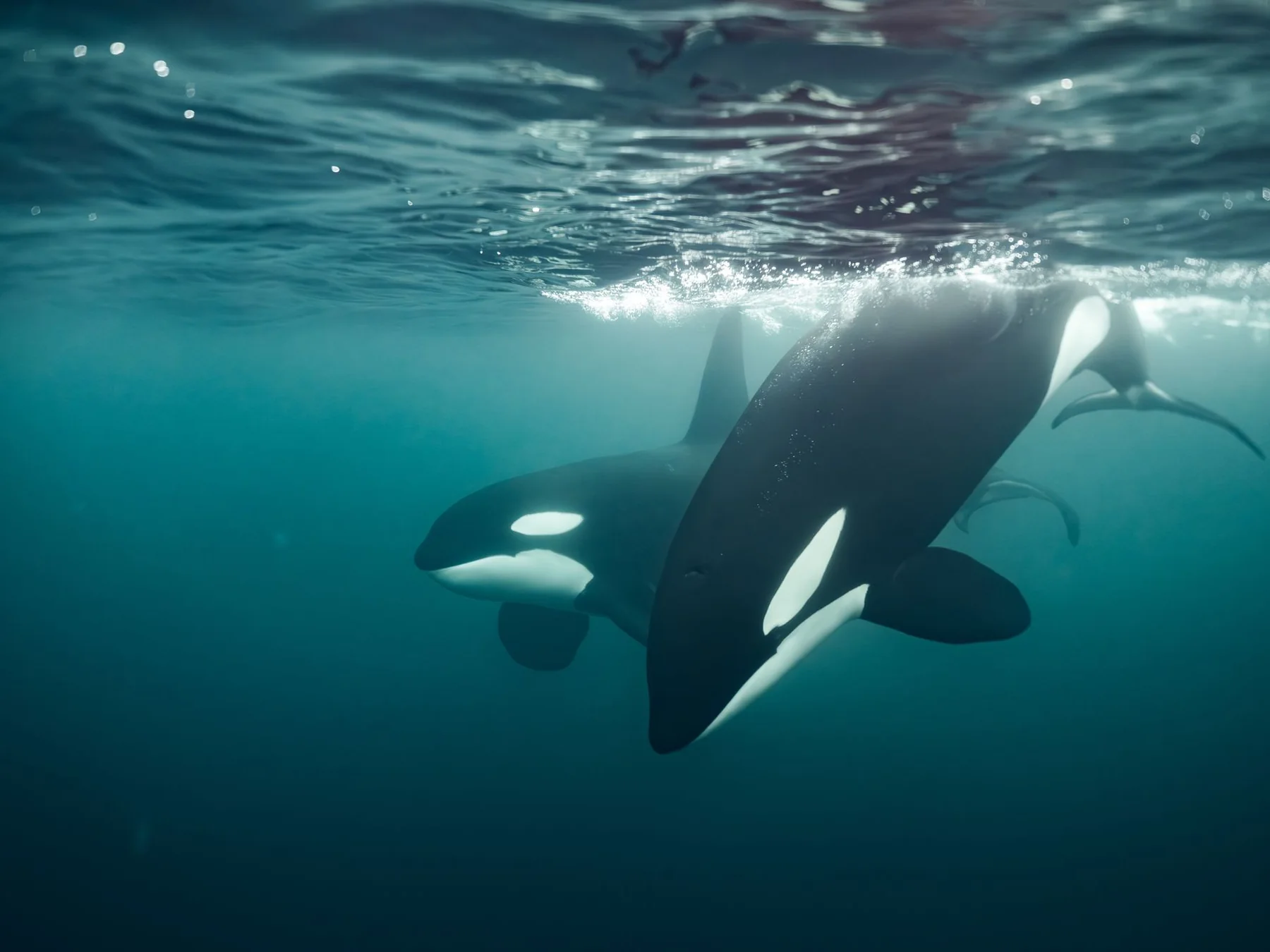
- Orcas are mammals and must surface to breathe.
- They breathe through one blowhole on top of the head.
- The blowhole connects to the respiratory system rather than the mouth.
- This separation helps orcas eat underwater without inhaling seawater.
- Orcas exchange a large portion of lung air during rapid surface breaths.
- They close the blowhole tightly before diving.
- A surface exhalation can create a visible blow of moist air and droplets.
- Orcas can remain underwater for several minutes during normal dives.
- Dive duration varies with activity, prey, depth, and individual behavior.
- They can dive hundreds of meters deep.
- Blood and muscle tissues store oxygen for dives.
- Marine mammals can redirect circulation toward essential organs while underwater.
- Heart rate can slow during diving.
- Orcas sleep differently from humans because they must continue surfacing to breathe.
- Like other dolphins, they can rest portions of the brain while maintaining enough awareness for breathing and movement.
Pods are families
- Orcas are highly social.
- Many populations live in stable family groups.
- These groups are commonly called pods.
- In resident killer whales of the Pacific Northwest, family relationships can remain intact for life.
- Adult sons may stay with their mothers.
- Adult daughters can also remain within maternal social networks.
- Several generations may travel together.
- Older females can become important social leaders.
- Families share calls and learned behavior.
- Pods can associate with other related groups.
- Larger temporary gatherings can contain many whales.
- Social structure differs among orca populations.
- Not every orca ecotype forms identical group sizes.
- Mammal-hunting orcas may travel in smaller groups than some fish-eating populations.
- Social organization reflects prey strategy, kinship, communication, and local ecology.
Orca culture is real
- Different orca communities can have distinct hunting traditions.
- Those behaviors are learned socially rather than explained only by instinct.
- Some populations specialize strongly on fish.
- Others specialize on marine mammals.
- Some hunt sharks, rays, seabirds, or other prey.
- Diet specialization can persist across generations.
- Vocal dialects can differ between pods.
- Calves learn calls from their social group.
- Researchers therefore use the word culture when describing inherited social traditions.
- Culture can affect what an orca recognizes as food.
- An abundant prey species may be ignored if it is not part of a population’s learned diet.
- Hunting techniques can require years of practice.
- Young orcas learn by watching and participating with older animals.
- Adults may appear to modify hunting behavior when calves are learning.
- Orca culture is one reason conservation cannot treat every population as ecologically interchangeable.
Resident and Bigg’s killer whales
- The northeastern Pacific contains several well-studied killer-whale ecotypes.
- Resident killer whales specialize mainly on fish.
- Chinook salmon is especially important to Southern Resident killer whales.
- Residents often travel in relatively vocal social groups.
- Bigg’s killer whales specialize on marine mammals.
- They were formerly commonly called transients.
- The Bigg’s name honors pioneering killer-whale researcher Michael Bigg.
- Bigg’s killer whales hunt seals, sea lions, porpoises, dolphins, and sometimes whales.
- They tend to use quieter hunting behavior than fish-eating residents.
- Marine-mammal prey can hear well and may respond to orca calls.
- Quiet hunting therefore provides an advantage.
- Offshore killer whales form another northeastern Pacific ecotype.
- Offshores can travel in large groups.
- They eat fish and are known to prey heavily on sharks in some areas.
- Ecotypes can differ genetically, behaviorally, acoustically, and ecologically despite belonging to the same currently recognized species.
Hunting techniques can be spectacular
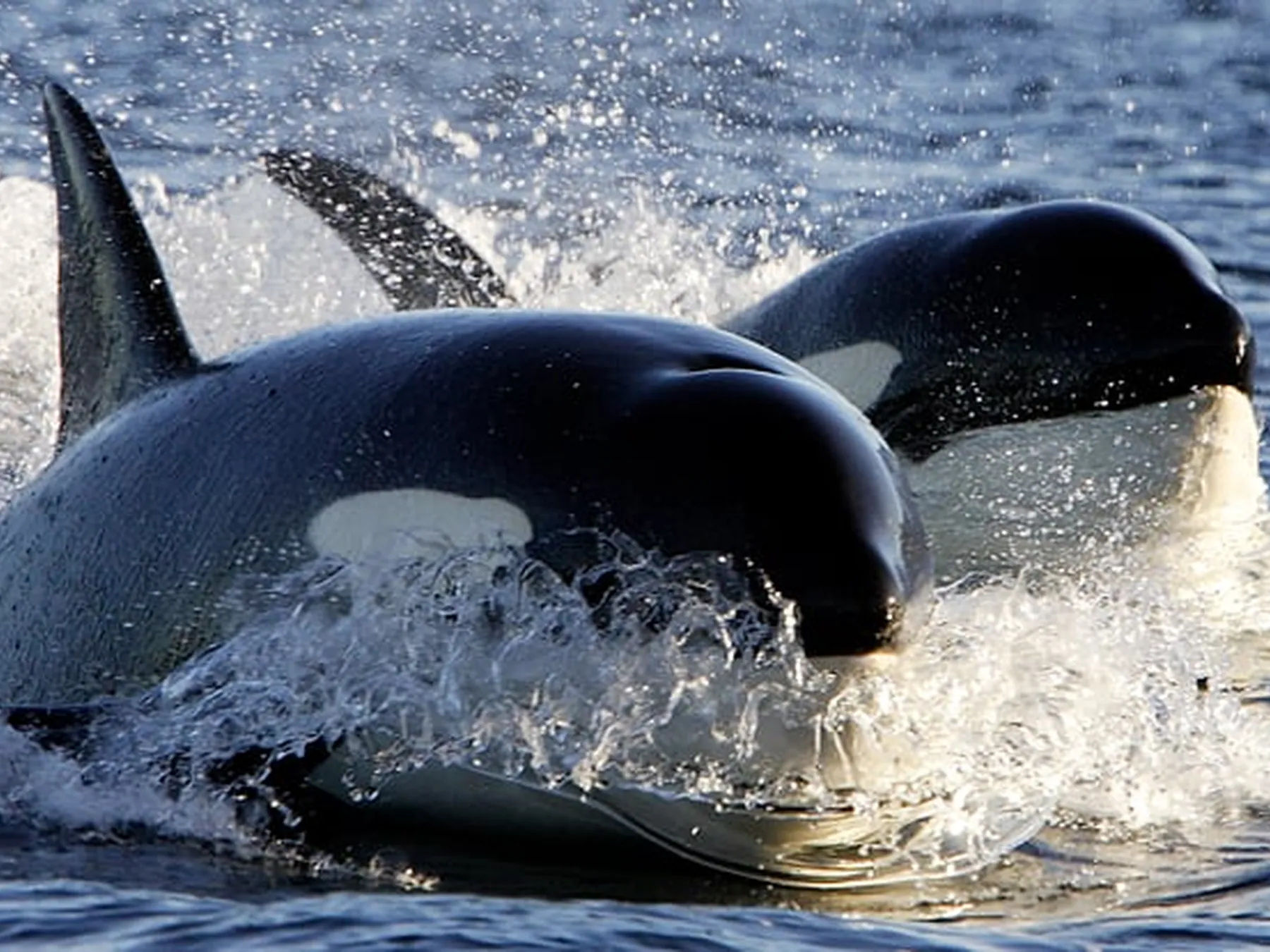
- Orcas cooperate during many hunts.
- Groups can herd schooling fish into dense balls.
- Norwegian killer whales hunt herring using coordinated tactics.
- Some strike fish with tail flukes to stun them.
- Antarctic orcas can create waves to wash seals from floating ice.
- Several whales may swim together to build the wave.
- They can repeat the technique until prey loses its position.
- Patagonian killer whales intentionally strand themselves briefly while hunting sea-lion pups near beaches.
- The whales time their approach with waves and retreat quickly back to deeper water.
- This dangerous technique is learned within local groups.
- Some orcas attack large whales cooperatively.
- They may target calves or weakened individuals.
- Orcas have also been observed hunting great white sharks.
- Some shark-hunting orcas consume energy-rich livers selectively.
- The range of techniques makes orcas one of the most behaviorally versatile predators in the ocean.
Calves, mothers, and menopause
- Orca pregnancy lasts roughly 17 months.
- Females usually give birth to one calf at a time.
- Calves nurse on milk produced by the mother.
- Young whales remain socially dependent for years.
- Birth intervals can be several years long.
- Female orcas can live for many decades.
- Some populations show one of the rare examples of menopause outside humans.
- Older females can live long after they stop reproducing.
- Post-reproductive females may improve the survival of relatives through ecological knowledge and social leadership.
- Southern Resident research has shown older females often lead groups, especially when salmon are scarce.
- Grandmothers can therefore contribute to family success without producing more calves.
- Adult sons may benefit strongly from their mothers’ continued presence.
- Long family relationships create opportunities to transfer hunting knowledge.
- Low reproductive rates make orca populations slow to recover from major declines.
- Protecting adult females can therefore have effects across multiple generations.
Ten surprising orca facts
- Orcas are dolphins, not a separate kind of non-dolphin whale.
- The white patch on an orca’s head is not its eye.
- Some adult sons remain closely associated with their mothers for life.
- Different orca communities can effectively have different cuisines.
- Marine-mammal hunters are often quieter than fish-eating orcas.
- Some orcas manufacture waves as tools for knocking seals off ice.
- Others deliberately rush onto beaches during specialized hunts.
- Some female orcas live for decades after menopause.
- Researchers can recognize individuals by dorsal fins and saddle patches like natural identification cards.
- For more marine-mammal trivia, explore our whale facts, dolphin facts, and Science facts.
Quick orca FAQ
Are orcas whales or dolphins?
They are members of the oceanic dolphin family, making them the world’s largest dolphins. Dolphins are themselves toothed whales, so both descriptions can be biologically valid at different taxonomic levels.
What do orcas eat?
It depends on the population. Some specialize on fish such as salmon, while others hunt seals, sea lions, dolphins, whales, sharks, rays, or other prey.
Do orcas have language?
They use sophisticated calls, whistles, and echolocation, and pods can have distinctive learned vocal dialects. Scientists use terms such as communication and culture rather than claiming these systems match human language exactly.
Do orcas attack people in the wild?
Wild orcas are powerful predators, but fatal attacks on humans in natural settings are extraordinarily rare and are not part of their normal feeding ecology.
Why are some orca populations endangered?
Threats can include prey shortages, pollution, vessel disturbance, underwater noise, habitat changes, entanglement, and low reproductive rates, with importance varying by population.

Ellie is the owner and sole author of Fun Facts, combining her mechanical engineering background with years of research-driven writing to deliver facts you can trust. Every article is thoroughly fact-checked and routinely updated as new science and sources emerge to keep information accurate and current. Her mission is to make learning delightful while upholding high standards of reliability and transparency.