
A galaxy is not just a big pile of stars. It is a gravity-bound ecosystem of stars, planets, gas, dust, dark matter, stellar nurseries, dead stars, and usually a giant black hole near the center. Some galaxies are elegant spirals, some smooth ellipses, and some look like cosmic train wrecks. These 145 galaxy facts explore their shapes, sizes, collisions, black holes, star formation, dark matter, distances, clusters, the early universe, and how astronomers photograph light that left before humans existed.
Galaxy basics
- A galaxy is a large gravitationally bound system of stars, gas, dust, dark matter, and other objects.
- Galaxies can contain millions, billions, or even trillions of stars.
- The smallest galaxies are called dwarf galaxies.
- Giant galaxies can extend hundreds of thousands of light-years across.
- A light-year is a unit of distance, not time.
- One light-year is the distance light travels in one year.
- Galaxies are separated by enormous stretches of intergalactic space.
- Gravity keeps stars orbiting within galaxies.
- Dark matter contributes much of the gravitational mass in most galaxies.
- Gas and dust provide raw material for new stars.
- Stars recycle heavier elements back into galactic gas when they die.
- Galaxies therefore evolve over billions of years.
- They can grow by forming stars and merging with other galaxies.
- The universe contains an enormous number of galaxies.
- NASA’s galaxy overview describes them as fundamental building blocks of the universe.
Spiral galaxies
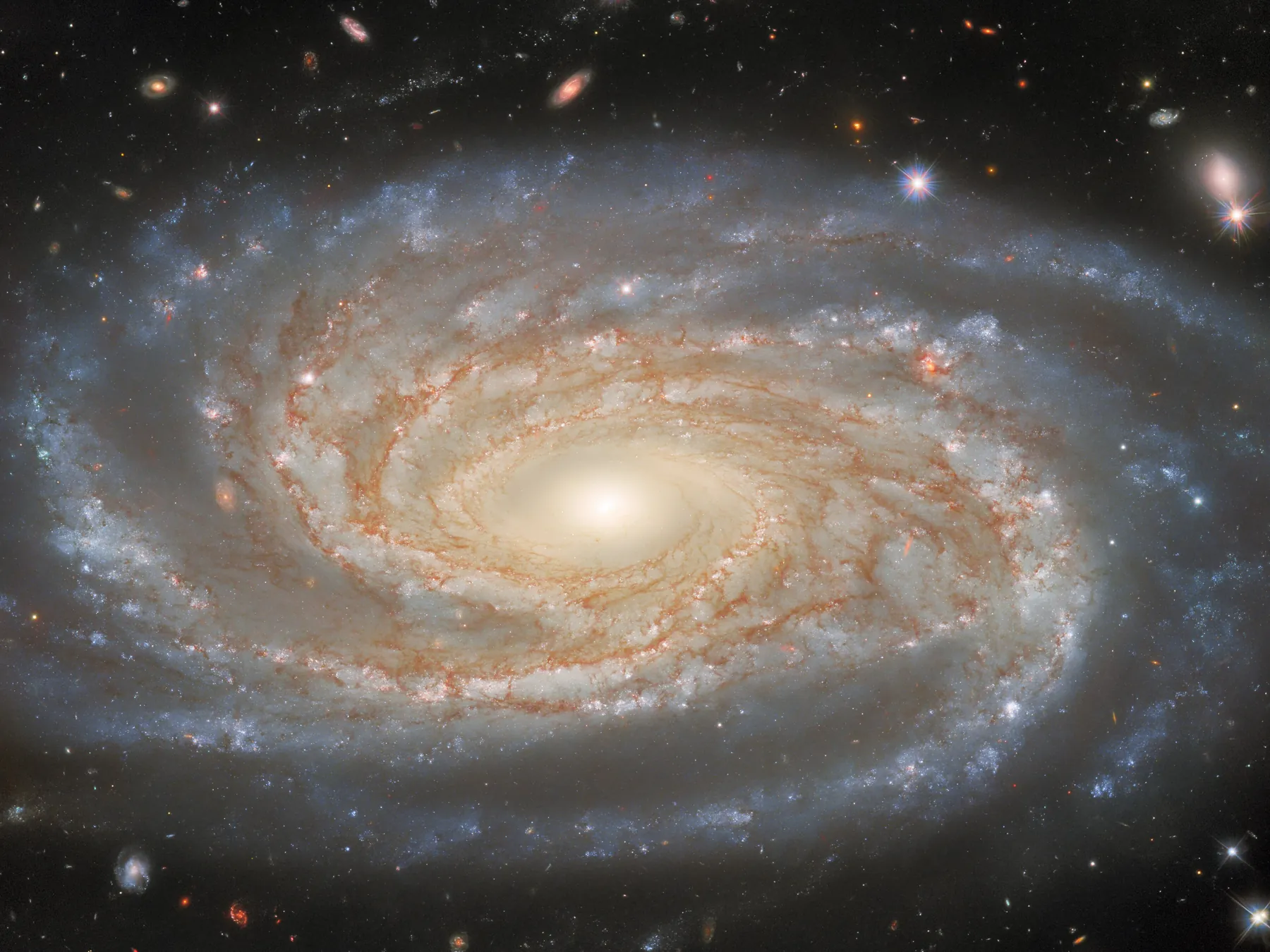
- Spiral galaxies have flattened rotating disks.
- Many display curving spiral arms.
- A central bulge rises above and below the disk.
- A halo of old stars and dark matter surrounds the visible disk.
- Spiral arms contain gas, dust, and many young stars.
- Bright blue stars often make arms stand out strongly in visible-light images.
- The arms are not rigid material structures rotating like spokes on a wheel.
- Stars can move into and out of spiral-arm regions.
- Density-wave and dynamical processes help create and maintain spiral patterns.
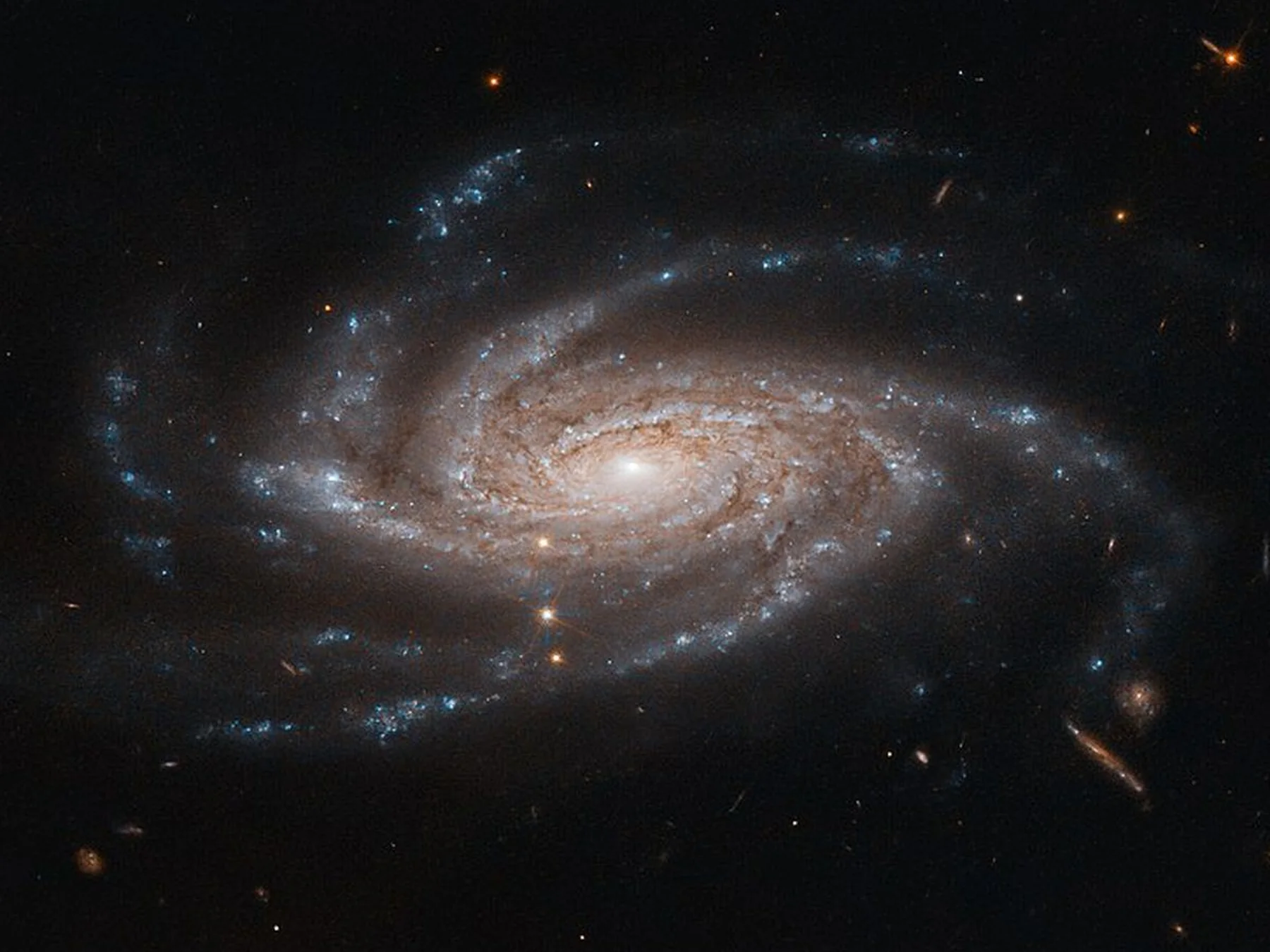
- Some spirals have a straight bar of stars through the center.
- These are called barred spiral galaxies.
- The Milky Way is a barred spiral.
- Andromeda is another large spiral galaxy.
- Spiral galaxies contain both young and old stellar populations.
- Their disks can warp because of gravitational interactions and uneven mass distribution.
Elliptical and irregular galaxies
- Elliptical galaxies look smoother and rounder than spirals.
- Their shapes range from nearly spherical to strongly elongated.
- They generally contain less cold gas than actively star-forming spirals.
- Many elliptical galaxies are dominated by older stars.
- Star formation is often weak in large ellipticals.
- Giant elliptical galaxies are common near the centers of rich galaxy clusters.
- Some formed through repeated galaxy mergers.
- Irregular galaxies lack an obvious spiral or elliptical structure.
- Gravitational interactions can distort galaxies into irregular shapes.
- Some irregular galaxies are naturally small and patchy.
- The Large Magellanic Cloud is an irregular or Magellanic-type galaxy near the Milky Way.
- The Small Magellanic Cloud is another nearby companion.
- Both are visible to the naked eye from dark southern skies.
- Irregular galaxies can contain intense star-forming regions.
- Galaxy classifications describe appearance but do not tell the complete evolutionary story.
Galaxies are enormous
- The Milky Way’s stellar disk is roughly 100,000 light-years across by common estimates.
- Its extended halo reaches much farther.
- Light needs about 100,000 years to cross the stellar disk from one side to the other.
- Our solar system sits far from the galactic center.
- The Sun takes roughly a few hundred million years to orbit the Milky Way once.
- That timescale is sometimes called a galactic year.
- Astronomers have directly observed galaxies far smaller than the Milky Way.
- They have also observed giant galaxies several times wider.
- Size does not always correspond directly with star count.
- Diffuse galaxies can spread relatively few stars across huge volumes.
- Ultra-diffuse galaxies are surprisingly large but faint.
- Compact galaxies can pack many stars into small regions.
- Galaxy brightness depends on star populations, dust, size, and distance.
- A huge galaxy can look faint if it is extremely distant or diffuse.
- Most individual stars in distant galaxies blur together in ordinary telescope images.
Black holes live in galactic centers
- Most large galaxies appear to contain supermassive black holes near their centers.
- These black holes can contain millions or billions of times the Sun’s mass.
- The Milky Way’s central black hole is called Sagittarius A*.
- It has a mass of about four million Suns.
- The black hole itself produces no light that escapes from inside the event horizon.
- Matter falling toward an active black hole can become extremely bright.
- Gas forms a hot accretion disk around some black holes.
- Friction and magnetic processes heat the gas to enormous temperatures.
- An actively feeding supermassive black hole can power an active galactic nucleus.
- Quasars are exceptionally luminous active galactic nuclei.
- A quasar can outshine all the stars in its host galaxy.
- Some active galaxies launch jets traveling far beyond the central region.
- Jets are associated with magnetic fields and material near the black hole, not matter escaping from inside the event horizon.
- Supermassive black-hole mass often correlates with properties of the host galaxy’s central bulge.
- This suggests black holes and galaxies influence one another’s evolution.
Galaxies make stars
- New stars form inside cold dense clouds of gas and dust.
- Molecular clouds can collapse under gravity.
- Dense cores inside those clouds become protostars.
- Young stars heat and ionize surrounding gas.
- This can create glowing nebulae visible across a galaxy.
- Massive stars live much shorter lives than low-mass stars.
- They can explode as supernovae after only millions of years.
- Supernovae distribute oxygen, silicon, iron, and other elements into surrounding space.
- Those enriched materials can later become new stars and planets.
- Galaxy star-formation rates change over cosmic time.
- Some galaxies undergo intense starbursts.
- Starburst galaxies form stars much faster than typical galaxies of similar mass.
- Galaxy interactions can compress gas and trigger star formation.
- Black-hole feedback can also heat or expel gas and reduce star formation.
- A galaxy’s color can therefore reveal clues about the age and activity of its stars.
Galaxies collide without stars constantly crashing
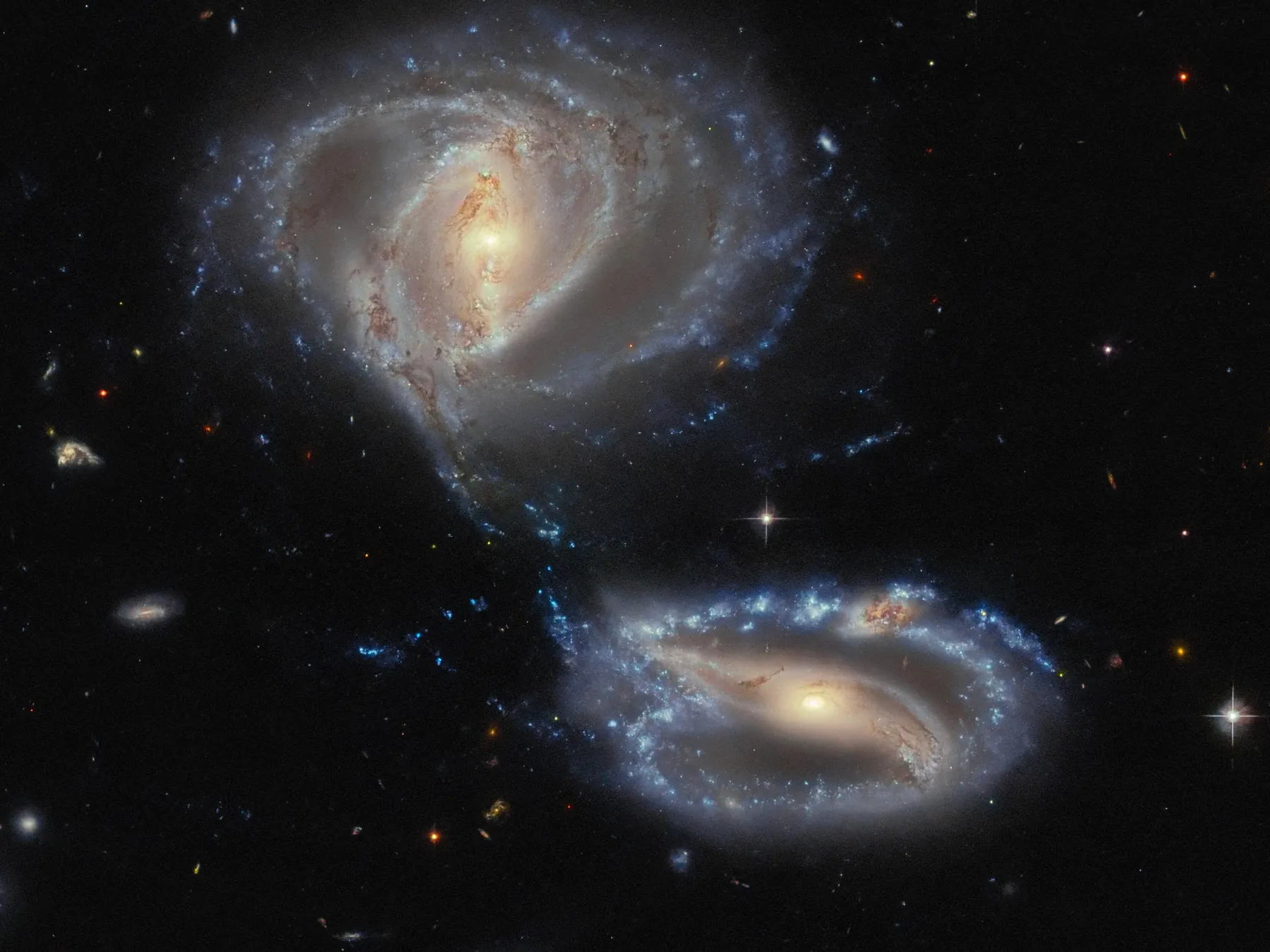
- Galaxy collisions are common over cosmic timescales.
- Two galaxies can pass through one another and eventually merge.
- Individual stars are so widely separated that direct star-on-star collisions are unlikely.
- Gas clouds interact much more strongly during mergers.
- Gravitational forces can stretch long tidal tails from galaxies.
- Mergers can disturb or destroy neat spiral patterns.
- They can trigger bursts of new star formation.
- Supermassive black holes may eventually form binary systems after galaxy mergers.
- Those black holes can later merge and produce gravitational waves.
- The Antennae Galaxies are a famous pair in the process of merging.
- Their long tails were pulled out by gravitational interaction.
- The Milky Way and Andromeda are moving toward one another overall.
- They are expected to interact billions of years from now.
- The future merger will radically reshape both galaxies.
- The Sun itself is unlikely to collide directly with another star during that galactic merger.
Galaxy groups, clusters, and the cosmic web
- Galaxies rarely exist completely alone.
- The Milky Way belongs to the Local Group.
- Andromeda is the other dominant large galaxy in the Local Group.
- Dozens of smaller dwarf galaxies also belong to the group.
- Galaxy groups contain fewer members than rich galaxy clusters.
- Clusters can contain hundreds or thousands of galaxies.
- Hot X-ray-emitting gas fills space between galaxies in many clusters.
- Much of a cluster’s mass is dark matter.
- Galaxy clusters are among the largest gravitationally bound structures in the universe.
- Clusters themselves form part of larger filaments and walls.
- These structures create the cosmic web.
- Huge voids lie between filaments.
- Dark matter provides the gravitational framework along which ordinary matter collects.
- Computer simulations reproduce cosmic-web patterns from early density fluctuations.
- On the largest scales, galaxies reveal the architecture of the expanding universe.
Looking far away means looking back in time
- Light does not travel infinitely fast.
- When astronomers see a distant galaxy, they see light that left it in the past.
- Andromeda is about 2.5 million light-years away.
- We therefore see Andromeda roughly as it was 2.5 million years ago.
- Very distant galaxies appear as they existed billions of years ago.
- The expansion of the universe stretches light toward longer wavelengths.
- This effect is called cosmological redshift.
- Redshift helps astronomers estimate cosmic distance and epoch.
- Infrared telescopes are especially useful for observing very distant galaxies whose light has been strongly redshifted.
- The James Webb Space Telescope was designed partly for this work.
- Hubble Deep Field images revealed thousands of galaxies in tiny patches of sky.
- Later deep surveys found even more distant systems.
- Astronomers use galaxies to study how the universe changed from its youth to the present.
- No telescope sees the entire universe from one vantage point.
- Every deep galaxy image is also a layered photograph of cosmic history.
Ten surprising galaxy facts
- A galaxy can contain trillions of stars yet still be mostly empty space.
- Galaxy mergers usually do not mean billions of stars physically smashing into one another.
- Many giant galaxies hide supermassive black holes at their centers.
- A feeding black hole can briefly outshine an entire host galaxy.
- The Milky Way itself is a barred spiral rather than a simple spiral.
- Some galaxies are huge but so diffuse that they are difficult to detect.
- Andromeda’s light began traveling toward us long before modern humans existed.
- When astronomers look billions of light-years away, they are literally observing younger versions of the universe.
- The cosmic web organizes galaxies into filaments separated by enormous voids.
- For our own galactic neighborhood, explore the upcoming Milky Way guide and our space facts.
Quick galaxies FAQ
What is a galaxy?
A gravitationally bound system containing stars, gas, dust, dark matter, stellar remnants, planets, and other objects.
What types of galaxies are there?
Major visual categories include spiral, barred spiral, elliptical, lenticular, and irregular galaxies, with many subtypes and transitional forms.
Do galaxies collide?
Yes. Galaxies can interact and merge, although individual stars usually pass one another because the space between stars is enormous.
Do all galaxies have black holes?
Not every tiny galaxy is known to host one, but most large galaxies appear to contain supermassive black holes near their centers.
Why does looking farther away mean looking back in time?
Light takes time to travel. If a galaxy is millions or billions of light-years away, its light left millions or billions of years before reaching our telescopes.

Ellie is the owner and sole author of Fun Facts, combining her mechanical engineering background with years of research-driven writing to deliver facts you can trust. Every article is thoroughly fact-checked and routinely updated as new science and sources emerge to keep information accurate and current. Her mission is to make learning delightful while upholding high standards of reliability and transparency.