
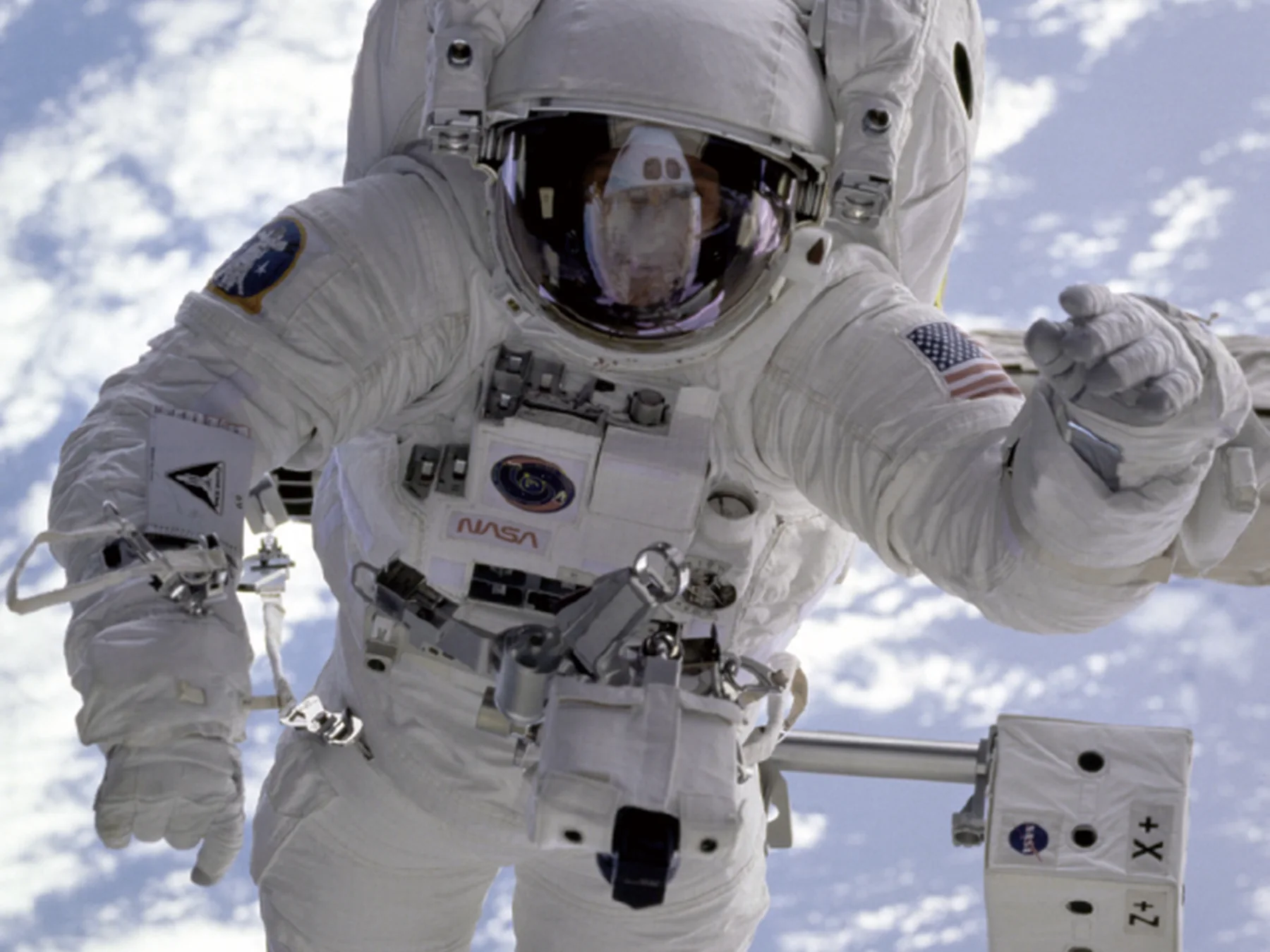
Astronauts do far more than float for photos. They learn spacecraft systems, emergency medicine, robotics, survival skills, geology, spacewalk procedures, exercise routines, and even how to use a toilet when gravity is not helping. These 145 astronaut facts explore training, launch, microgravity, spacesuits, food, sleep, exercise, space sickness, spacewalks, the Moon, the International Space Station, records, and the strange realities of living away from Earth.
Astronaut basics
- An astronaut is a person trained to travel or work in space.
- The word comes from Greek roots meaning star sailor.
- Russia and the former Soviet Union commonly use the term cosmonaut.
- China commonly uses the English term taikonaut in international media, though its official Chinese terminology differs.
- Astronauts can serve as commanders, pilots, engineers, scientists, physicians, or mission specialists.
- Modern crews often include people from multiple countries.
- Astronauts spend far more time training on Earth than flying in space.
- Professional astronaut selection is extremely competitive.
- NASA astronaut candidates typically need strong technical, scientific, medical, or engineering backgrounds.
- Operational experience and teamwork matter as much as academic achievement.
- Excellent health is important because launch and microgravity stress the body.
- Astronauts must remain calm during emergencies and complex technical problems.
- Communication skills are crucial because missions depend on coordinated teams.
- Not every person who reaches space is a career government astronaut.
- Commercial human spaceflight has expanded who can travel beyond Earth.
The first humans in space
- Yuri Gagarin became the first human in space.
- He launched aboard Vostok 1 on April 12, 1961.
- Gagarin completed one orbit of Earth.
- His flight lasted about 108 minutes.
- Gagarin was a Soviet cosmonaut.
- Alan Shepard became the first American in space less than a month later.
- Shepard’s Freedom 7 mission launched on May 5, 1961.
- His flight was suborbital.
- John Glenn became the first American to orbit Earth in February 1962.
- Valentina Tereshkova became the first woman in space in 1963.
- She flew alone aboard Vostok 6.
- Alexei Leonov performed the first spacewalk in 1965.
- Ed White performed the first American spacewalk later that year.
- Early astronauts tested whether humans could survive and function in conditions no one had experienced before.
- The first decade of crewed spaceflight transformed impossible-sounding ideas into routine engineering objectives.
Astronaut training is intense
- Astronaut training includes spacecraft systems and emergency procedures.
- Crews practice using high-fidelity simulators.
- Simulators can reproduce failures that would be too dangerous to create during real missions.
- Astronauts train repeatedly for fires, depressurization, toxic leaks, and medical emergencies.
- International Space Station crews study Russian and American systems.
- Language training is often required for international missions.
- NASA astronauts commonly study Russian because of decades of U.S.-Russian space cooperation.
- Astronauts train in robotics for moving equipment and assisting spacecraft operations.
- Spacewalk training occurs in enormous swimming pools.
- NASA’s Neutral Buoyancy Laboratory contains full-scale underwater hardware mockups.
- Buoyancy is adjusted so suited astronauts can practice three-dimensional movement.
- Underwater training does not perfectly reproduce microgravity.
- It does provide useful practice for body positioning and handling tools.
- Astronauts also perform wilderness survival training for off-target landings.
- Training emphasizes teamwork because space emergencies rarely reward individual heroics.
Launch is physically intense
- Rocket launch accelerates astronauts from rest to orbital speeds in minutes.
- Crews experience increased g-forces during portions of ascent.
- Seats are shaped to distribute those forces across the body.
- Astronauts wear pressure suits on many launch systems.
- Launch suits provide protection during cabin-pressure emergencies.
- Crews are strapped tightly into seats for ascent.
- Vibration, engine noise, and acceleration make launch far more physical than watching from the ground suggests.
- Orbital spacecraft must reach roughly 28,000 kilometers per hour, or 17,500 miles per hour, in low Earth orbit.
- Orbit does not mean gravity disappears.
- Spacecraft in low Earth orbit are still strongly pulled by Earth’s gravity.
- They feel weightless because the spacecraft and everything inside are falling around Earth together.
- That continuous free fall is called microgravity.
- Objects released inside a spacecraft float relative to the cabin.
- A small push can send an object drifting until another surface or force stops it.
- Astronauts learn quickly to attach almost everything with Velcro, clips, bags, or restraints.
Microgravity changes the human body
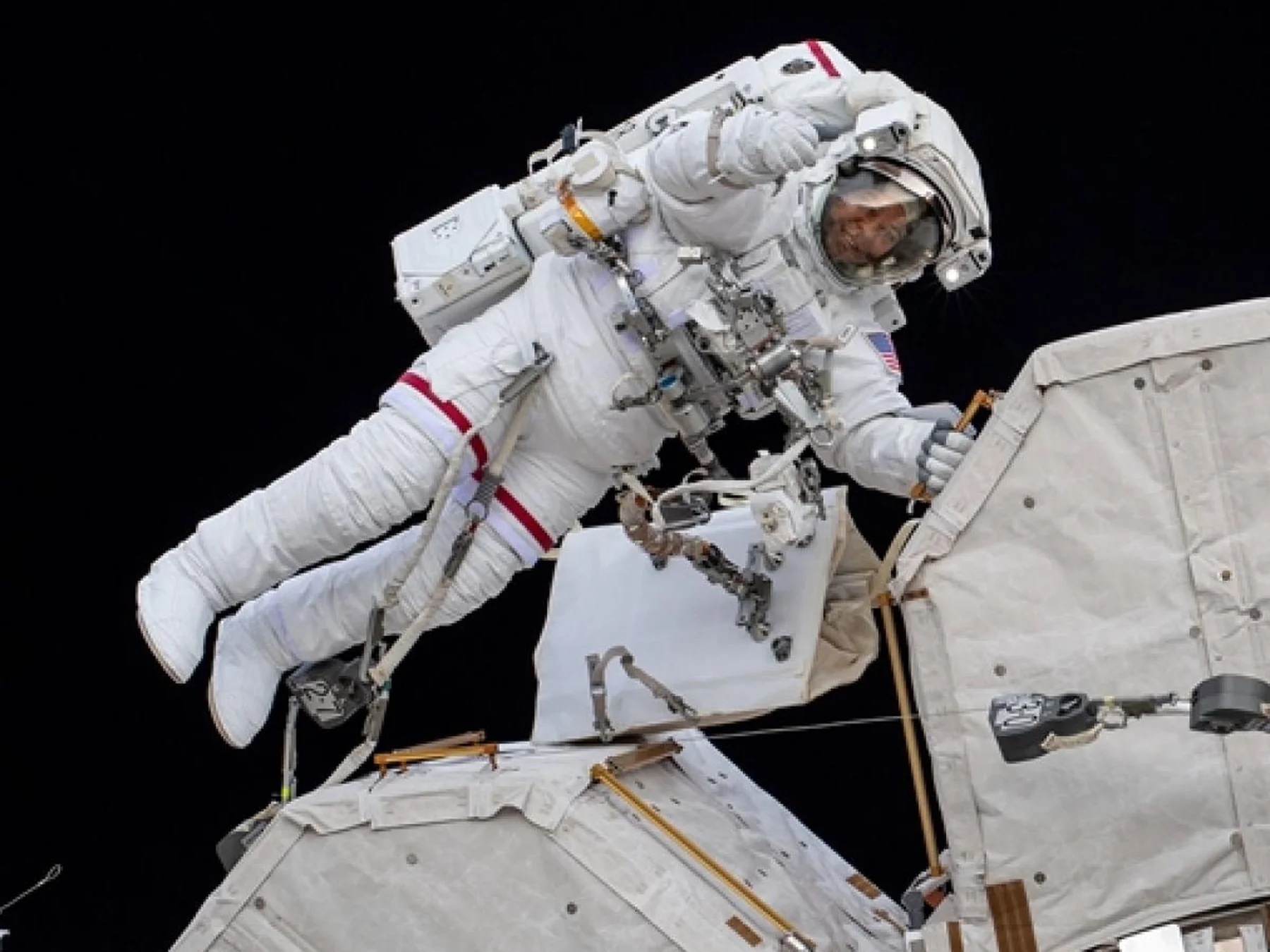
- Human bodies evolved under Earth gravity.
- Removing normal weight-bearing changes muscles and bones.
- Leg and back muscles can weaken when they no longer support body weight.
- Bone mineral density can decline during long missions.
- Astronauts therefore exercise for hours each day on long-duration missions.
- Body fluids shift upward toward the head in microgravity.
- This can produce puffy faces and thinner-looking legs.
- The fluid shift changes pressure in the head and eyes.
- Some astronauts develop spaceflight-associated neuro-ocular changes.
- The spine can lengthen slightly without ordinary gravitational compression.
- Astronauts may become a little taller in space.
- That temporary height gain usually disappears after returning to Earth.
- The balance system in the inner ear must adapt to weightlessness.
- Many astronauts experience space motion sickness during their first days in orbit.
- Human research in space helps scientists understand how to protect crews on future long missions.
Eating and drinking in space
- Space food must be safe, nutritious, compact, and reasonably shelf-stable.
- Many foods are dehydrated to reduce mass.
- Astronauts add water to rehydrate some meals.
- Other foods are thermostabilized in sealed packages.
- Tortillas are popular because they produce fewer crumbs than ordinary bread.
- Floating crumbs can enter equipment or become irritating inside a spacecraft.
- Salt and pepper are often provided in liquid form.
- Ordinary grains of salt would float away from a plate.
- Drinks come in sealed pouches with straws.
- Surface tension can make liquids form floating blobs.
- Astronauts can swallow normally in microgravity.
- Gravity is not required for the muscles of the esophagus to move food into the stomach.
- Congestion from fluid shifts can dull the sense of smell.
- Some astronauts prefer stronger or spicier flavors in orbit.
- Fresh fruit is especially appreciated when cargo spacecraft deliver it.
Sleeping without a bed
- Astronauts do not need mattresses to support their body weight in microgravity.
- They commonly sleep inside sleeping bags secured to walls or crew compartments.
- Straps keep sleepers from drifting into equipment.
- There is no meaningful up or down inside a weightless cabin.
- An astronaut can sleep vertically relative to another crewmember without feeling upside down.
- International Space Station crew quarters provide small private spaces.
- These compartments include airflow, lighting, storage, and communication equipment.
- Ventilation matters because exhaled carbon dioxide does not naturally rise away from a sleeper.
- Fans keep cabin air circulating.
- The International Space Station circles Earth roughly every 90 minutes.
- Crews therefore see many sunrises and sunsets during one Earth day.
- They do not reset their clocks for every orbital sunrise.
- Mission schedules use a standardized 24-hour workday.
- Eye masks and controlled lighting help manage sleep.
- Good sleep remains challenging because of noise, workload, changing light, and excitement.
Spacewalking is like becoming a tiny spacecraft
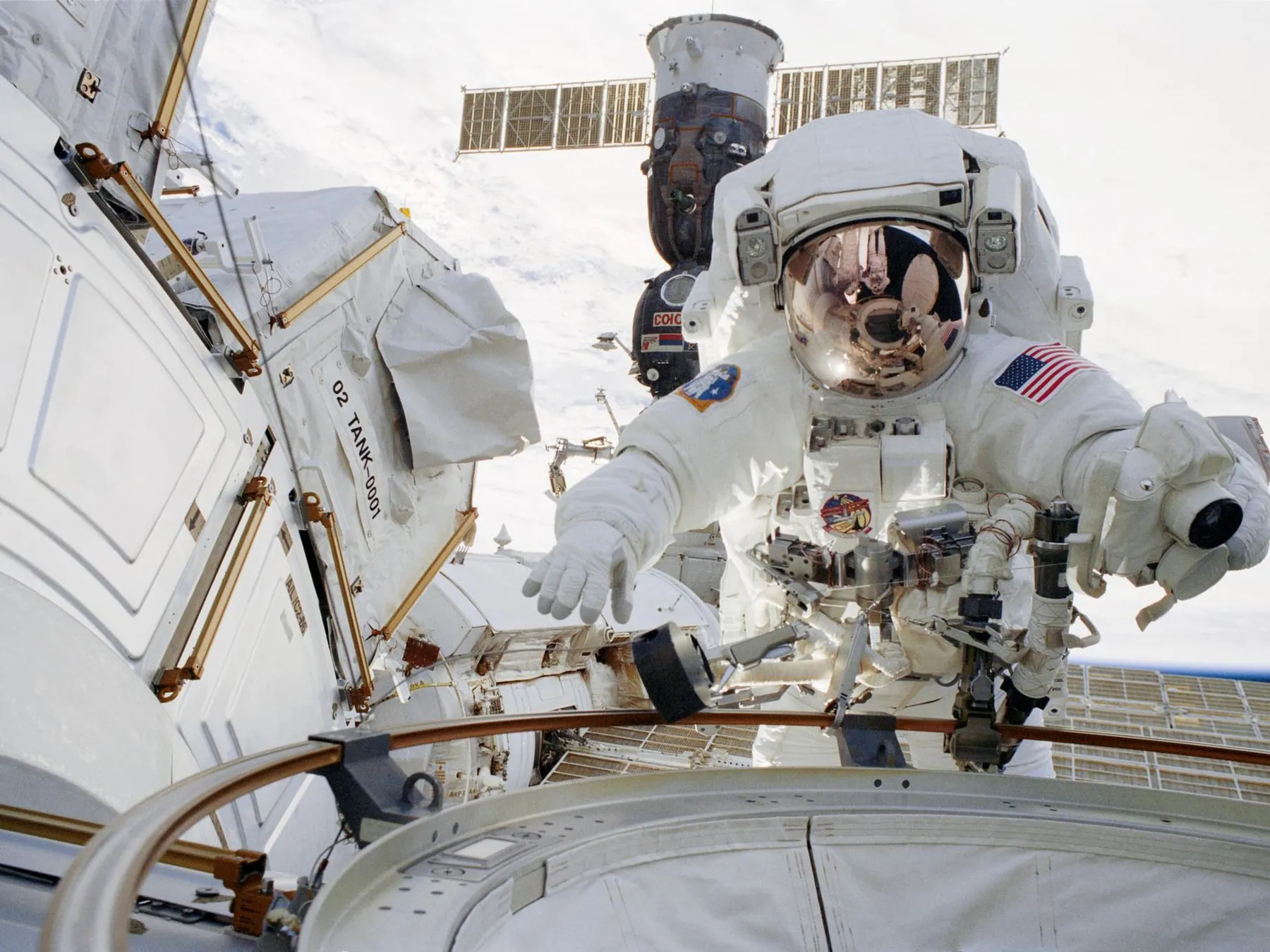
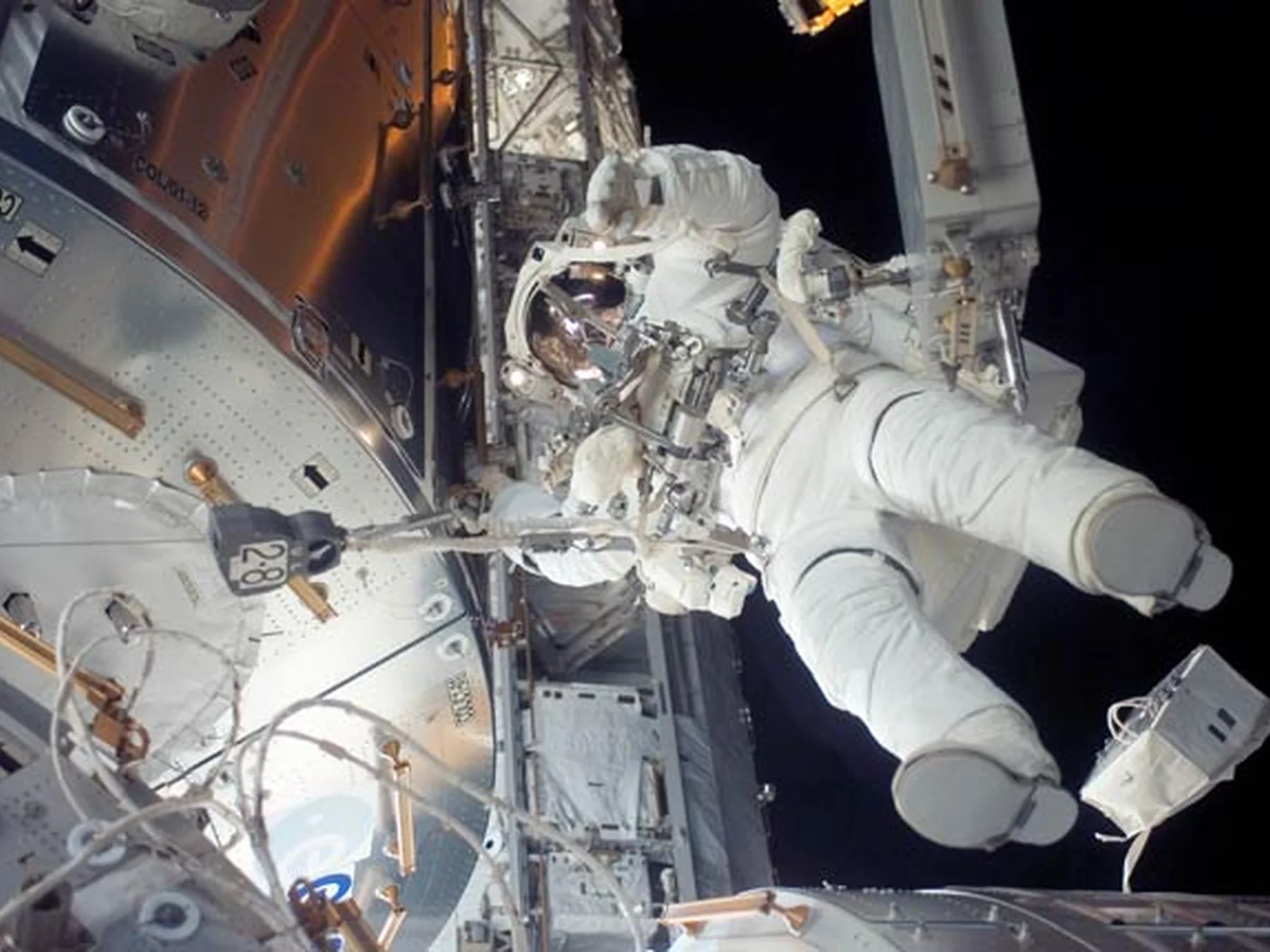
- A spacewalk is formally called an extravehicular activity, or EVA.
- A spacesuit must provide oxygen, pressure, temperature control, and carbon-dioxide removal.
- The suit also protects against extreme temperature changes and small particle impacts.
- NASA’s traditional EVA suit functions like a miniature personal spacecraft.
- A backpack contains life-support hardware.
- Gloves are among the hardest suit components to design.
- Astronauts need dexterity while their hands push against pressurized glove material.
- Fingernail and hand injuries have occurred after long spacewalks.
- Tools are tethered so they do not drift away.
- Astronauts usually tether themselves to the spacecraft too.
- Handrails provide routes around the exterior of the International Space Station.
- Spacewalkers communicate continuously with crewmates and mission control.
- Preparing for an EVA can take hours before the hatch opens.
- Crews reduce nitrogen in their bodies beforehand to lower decompression-sickness risk.
- Every ordinary repair becomes harder when the mechanic is wearing a pressurized suit outside a spacecraft moving around Earth.
Astronauts on the Moon and beyond
- Neil Armstrong became the first person to walk on the Moon in 1969.
- Buzz Aldrin became the second.
- Twelve people walked on the Moon during the Apollo program.
- All twelve were American astronauts.
- The last people to walk on the Moon were Gene Cernan and Harrison Schmitt in 1972.
- Schmitt was a professional geologist.
- Apollo astronauts collected hundreds of kilograms of lunar samples.
- They deployed scientific instruments on the surface.
- Later Apollo crews drove electric lunar roving vehicles.
- Lunar gravity is about one-sixth of Earth gravity.
- Astronauts used a distinctive hopping gait while moving in bulky suits.
- Falling on the Moon could be awkward even at lower gravity because suits restricted movement.
- Future lunar crews will use lessons learned from Apollo and decades of orbital operations.
- Long-term Mars missions would expose astronauts to far longer isolation, radiation, and communication delays.
- Human exploration beyond low Earth orbit remains one of the most demanding engineering challenges in the solar system.
Ten surprising astronaut facts
- Astronauts in orbit are not beyond gravity, they are continuously falling around Earth.
- People can become slightly taller in space because the spine is less compressed.
- Astronauts use tortillas partly because bread crumbs are annoying floating debris.
- Liquid salt and pepper make more sense than loose grains in microgravity.
- You can sleep attached to a wall and feel no more upside down than someone beside you.
- An orbiting astronaut can see around 16 sunrises and sunsets in one day.
- A spacesuit is essentially a tiny human-shaped spacecraft.
- Spacewalk tools need tethers for the same reason astronauts do.
- The first human in space completed only one orbit.
- For more space trivia, explore our NASA facts and space facts.
Quick astronaut FAQ
Why do astronauts float?
They are in continuous free fall around Earth. The spacecraft and everything inside accelerate together, producing the condition called microgravity.
How do astronauts sleep?
They usually sleep in bags secured to walls or small crew compartments so they do not drift through the spacecraft.
Can astronauts eat normal food?
Yes, but packaging and preparation are adapted for microgravity. Crumbly foods are limited, drinks use pouches, and some meals are dehydrated or thermostabilized.
Why do astronauts exercise so much?
Without ordinary weight-bearing, muscles weaken and bone mineral can decline. Daily resistance and cardiovascular exercise helps reduce those effects.
How many people walked on the Moon?
Twelve astronauts walked on the lunar surface during six Apollo missions between 1969 and 1972.

Ellie is the owner and sole author of Fun Facts, combining her mechanical engineering background with years of research-driven writing to deliver facts you can trust. Every article is thoroughly fact-checked and routinely updated as new science and sources emerge to keep information accurate and current. Her mission is to make learning delightful while upholding high standards of reliability and transparency.