
Octopuses have three hearts, blue blood, eight remarkably independent arms, and camouflage abilities that can make them seem like underwater magicians. They are mollusks, not fish, and their bodies work very differently from ours. These 145 octopus facts dive into their anatomy, intelligence, senses, defenses, babies, habitats, and some of the strangest behaviors ever observed in the ocean.
Octopus basics
- Octopuses are marine mollusks belonging to the class Cephalopoda.
- Cephalopods also include squid, cuttlefish, and nautiluses.
- Octopuses belong to the order Octopoda.
- The word octopus comes through scientific Latin from a Greek word meaning “eight-footed.”
- An octopus has eight arms surrounding its mouth.
- Biologists usually call octopus appendages arms rather than tentacles.
- Typical octopuses do not have the two longer feeding tentacles seen in squid and cuttlefish.
- Most familiar octopuses lack an external shell.
- They also lack the rigid internal pen found in many squid.
- An octopus body is exceptionally soft and flexible.
- The hard beak is one of the main rigid structures in an octopus body.
- Octopus species live in oceans around the world.
- They occupy habitats ranging from shallow reefs to the deep sea.
- There are hundreds of recognized octopus species.
- Octopuses are invertebrates, meaning they do not have a backbone.
Three hearts and blue blood
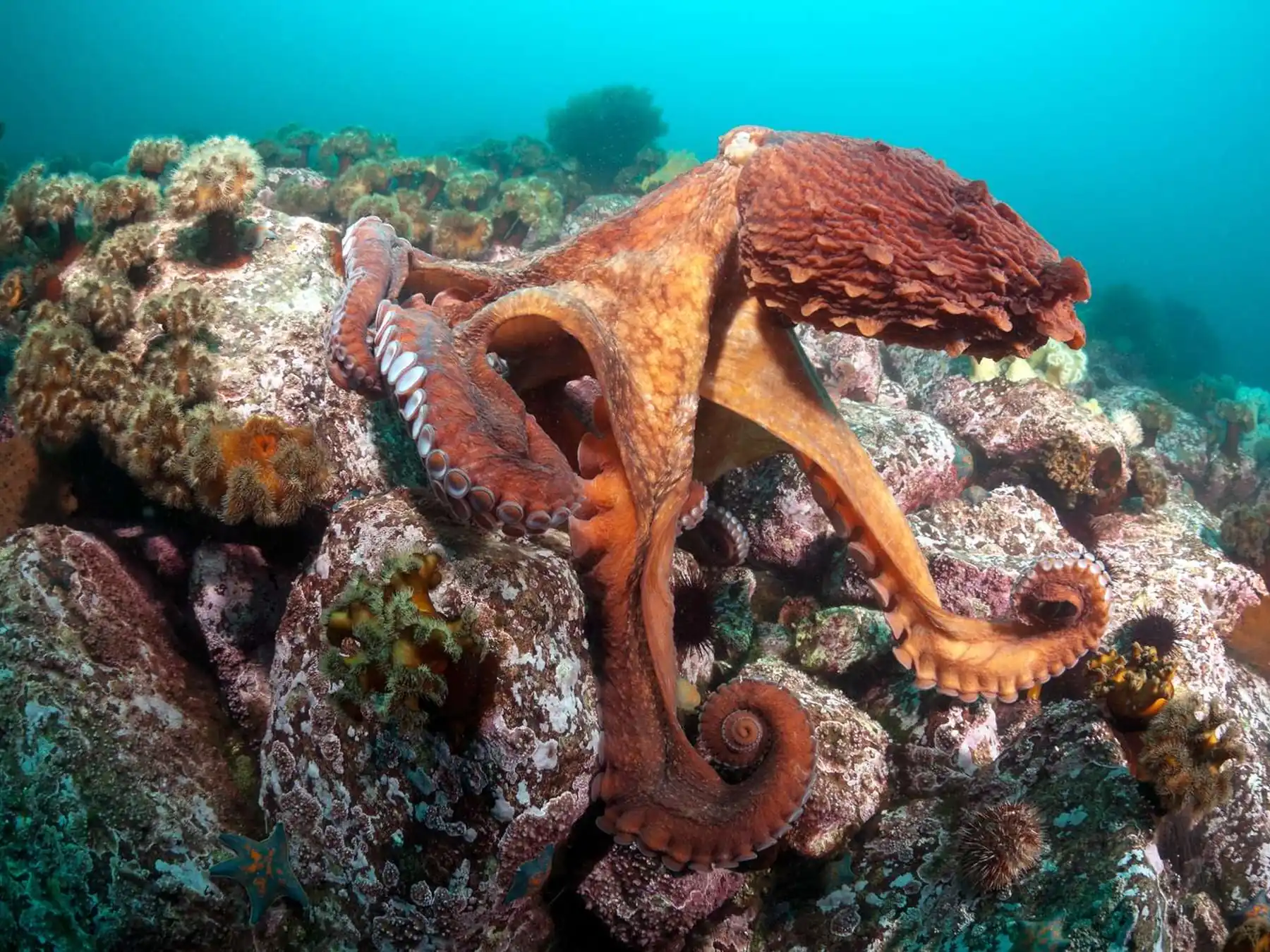
- An octopus has three hearts.
- Two branchial hearts pump blood through the gills.
- A systemic heart pumps oxygenated blood through the rest of the body.
- Octopus blood is blue because it uses the copper-containing protein hemocyanin to transport oxygen.
- Human blood uses iron-containing hemoglobin instead.
- Hemocyanin performs well in the cold, low-oxygen conditions many cephalopods encounter.
- The gills are located inside the mantle cavity.
- Water drawn into the mantle cavity passes over the gills.
- Octopuses can force water out through a muscular funnel called a siphon.
- That water jet can propel an octopus rapidly in the opposite direction.
- Jet propulsion is useful for quick escapes but can be energetically costly.
- Many octopuses prefer crawling along the seafloor when they are not fleeing danger.
- The systemic heart reduces or pauses its activity during vigorous swimming in some octopuses.
- That is one reason sustained swimming can be tiring for an octopus.
- The Smithsonian’s cephalopod overview explains the unusual three-heart circulation system.
Eight amazing arms
- Each octopus arm contains muscles arranged without bones or rigid joints.
- This muscular-hydrostat design lets an arm bend, shorten, lengthen, twist, and stiffen.
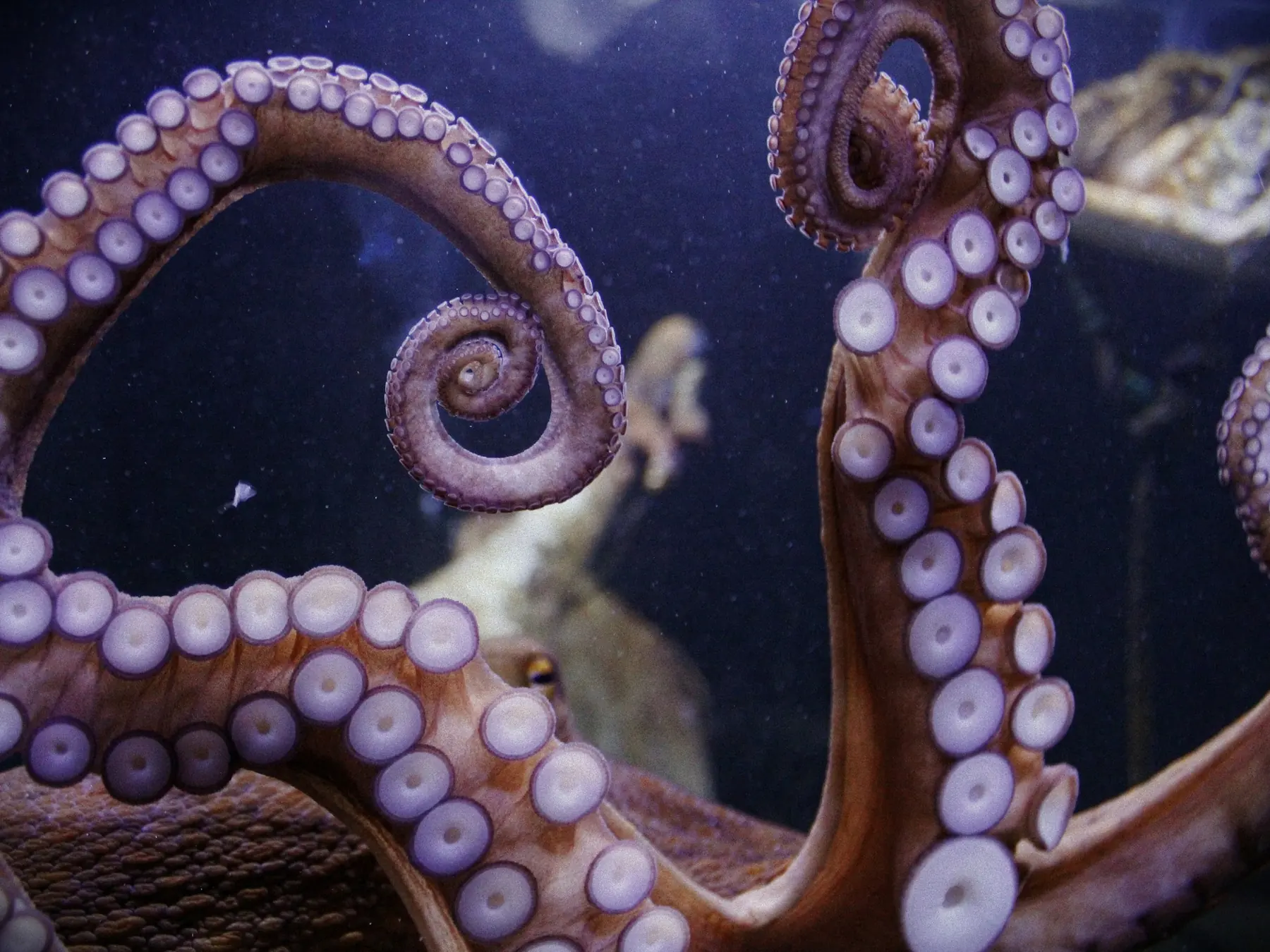
- Most octopus species have suckers arranged along their arms.
- Octopus suckers can grip surfaces using muscular control and pressure differences.
- Suckers also contain sensory receptors.
- An octopus can effectively taste and chemically sense objects with its suckers.
- A large share of an octopus’s neurons are located in its arms rather than its central brain.
- That distributed nervous system gives the arms substantial local control.
- Arms can perform complex movements while the central brain coordinates broader goals.
- An octopus can explore several places with different arms at the same time.
- Many octopuses can regrow an injured or lost portion of an arm.
- Arm regeneration takes time and depends on the severity of the injury.
- Octopus arms do not normally become fully independent new octopuses when detached.
- The mouth sits at the center where the eight arms meet.
- Inside the mouth is a hard, parrot-like beak used to bite prey.
Camouflage superpowers
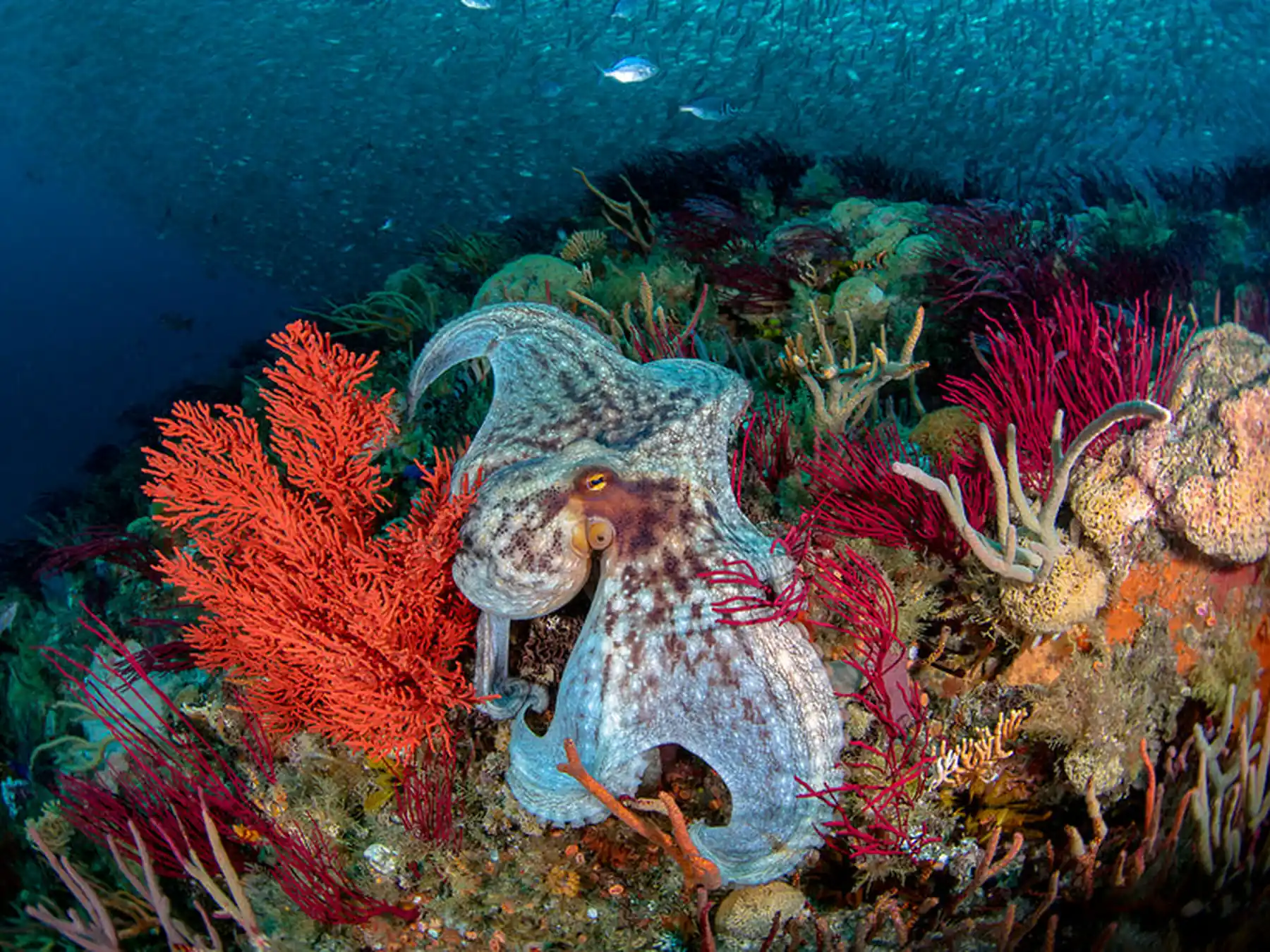
- Many octopuses can change their skin color in a fraction of a second.
- Special pigment organs called chromatophores help create rapid color changes.
- Chromatophores can expand or contract under nervous-system control.
- Other reflective skin cells help produce iridescent and lighter effects.
- Octopus camouflage can involve brightness, color, pattern, posture, and texture all at once.
- Muscular structures called papillae can make the skin look bumpy or smooth.
- An octopus can resemble rock, coral, algae, sand, or other parts of its surroundings.
- Camouflage helps octopuses hide from predators.
- It can also help them approach prey without being noticed.
- Octopuses use body patterns for communication as well as camouflage.
- Some displays signal threat, courtship, alarm, or aggression.
- Many shallow-water octopuses appear to have only one main type of visual photoreceptor.
- That means their color-changing abilities are especially remarkable because their color vision appears unlike ours.
- Cephalopods can detect polarized light, which humans cannot see without special equipment.
- Researchers still study exactly how octopuses select such convincing camouflage patterns.
Octopus brains and intelligence
- Octopuses have the largest and most complex nervous systems among many invertebrates.
- Their intelligence evolved on a very different branch of the animal family tree from vertebrate intelligence.
- Octopuses can learn through experience.
- Laboratory studies show that octopuses can solve certain puzzles and discrimination tasks.
- They can remember solutions for useful periods of time.
- Some captive octopuses learn how to open screw-top jars to reach food.
- Octopuses are famous for finding weak points in aquarium lids and plumbing.
- Their flexible bodies let them investigate objects in ways rigid-bodied animals cannot.
- Octopuses show exploratory behavior toward unfamiliar objects.
- Some individuals repeatedly manipulate objects in ways researchers interpret as play-like behavior.
- Individual octopuses can differ noticeably in boldness and behavior.
- They can learn visual patterns and shapes under controlled conditions.
- They can also learn through touch and chemical sensing.
- Octopus intelligence does not mean they reason exactly like humans.
- The distributed control of their nervous system makes octopus cognition especially interesting to neuroscientists.
How octopuses see, smell, and sense the world
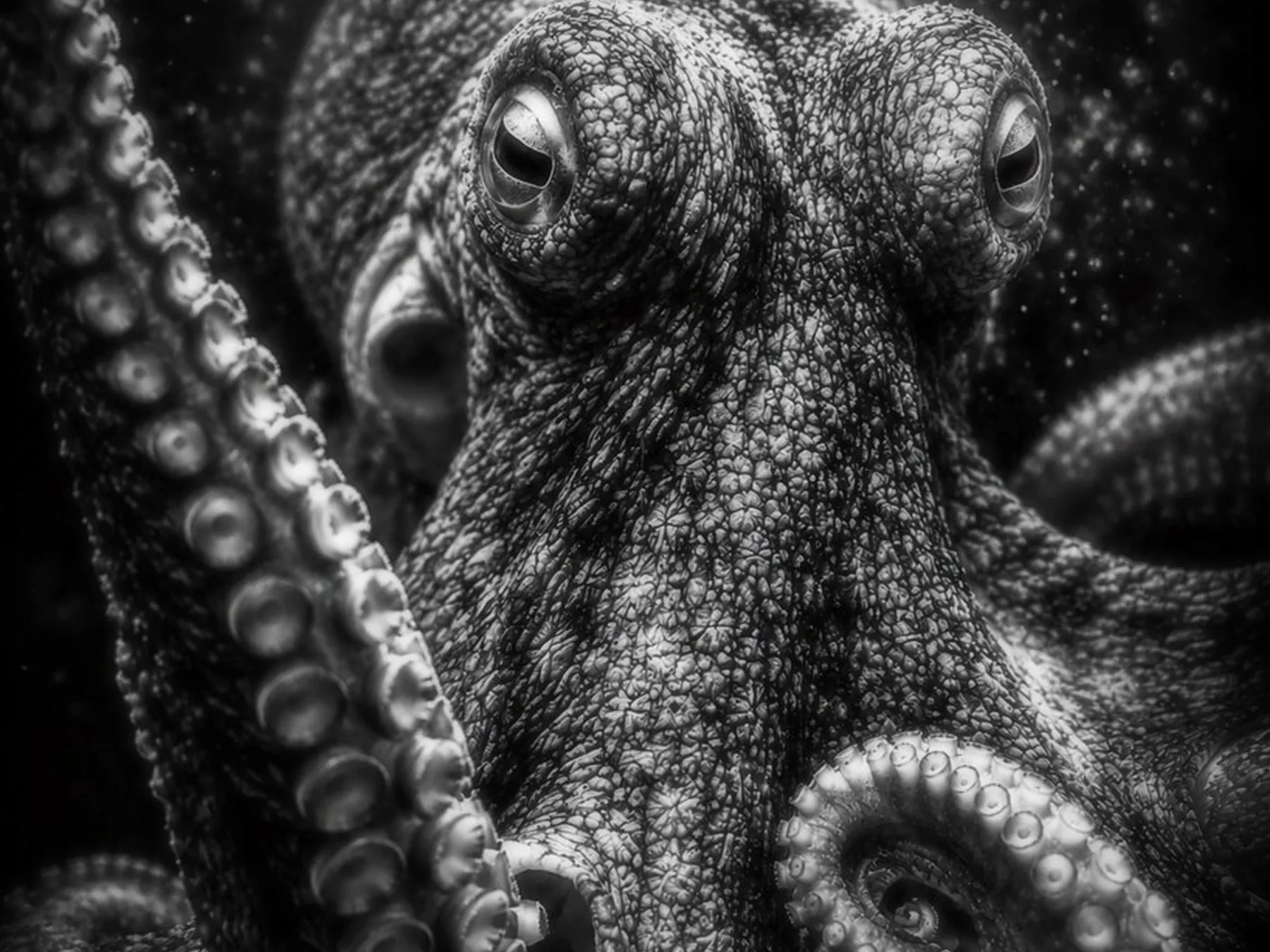
- Octopus eyes have camera-like structures with a lens, pupil, and retina.
- Cephalopod eyes evolved separately from vertebrate eyes.
- Their retinas are arranged differently from human retinas.
- Octopuses do not have the same blind spot caused by retinal wiring that humans do.
- Their pupils can change shape depending on light conditions.
- Vision is extremely important for hunting, navigation, camouflage, and communication.
- Chemical receptors help octopuses detect dissolved substances in seawater.
- Suckers combine touch with chemical sensing.
- Octopuses also possess statocysts, balance organs that help them sense orientation.
- Statocysts perform a role somewhat comparable to the balance system in vertebrate inner ears.
- An octopus can coordinate vision and arm movement while stalking prey.
- Its skin itself can respond to light through light-sensitive proteins.
- Researchers are investigating how much local light sensing contributes to skin pattern control.
- Octopus senses are tuned to underwater environments very different from the human world.
- Understanding octopus perception helps scientists study how complex senses can evolve independently.
Hunting and eating
- Octopuses are predators.
- Common prey includes crabs, shrimp, clams, snails, fish, and other marine animals.
- Diet varies greatly by octopus species and habitat.
- Many octopuses hunt at night or around dawn and dusk.
- An octopus can reach into narrow cracks with its arms to search for prey.
- The arms may spread over rocks like a web while the animal feels underneath for hidden animals.
- The beak can break into or tear prey after capture.
- Octopuses also possess a tongue-like radula covered with tiny teeth.
- Some octopuses drill small holes into shells using the radula and chemical secretions.
- Salivary secretions can help immobilize or digest prey.
- All octopuses produce venom used during feeding.
- Most octopus venom is not considered dangerously toxic to humans.
- Blue-ringed octopuses are a major exception because their venom can be deadly to people.
- Discarded crab shells can accumulate outside an octopus den and reveal what it has been eating.
- Marine food webs connect octopuses with predators such as large fish, eels, seals, dolphins, and sharks.
Defense and escape tricks
- Camouflage is one of an octopus’s first lines of defense.
- When camouflage fails, many octopuses release a dark cloud of ink.
- Octopus ink contains melanin, the same broad pigment family involved in human skin color.
- An ink cloud can obscure a predator’s view long enough for an octopus to escape.
- Ink can also interfere with chemical senses in some predators.
- Jet propulsion lets an octopus accelerate away from danger.
- A boneless body lets many octopuses squeeze through openings only slightly wider than their beak.
- That ability makes secure aquarium enclosures surprisingly challenging.
- Some octopuses flatten themselves against the seafloor to reduce their visible profile.
- The mimic octopus can combine unusual postures and movement patterns that resemble other marine animals.
- Coconut octopuses have been observed carrying coconut-shell halves and using them as portable shelter.
- That shell-carrying behavior is frequently discussed as an example of tool use in an invertebrate.
- Some octopuses walk or “stilt” across the seafloor using only a few arms.
- Two-arm locomotion can let an octopus move while keeping the rest of its body in a camouflage posture.
- The Smithsonian reports this unusual two-arm movement in coconut and algae octopuses.
Octopus reproduction and babies
- Male octopuses use a modified arm called a hectocotylus to transfer sperm packets to females.
- The hectocotylus is usually one of the male’s arms rather than a separate organ.
- Female octopuses commonly lay strings or clusters of eggs in protected dens.
- A brooding female cleans and ventilates her eggs by moving fresh water over them.
- Many females stop or greatly reduce feeding while guarding eggs.
- Most familiar octopus species reproduce only once during their lives.
- This one-reproductive-event life strategy is called semelparity.
- Many female octopuses die after their eggs hatch.
- Males also generally die not long after reproduction.
- Some deep-sea octopus mothers brood eggs for astonishingly long periods.
- A deep-sea octopus observed off California guarded eggs for more than four years, one of the longest known brooding periods for any animal.
- Some newly hatched octopuses live temporarily as tiny planktonic animals in open water.
- Other species hatch as miniature bottom-dwelling versions of adults.
- Octopus growth can be rapid because many species have relatively short lifespans.
- Lifespan ranges from months in some small species to several years in larger species.
Ten more wild octopus facts
- The giant Pacific octopus is one of the world’s largest octopus species.
- The tiny blue-ringed octopus proves that dangerous venom is not limited to large animals.
- Dumbo octopuses have ear-like fins that make them look remarkably different from shallow-water species.
- NOAA recognizes both finned cirrate octopuses and the more familiar finless incirrate forms.
- Deep-sea octopuses often live in cold, dark environments where sunlight never reaches.
- Octopus fossils are rare because soft bodies usually decay before they can fossilize.
- Cephalopod ancestors once included many animals with prominent external shells.
- An octopus’s soft body is both a vulnerability and one of its greatest survival advantages.
- Octopuses independently evolved sophisticated eyes, brains, behavior, and camouflage far from the vertebrate branch that produced humans.
- That separate evolutionary path is why octopuses are often used to explore how very different kinds of intelligence can arise.
Quick octopus FAQ
How many hearts does an octopus have?
Three. Two branchial hearts pump blood through the gills, while a systemic heart sends oxygenated blood through the rest of the body.
Why is octopus blood blue?
Octopus blood uses copper-containing hemocyanin to transport oxygen. Oxygenated hemocyanin appears blue, unlike the iron-containing hemoglobin that makes human blood red.
Do octopuses have eight arms or tentacles?
Eight arms. Squid and cuttlefish have eight arms plus two specialized longer tentacles, but ordinary octopuses do not.
Are octopuses intelligent?
Yes. They can learn, remember, solve certain puzzles, manipulate objects, and adapt their behavior. Their nervous systems are also unusually distributed through the arms.
Can an octopus really squeeze through tiny holes?
Many can squeeze through openings only a little wider than the hard beak because nearly the entire rest of the body is soft and flexible.

Ellie is the owner and sole author of Fun Facts, combining her mechanical engineering background with years of research-driven writing to deliver facts you can trust. Every article is thoroughly fact-checked and routinely updated as new science and sources emerge to keep information accurate and current. Her mission is to make learning delightful while upholding high standards of reliability and transparency.